


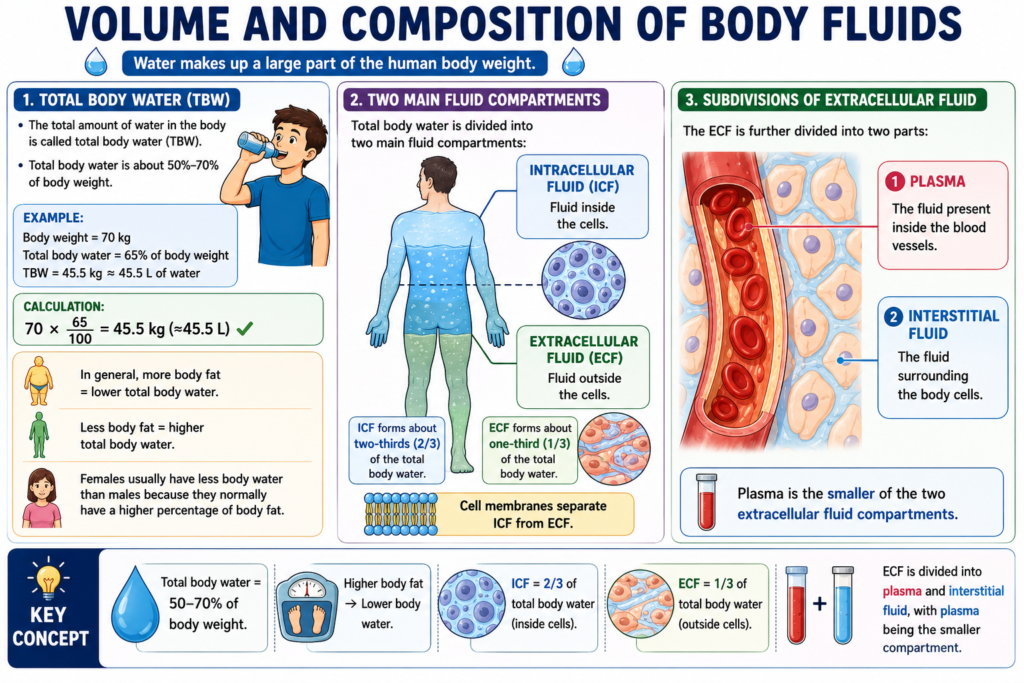
- Water makes up a large part of the human body weight.
- The total amount of water in the body is called total body water (TBW).
- Total body water is about 50%–70% of body weight.
- Example:
- Body weight = 70 kg
- Total body water = 65% of body weight
- TBW = 45.5 kg ≈ 45.5 L of water
- Calculation:
- 70 × 65/100 = 45.5 kg (≈45.5 L) ✔
- In general, more body fat = lower total body water.
- Less body fat = higher total body water.
- Females usually have less body water than males because they normally have a higher percentage of body fat.
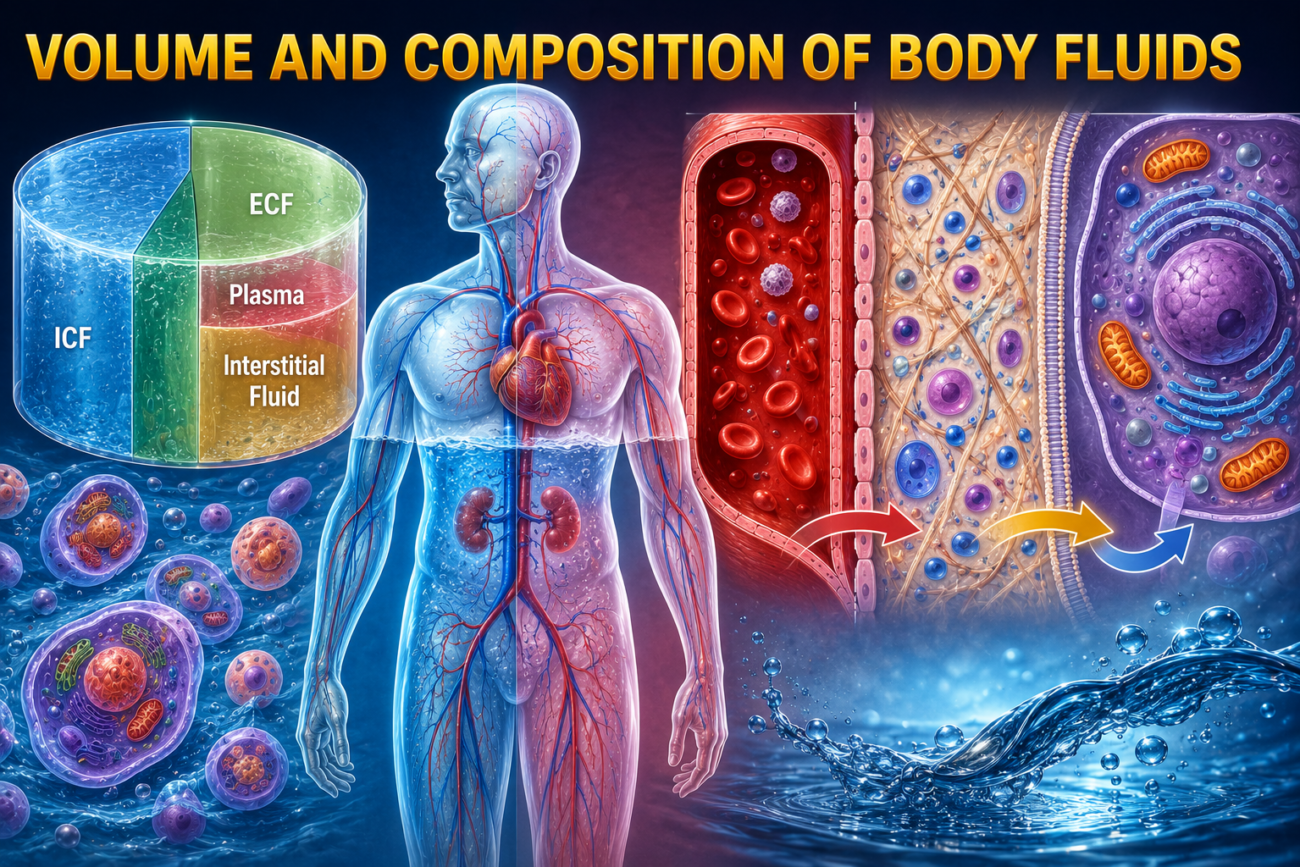
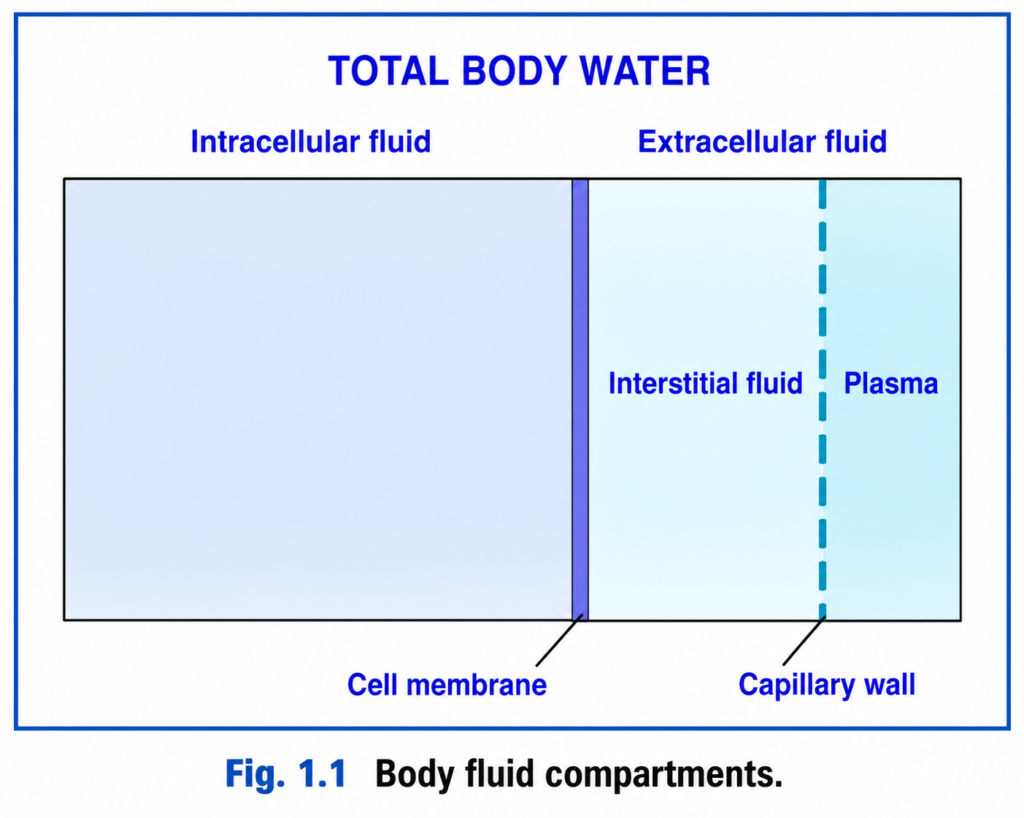
- Total body water is divided into two main fluid compartments:
- Intracellular fluid (ICF) – fluid inside the cells.
- Extracellular fluid (ECF) – fluid outside the cells.
- ICF forms about two-thirds (2/3) of the total body water.
- ECF forms about one-third (1/3) of the total body water.
- Cell membranes separate ICF from ECF.
- The ECF is further divided into two parts:
- Plasma – the fluid present inside the blood vessels.
- Interstitial fluid – the fluid surrounding the body cells.
- Plasma is the smaller of the two extracellular fluid compartments.
KEY CONCEPT
- Total body water = 50–70% of body weight.
- Higher body fat → Lower body water.
- ICF = 2/3 of total body water (inside cells).
- ECF = 1/3 of total body water (outside cells).
- ECF is divided into plasma and interstitial fluid, with plasma being the smaller compartment.
VOLUME AND COMPOSITION OF BODY FLUIDS
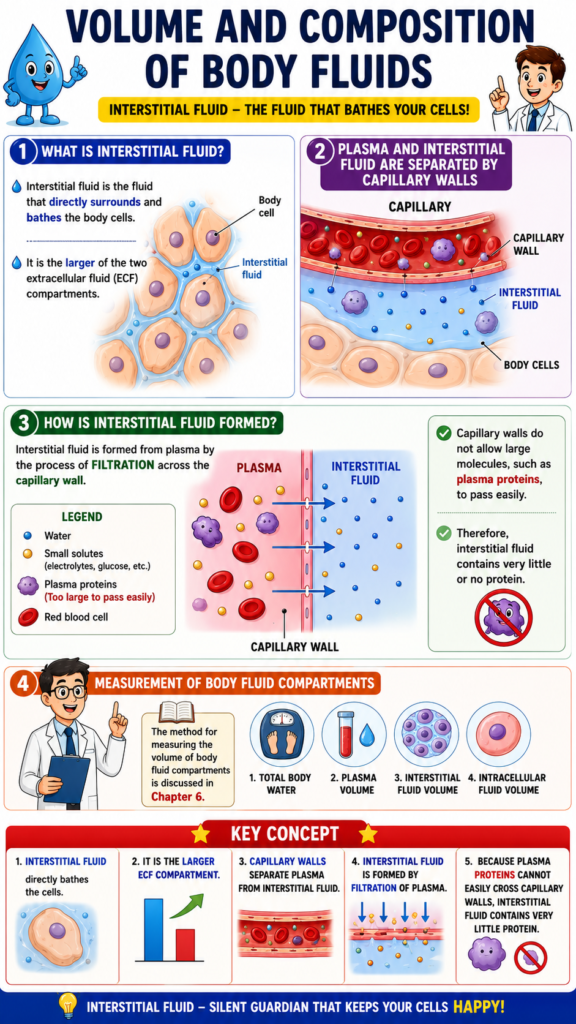
- Interstitial fluid is the fluid that directly surrounds and bathes the body cells.
- Interstitial fluid is the larger of the two extracellular fluid (ECF) compartments.
- Plasma and interstitial fluid are separated by capillary walls.
- Interstitial fluid is formed from plasma by the process of filtration across the capillary wall.
- Capillary walls do not allow large molecules, such as plasma proteins, to pass easily.
- Therefore, interstitial fluid contains very little or no protein.
- The method for measuring the volume of body fluid compartments is discussed in Chapter 6.
KEY CONCEPT
- Interstitial fluid directly bathes the cells.
- It is the larger ECF compartment.
- Capillary walls separate plasma from interstitial fluid.
- Interstitial fluid is formed by filtration of plasma.
- Because plasma proteins cannot easily cross capillary walls, interstitial fluid contains very little protein.
Composition of Body Fluid Compartments
- Body fluid compartments do not have the same composition.
- ICF (intracellular fluid) and ECF (extracellular fluid) contain very different concentrations of many solutes.
- Plasma and interstitial fluid also have predictable differences in solute concentrations.
- These differences occur because proteins are mostly prevented from entering the interstitial fluid.
- As a result, plasma contains more protein than interstitial fluid.
KEY CONCEPT
- Body fluid composition is not uniform.
- ICF and ECF have different solute concentrations.
- Plasma and interstitial fluid also differ in composition.
- The main reason is that proteins remain mainly in plasma and are largely excluded from interstitial fluid.
Units for Measuring Solute Concentrations
- The amount of a solute is commonly measured in moles, equivalents, or osmoles.
- Solute concentration is usually expressed as:
- Moles per liter (mol/L)
- Equivalents per liter (Eq/L)
- Osmoles per liter (Osm/L)
- Because body fluids contain low concentrations of solutes, the following smaller units are commonly used:
- Millimoles per liter (mmol/L)
- Milliequivalents per liter (mEq/L)
- Milliosmoles per liter (mOsm/L)
- One mole contains 6 × 10²³ molecules of a substance.
- One millimole (mmol) is 1/1000 of a mole (10⁻³ mole).
- Example:
- Glucose = 1 mmol/L
- This means 1 × 10⁻³ mole of glucose is present in 1 liter of solution.
- An equivalent (Eq) measures the amount of a charged (ionized) substance.
- It is calculated by:
- Equivalent = Number of moles × Valence (charge)
- Example: Potassium chloride (KCl)
- One mole of KCl separates into:
- 1 K⁺
- 1 Cl⁻
- Therefore:
- 1 mmol/L K⁺ = 1 mEq/L
- One mole of KCl separates into:
- Example: Calcium chloride (CaCl₂)
- One mole of CaCl₂ separates into:
- 1 Ca²⁺
- 2 Cl⁻
- Calcium has a valence of 2.
- Therefore:
- 1 mmol/L Ca²⁺ = 2 mEq/L
- One mole of CaCl₂ separates into:
- One osmole represents the total number of particles a solute forms after dissolving in solution.
- Osmolarity is the concentration of these particles and is expressed as osmoles per liter (Osm/L).
- If a solute does not break apart in solution (such as glucose):
- Osmolarity = Molarity
- If a solute breaks into more than one particle (such as NaCl):
- Osmolarity = Molarity × Number of particles formed
- Example: Sodium chloride (NaCl)
- NaCl separates into:
- Na⁺
- Cl⁻
- Total particles = 2
- Therefore:
- 1 mmol/L NaCl = 2 mOsm/L
- NaCl separates into:
- pH is a logarithmic value used to express hydrogen ion (H⁺) concentration.
- Because the H⁺ concentration in body fluids is very low, pH is a more convenient way to express it.
- As H⁺ concentration increases, pH decreases.
- As H⁺ concentration decreases, pH increases.
- Formula:
- pH = −log₁₀ [H⁺]
- Sample Problem
- Subject A: Arterial H⁺ = 65 × 10⁻⁹ Eq/L
- Subject B: Arterial pH = 7.3
- Calculation for Subject A
- pH = −log₁₀ (65 × 10⁻⁹)
- pH ≈ 7.19
- Comparison
- Subject A: pH = 7.19
- Subject B: pH = 7.30
- Since 7.19 is lower than 7.30, Subject A has the higher H⁺ concentration.
- Therefore, Subject A has more acidic blood.
KEY CONCEPT
- Mole measures the amount of a substance.
- Equivalent (Eq) measures the amount of charged particles and depends on valence.
- Osmole measures the total number of dissolved particles.
- Non-ionizing solutes: Osmolarity = Molarity.
- Ionizing solutes: Osmolarity = Molarity × Number of particles formed.
- pH and H⁺ are inversely related: Higher H⁺ → Lower pH; Lower H⁺ → Higher pH.
- In the sample problem, Subject A has the higher H⁺ concentration because its pH (7.19) is lower than Subject B’s pH (7.30).
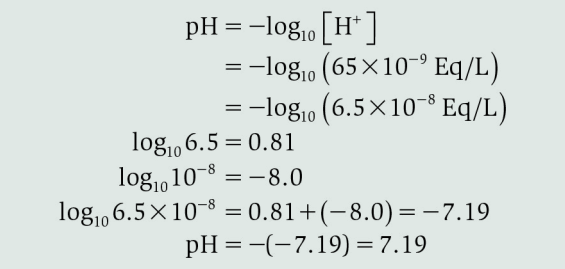
Solving the pH Formula (Easiest Conceptual Method)
Given
- Hydrogen ion concentration (H⁺) = 65 × 10⁻⁹ Eq/L
Formula
pH=−log10[H+]Step 1: Write the given value
pH=−log10(65×10−9)
Step 2: Make the number easy to calculate
We know:65=6.5×10
So,65×10−9=6.5×10⁻⁸
Now the formula becomespH=−log10(6.5×10⁻⁸)
Step 3: Split the logarithm
Use this logarithm rule:log(ab)=loga+logb
Therefore,log(6.5×10⁻⁸)=log6.5+log10−8
Step 4: Find each value
From the logarithm table (or calculator):log6.5=0.81
Also,log10−8=−8
Step 5: Add the values
0.81+(−8)=−7.19
So,log(6.5×10⁻⁸)=−7.19
Step 6: Apply the negative sign
Remember the formula:pH=−log[H+]
Therefore,pH=−(−7.19)=7.19
Final Answer
pH = 7.19
Easy Concept to Remember
Think of the calculation in three simple steps:
H⁺ → Take Log → Change the Sign
Example:
- H⁺ = 65 × 10⁻⁹
- Log = −7.19
- Change the sign → +7.19
✅ Final pH = 7.19
Why Did We Change 65 × 10⁻⁹ to 6.5 × 10⁻⁸?
This makes the logarithm easy.
Because65=6.5×10
So,65×10−9=6.5×10×10−9=6.5×10⁻⁸
The value does not change—it is only rewritten in standard scientific notation.
Clinical Concept
- Higher H⁺ concentration → Lower pH → More acidic
- Lower H⁺ concentration → Higher pH → Less acidic
Here,
- pH = 7.19, which is lower than the normal arterial pH (7.35–7.45).
- Therefore, this blood is more acidic (acidosis) because it contains more H⁺ ions.
KEY CONCEPT
- pH = −log₁₀(H⁺ concentration)
- Rewrite the number into standard scientific notation first.
- Use:
- log(ab) = log a + log b
- log10ⁿ = n
- After finding the logarithm, change its sign because of the negative sign in the pH formula.
- Higher H⁺ = Lower pH = More acidic blood.
Electroneutrality of Body Fluid Compartments
- Every body fluid compartment follows the law of electroneutrality.
- This means that the total positive charges (cations) must always equal the total negative charges (anions).
- The concentrations of cations and anions are equal when measured in mEq/L.
- There cannot be more positive charges than negative charges, and there cannot be more negative charges than positive charges.
- This balance is maintained in every body fluid compartment.
- A small electrical potential difference may exist across the cell membrane.
- Even with this potential difference, the overall fluid on each side of the membrane remains electrically neutral.
- This is because only a very small number of charges are separated near the cell membrane.
- The separated charges are too few to change the overall (bulk) concentrations of cations and anions in the fluid.
KEY CONCEPT
- Every body fluid compartment is electrically neutral.
- Total cations (positive charges) = Total anions (negative charges).
- Charge balance is maintained in mEq/L.
- A small membrane potential does not disturb overall electroneutrality because only a few charges are separated near the cell membrane.
Electroneutrality of Body Fluid Compartments
Sample Problem
A biologic fluid has the following ion concentrations:
| Cations (Positive Ions) | mEq/L |
|---|---|
| Na⁺ | 140 |
| K⁺ | 4 |
| Ca²⁺ | 2 |
| Total Cations | 146 mEq/L |
| Anions (Negative Ions) | mEq/L |
|---|---|
| Cl⁻ | 110 |
| HPO₄²⁻ | 6 |
| Protein⁻ | 0 |
| HCO₃⁻ | ? |
Question:
What should the HCO₃⁻ concentration be to satisfy the law of electroneutrality?
Step 1: Remember the Main Rule
The law of electroneutrality says:
Total Positive Charges (Cations) = Total Negative Charges (Anions)
So,Total Cations=Total Anions
Step 2: Calculate Total Cations
Add all positive ions:Na++K++Ca2+ 140+4+2=146 mEq/L
✅ Total Cations = 146 mEq/L
Step 3: Calculate the Known Anions
Add the measured negative ions:Cl−+HPO42−+Protein− 110+6+0=116 mEq/L
✅ Known Anions = 116 mEq/L
Step 4: Find the Missing HCO₃⁻
SinceTotal Cations=Total Anions 146=116+HCO3−
Subtract 116 from both sides:146−116=30
Therefore,HCO3−=30 mEq/L
Final Answer
HCO3−=30 mEq/L
Easy Concept
Imagine a balance scale.
⚖️ Left Side (Positive Charges)
- Na⁺ = 140
- K⁺ = 4
- Ca²⁺ = 2
Total = 146
⚖️ Right Side (Negative Charges)
- Cl⁻ = 110
- HPO₄²⁻ = 6
- Protein⁻ = 0
Current Total = 116
The right side is 30 mEq/L short.
So bicarbonate (HCO₃⁻) must provide the missing 30 mEq/L to make both sides equal.
Positive charges = 146 mEq/L
⬇️ Must equal
Negative charges = 110 + 6 + 0 + 30 = 146 mEq/L
Now the solution is electrically neutral.
Memory Trick
Think of electroneutrality as a see-saw.
- More positive than negative? ❌ Impossible
- More negative than positive? ❌ Impossible
- Both equal? ✅ Correct
Always use:Missing ion=Total Cations−Known Anions
KEY CONCEPT
- Every body fluid must remain electrically neutral.
- Total cations = Total anions (in mEq/L).
- First, calculate the total positive charges.
- Next, calculate the known negative charges.
- The missing anion equals the difference between total cations and known anions.
- In this example:
- Total cations = 146 mEq/L
- Known anions = 116 mEq/L
- HCO₃⁻ = 30 mEq/L to maintain electroneutrality.
Composition of Intracellular Fluid and Extracellular Fluid
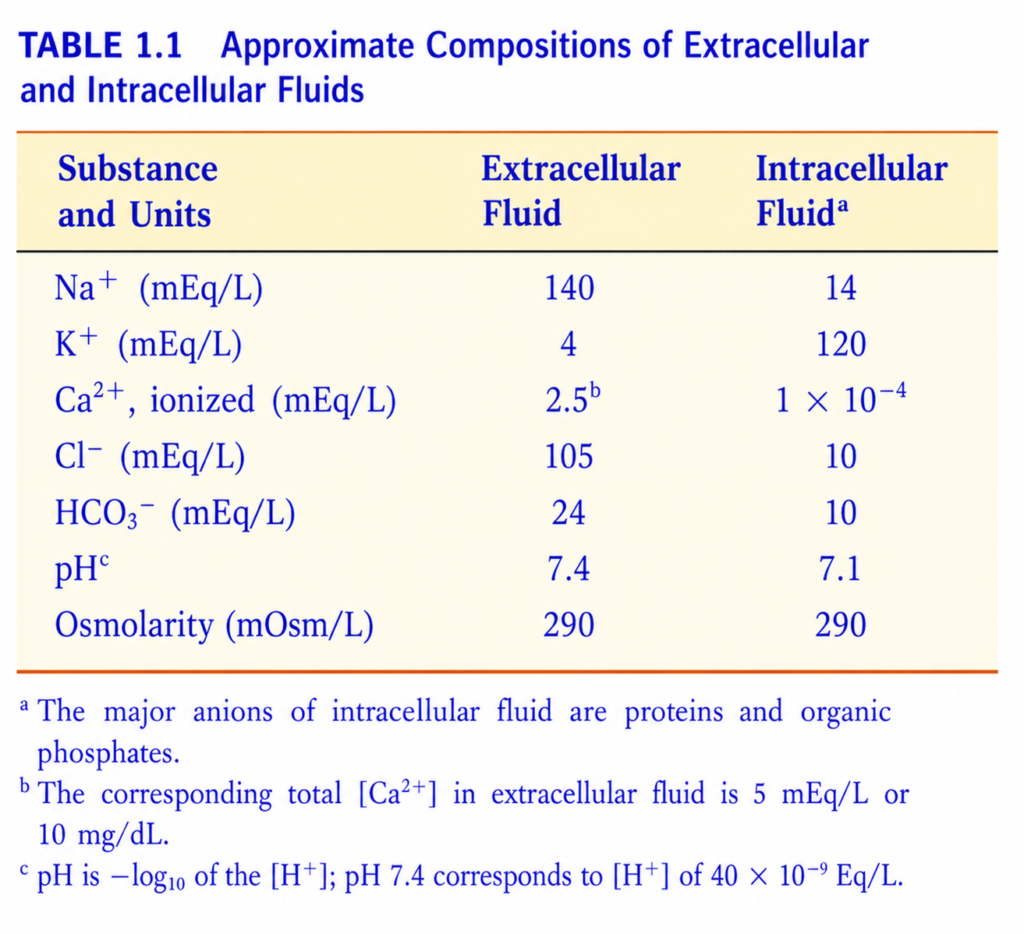
- ICF (intracellular fluid) and ECF (extracellular fluid) have very different chemical compositions.
- The main positive ion (cation) in ECF is sodium (Na⁺).
- The main negative ions (anions) in ECF are:
- Chloride (Cl⁻)
- Bicarbonate (HCO₃⁻)
- The main positive ions (cations) in ICF are:
- Potassium (K⁺)
- Magnesium (Mg²⁺)
- The main negative ions (anions) in ICF are:
- Proteins
- Organic phosphates
- Calcium (Ca²⁺) concentration is very different in the two compartments.
- ICF contains an extremely low concentration of ionized Ca²⁺ (≈10⁻⁷ mol/L).
- ECF contains a Ca²⁺ concentration that is about 10,000 times (four orders of magnitude) higher than ICF.
- ICF is more acidic than ECF, so ICF has a lower pH.
- In general:
- Substances present in high concentration in ECF are present in low concentration in ICF.
- Substances present in high concentration in ICF are present in low concentration in ECF.
- Although the concentrations of individual solutes are very different, the total solute concentration (osmolarity) is the same in ICF and ECF.
- This happens because water moves freely across the cell membrane.
- If a temporary difference in osmolarity develops, water quickly moves into or out of the cells.
- This water movement restores equal osmolarity between ICF and ECF.
KEY CONCEPT
- ECF: Main cation = Na⁺; Main anions = Cl⁻ and HCO₃⁻.
- ICF: Main cations = K⁺ and Mg²⁺; Main anions = Proteins and organic phosphates.
- ICF has very low Ca²⁺ and a lower pH than ECF.
- ICF and ECF have different solute compositions but the same osmolarity.
- Free movement of water across cell membranes maintains equal osmolarity in both compartments.
Creation of Concentration Differences Across Cell Membranes
- Differences in solute concentrations across cell membranes are created and maintained by energy-dependent transport mechanisms.
- These transport mechanisms use energy to move substances across the cell membrane.
- The best-known transporter is the Na⁺-K⁺ ATPase (Na⁺-K⁺ pump).
- The Na⁺-K⁺ pump moves:
- Na⁺ from ICF to ECF
- K⁺ from ECF to ICF
- Both Na⁺ and K⁺ are transported against their electrochemical gradients.
- Because they move against their gradients, the pump requires ATP (adenosine triphosphate) as an energy source.
- The Na⁺-K⁺ ATPase creates and maintains:
- Low Na⁺ concentration inside the cell.
- High K⁺ concentration inside the cell.
- Intracellular Ca²⁺ concentration is also kept much lower than extracellular Ca²⁺ concentration.
- This difference is maintained partly by the Ca²⁺ ATPase pump.
- The Ca²⁺ ATPase pumps Ca²⁺ out of the cell against its electrochemical gradient.
- Like the Na⁺-K⁺ pump, the Ca²⁺ ATPase also uses ATP directly.
- Some membrane transporters do not use ATP directly.
- Instead, they use the Na⁺ concentration gradient created by the Na⁺-K⁺ ATPase as their energy source.
- These transporters help create concentration gradients for:
- Glucose
- Amino acids
- Ca²⁺
- H⁺
- Cell membranes can create large concentration differences for many solutes.
- If the membrane were freely permeable to all solutes, these concentration differences would quickly disappear.
- Therefore, cell membranes are selectively permeable.
- Selective permeability helps maintain the concentration gradients produced by energy-dependent transport.
- The differences between ICF and ECF compositions are essential for normal body functions.
- Examples include:
- Resting membrane potential of nerves and muscles depends on the difference in K⁺ concentration across the cell membrane.
- Action potential upstroke depends on the difference in Na⁺ concentration across the cell membrane.
- Excitation-contraction coupling in muscles depends on the difference in Ca²⁺ concentration across the cell membrane and the sarcoplasmic reticulum (SR).
- Absorption and reabsorption of glucose depend on the Na⁺ concentration gradient, such as:
- Glucose absorption in the small intestine.
- Glucose reabsorption in the renal proximal tubule.
KEY CONCEPT
- Energy-dependent transporters create concentration differences across cell membranes.
- Na⁺-K⁺ ATPase uses ATP to pump Na⁺ out and K⁺ into cells.
- Ca²⁺ ATPase uses ATP to keep intracellular Ca²⁺ very low.
- Some transporters use the Na⁺ gradient instead of ATP directly.
- Selective permeability of the cell membrane prevents concentration gradients from disappearing.
- These concentration differences are essential for nerve impulses, muscle contraction, and nutrient transport.
Concentration Differences Between Plasma and Interstitial Fluids
- ECF (extracellular fluid) is divided into two compartments:
- Plasma
- Interstitial fluid
- The main difference between plasma and interstitial fluid is the presence of proteins in plasma.
- Plasma contains proteins such as albumin.
- Interstitial fluid contains very little or no protein.
- Plasma proteins cannot easily cross capillary walls because they are large molecules.
- Therefore, plasma proteins remain mainly inside the blood vessels (plasma).
- The presence of plasma proteins produces secondary effects on ion distribution.
- Plasma proteins carry a negative charge.
- Their negative charge causes a slight redistribution of small ions across the capillary wall.
- This redistribution is called the Gibbs-Donnan equilibrium.
- Because plasma contains negatively charged proteins, it must still remain electrically neutral.
- Therefore:
- Plasma has a slightly lower concentration of small anions (such as Cl⁻).
- Plasma has a slightly higher concentration of small cations (such as Na⁺ and K⁺) than interstitial fluid.
- These small concentration differences are expressed by the Gibbs-Donnan ratio.
- Example: Chloride (Cl⁻)
- Plasma contains slightly less Cl⁻ than interstitial fluid.
- Gibbs-Donnan ratio = 0.95
- [Cl⁻]plasma / [Cl⁻]interstitial fluid = 0.95
- Example: Sodium (Na⁺)
- Plasma contains slightly more Na⁺ than interstitial fluid.
- Gibbs-Donnan ratio = 0.95
- [Na⁺]interstitial fluid / [Na⁺]plasma = 0.95
- These differences in the concentrations of small ions between plasma and interstitial fluid are very small.
- In most situations, these minor differences are ignored.
KEY CONCEPT
- Plasma contains proteins; interstitial fluid contains little or no protein.
- Large plasma proteins cannot cross capillary walls.
- Negatively charged plasma proteins create the Gibbs-Donnan equilibrium.
- Plasma has slightly fewer anions (Cl⁻) and slightly more cations (Na⁺, K⁺) than interstitial fluid.
- These ion differences are very small and are usually ignored.
