


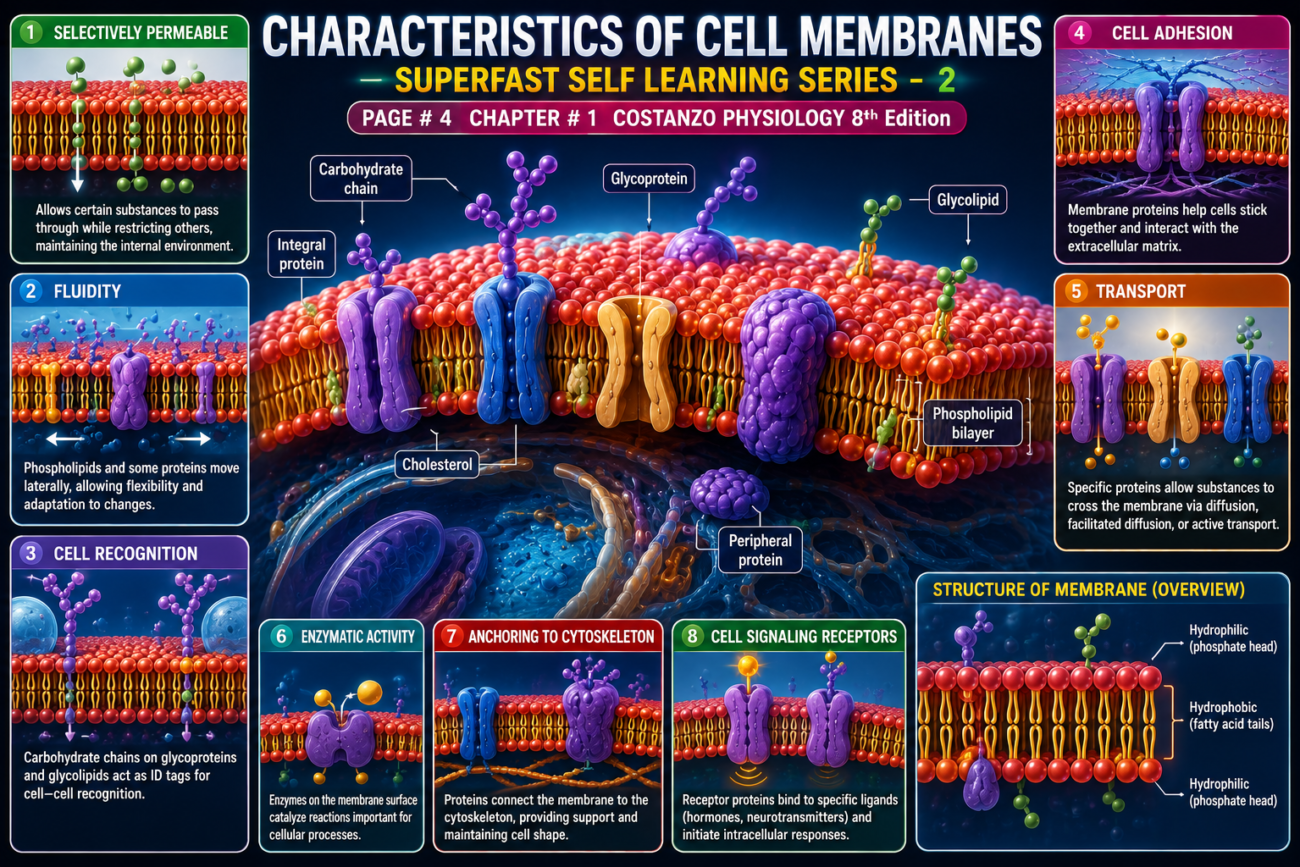
- Cell membranes are mainly made of lipids and proteins.
- The lipid component consists of:
- Phospholipids
- Cholesterol
- Glycolipids
- The lipid component allows lipid-soluble substances to pass easily through the cell membrane.
- Examples of lipid-soluble substances include:
- Carbon dioxide (CO₂)
- Oxygen (O₂)
- Fatty acids
- Steroid hormones
- The lipid component does not allow water-soluble substances to pass easily.
- Examples of water-soluble substances include:
- Ions
- Glucose
- Amino acids
- The protein component of the cell membrane contains:
- Transporters
- Enzymes
- Hormone receptors
- Cell-surface antigens
- Ion channels
- Water channels
KEY CONCEPT
- Cell membranes are made mainly of lipids and proteins.
- Lipids make the membrane highly permeable to lipid-soluble substances (CO₂, O₂, fatty acids, steroid hormones).
- Lipids make the membrane poorly permeable to water-soluble substances (ions, glucose, amino acids).
- Membrane proteins function as transporters, enzymes, receptors, antigens, and ion/water channels.
Phospholipid Component of Cell Membranes
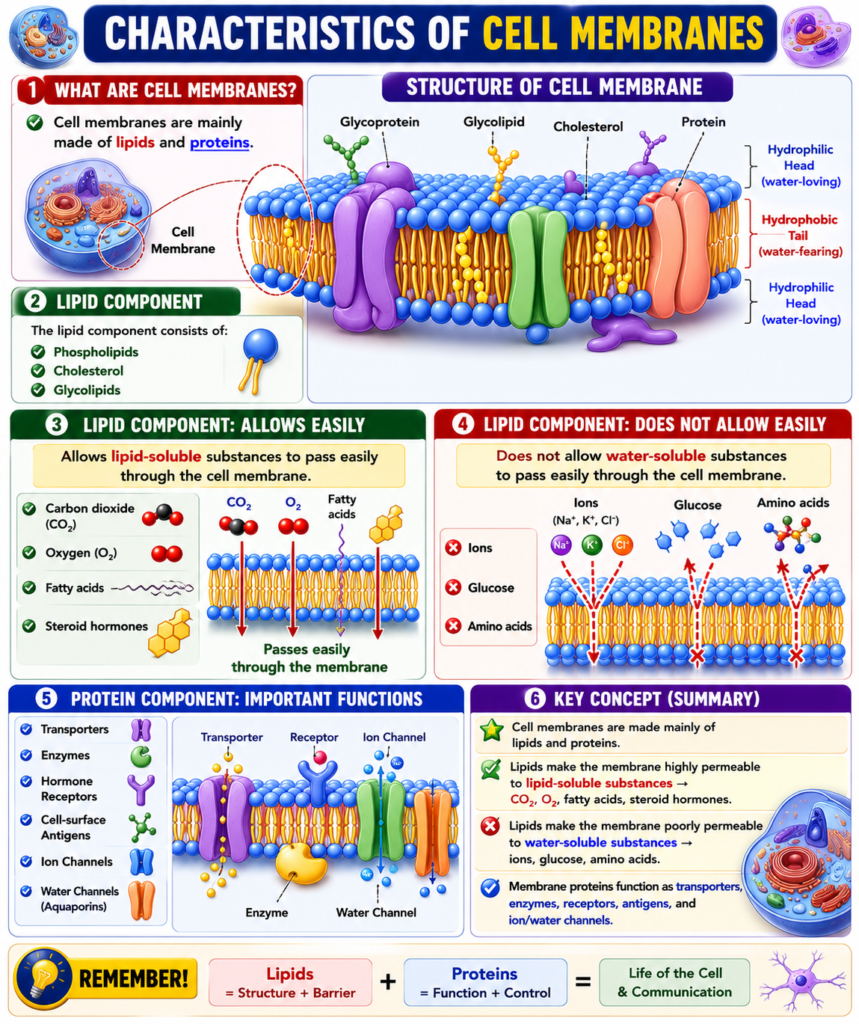
- Phospholipids are made of two main parts:
- A phosphorylated glycerol backbone (head).
- Two fatty acid tails.
- The glycerol head is hydrophilic (water-soluble).
- The fatty acid tails are hydrophobic (water-insoluble).
- Because phospholipids have both hydrophilic and hydrophobic properties, they are called amphipathic molecules.
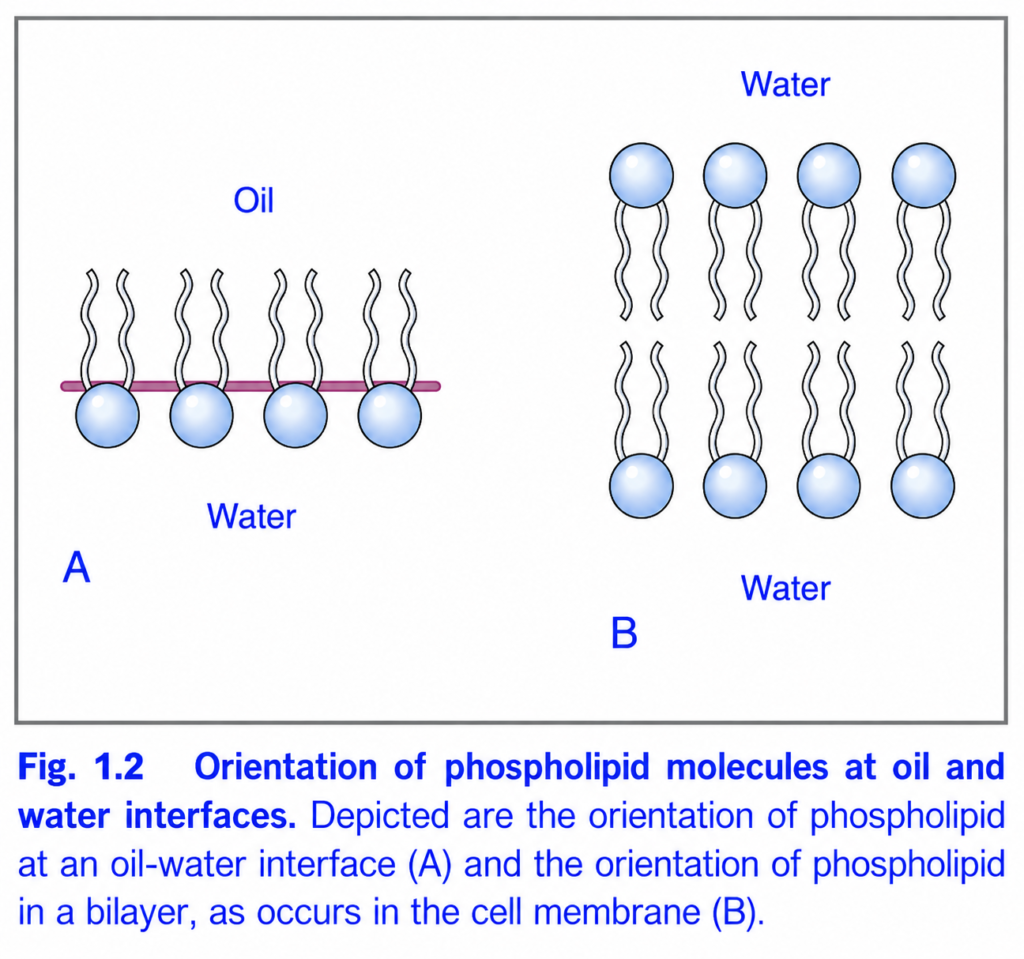
- At an oil–water interface, phospholipids form a single layer (monolayer) and arrange themselves so that:
- The hydrophilic heads face the water.
- The hydrophobic tails face the oil. (Fig. 1.2A)
- In cell membranes, phospholipids arrange into a lipid bilayer.
- In this bilayer:
- The fatty acid tails face each other in the center of the membrane.
- The hydrophilic glycerol heads face the watery environments of the ICF and ECF.
- This arrangement forms the lipid bilayer of the cell membrane. (Fig. 1.2B)
KEY CONCEPT
- Phospholipids have a water-loving (hydrophilic) head and water-fearing (hydrophobic) tails.
- Because they have both properties, they are called amphipathic molecules.
- At an oil–water interface, they form a monolayer. (Fig. 1.2A)
- In cell membranes, they form a lipid bilayer with tails facing inward and heads facing the ICF and ECF. (Fig. 1.2B)
Protein Component of Cell Membranes
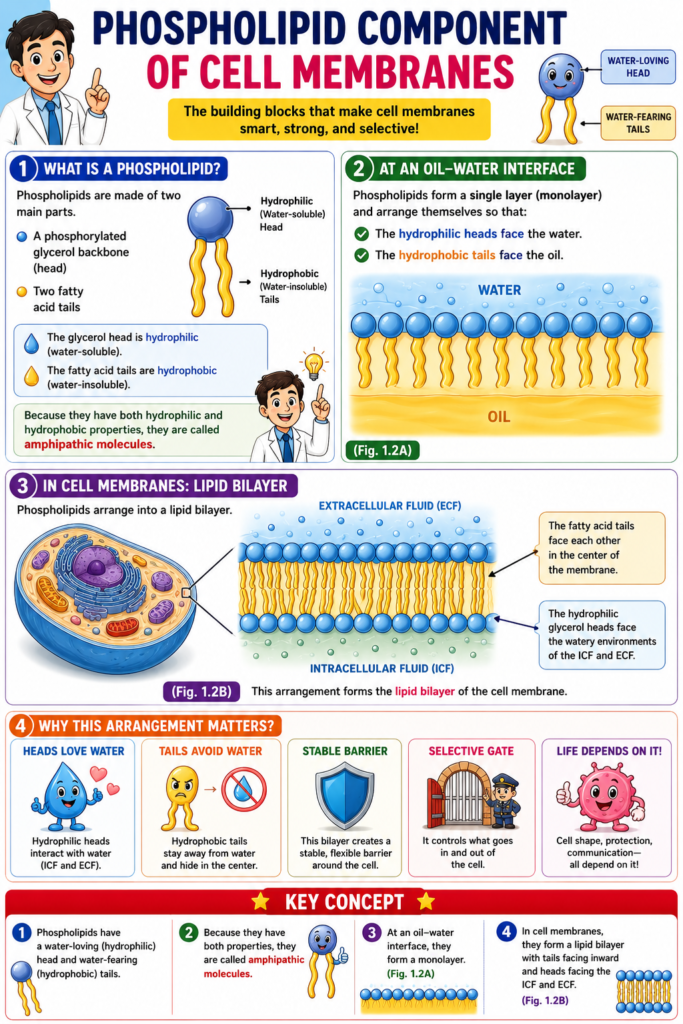
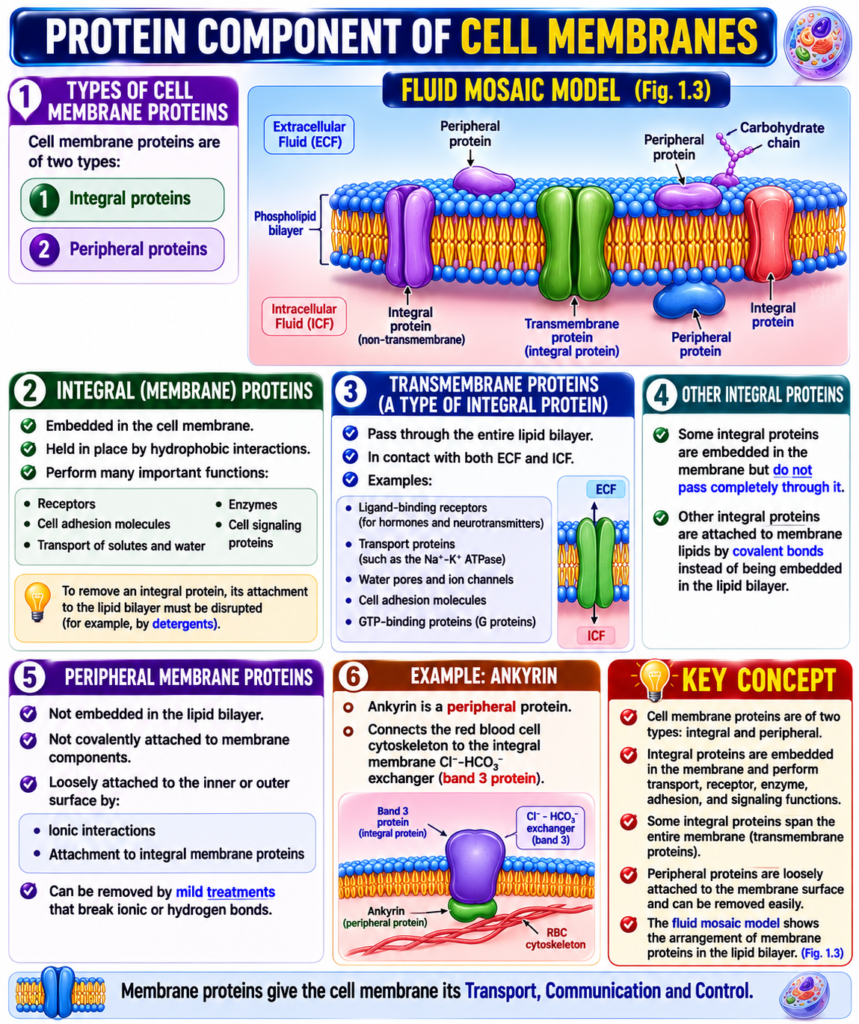
- Cell membrane proteins are of two types:
- Integral proteins
- Peripheral proteins
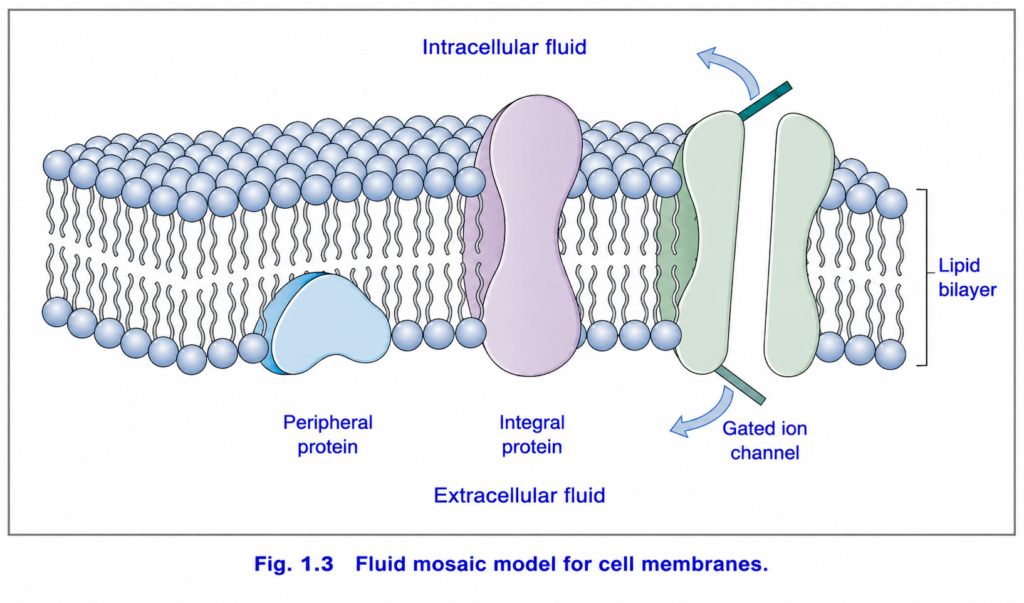
- The arrangement of these proteins in the phospholipid bilayer is shown in the fluid mosaic model. (Fig. 1.3)
- Integral membrane proteins are embedded in the cell membrane and are held in place by hydrophobic interactions.
- Integral membrane proteins perform many functions, including:
- Receptors
- Cell adhesion molecules
- Transport of solutes and water
- Enzymes
- Cell signaling proteins
- To remove an integral protein, its attachment to the lipid bilayer must be disrupted (for example, by detergents).
- Some integral proteins are transmembrane proteins, which pass through the entire lipid bilayer.
- These proteins are in contact with both the extracellular fluid (ECF) and intracellular fluid (ICF).
- Examples of transmembrane proteins include:
- Ligand-binding receptors (for hormones and neurotransmitters)
- Transport proteins (such as the Na⁺-K⁺ ATPase)
- Water pores and ion channels
- Cell adhesion molecules
- GTP-binding proteins (G proteins)
- Some integral proteins are embedded in the membrane but do not pass completely through it.
- Other integral proteins are attached to membrane lipids by covalent bonds instead of being embedded in the lipid bilayer.
- Peripheral membrane proteins are not embedded in the lipid bilayer.
- They are not covalently attached to membrane components.
- They are loosely attached to either the inner or outer surface of the cell membrane by:
- Ionic interactions
- Attachment to integral membrane proteins
- Peripheral proteins can be removed by mild treatments that break ionic or hydrogen bonds.
- An example of a peripheral protein is ankyrin.
- Ankyrin connects the red blood cell cytoskeleton to the integral membrane Cl⁻-HCO₃⁻ exchanger (band 3 protein).
KEY CONCEPT
- Cell membrane proteins are of two types: integral and peripheral.
- Integral proteins are embedded in the membrane and perform transport, receptor, enzyme, adhesion, and signaling functions.
- Some integral proteins span the entire membrane (transmembrane proteins).
- Peripheral proteins are loosely attached to the membrane surface and can be removed easily.
- The fluid mosaic model shows the arrangement of membrane proteins in the lipid bilayer. (Fig. 1.3)
prepare by Dr sheen
