

- Gastrointestinal hormones are released into the portal circulation (portal blood).
- They act on target cells that have specific receptors for each hormone.
- Their effects continue even if all nerve connections between the site of release and the site of action are cut.
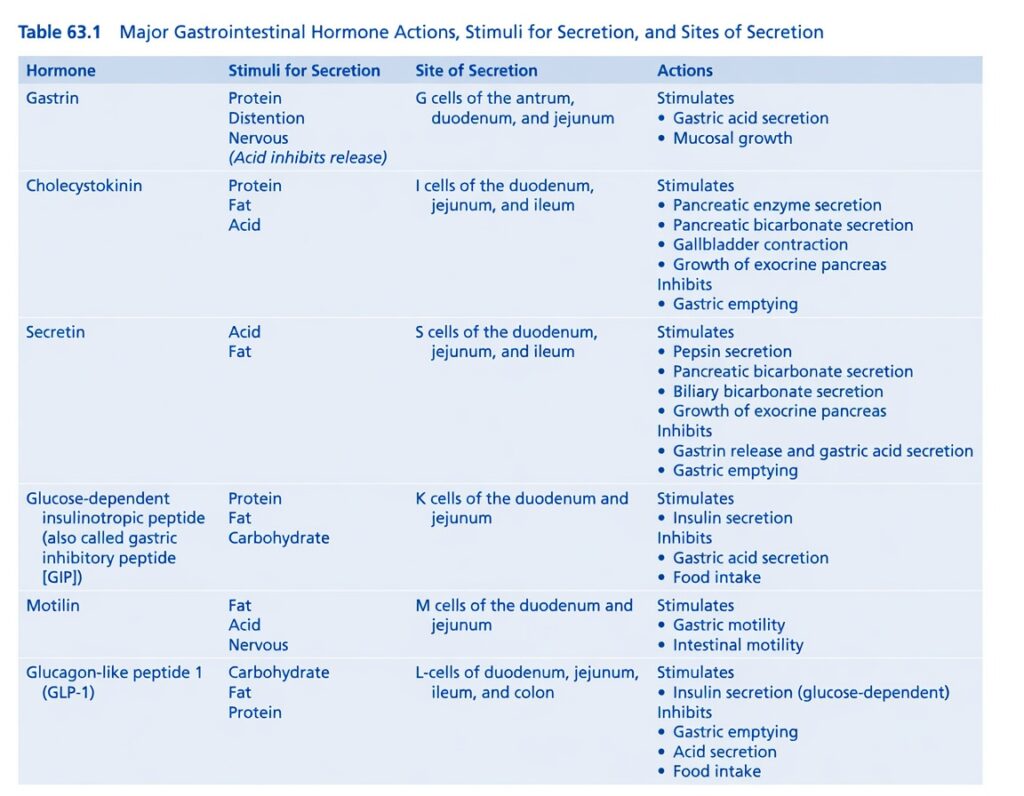
- Table 63.1 summarizes:
- The major gastrointestinal hormones.
- Their actions.
- The stimuli for their secretion.
- The sites where they are secreted.
- Several gastrointestinal hormones also control gastrointestinal secretion.
- Most of these hormones also affect gastrointestinal motility.
- Their effects on motility are usually less important than their effects on secretion.
- The important motility effects are described below.
Gastrin
- Gastrin is secreted by G cells in the antrum of the stomach.
- It is released in response to:
- Stomach distention
- Protein digestion products
- Gastrin-releasing peptide (GRP) released from gastric mucosal nerves during vagal stimulation
- The main actions of gastrin are:
- Stimulates gastric acid secretion
- Stimulates growth of the gastric mucosa
Cholecystokinin (CCK)
- CCK is secreted by I cells in the mucosa of the duodenum and jejunum.
- It is released mainly in response to:
- Fat digestion products
- Fatty acids
- Monoglycerides in the intestinal contents
- CCK strongly contracts the gallbladder.
- This releases bile into the small intestine.
- Bile helps emulsify fats and allows their digestion and absorption.
- CCK also moderately inhibits stomach contractions.
- Therefore, stomach emptying slows, giving more time for fat digestion in the upper small intestine.
- CCK also promotes satiety (feeling of fullness).
- It does this by stimulating sensory afferent nerve fibers in the duodenum.
- These signals travel through the vagus nerve to the feeding centers of the brain, helping prevent overeating.
Secretin
- Secretin was the first gastrointestinal hormone discovered.
- It is secreted by S cells in the mucosa of the duodenum.
- It is released when acidic gastric juice enters the duodenum from the pylorus of the stomach.
- Secretin has a mild effect on gastrointestinal motility.
- It mainly stimulates pancreatic bicarbonate secretion.
- Bicarbonate neutralizes the acid in the small intestine.
Glucose-dependent Insulinotropic Peptide (GIP)
- Glucose-dependent insulinotropic peptide (GIP) is also called gastric inhibitory peptide.
- It is secreted by the mucosa of the upper small intestine.
- It is released mainly in response to:
- Fatty acids
- Amino acids
- It is released to a lesser extent by carbohydrates.
- GIP slightly decreases stomach motor activity.
- As a result, stomach emptying slows when the upper small intestine already contains a large amount of food.
- At very low blood levels, even before affecting stomach motility, GIP stimulates insulin secretion.
Motilin
- Motilin is secreted by the stomach and upper duodenum.
- It is released during fasting.
- Its main function is to increase gastrointestinal motility.
- Motilin is released cyclically.
- It stimulates interdigestive myoelectric complexes.
- These are waves of gastrointestinal contractions.
- They pass through the stomach and small intestine about every 90 minutes in a fasting person.
KEY CONCEPT
- Gastrointestinal hormones travel through the blood and act on specific receptors.
- Their effects continue even without nerve connections.
- Gastrin → Increases gastric acid secretion and gastric mucosal growth.
- CCK → Contracts the gallbladder, slows stomach emptying, and promotes satiety.
- Secretin → Stimulates pancreatic bicarbonate secretion to neutralize acid.
- GIP → Slows stomach emptying and stimulates insulin secretion.
- Motilin → Increases gastrointestinal motility during fasting by producing interdigestive myoelectric complexes every 90 minutes.
Conceptual Examples
- Protein enters the stomach → Gastrin is released → More gastric acid is produced.
- Fat enters the duodenum → CCK is released → Gallbladder contracts and stomach emptying slows.
- Acid enters the duodenum → Secretin is released → Pancreas secretes bicarbonate to neutralize the acid.
- Food overloads the upper small intestine → GIP is released → Stomach empties more slowly and insulin secretion increases.
- During fasting → Motilin is released every 90 minutes → Interdigestive myoelectric complexes sweep through the stomach and small intestine.
Figure Number: Table 63.1
KEEP IN MIND
- Interdigestive myoelectric complexes occur approximately every 90 minutes during fasting.
HORMONAL CONTROL OF GASTROINTESTINAL MOTILITY
- Motilin secretion is inhibited after food is eaten.
- Glucagon-like peptide-1 (GLP-1) is secreted by intestinal L-cells.
- The number of L-cells is low in the duodenum and jejunum.
- The number of L-cells gradually increases toward the lower parts of the intestine.
- The highest number of L-cells is found in the ileum and colon.
- The L-cells face the intestinal lumen.
- Therefore, they directly detect nutrients present inside the intestine.
- In healthy people, eating carbohydrates or proteins causes a rapid increase in blood GLP-1 levels within 10–15 minutes.
- GLP-1 reaches its highest level about 30–60 minutes after eating carbohydrates or proteins.
- Eating fats (lipids) causes a later but longer-lasting increase in GLP-1.
- The important effects of GLP-1 include:
- Stimulates insulin secretion in a glucose-dependent manner.
- Inhibits stomach emptying.
- Inhibits gastric acid secretion.
- Promotes satiety (feeling of fullness).
- Reduces food intake.
- Besides these gastrointestinal hormones, there are many other peptides and paracrine factors.
- These substances also affect different gastrointestinal functions, including gastrointestinal motility.
- Many of these are discussed in later chapters.
KEY CONCEPT
- Motilin decreases after eating food.
- GLP-1 is released from intestinal L-cells.
- L-cells are most numerous in the ileum and colon.
- Carbohydrates and proteins increase GLP-1 quickly (10–15 minutes), with a peak at 30–60 minutes.
- Fats produce a later but longer-lasting increase in GLP-1.
- GLP-1:
- Increases insulin secretion
- Slows stomach emptying
- Decreases gastric acid secretion
- Increases satiety
- Reduces food intake
Conceptual Examples
- After eating carbohydrates → GLP-1 rises within 10–15 minutes → Insulin secretion increases.
- After eating a fatty meal → GLP-1 rises more slowly but lasts longer → Stomach empties more slowly and fullness lasts longer.
- After a meal → Motilin secretion decreases → Interdigestive fasting contractions stop.
KEEP IN MIND : GLP-1 rises within 10–15 minutes, peaks at 30–60 minutes after carbohydrates/proteins; motilin is inhibited after food intake.)
MADE BY EASIEST AND SELF LEARNING BY CEO AND FOUNDER DR SHEEN
