

PROPULSIVE MOVEMENTS—PERISTALSIS
- Two main types of movements occur in the gastrointestinal tract:
- Propulsive movements move food forward at the proper speed for digestion and absorption.
- Mixing movements keep the intestinal contents well mixed all the time.
- The main propulsive movement of the gastrointestinal tract is peristalsis (Fig. 63.5A).
- In peristalsis, a ring of contraction forms around the gut.
- This contractile ring moves forward along the intestine.
- It works like squeezing a soft tube with your fingers and moving your fingers forward.
- The food in front of the contractile ring is pushed forward.
- Peristalsis is a natural property of many syncytial smooth muscle tubes.
- Stimulation at any point of the gut can produce a contractile ring in the circular muscle.
- This contractile ring then spreads along the gut.
- Peristalsis also occurs in:
- Bile ducts
- Glandular ducts
- Ureters
- Many other smooth muscle tubes of the body
- The most common stimulus for intestinal peristalsis is distention (stretching) of the gut.
- When a large amount of food collects in one area, the gut wall stretches.
- This stretching stimulates the enteric nervous system.
- The enteric nervous system causes the gut wall to contract about 2–3 cm behind the stretched area.
- This forms a contractile ring.
- The contractile ring starts the peristaltic movement.
- Other stimuli that can start peristalsis include:
- Chemical irritation of the gut lining
- Physical irritation of the gut lining
- Strong parasympathetic stimulation of the gut also produces strong peristalsis.
KEY CONCEPT
- The gastrointestinal tract has two main movements:
- Propulsive movements → Move food forward.
- Mixing movements → Mix food thoroughly.
- Peristalsis is the main propulsive movement.
- A contractile ring forms and moves forward, pushing food ahead.
- The main stimulus for peristalsis is stretching (distention) of the gut.
- Chemical irritation, physical irritation, and strong parasympathetic stimulation can also start peristalsis.
Conceptual Examples
- Food stretches the intestine → Enteric nervous system is activated → A contractile ring forms 2–3 cm behind the food → Food moves forward.
- Chemical irritation of the intestinal lining → Peristalsis begins → Contents move forward.
- Strong parasympathetic stimulation → Peristalsis becomes stronger → Food moves through the gastrointestinal tract more efficiently.
KEEP IN MIND
- Contractile ring forms approximately 2–3 cm behind the stretched area of the gut.
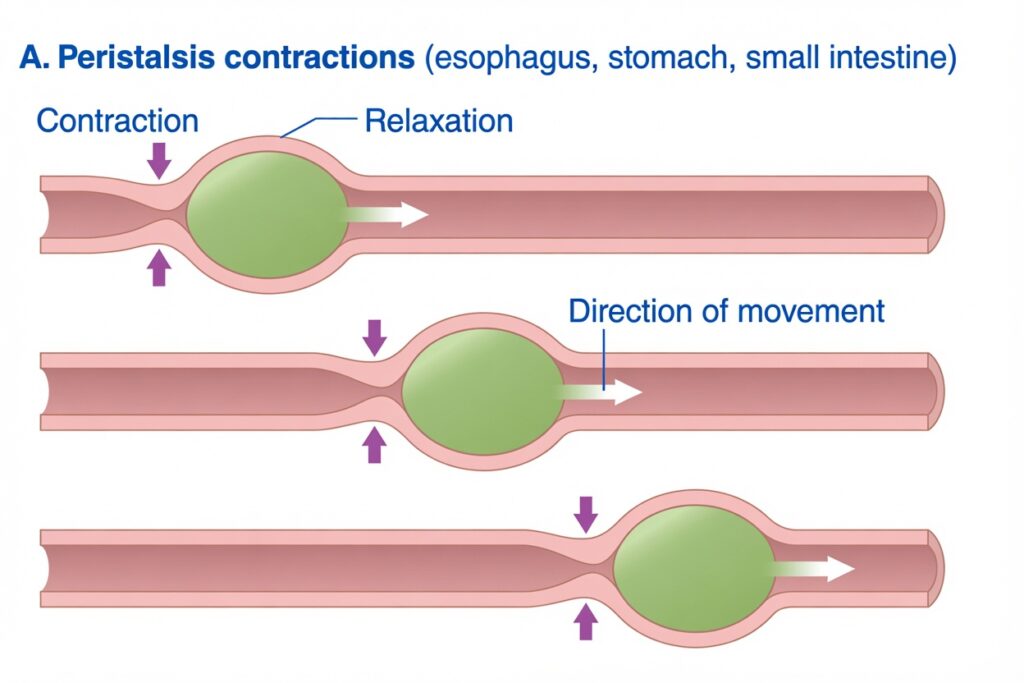
Figure: Peristalsis Contractions (Esophagus, Stomach, Small Intestine)
Easiest and Most Conceptual Explanation
⭐ One-Line Concept
Peristalsis is a wave-like movement in which the muscle contracts behind the food and relaxes in front of it, pushing the food forward through the gastrointestinal tract.
First Understand the Whole Story
Imagine squeezing a toothpaste tube.
- You squeeze behind the toothpaste.
- The front remains open.
- The toothpaste moves forward.
The gastrointestinal tract moves food in exactly the same way.
What is the Green Circle?
The green circle represents:
Food bolus (food mass).
This is the food that needs to move forward.
What is the Pink Tube?
The pink tube represents the wall of the gastrointestinal tract, such as:
- Esophagus
- Stomach
- Small intestine
What do the Purple Arrows Mean?
The purple arrows indicate muscle contraction.
Where the purple arrows point inward:
➡️ Circular smooth muscle contracts.
This narrows the lumen.
What Does “Relaxation” Mean?
The area in front of the food is relaxed.
The intestinal wall becomes wider.
This creates an easy path for the food.
White Arrow
The white arrow shows the:
Direction of food movement
➡️ Always forward.
Understanding the Figure Step by Step
Step 1 (Top Image)
Food enters the tube.
Behind the food:
⬇ Circular muscle contracts.
In front of the food:
⬇ Muscle relaxes.
Result:
Food is squeezed forward.
Easy Concept
Think:
Push from behind + Open in front
↓
Food moves forward.
Step 2 (Middle Image)
The contraction moves forward.
Now:
The contracted muscle is still behind the food.
The relaxed area is still ahead.
The food continues moving.
Easy Concept
The squeezing wave travels with the food.
Step 3 (Bottom Image)
The contraction wave reaches farther down.
Again:
Behind the food:
✔ Muscle contracts.
Ahead of the food:
✔ Muscle relaxes.
Food continues moving forward.
Final Result
The food reaches the next part of the gastrointestinal tract.
Why Doesn’t Food Move Backward?
Because:
Behind food:
➡️ Strong contraction.
Ahead of food:
➡️ Relaxation.
Pressure is always:
High behind
↓
Low ahead
So food naturally moves forward.What Muscles Produce Peristalsis?
Mainly:
Circular smooth muscle
- Contracts behind the food.
- Narrows the lumen.
- Pushes the food forward.
The longitudinal muscle also shortens the segment ahead of the bolus, helping the wave progress more efficiently.
Where Does Peristalsis Occur?
The figure mentions:
1. Esophagus
Moves swallowed food from:
Mouth
↓
Stomach
2. Stomach
Mixes food.
Also slowly pushes it toward the duodenum.
3. Small Intestine
Moves chyme gradually forward while digestion and absorption occur.
What Starts Peristalsis?
Usually:
Food stretches the intestinal wall.
↓
Stretch receptors are activated.
↓
Enteric nervous system is stimulated.
↓
Circular muscle contracts behind the food.
↓
Muscle relaxes ahead.
↓
Peristaltic wave begins.
Pressure Changes During Peristalsis
Behind food:
⬆ High pressure
Ahead of food:
⬇ Low pressure
Therefore:
Food moves toward the lower-pressure area.
Easy Story
Imagine pushing a tennis ball through a soft rubber tube.
You squeeze the tube behind the ball.
The tube ahead stays open.
The ball moves forward.
This is exactly how peristalsis works.
Simple Flow Diagram
Food enters
↓
Gut wall stretches
↓
Enteric nervous system is activated
↓
Circular muscle contracts behind the food
↓
Muscle relaxes ahead of the food
↓
Pressure increases behind the food
↓
Food moves forward
↓
The contraction wave continues along the tube
Difference Between Contraction and Relaxation
| Contraction | Relaxation |
|---|---|
| Occurs behind the food | Occurs ahead of the food |
| Narrows the lumen | Widens the lumen |
| Increases pressure | Decreases resistance |
| Pushes food forward | Allows food to enter easily |
Understanding Every Label in the Figure
Contraction
- Circular smooth muscle contracts.
- Lumen becomes narrow.
- Pushes the food.
Relaxation
- Smooth muscle relaxes.
- Lumen widens.
- Allows food to move into the next segment.
Direction of Movement
- Shows the normal forward movement of food (aboral direction).
- Indicates the direction of the peristaltic wave.
Green Bolus
- Represents the food or chyme being propelled.
High-Yield Summary Table
| Structure/Label | Function | Easy Concept |
|---|---|---|
| Green circle | Food bolus | Food being pushed |
| Pink tube | Gastrointestinal wall | Passage through which food travels |
| Purple arrows | Circular muscle contraction | Squeezes the food from behind |
| Relaxation | Muscle ahead relaxes | Opens the path |
| White arrow | Direction of movement | Forward movement of food |
Key Concept
Peristalsis is the primary propulsive movement of the gastrointestinal tract. A ring of circular smooth muscle contracts behind the food bolus, while the segment ahead relaxes. This creates high pressure behind and low resistance in front, causing the food to move forward. The peristaltic wave travels along the gastrointestinal tract, propelling food through the esophagus, stomach, and small intestine while allowing digestion and absorption to continue efficiently.
FUNCTION OF THE MYENTERIC PLEXUS IN PERISTALSIS
- Peristalsis is weak or absent in parts of the gastrointestinal tract that are born without the myenteric plexus.
- Peristalsis is also greatly reduced or completely blocked when a person is treated with atropine, which paralyzes the cholinergic nerve endings of the myenteric plexus.
- Therefore, effective peristalsis requires a normally functioning myenteric plexus.
- Peristalsis can theoretically move in either direction from the point where it starts.
- Normally, it quickly stops in the orad (toward the mouth) direction.
- It continues for a much longer distance toward the anus.
- The exact reason for this one-way movement is not completely known.
- It is probably because the myenteric plexus is polarized in the anal direction.
- When a part of the intestine is stretched (distended), peristalsis begins.
- The contractile ring forms on the orad side (mouth side) of the stretched segment.
- The contractile ring then moves toward the stretched segment.
- This movement pushes the intestinal contents toward the anus.
- The intestinal contents are usually pushed 5–10 cm before the peristaltic wave dies out (Video 63.1).
- At the same time, the intestine several centimeters ahead (toward the anus) relaxes.
- This relaxation is called receptive relaxation.
- Receptive relaxation allows food to move more easily toward the anus than toward the mouth.
- This complete pattern does not occur without the myenteric plexus.
- Therefore, it is called the myenteric reflex or the peristaltic reflex.
- The peristaltic reflex, together with the movement toward the anus, is called the “law of the gut.”
KEY CONCEPT
- The myenteric plexus is essential for normal peristalsis.
- Without the myenteric plexus, peristalsis becomes weak or stops completely.
- Atropine blocks cholinergic nerve endings of the myenteric plexus and reduces or abolishes peristalsis.
- During peristalsis:
- The contractile ring forms behind (orad to) the stretched segment.
- The intestinal contents move toward the anus.
- Receptive relaxation occurs ahead of the food to make movement easier.
- This complete mechanism is called the myenteric (peristaltic) reflex.
- The peristaltic reflex plus movement toward the anus is called the “law of the gut.”
Conceptual Examples
- Food stretches the intestine → Contractile ring forms behind the food → Food is pushed 5–10 cm toward the anus → The intestine ahead relaxes (receptive relaxation) → Food moves easily forward.
- Congenital absence of the myenteric plexus → Weak or absent peristalsis.
- Atropine administration → Myenteric cholinergic nerves are blocked → Peristalsis decreases or stops.
- Peristaltic wave usually pushes intestinal contents about 5–10 cm before dying out.
SEGMENTATION CONTRACTIONS—MIXING MOVEMENTS
- Mixing movements are different in different parts of the gastrointestinal tract.
- In some parts, peristaltic contractions perform most of the mixing.
- This especially happens when a sphincter blocks the forward movement of intestinal contents.
- In this situation, the peristaltic wave cannot push the contents forward.
- Instead, it mixes (churns) the intestinal contents.
- At other times, local segmentation contractions occur at intervals of a few centimeters along the gut wall (Fig. 63.5B).
- These constrictions usually last for 5–30 seconds.
- After that, new constrictions appear at different places in the intestine.
- These repeated contractions cut (“chop”) and mix (“shear”) the intestinal contents from one place to another.
- These peristaltic and segmentation contractions are modified in different parts of the gastrointestinal tract.
- This helps achieve proper movement (propulsion) and thorough mixing of the intestinal contents.
KEY CONCEPT
- Segmentation contractions are mixing movements of the gastrointestinal tract.
- In some areas, peristalsis also helps mix the intestinal contents, especially when a sphincter blocks forward movement.
- Segmentation contractions occur every few centimeters along the intestine.
- Each contraction lasts about 5–30 seconds.
- New contractions then develop at different locations, producing continuous mixing.
- Together, peristalsis and segmentation contractions ensure proper propulsion and mixing of food.
Conceptual Examples
- Food reaches a closed sphincter → Peristaltic wave cannot push it forward → The food is churned and mixed instead.
- Segmentation contractions occur at one location for 5–30 seconds → They disappear → New contractions appear a few centimeters away → Food is repeatedly chopped and mixed.
- Small intestine → Alternating segmentation contractions continuously mix food with digestive juices, improving digestion and absorption.
Duration of each segmentation contraction:5–30 seconds. Location: Contractions occur every few centimeters along the gut wall.
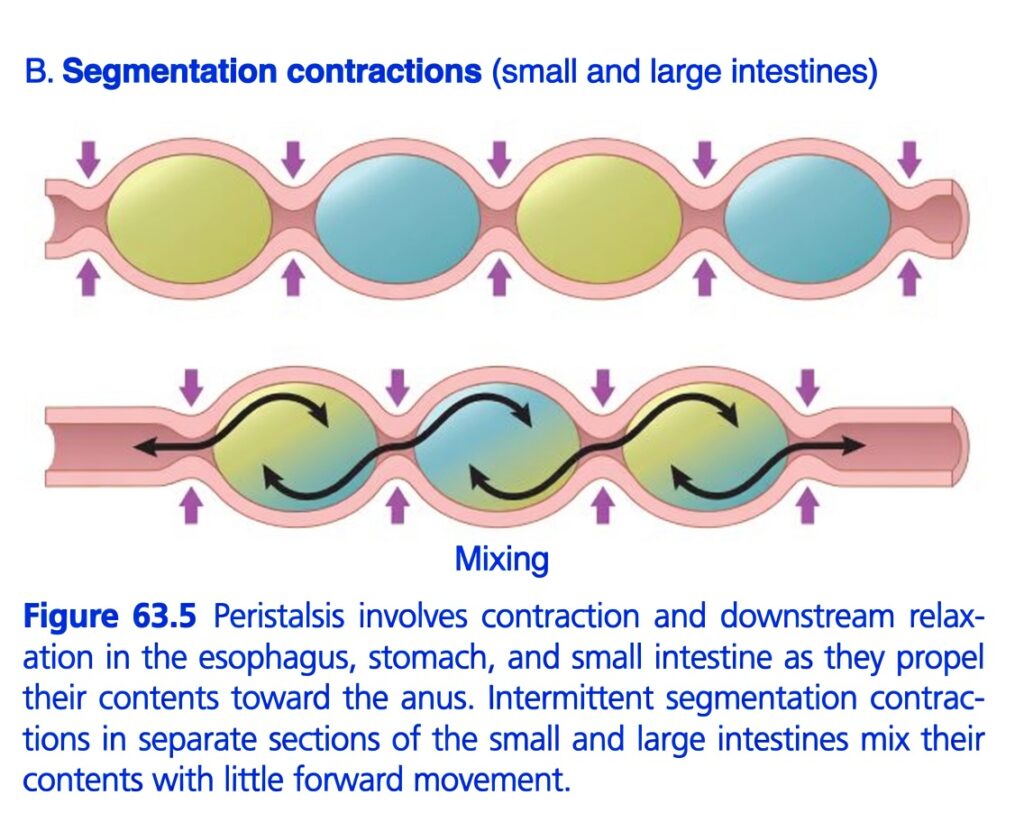
Figure 63.5B: Segmentation Contractions (Small and Large Intestines)
Easiest and Most Conceptual Explanation (Every Part of the Figure)
⭐ One-Line Concept
Segmentation contractions are rhythmic contractions that mainly mix the intestinal contents with digestive juices and the intestinal wall, with very little forward movement.
First Understand the Whole Story
Imagine kneading dough.
- You press one part.
- Then another part.
- Then another part.
The dough does not travel forward very much, but it becomes thoroughly mixed.
Segmentation works exactly like kneading dough.
What is the Pink Tube?
The pink tube represents the:
Wall of the small or large intestine.at are the Green and Blue Circles?
The green and blue circles represent:
Food (chyme or intestinal contents).
Different colors are used only to help distinguish adjacent segments. They do not represent different types of food.
What Do the Purple Arrows Mean?
The purple arrows indicate:
Circular smooth muscle contraction.
Where the arrows point inward:
- The intestinal wall squeezes.
- The lumen becomes narrow.
What Do the Black Curved Arrows Mean?
The black curved arrows show:
Mixing movement of the intestinal contents.
Instead of moving mainly forward, the contents move:
- Forward a little
- Backward a little
- Around within each segment
This creates thorough mixing.
What Does “Mixing” Mean?
Mixing means:
Food combines with:
- Digestive enzymes
- Bile
- Pancreatic juice
- Intestinal secretions
Food is also repeatedly brought into contact with the intestinal lining, improving digestion and absorption.
Understanding the Figure Step by Step
Step 1 (Top Image)
Several separate rings of circular muscle contract at the same time.
This divides the intestine into many small compartments.
Food becomes trapped between these contractions.
Easy Concept
The intestine looks like a string of small balloons because of alternating contractions.
Step 2 (Bottom Image)
The contractions relax and new contractions appear in nearby segments.
The trapped food is squeezed:
- Forward
- Backward
- Side to side
The contents swirl within each compartment.
Result
The food becomes thoroughly mixed.
Only a small amount moves forward overall.
Why Doesn’t Food Move Forward Much?
Unlike peristalsis:
- There is no continuous contraction wave moving in one direction.
- Contractions occur at separate, alternating locations.
Therefore:
Most movement is back-and-forth mixing, not propulsion.
Why Is Segmentation Important?
Segmentation increases:
1. Mixing
Food mixes with digestive juices.
2. Digestion
Digestive enzymes contact all parts of the food.
3. Absorption
Food repeatedly touches the intestinal mucosa.
This improves absorption of:
- Glucose
- Amino acids
- Fatty acids
- Water
- Electrolytes
Where Does Segmentation Occur?
The figure specifically mentions:
Small intestine
Main function:
- Mixing
- Digestion
- Absorption
Large intestine
Main function:
- Mixing
- Water absorption
- Electrolyte absorption
- Formation of feces
Difference Between Peristalsis and Segmentation
| Peristalsis | Segmentation |
|---|---|
| Pushes food forward | Mixes food |
| Continuous wave | Separate rhythmic contractions |
| Contraction behind food | Contractions at multiple locations |
| Relaxation ahead of food | No organized downstream relaxation wave |
| Major forward movement | Very little forward movement |
| Propulsion | Mixing |
Easy Story
Imagine washing clothes in a washing machine.
The clothes move:
- Left
- Right
- Around
They are mixed thoroughly.
They do not simply travel in one direction.
Segmentation works in the same way.
Flow Diagram
Food enters intestine
↓
Circular muscles contract at separate points
↓
Food is divided into small segments
↓
Contractions shift to nearby locations
↓
Food moves back and forth
↓
Digestive juices mix thoroughly with food
↓
Food repeatedly contacts the intestinal wall
↓
Digestion and absorption become more efficient
↓
Only a small amount of food moves forward
Understanding Every Label in the Figure
Segmentation Contractions
- Rhythmic contractions of circular smooth muscle.
- Divide the intestine into multiple segments.
- Mainly responsible for mixing.
Purple Arrows
- Show contraction of circular smooth muscle.
- Narrow the lumen at specific sites.
Green and Blue Circles
- Represent intestinal contents (chyme).
- Different colors simply distinguish neighboring segments.
Black Curved Arrows
- Show back-and-forth mixing within each segment.
- Indicate swirling of intestinal contents.
Mixing
- Food mixes with digestive juices.
- Increases contact with the intestinal mucosa.
- Improves digestion and absorption.
High-Yield Summary Table
| Structure/Label | Function | Easy Concept |
|---|---|---|
| Pink tube | Intestinal wall | Tube where mixing occurs |
| Green and blue circles | Chyme (intestinal contents) | Food being mixed |
| Purple arrows | Circular muscle contraction | Squeezes separate intestinal segments |
| Black curved arrows | Mixing movement | Food moves back and forth within each segment |
| Mixing | Combines food with digestive juices and mucosa | Improves digestion and absorption |
Key Concept
Segmentation contractions are rhythmic circular smooth muscle contractions that occur mainly in the small and large intestines. These contractions divide the intestinal contents into small segments and repeatedly move the contents back and forth, producing thorough mixing with digestive juices and repeated contact with the intestinal lining. Unlike peristalsis, segmentation causes very little forward movement and is designed primarily to enhance digestion and absorption, not propulsion.
MADE BY EASIEST AND SELF LEARNING CEO AND FOUNDER DR SHEEN
