


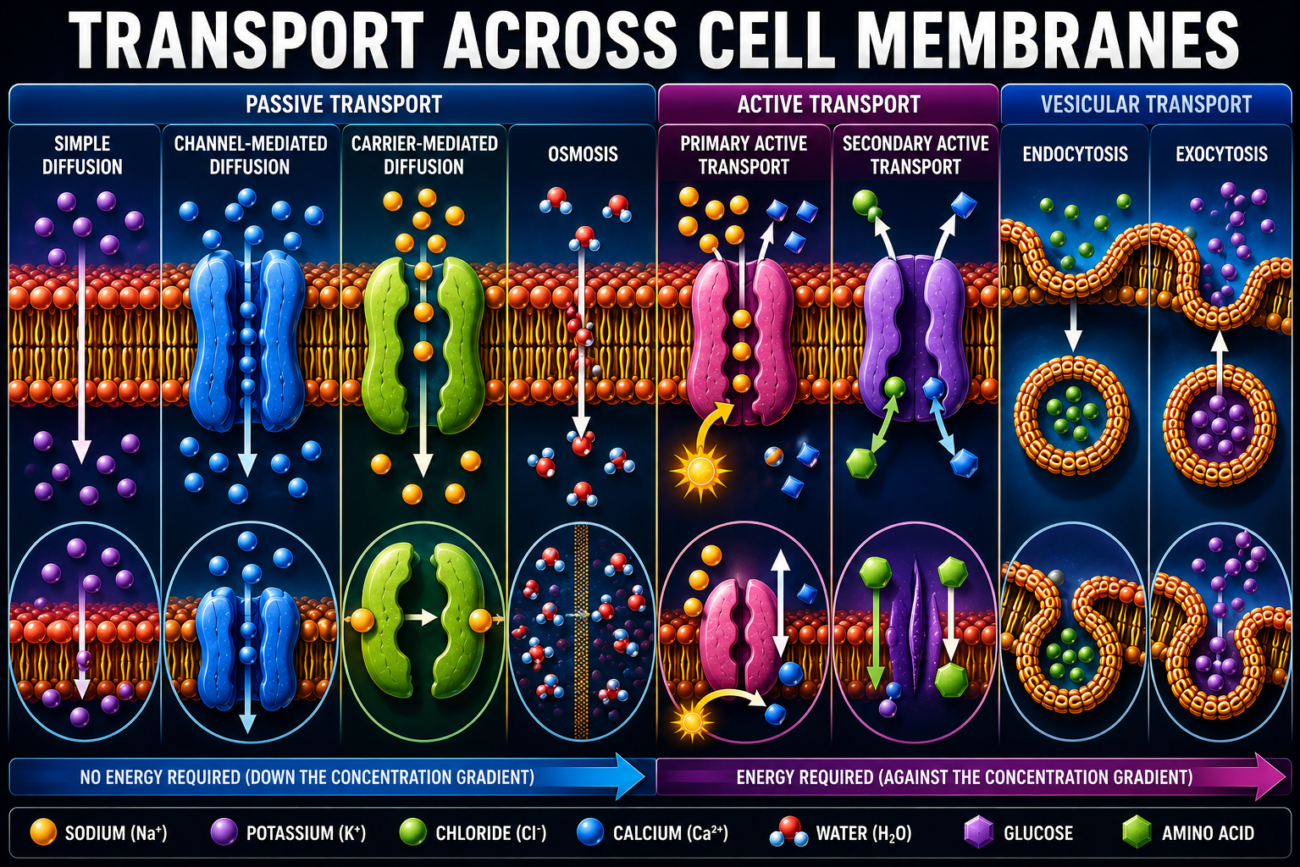
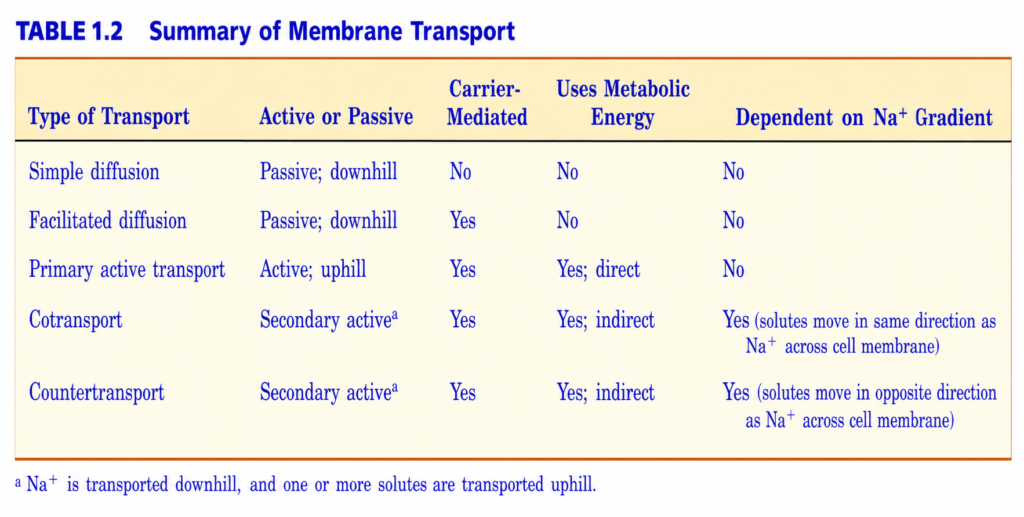
- Substances cross the cell membrane by different transport mechanisms. (Table 1.2)
- Substances may move:
- Down an electrochemical gradient (downhill).
- Against an electrochemical gradient (uphill).
- Downhill transport occurs by diffusion.
- Diffusion may be:
- Simple diffusion.
- Facilitated diffusion.
- Downhill transport does not require metabolic energy.
- Uphill transport occurs by active transport.
- Active transport may be:
- Primary active transport.
- Secondary active transport.
- Primary active transport requires a direct input of metabolic energy.
- Secondary active transport uses an indirect input of metabolic energy.
- Transport mechanisms are also classified according to whether they use a protein carrier.
- Simple diffusion is the only transport mechanism that is not carrier-mediated.
- Facilitated diffusion, primary active transport, and secondary active transport are carrier-mediated transport mechanisms.
- These transport processes use integral membrane proteins.
- All carrier-mediated transport mechanisms have three common features:
- Saturation.
- Stereospecificity.
- Competition.
Saturation
- Carrier proteins have a limited number of solute-binding sites.
- At low solute concentrations, many binding sites are available.
- Therefore, the rate of transport increases rapidly as solute concentration increases.
- At high solute concentrations, most binding sites are already occupied.
- Fewer binding sites remain available.
- As a result, the rate of transport gradually levels off.
- When all binding sites are occupied, the transporter reaches the transport maximum (Tm). (Fig. 1.4)
- Carrier-mediated transport follows kinetics similar to Michaelis-Menten enzyme kinetics.
- The Tm is comparable to the Vmax of enzyme kinetics.
- Glucose transport in the proximal tubule of the kidney is an example of Tm-limited transport.
Stereospecificity
- The binding sites of carrier proteins are stereospecific.
- The glucose transporter in the renal proximal tubule transports D-glucose.
- It does not transport L-glucose.
- Simple diffusion does not distinguish between D-glucose and L-glucose.
- This is because simple diffusion does not require a carrier protein.
Competition
- Carrier proteins are highly specific, but they may also recognize chemically related substances.
- The glucose transporter recognizes D-glucose.
- It also transports D-galactose.
- D-galactose competes with D-glucose for the same carrier binding sites.
- As a result, D-galactose reduces the transport of D-glucose by occupying some of the available binding sites.
Summary of Membrane Transport (Table 1.2)
- Simple diffusion
- Passive transport
- Moves downhill
- Not carrier-mediated
- Does not require metabolic energy
- Not dependent on the Na⁺ gradient
- Facilitated diffusion
- Passive transport
- Moves downhill
- Carrier-mediated
- Does not require metabolic energy
- Not dependent on the Na⁺ gradient
- Primary active transport
- Active transport
- Moves uphill
- Carrier-mediated
- Requires direct metabolic energy
- Not dependent on the Na⁺ gradient
- Cotransport
- Secondary active transport
- Carrier-mediated
- Uses indirect metabolic energy
- Depends on the Na⁺ gradient
- Na⁺ and the transported solute move in the same direction across the membrane
- Countertransport
- Secondary active transport
- Carrier-mediated
- Uses indirect metabolic energy
- Depends on the Na⁺ gradient
- Na⁺ and the transported solute move in opposite directions across the membrane
KEY CONCEPT
- Cell membrane transport occurs either down (passive) or against (active) the electrochemical gradient.
- Simple diffusion is the only transport mechanism that is not carrier-mediated.
- Facilitated diffusion, primary active transport, and secondary active transport require carrier proteins.
- Carrier-mediated transport has three important properties: saturation, stereospecificity, and competition.
- Transport maximum (Tm) occurs when all carrier binding sites are occupied. (Fig. 1.4)
- Primary active transport uses direct metabolic energy, whereas secondary active transport uses the Na⁺ gradient as an indirect energy source.
- In cotransport, Na⁺ and the solute move in the same direction; in countertransport, they move in opposite directions. (Table 1.2)
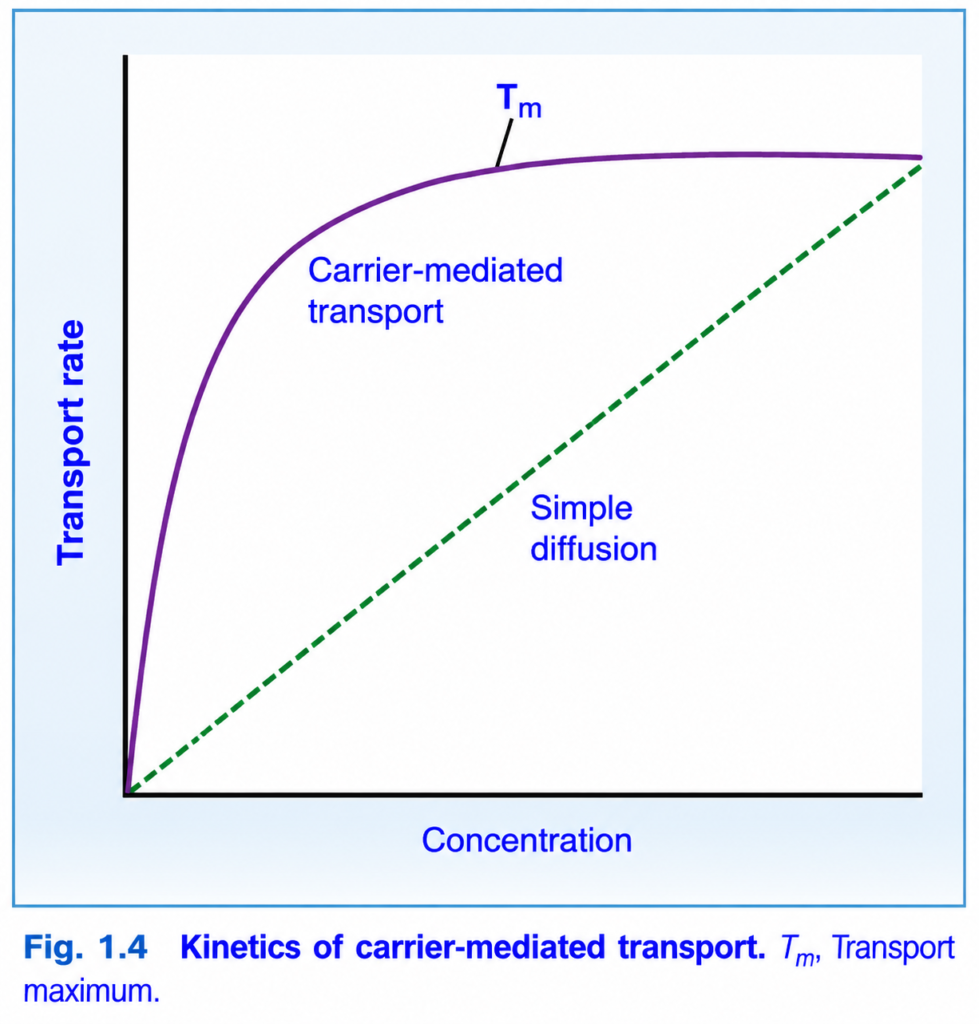
Kinetics of Carrier-Mediated Transport (Fig. 1.4) – Easy
This graph compares carrier-mediated transport with simple diffusion.
It explains why some substances have a maximum transport rate (Tm) while others continue to move faster as their concentration increases.
Basic Concept
Substances cross cell membranes by two major mechanisms:
1. Simple Diffusion
- No carrier protein is needed.
- Movement occurs directly through the membrane or channels.
- The higher the concentration, the faster the movement.
- No transport maximum (Tm).
2. Carrier-Mediated Transport
- Requires a specific carrier (transport protein).
- The carrier binds the substance and transports it across the membrane.
- The number of carriers is limited.
- Therefore, transport eventually reaches a maximum rate (Tm).
Understanding the Axes
X-axis (Concentration)
Shows the concentration of the substance.
Moving to the right means:
➡️ The concentration increases.
Y-axis (Transport Rate)
Shows how rapidly the substance crosses the membrane.
Moving upward means:
➡️ Faster transport.
Understanding Every Line
1. Purple Curve — Carrier-Mediated Transport
What happens?
The purple curve has three phases:
Phase 1: Rapid Increase
At low concentrations,
The transport rate rises very quickly.
Why?
Many carrier proteins are available.
Almost every molecule easily finds a free carrier.
Therefore,
Transport increases rapidly.
Easy Concept
Imagine 10 buses waiting at a bus stop.
Only 5 passengers arrive.
Every passenger immediately finds a bus.
Transport is very fast.
Phase 2: Slowing of the Curve
As concentration continues to increase,
The curve begins to bend.
Why?
More carriers become occupied.
Fewer free carriers remain.
Although transport still increases,
It increases more slowly.
Easy Concept
Now,
50 passengers arrive,
but there are still only 10 buses.
Passengers must wait for buses to return.
Transport slows.
Phase 3: Plateau (Tm)
Eventually,
The curve becomes almost horizontal.
This point is called Transport Maximum (Tm).
What is Tm?
Tm (Transport Maximum) is the highest transport rate that carrier proteins can achieve.
At this point,
All carriers are fully occupied (saturated).
Even if concentration continues to increase,
Transport cannot increase further.
Easy Concept
All buses are completely full.
Even if 100 more passengers arrive,
No extra passengers can be transported until a bus becomes available.
Adding more passengers does not increase transport.
2. Green Dashed Line — Simple Diffusion
What happens?
The green dotted line rises in a straight line from beginning to end.
Why?
Simple diffusion does not require carrier proteins.
Therefore,
There is no saturation.
As concentration increases,
The transport rate increases proportionally.
Easy Concept
Imagine water flowing through an open pipe.
The greater the water pressure,
The faster the flow.
There is no waiting for carriers.
Why Are the Two Curves Different?
Carrier-Mediated Transport
- Limited number of carriers.
- Carriers become saturated.
- Transport reaches Tm.
- Curve becomes flat.
Simple Diffusion
- No carriers.
- No saturation.
- Transport continues increasing.
- Straight-line graph.
Clinical Importance
Many important substances use carrier-mediated transport, including:
- Glucose (SGLT, GLUT transporters)
- Amino acids
- Phosphate
- Organic acids
- Organic bases
- PAH secretion
- Many drugs
When the carriers become saturated,
The transport rate cannot increase further.
This explains:
- Transport maximum (Tm)
- Glucosuria in diabetes mellitus
- Splay in renal glucose transport
- Saturation of PAH secretion
Examples
Example 1: Glucose
Normally,
All filtered glucose is reabsorbed by SGLT transporters.
When plasma glucose becomes very high,
All SGLT transporters become saturated.
The transport rate reaches Tm.
Excess glucose cannot be reabsorbed and appears in urine (glucosuria).
Example 2: PAH
PAH is secreted by carrier proteins in the proximal tubule.
As plasma PAH increases,
These transporters eventually become saturated.
After reaching Tm,
Further increases in PAH secretion are not possible.
Comparison of the Two Curves
| Feature | Carrier-Mediated Transport | Simple Diffusion |
|---|---|---|
| Carrier protein required | ✔ Yes | ✘ No |
| Specificity | High | Low |
| Saturation | ✔ Yes | ✘ No |
| Transport Maximum (Tm) | ✔ Present | ✘ Absent |
| Graph shape | Curved then plateau | Straight line |
| Examples | Glucose, amino acids, PAH, phosphate | Oxygen, carbon dioxide, urea, lipid-soluble substances |
Quick Memory Trick
Carrier-Mediated = “Bus System”
- Limited buses (carriers)
- Buses become full
- Maximum transport = Tm
Simple Diffusion = “Open Road”
- No buses
- No waiting
- More concentration → More movement
- No transport limit
Key Concept
This graph demonstrates the fundamental difference between carrier-mediated transport and simple diffusion. In carrier-mediated transport, the transport rate increases rapidly at low concentrations because many carrier proteins are available. As concentration rises, the carriers progressively become occupied, causing the curve to bend. Once all carriers are saturated, transport reaches the transport maximum (Tm) and cannot increase further, producing a plateau. In contrast, simple diffusion does not require carrier proteins, so it never becomes saturated. Its transport rate increases in direct proportion to the concentration gradient, producing a straight-line relationship. This principle explains why renal transport of glucose, amino acids, and PAH exhibits a Tm, whereas substances that move by simple diffusion, such as oxygen and carbon dioxide, do not.
Simple Diffusion
Diffusion of Nonelectrolytes
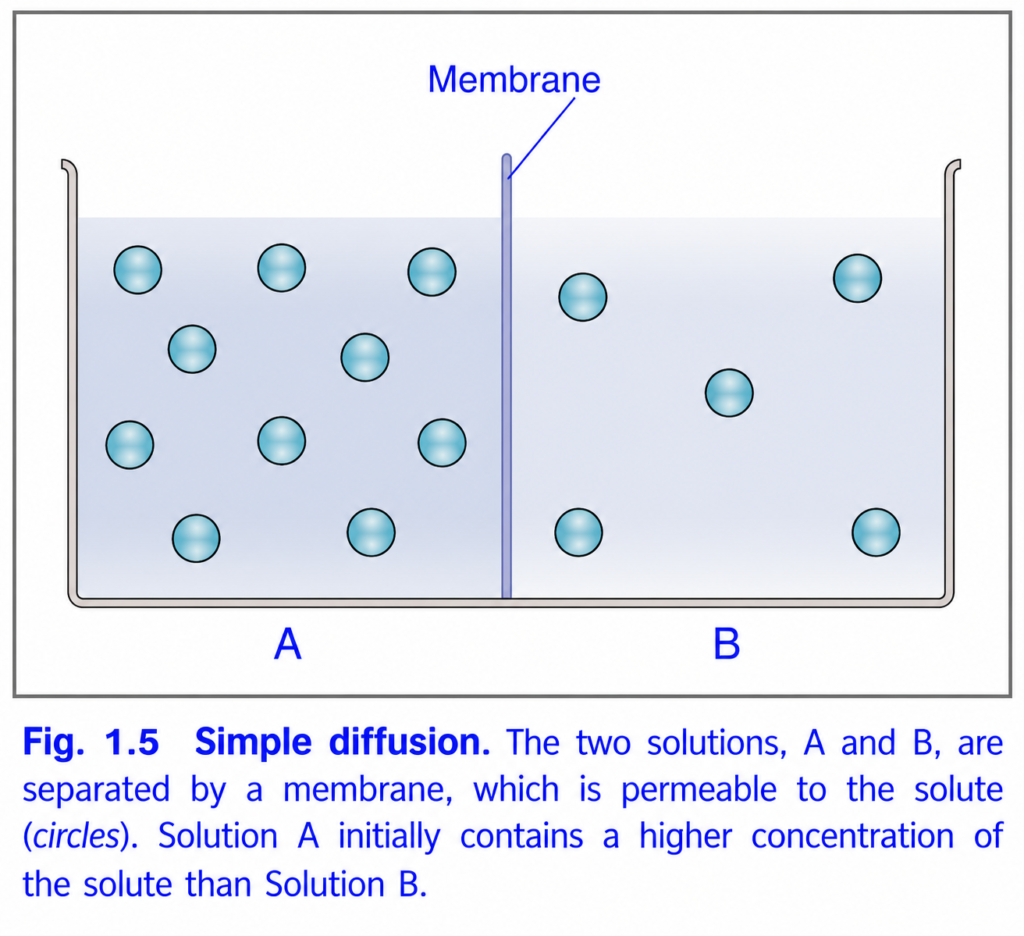
- Simple diffusion occurs because of the random thermal movement of molecules. (Fig. 1.5)
- Two solutions, A and B, are separated by a membrane that is permeable to the solute.
- Initially, the solute concentration in Solution A is twice that of Solution B.
- The solute molecules are constantly moving in random directions.
- Each molecule has an equal chance of crossing the membrane into the other solution.
- Because Solution A contains more solute molecules, more molecules move from A to B than from B to A.
- Therefore, there is net diffusion of solute from Solution A to Solution B.
- Net diffusion continues until the solute concentration becomes equal in both solutions.
- Even after the concentrations become equal, the random movement of molecules continues continuously.
- The net movement of solute is called flux (J) or flow.
- Flux (J) depends on:
- Size of the concentration gradient.
- Partition coefficient.
- Diffusion coefficient.
- Thickness of the membrane.
- Surface area available for diffusion.
Concentration Gradient
- The concentration gradient is one of the main factors that determines the rate of simple diffusion.
KEY CONCEPT
- Simple diffusion occurs because of the random thermal movement of molecules.
- Solutes move from an area of higher concentration to an area of lower concentration. (Fig. 1.5)
- Net diffusion continues until both sides reach equal solute concentrations.
- Random molecular movement continues even after equilibrium is reached.
- The net movement of solute is called flux (J).
- Flux depends on the concentration gradient, partition coefficient, diffusion coefficient, membrane thickness, and membrane surface area.
Flux (J) —
Definition
- Flux (J) means the net amount of a substance that moves across a membrane per unit time.
- In simple words:
Flux (J) = The actual overall movement (flow) of molecules from one side of a membrane to the other side.
Understand It Conceptually
🎯 Imagine Two Rooms
Suppose there are two rooms connected by an open door.
- Room A: 100 students 👨🎓👨🎓👨🎓
- Room B: 20 students 👨🎓
Students keep walking randomly through the door.
Some students move:
- A → B
- B → A
But because Room A has many more students, more students move from A to B than from B to A.
What is the Flux (J)?
Flux is not the students moving in one direction.
It is the net (overall) movement.
Example:
- 30 students move from A → B
- 10 students move from B → A
Net movement (Flux)
Flux = 30 − 10 = 20 students from A → B
👉 Flux = 20 students per unit time
In the Kidney or Cell Membrane
Suppose:
- Left side = 100 glucose molecules
- Right side = 40 glucose molecules
Random movement occurs in both directions.
| Direction | Molecules |
|---|---|
| Left → Right | 50 |
| Right → Left | 20 |
Net movement
Flux (J) = 50 − 20 = 30 glucose molecules
So,
👉 Flux = 30 glucose molecules moving from left to right per unit time.
Very Easy Formula
Flux (J) = Forward movement − Backward movement
or
Flux = Net flow of molecules
Remember This Important Point
❌ Flux does NOT mean all movement.
✔️ Flux means only the overall (net) movement after subtracting movement in the opposite direction.
When Does Flux Become Zero?
Suppose both sides have equal concentration.
- 20 molecules move Left → Right
- 20 molecules move Right → Left
Net movement:
Flux = 20 − 20 = 0
Although molecules are still moving randomly, there is no net movement.
This is called dynamic equilibrium.
What Increases Flux?
According to Fick’s Law, flux increases when:
- ✅ Concentration gradient increases
- ✅ Membrane surface area increases
- ✅ Diffusion coefficient increases
- ✅ Lipid solubility (partition coefficient) increases
Flux decreases when:
- ❌ Membrane thickness increases
MBBS Exam Definition
Flux (J) is the net movement (flow) of a substance across a membrane per unit time due to a concentration gradient.
Memory Trick
J = Journey of molecules
Not every molecule’s journey counts.
Only the final overall journey (net movement) is called Flux (J).
KEY CONCEPT
- Flux (J) = Net movement of molecules across a membrane per unit time.
- Molecules always move in both directions.
- Flux is calculated as: Forward movement − Backward movement.
- Flux is directed from higher concentration to lower concentration during simple diffusion.
- At equilibrium, molecules still move randomly, but Flux = 0 because movement in both directions is equal.
CONCENTRATION GRADIENT (CA > CB)
- The concentration gradient across the membrane is the driving force for net diffusion.
- The greater the difference in solute concentration between Solution A and Solution B, the greater the driving force.
- A greater driving force produces greater net diffusion.
- If the solute concentrations in Solution A and Solution B become equal, there is no driving force.
- When there is no driving force, there is no net diffusion.
KEY CONCEPT
- The concentration gradient is the driving force for net diffusion.
- A larger concentration difference produces greater net diffusion.
- When the concentrations on both sides are equal, there is no driving force and no net diffusion.
PARTITION COEFFICIENT (K)
- The partition coefficient (K) describes the solubility of a solute in oil (lipid) compared with its solubility in water.
- The partition coefficient is important for simple diffusion because the cell membrane is made of lipids.
- A solute with greater solubility in oil has a higher partition coefficient (K).
- A higher partition coefficient (K) allows the solute to dissolve more easily in the lipid bilayer of the cell membrane.
- Nonpolar solutes are more soluble in oil and therefore have a high partition coefficient (K).
- Polar solutes are less soluble in oil and therefore have a low partition coefficient (K).
- The partition coefficient (K) is measured by:
- Adding the solute to a mixture of olive oil and water.
- Measuring the concentration of the solute in the oil phase.
- Measuring the concentration of the solute in the water phase.
- Comparing these two concentrations.
Formula
K=Concentration in waterConcentration in olive oil
Conceptual Understanding of the Formula
- If the concentration in olive oil is greater than the concentration in water:
- K is high.
- The solute is more lipid-soluble.
- It diffuses more easily through the cell membrane.
- If the concentration in olive oil is lower than the concentration in water:
- K is low.
- The solute is less lipid-soluble.
- It diffuses less easily through the cell membrane.
KEY CONCEPT
- The partition coefficient (K) measures how well a solute dissolves in oil compared with water.
- The cell membrane is lipid-rich, so lipid-soluble substances diffuse more easily.
- Nonpolar solutes have a high partition coefficient (K).
- Polar solutes have a low partition coefficient (K).
- Formula: K = Concentration in olive oil ÷ Concentration in water.
DIFFUSION COEFFICIENT (D)
- The diffusion coefficient (D) depends on:
- The size of the solute molecule.
- The viscosity of the medium.
- The diffusion coefficient (D) is defined by the Stokes-Einstein equation.
Stokes-Einstein Equation
D=6πrηKT
Where:
- D = Diffusion coefficient
- K = Boltzmann constant
- T = Absolute temperature (Kelvin)
- r = Molecular radius
- η = Viscosity of the medium
Conceptual Understanding of the Equation
- If the molecular radius (r) decreases:
- D increases.
- Small molecules diffuse more easily.
- If the molecular radius (r) increases:
- D decreases.
- Large molecules diffuse less easily.
- If the viscosity (η) decreases:
- D increases.
- Diffusion becomes easier.
- If the viscosity (η) increases:
- D decreases.
- Diffusion becomes slower.
- The diffusion coefficient (D) is inversely related to:
- Molecular radius (r).
- Viscosity of the medium (η).
- Therefore:
- Small solutes in nonviscous solutions have the highest diffusion coefficients and diffuse most readily.
- Large solutes in viscous solutions have the lowest diffusion coefficients and diffuse least readily.
- Thus, the Stokes-Einstein equation shows the relationship between the diffusion coefficient, molecular size, and viscosity of the medium.
KEY CONCEPT
- The diffusion coefficient (D) determines how easily a substance diffuses.
- D depends on the size of the solute molecule and the viscosity of the medium.
- Small molecules have a higher diffusion coefficient and diffuse faster.
- Large molecules have a lower diffusion coefficient and diffuse slower.
- Higher viscosity decreases diffusion, while lower viscosity increases diffusion.
- Formula: D=KT6πrηD=\dfrac{KT}{6\pi r\eta}D=6πrηKT.
Stokes-Einstein Equation
D=6πrηKT
Conceptual Breakdown of the Equation
This equation is not solved numerically because no values are given for K, T, r, or η. Instead, we can understand how each variable affects the diffusion coefficient (D).
Step 1: Look at the Numerator
Numerator = KT
- K = Boltzmann constant (a constant value)
- T = Absolute temperature (Kelvin)
Since K is constant, only T changes.
➡️ If T increases → D increases
Example:
- Temperature = 300 K
- Temperature rises to 600 K
Then,D=6πrηK(600)>6πrηK(300)
✅ Higher temperature → Faster diffusion
Step 2: Look at the Denominator
Denominator = 6πrη6\pi r\eta6πrη
- 6 = Constant
- π = Constant
- r = Molecular radius
- η = Viscosity
Only r and η change.
Case 1: Increase Molecular Radius (r)
Suppose:
- r = 1
D=6π(1)ηKT
Now,
- r = 2
D=6π(2)ηKT
The denominator becomes twice as large.
Therefore,
✅ D becomes half as large.
Conclusion:
- Large molecule → Small D → Slow diffusion
Case 2: Decrease Molecular Radius (r)
Suppose:
- r = 2
Now,
- r = 1
The denominator becomes smaller.
Therefore,
✅ D increases.
Conclusion:
- Small molecule → Large D → Fast diffusion
Case 3: Increase Viscosity (η)
Suppose:
- Water = Low viscosity
- Honey = High viscosity
If viscosity increases,D=6πr(High η)KT
The denominator becomes larger.
Therefore,
✅ D decreases.
Conclusion:
- High viscosity → Slow diffusion
Case 4: Decrease Viscosity (η)
Suppose the medium changes from honey to water.
Viscosity decreases.
The denominator becomes smaller.
Therefore,
✅ D increases.
Conclusion:
- Low viscosity → Fast diffusion
Final Relationship
| Variable | Effect on D |
|---|---|
| ↑ Temperature (T) | ↑ D |
| ↓ Temperature (T) | ↓ D |
| ↑ Molecular radius (r) | ↓ D |
| ↓ Molecular radius (r) | ↑ D |
| ↑ Viscosity (η) | ↓ D |
| ↓ Viscosity (η) | ↑ D |
Super Easy Memory Trick
Top = Helps Diffusion
- Temperature (T) ↑ → Diffusion ↑
Bottom = Opposes Diffusion
- Radius (r) ↑ → Diffusion ↓
- Viscosity (η) ↑ → Diffusion ↓
KEY CONCEPT
- The Stokes-Einstein equation explains what determines the diffusion coefficient (D).
- Higher temperature increases diffusion.
- Larger molecules diffuse more slowly because D decreases.
- Higher viscosity slows diffusion because D decreases.
- Small molecules in low-viscosity solutions have the highest diffusion coefficient and diffuse most rapidly.
THICKNESS OF THE MEMBRANE (Δx)
- The thicker the cell membrane, the greater the distance the solute must diffuse.
- The greater the diffusion distance, the lower the rate of diffusion.
SURFACE AREA (A)
- The greater the membrane surface area, the higher the rate of diffusion.
- Lipid-soluble gases, such as oxygen (O₂) and carbon dioxide (CO₂), diffuse very rapidly across cell membranes.
- These high diffusion rates are due to the large surface area for diffusion provided by the lipid component of the membrane.
- To simplify the description of diffusion, the partition coefficient (K), diffusion coefficient (D), and membrane thickness (Δx) are combined into a single term called permeability (P).
Permeability Equation
P=ΔxKD
Conceptual Understanding of the Equation
- If the partition coefficient (K) increases:
- P increases.
- Diffusion becomes easier.
- If the diffusion coefficient (D) increases:
- P increases.
- Diffusion becomes faster.
- If the membrane thickness (Δx) increases:
- P decreases.
- Diffusion becomes slower.
- Therefore:
- High K + High D + Thin membrane = High permeability (P).
- Low K + Low D + Thick membrane = Low permeability (P).
- By combining these variables into permeability (P), the rate of net diffusion can be written as:
Net Diffusion Equation
J=P×A×(CA−CB)
Conceptual Understanding of the Equation
- J = Net rate of diffusion.
- P = Permeability.
- A = Surface area available for diffusion.
- Cₐ − Cᵦ = Concentration gradient.
If Permeability (P) Increases
- J increases.
- Solute diffuses faster.
If Surface Area (A) Increases
- J increases.
- More molecules can diffuse at the same time.
If the Concentration Gradient (Cₐ − Cᵦ) Increases
- J increases.
- The driving force for diffusion becomes greater.
If Permeability, Surface Area, or Concentration Gradient Decreases
- J decreases.
- Diffusion becomes slower.
Where
- J = Net rate of diffusion (mmol/s)
- P = Permeability (cm/s)
- A = Surface area for diffusion (cm²)
- Cₐ = Concentration in Solution A (mmol/L)
- Cᵦ = Concentration in Solution B (mmol/L)
KEY CONCEPT
- A thicker membrane decreases the rate of diffusion.
- A larger membrane surface area increases the rate of diffusion.
- Permeability (P) depends on the partition coefficient (K), diffusion coefficient (D), and membrane thickness (Δx).
- Formula: P=KDΔxP=\dfrac{KD}{\Delta x}P=ΔxKD.
- Net diffusion depends on permeability, surface area, and the concentration gradient.
- Formula: J=P×A×(CA−CB)J=P\times A\times(C_A-C_B)J=P×A×(CA−CB).
There are no numerical values, so the equation cannot be solved numerically. However, it can be solved conceptually.
Given Equation
J=P×A×(CA−CB)
Step 1: Calculate the Concentration Gradient
Suppose:
- Cₐ = 100 mmol/L
- Cᵦ = 40 mmol/L
CA−CB=100−40=60 mmol/L
Concentration gradient = 60 mmol/L
Step 2: Multiply by Permeability (P)
Suppose:
- P = 0.5 cm/s
J=0.5×A×60 J=30A
Step 3: Multiply by Surface Area (A)
Suppose:
- A = 2 cm^2
- P = 0.5 cm/s
- Cₐ = 100 mmol/L
- Cᵦ = 40 mmol/L
J=0.5×2×(100−40) J=0.5×2×60 J=1×60 J=60
Meaning of Each Variable
- J = Net rate of diffusion (How much solute crosses the membrane per second)
- P = Permeability (How easily the membrane allows diffusion)
- A = Surface area (How much membrane is available for diffusion)
- Cₐ = Concentration in Solution A
- Cᵦ = Concentration in Solution B
How Each Variable Affects Diffusion
↑ Permeability (P)
- Membrane becomes easier to cross.
- J increases.
↑ Surface Area (A)
- More membrane is available.
- J increases.
↑ Concentration Gradient (Cₐ − Cᵦ)
- Greater driving force.
- J increases.
If P, A, or (Cₐ − Cᵦ) Decreases
- J decreases.
Super Easy Memory Trick
The equation is like:
Diffusion = Easy membrane × Big membrane × Big concentration difference
or
J = P × A × (Cₐ − Cᵦ)
- P → How easily molecules pass.
- A → How much space is available.
- Cₐ − Cᵦ → How strongly molecules are pushed from high to low concentration.
KEY CONCEPT
- J increases when permeability (P) increases.
- J increases when surface area (A) increases.
- J increases when the concentration difference (Cₐ − Cᵦ) increases.
- If any of these three factors decreases, the net rate of diffusion decreases.
- Formula: J=P×A×(CA−CB)J=P\times A\times(C_A-C_B)J=P×A×(CA−CB).
Equation: Net Rate of Diffusion
J=P×A×(CA−CB)
Solve It Step-by-Step (Conceptual Way)
Suppose:
- P = 2 cm/s
- A = 5 cm²
- Cₐ = 100 mmol/L
- Cᵦ = 40 mmol/L
Step 1: Calculate the Concentration Gradient
CA−CB=100−40=60 mmol/L
✅ Concentration Gradient = 60 mmol/L
Step 2: Multiply Permeability by Surface Area
P×A=2×5=10
✅ P × A = 10
Step 3: Calculate Net Rate of Diffusion
J=10×60 J=600
Another Example
Suppose:
- P = 0.5 cm/s
- A = 2 cm²
- Cₐ = 80 mmol/L
- Cᵦ = 20 mmol/L
Step 1
CA−CB=80−20=60
Step 2
P×A=0.5×2=1
Step 3
J=1×60 J=60
What Happens if One Variable Changes?
Increase Permeability (P)
J=4×5×60=1200
✅ J doubles because P doubled.
Increase Surface Area (A)
J=2×10×60=1200
✅ J doubles because A doubled.
Increase Concentration Gradient
Suppose:CA=150,CB=50 CA−CB=100
Then,J=2×5×100 J=1000
✅ Greater concentration difference → Greater diffusion.
Remember This Formula
J=P×A×(CA−CB)
Easy Meaning
- J = How much diffuses
- P = How easily it passes through the membrane
- A = How much membrane is available
- Cₐ − Cᵦ = How strong the driving force is
KEY CONCEPT
- Net diffusion (J) increases when permeability (P) increases.
- Net diffusion (J) increases when surface area (A) increases.
- Net diffusion (J) increases when the concentration gradient (Cₐ − Cᵦ) increases.
- If any one of these factors decreases, the net rate of diffusion decreases.
- Formula: J=P×A×(CA−CB)J=P\times A\times(C_A-C_B)J=P×A×(CA−CB).
SAMPLE PROBLEM
- Solution A and Solution B are separated by a membrane.
- The membrane has a permeability to urea of 2×10−52 \times 10^{-5}2×10⁻⁵ cm/s.
- The membrane has a surface area of 1 cm².
- The urea concentration in Solution A is 10 mg/mL.
- The urea concentration in Solution B is 1 mg/mL.
- The partition coefficient of urea is 10−310^{-3}10−3, measured in an oil-water mixture.
- The question asks for the initial rate and direction of net diffusion of urea.
SOLUTION
- The partition coefficient is not needed because the permeability value already includes the partition coefficient.
- Calculate the net diffusion (J) using the equation:
J=P×A×(CA−CB)
Step 1: Write the given values
- P = 2×10−52 \times 10^{-5}2×10⁻⁵ cm/s
- A = 1 cm²
- Cₐ = 10 mg/mL
- Cᵦ = 1 mg/mL
- Assume:
1 mL=1 cm3
So,
- Cₐ = 10 mg/cm³
- Cᵦ = 1 mg/cm³
Step 2: Calculate the concentration gradient
CA−CB=10−1=9 mg/cm3
Step 3: Substitute into the equation
J=2×10−5×1×9
Step 4: Calculate
J=18×10−5 mg/s
Convert to scientific notation:J=1.8×10⁻⁴ mg/s
Direction of Net Diffusion
- The net rate of diffusion is 1.8×10−41.8 \times 10^{-4}1.8×10⁻⁴ mg/s.
- Urea diffuses from Solution A to Solution B.
- Diffusion occurs from the higher concentration (Solution A) to the lower concentration (Solution B).
- Net diffusion continues until the urea concentrations in both solutions become equal.
- When the concentrations become equal, the driving force becomes zero.
KEY CONCEPT
- Use the equation J=P×A×(CA−CB)J=P\times A\times(C_A-C_B)J=P×A×(CA−CB) to calculate net diffusion.
- The partition coefficient is not used because it is already included in permeability (P).
- Concentration gradient = 10−1=9 mg/cm310-1=9\ \text{mg/cm}^310−1=9 mg/cm3.
- Net diffusion = 1.8×10⁻⁴ mg/s\boxed{1.8\times10^{-4}\ \text{mg/s}}1.8×10−4 mg/s.
- Urea diffuses from the higher concentration (Solution A) to the lower concentration (Solution B).
- Diffusion stops when the concentrations become equal because the driving force becomes zero.
iffusion of Electrolytes
- The previous discussion assumed that the diffusing solute is a nonelectrolyte (uncharged).
- If the diffusing solute is an ion or an electrolyte (charged), there are two additional effects because of its charge.
- First, if there is a potential difference across the membrane, it changes the net rate of diffusion of a charged solute.
- A potential difference does not affect the diffusion of a nonelectrolyte.
- For example, the diffusion of K⁺ ions is slowed when K⁺ diffuses toward an area of positive charge.
- The diffusion of K⁺ ions is increased when K⁺ diffuses toward an area of negative charge.
- The effect of the potential difference may increase or decrease the effect of the concentration gradient.
- If the concentration gradient and the electrical force act in the same direction, their effects combine.
- If the concentration gradient and the electrical force act in opposite directions, they may cancel each other.
- Second, when a charged solute diffuses down its concentration gradient, it can create a potential difference across the membrane.
- This potential difference is called the diffusion potential.
- The diffusion potential is discussed in more detail in a later section.
KEY CONCEPT
- Electrolytes are charged particles, so their diffusion is affected by both concentration gradient and electrical potential.
- A membrane potential changes the rate of diffusion of charged solutes but does not affect nonelectrolytes.
- K⁺ diffuses more slowly toward a positive charge and more rapidly toward a negative charge.
- When the concentration gradient and electrical force act in the same direction, they reinforce each other.
- When they act in opposite directions, they oppose each other.
- Diffusion of charged solutes can generate a diffusion potential across the membrane.
PREPARE AND MADE BY DR SHEEN SELF LEARNING SERIES
