


- Thyroid hormones generally increase nuclear transcription of many genes (Fig. 77.5).
- Therefore, in almost all body cells, they increase production of protein enzymes, structural proteins, transport proteins, and other substances.
- The overall result is a general increase in functional activity throughout the body.
- Before thyroid hormone acts on genes, most T₄ loses one iodide and becomes T₃.
- T₃ binds much more strongly to intracellular thyroid hormone receptors.
- Therefore, more than 90% of thyroid hormone bound to receptors is T₃.
- Thyroid hormone receptors are attached to or located near DNA.
- The receptor usually forms a heterodimer with retinoid X receptor (RXR) at specific thyroid hormone response elements on DNA.
- When thyroid hormone binds, the receptors become activated and start transcription.
- Many different types of messenger RNA (mRNA) are produced.
- The mRNA is then translated by cytoplasmic ribosomes, producing hundreds of new intracellular proteins.
- Different proteins increase by different amounts, from slight increases to about 6-fold.
- Most thyroid hormone effects result from the enzymatic and other functions of these newly formed proteins.
- Thyroid hormones also produce nongenomic effects, which do not depend on gene transcription.
- Some of these effects occur within minutes, too quickly to result from new protein synthesis.
- These effects are also not prevented by inhibitors of gene transcription or translation.
- Nongenomic actions occur in tissues such as the heart, pituitary, and adipose tissue.
- Their sites of action appear to include the plasma membrane, cytoplasm, and possibly mitochondria.
- These actions include regulation of ion channels and oxidative phosphorylation.
- They can also activate intracellular signaling systems such as cAMP and protein kinase cascades.
KEY CONCEPT
- T₄ → loses iodine → T₃ → nuclear receptor → DNA transcription → mRNA → new proteins → increased cellular activity.
- T₃ is the main receptor-bound thyroid hormone (>90%).
- Thyroid hormones act by:
- Genomic pathway: slower, through gene transcription and new proteins.
- Nongenomic pathway: faster, through membrane/cytoplasmic signaling.
CONCEPTUAL EXAMPLES
- Gene effect: T₃ binds receptor → DNA transcription increases → new proteins form → cell activity increases.
- Protein effect: New enzymes and transport proteins → increased cellular functions.
- Rapid effect: Thyroid hormone → membrane/cytoplasmic signaling → effect within minutes.
- Nongenomic effect: Thyroid hormone → cAMP/protein kinase signaling → rapid cellular response.
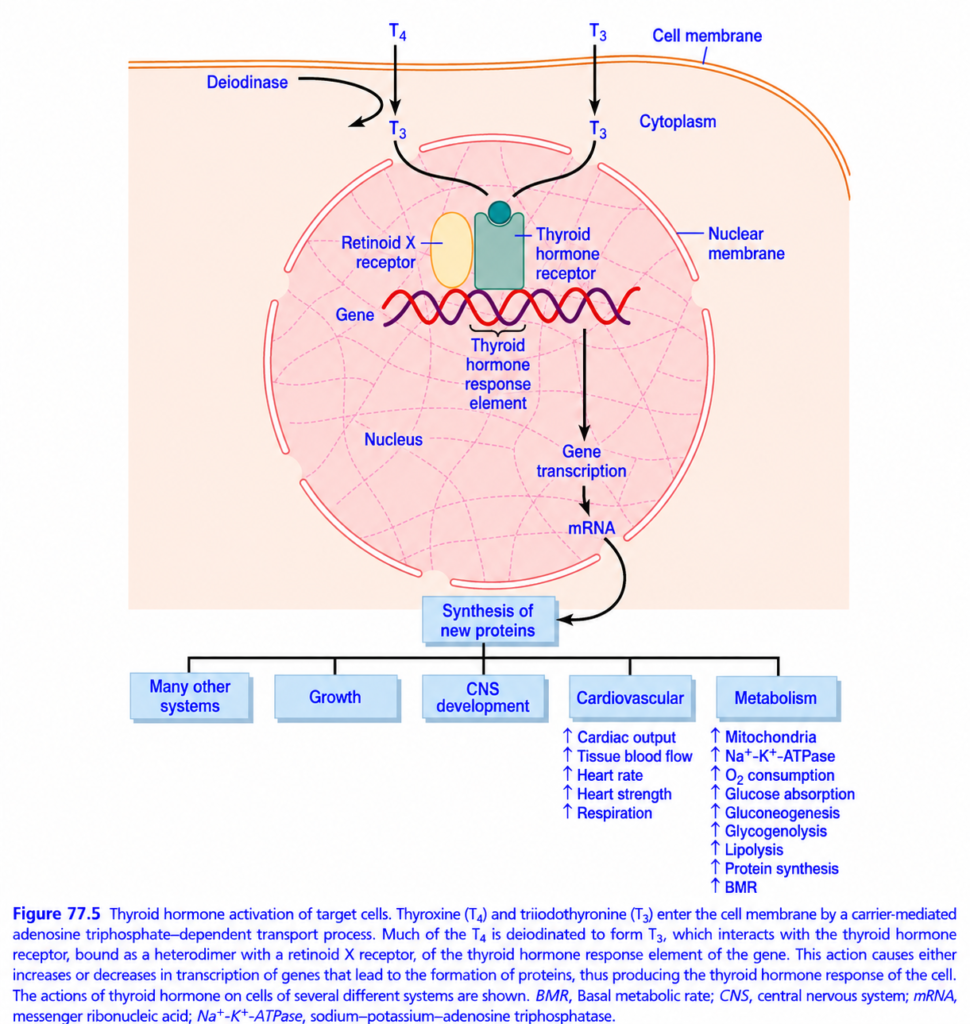
This figure is the “WHAT THYROID HORMONES DO INSIDE THE TARGET CELL” figure.
The previous figure explained how T₃/T₄ are made.
This one explains how T₃/T₄ produce their effects.
🧠 BIG IDEA — 10 SECONDS
T₄/T₃ → enter cell → T₄ becomes T₃ → T₃ enters nucleus → binds thyroid receptor → DNA → mRNA → new proteins → body effects
Think:
T₃ is the main “ON switch” for thyroid-hormone gene activity.
🚪 1. T₄ AND T₃ ENTER THE CELL
At the top:
T₄ + T₃
⬇️
cross the cell membrane
The figure says this occurs through a:
carrier-mediated transport system
So don’t imagine them simply floating through the membrane randomly.
🔄 2. T₄ → T₃
This is VERY important.
Inside many cells:
T₄
⬇️ deiodinase
T₃
Think:
T₄ = mostly the circulating/storage form
T₃ = more active form
So:
Deiodinase = converts T₄ → T₃
Some T₄ can also remain T₄.
⭐ HIGH-YIELD
T₄ enters → gets converted to T₃ → T₃ does most of the receptor activation
This is one of the key concepts in the whole figure.
🧠 3. T₃ GOES TO THE NUCLEUS
T₃ travels into the:
Nucleus
Why?
Because the thyroid hormone receptor is associated with DNA inside the nucleus.
🧲 4. T₃ BINDS THYROID HORMONE RECEPTOR
Inside the nucleus:
T₃ + thyroid hormone receptor
The receptor is already associated with DNA through a:
Thyroid hormone response element
Think:
DNA has a special “thyroid hormone switch.”
T₃ activates that switch.🤝 5. THYROID RECEPTOR + RETINOID X RECEPTOR
Look at the two receptors:
Thyroid hormone receptor
and
Retinoid X receptor (RXR)
They form a pair (heterodimer) that binds the DNA response element.
For exam purposes:
TR + RXR → binds thyroid hormone response element
Then T₃ binding changes the receptor complex so that gene transcription is regulated.
🧬 6. GENE TRANSCRIPTION
Once the receptor is activated:
Target gene
⬇️
Gene transcription
⬇️
mRNA
Meaning:
The DNA instruction is copied into an mRNA message.
🏭 7. mRNA → NEW PROTEINS
mRNA leaves the nucleus.
⬇️
Protein synthesis
⬇️
New proteins
And these proteins actually create the cell’s physiological effects.
This is why thyroid hormone effects are generally slower to develop but longer-lasting than many membrane-receptor hormone effects.
🎯 8. WHAT DO THESE NEW PROTEINS DO?
The bottom of the figure gives the major effects.
🫀 CARDIOVASCULAR SYSTEM
Thyroid hormone causes:
⬆️ Cardiac output
⬆️ Tissue blood flow
⬆️ Heart rate
⬆️ Heart strength
⬆️ Respiration
Easy idea:
Thyroid hormone makes the cardiovascular system more active.
🔥 9. METABOLISM
This is one of the most important sections.
Thyroid hormone increases:
⬆️ Mitochondria
More cellular energy machinery.
⬆️ Na⁺-K⁺ ATPase
More ion pumping.
⬆️ O₂ consumption
Cells use more oxygen.
⬆️ Glucose absorption
More glucose handling.
⬆️ Gluconeogenesis
Make new glucose.
⬆️ Glycogenolysis
Break glycogen into glucose.
⬆️ Lipolysis
Break down fat.
⬆️ Protein synthesis
Build proteins.
⬆️ BMR
Basal metabolic rate.
🔥 THE BIG METABOLIC IDEA
Don’t memorize the list as 10 unrelated things.
Think:
Thyroid hormone turns up the cell’s metabolic machinery.
Therefore:
↑ Energy production/use
↑ Oxygen consumption
↑ Heat production
↑ BMR
🧠 10. CNS DEVELOPMENT
Thyroid hormones are important for:
Central nervous system development
Especially during development.
So:
Thyroid hormone → normal brain/CNS development
🦴 11. GROWTH
Thyroid hormone supports:
Normal growth
It works together with other growth-related hormones.
So remember:
GH/IGF-1 provide major growth stimulation, but thyroid hormone is essential for normal growth and development.
🧩 “MANY OTHER SYSTEMS”
The figure also shows:
Many other systems
Why?
Because thyroid hormone receptors are present in many tissues.
Therefore thyroid hormones have widespread effects throughout the body.
🔗 NOW CONNECT THE WHOLE FIGURE
Step 1
T₄/T₃ enter cell
⬇️
Step 2
T₄ → T₃ by deiodinase
⬇️
Step 3
T₃ enters nucleus
⬇️
Step 4
T₃ binds thyroid hormone receptor
⬇️
Step 5
TR/RXR interacts with DNA response element
⬇️
Step 6
Gene transcription
⬇️
Step 7
mRNA
⬇️
Step 8
New protein synthesis
⬇️
Physiological effects
🧠 STORY
Imagine the cell is a factory.
T₄ = inactive-ish delivery package 📦
Deiodinase = activation machine 🔧
T₃ = active instruction 🟢
Nuclear receptor = switch 🎛️
DNA = factory instruction manual 📖
mRNA = copied instruction 📄
Protein = newly built machine ⚙️
Physiological effect = factory works faster 🚀
🚨 EXAM TRAPS
❌ T₄ is the main active intracellular hormone
✅ T₃ is generally more active.
❌ T₄ cannot become T₃
✅ Deiodinase converts T₄ → T₃.
❌ Thyroid hormone acts mainly through a membrane receptor
✅ Its major effects are through nuclear receptors regulating gene transcription.
❌ T₃ directly makes protein
✅ T₃ → gene transcription → mRNA → protein synthesis.
❌ Thyroid hormone immediately changes cell function
✅ Many major effects require new protein synthesis, so they develop relatively slowly.
🏆 THE 5 THINGS TO MEMORIZE
1. T₄ → T₃
Deiodinase
2. T₃ → nuclear receptor
3. Receptor → DNA response element
4. DNA → mRNA → protein
5. Proteins → growth + CNS development + cardiovascular + metabolism
🔥 ONE-LINE MASTER MEMORY
T₄ enters → T₃ activates → nuclear receptor → DNA → mRNA → protein → metabolism & growth
And the ultimate concept:
Thyroid hormone doesn’t simply “push” the cell directly—it changes which genes are expressed, causing the cell to manufacture new proteins that produce the long-term physiological effects.
THYROID HORMONES INCREASE CELLULAR METABOLIC ACTIVITY
- Thyroid hormones increase metabolic activity in almost all body tissues.
- Large amounts can increase the basal metabolic rate (BMR) by 60–100%.
- They greatly accelerate the use of food for energy.
- They increase both protein synthesis and protein breakdown.
- They greatly accelerate growth in young people, stimulate mental activity, and increase activity of many other endocrine glands.
- Thyroxine and triiodothyronine increase the size and number of mitochondria in many cells.
- Mitochondrial membrane area also increases roughly with the increase in whole-body metabolic rate.
- More active mitochondria increase ATP formation, providing energy for cellular functions.
- Thyroid hormone may therefore increase mitochondrial activity, although increased cell activity may also contribute to these mitochondrial changes.
- Thyroid hormone receptors are also found in mitochondria of the heart, skeletal muscle, liver, kidney, and brain.
- Thyroid hormones may also increase transcription of mitochondrial oxidative-phosphorylation genes.
- Thyroid hormones increase Na⁺-K⁺ ATPase activity, increasing Na⁺ and K⁺ transport across cell membranes.
- This uses energy and increases heat production.
- Thyroid hormones also make most cell membranes more leaky to Na⁺, further stimulating the sodium pump and heat production.
EFFECT OF THYROID HORMONES ON GROWTH
- Thyroid hormones have both general and specific effects on growth.
- They are essential for normal growth in children.
- In hypothyroidism, growth is greatly slowed.
- In hyperthyroidism, skeletal growth may occur too rapidly, but bones also mature and epiphyses close early, so final adult height may actually be shortened.
- Thyroid hormones are essential for brain growth and development during fetal life and the first few years after birth.
- Insufficient thyroid hormone during this period greatly retards brain growth and maturation.
- Without thyroid therapy soon after birth, a child without a thyroid gland may remain mentally deficient throughout life.
EFFECTS OF THYROID HORMONES ON SPECIFIC BODY FUNCTIONS
- Thyroid hormones stimulate almost every major aspect of carbohydrate metabolism.
- They increase glucose uptake, glycolysis, gluconeogenesis, gastrointestinal glucose absorption, and insulin secretion.
- These effects largely result from increased production of cellular metabolic enzymes.
- Thyroid hormones also increase almost every aspect of fat metabolism.
- They rapidly mobilize fat from adipose tissue, reducing body fat stores.
- They increase plasma free fatty acids and their oxidation by cells.
- Increased thyroid hormone decreases plasma cholesterol, phospholipids, and triglycerides, even though free fatty acids increase.
- Reduced thyroid secretion does the opposite and can cause excessive fat deposition in the liver.
- Prolonged hypothyroidism can cause marked hypercholesterolemia associated with severe atherosclerosis.
- Thyroid hormone increases cholesterol removal through bile and feces.
- It may do this partly by increasing LDL receptors in liver cells, causing faster removal of LDL from plasma.
- Because thyroid hormones increase many enzymes, they also increase the body’s need for vitamins.
- Excess thyroid hormone can therefore produce a relative vitamin deficiency if vitamin supply does not increase.
- Excess thyroid hormone can increase BMR by 60–100%.
- With no thyroid hormone production, BMR can fall to about 50% of normal (Fig. 77.6).
- Very high thyroid hormone levels are required to produce very high BMR.
- Large increases in thyroid hormone usually decrease body weight, while large decreases usually increase body weight.
- This effect can be partly opposed because thyroid hormone also increases appetite.
- Increased metabolism increases oxygen use and metabolic waste production, causing vasodilation and increased blood flow.
- Skin blood flow especially increases to help remove heat.
- Cardiac output can rise to 60% or more above normal with excess thyroid hormone and fall to about 50% of normal in severe hypothyroidism.
- Thyroid hormone markedly increases heart rate, partly through a direct effect on cardiac excitability.
- A slight excess of thyroid hormone increases heart strength.
- Marked excess can weaken the heart because of prolonged protein catabolism and increased cardiac workload.
- Mean arterial pressure usually remains approximately normal.
- Pulse pressure increases because systolic pressure rises and diastolic pressure falls.
- In hyperthyroidism, systolic pressure may rise 10–15 mm Hg, with a corresponding fall in diastolic pressure.
- Increased metabolism raises oxygen consumption and carbon dioxide production.
- These changes increase the rate and depth of respiration.
- Thyroid hormone increases digestive secretion and gastrointestinal motility.
- Hyperthyroidism may therefore cause diarrhea, whereas thyroid hormone deficiency may cause constipation.
- Thyroid hormone generally increases the rapidity of cerebral activity.
- Hyperthyroidism may cause nervousness, anxiety, extreme worry, and paranoia.
- Lack of thyroid hormone decreases the rapidity of mental processes.
- A slight increase in thyroid hormone makes muscles react more vigorously.
- Excess thyroid hormone weakens muscles because of increased protein breakdown.
- Lack of thyroid hormone makes muscles sluggish, with slow relaxation after contraction.
- A characteristic sign of hyperthyroidism is a fine muscle tremor.
- It occurs at about 10–15 times per second and differs from the coarse tremor of Parkinson disease or shivering.
- It is thought to result from increased reactivity of neuronal synapses controlling muscle tone.
- The tremor helps assess the degree of thyroid hormone effect on the central nervous system.
- Hyperthyroidism often causes tiredness but difficulty sleeping because thyroid hormone both exhausts the body and excites the nervous system.
- Hypothyroidism can cause extreme sleepiness, sometimes 12–14 hours of sleep per day.
- Increased thyroid hormone increases secretion of several other endocrine hormones while also increasing the tissues’ need for those hormones.
- Increased glucose metabolism increases the need for insulin.
- Increased bone-forming activity increases the need for parathyroid hormone.
- Thyroid hormone also increases liver inactivation of adrenal glucocorticoids, which increases ACTH and consequently glucocorticoid secretion.
- Normal thyroid hormone levels are important for normal sexual function.
- In men, deficiency may reduce libido, while marked excess may sometimes cause impotence.
- In women, deficiency may cause menorrhagia, polymenorrhea, irregular periods, or amenorrhea.
- Hyperthyroidism commonly causes oligomenorrhea and occasionally amenorrhea.
- Thyroid hormone effects on the gonads probably result from both direct metabolic effects and feedback effects through anterior pituitary hormones.
KEY CONCEPT
- Thyroid hormone ↑ cellular metabolism → ↑ energy use → ↑ ATP demand → ↑ heat production.
- Mitochondria ↑ activity → ATP ↑.
- Na⁺-K⁺ ATPase ↑ → ion transport ↑ → energy use and heat ↑.
- Growth: essential for normal skeletal and brain development.
- Carbohydrates: ↑ glucose use.
- Fats: ↑ fat mobilization and oxidation.
- Heart: ↑ heart rate and usually ↑ cardiac output.
- GI tract: ↑ motility.
- CNS: ↑ activity.
- Excess: high metabolism, weight loss, tremor, nervousness, diarrhea, and difficulty sleeping.
- Deficiency: low metabolism, slowed growth, sluggish muscles, constipation, and excessive sleepiness.
CONCEPTUAL EXAMPLES
- Thyroid hormone ↑ → mitochondria ↑ → ATP production ↑ → cellular activity ↑.
- Thyroid hormone ↑ → Na⁺-K⁺ ATPase ↑ → energy use ↑ → heat production ↑.
- Hyperthyroidism → metabolism ↑ → blood flow ↑ → cardiac output ↑.
- Hyperthyroidism → GI motility ↑ → diarrhea.
- Hypothyroidism → metabolism ↓ → constipation and sluggishness.
- Childhood thyroid deficiency → impaired growth and brain development.
- Excess thyroid hormone → fat mobilization ↑ → body weight usually ↓.
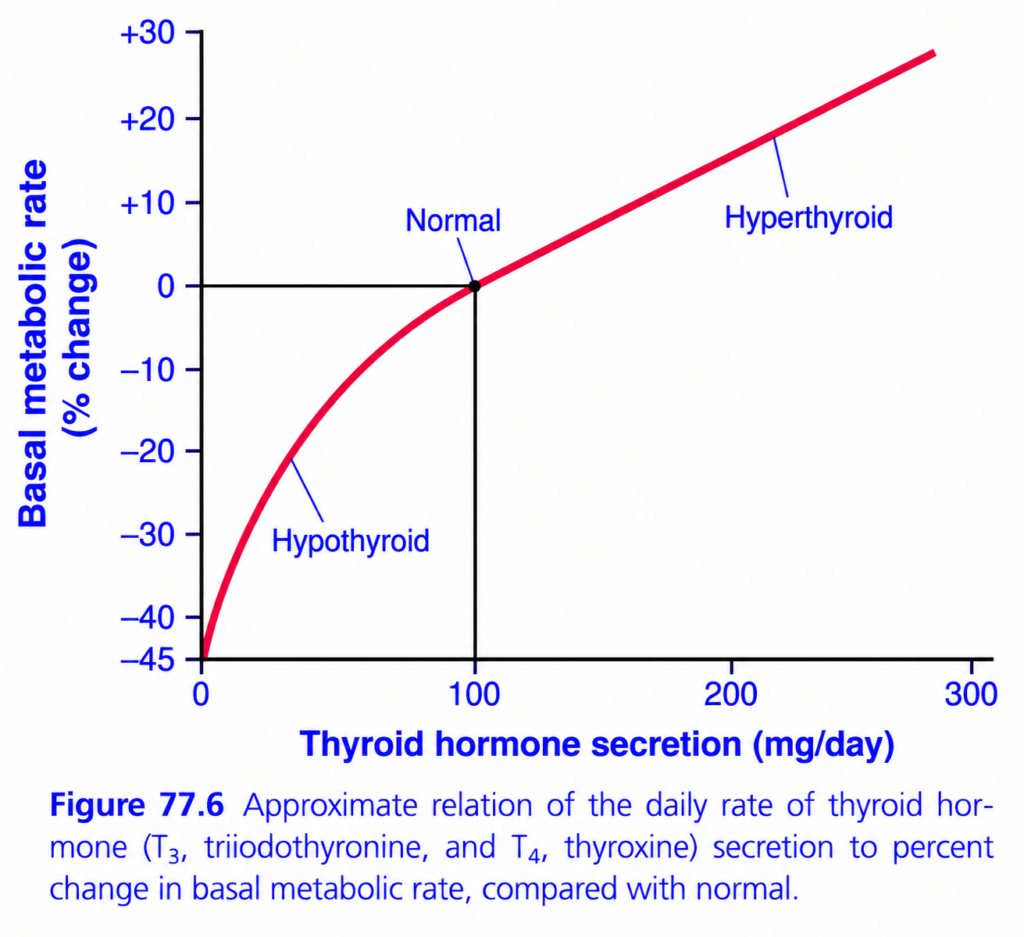
THYROID HORMONE vs BASAL METABOLIC RATE
🎯 BIG IDEA
More thyroid hormone → faster metabolism 🔥
Less thyroid hormone → slower metabolism 🐢
📊 Axes
➡️ X-axis = Thyroid hormone secretion (mg/day)
How much T₃ + T₄ the thyroid releases.
⬆️ Y-axis = Change in basal metabolic rate (%)
How much the body’s basic energy use changes compared with normal.
⚫ NORMAL = the middle point
At about 100 mg/day:
Thyroid hormone = normal
↓
BMR = 0% change
So 0% = normal baseline.
🔵 LEFT SIDE = HYPOTHYROID
Thyroid hormone ↓↓↓
↓
BMR ↓↓↓
Example:
Hormone very low → BMR can fall to about −45%.
🧠 Think:
Not enough thyroid hormone = body slows down 🐢
🔴 RIGHT SIDE = HYPERTHYROID
Thyroid hormone ↑↑↑
↓
BMR ↑↑↑
At very high hormone secretion, BMR can rise to around +25–30%.
🧠 Think:
Too much thyroid hormone = body speeds up 🔥
📈 Why does the curve rise?
The red curve shows a positive relationship:
Hormone ↑ → BMR ↑
But notice the relationship isn’t perfectly straight at very low hormone levels—the response becomes progressively larger as thyroid hormone increases.
⭐ 10-SECOND MEMORY
LOW T3/T4 → LOW BMR → HYPOthyroid 🐢
NORMAL T3/T4 → NORMAL BMR ⚖️
HIGH T3/T4 → HIGH BMR → HYPERthyroid 🔥
🔥 Ultimate concept:
Thyroid hormone is the body’s metabolic “accelerator”: decrease it → metabolism slows; increase it → metabolism speeds up.
