


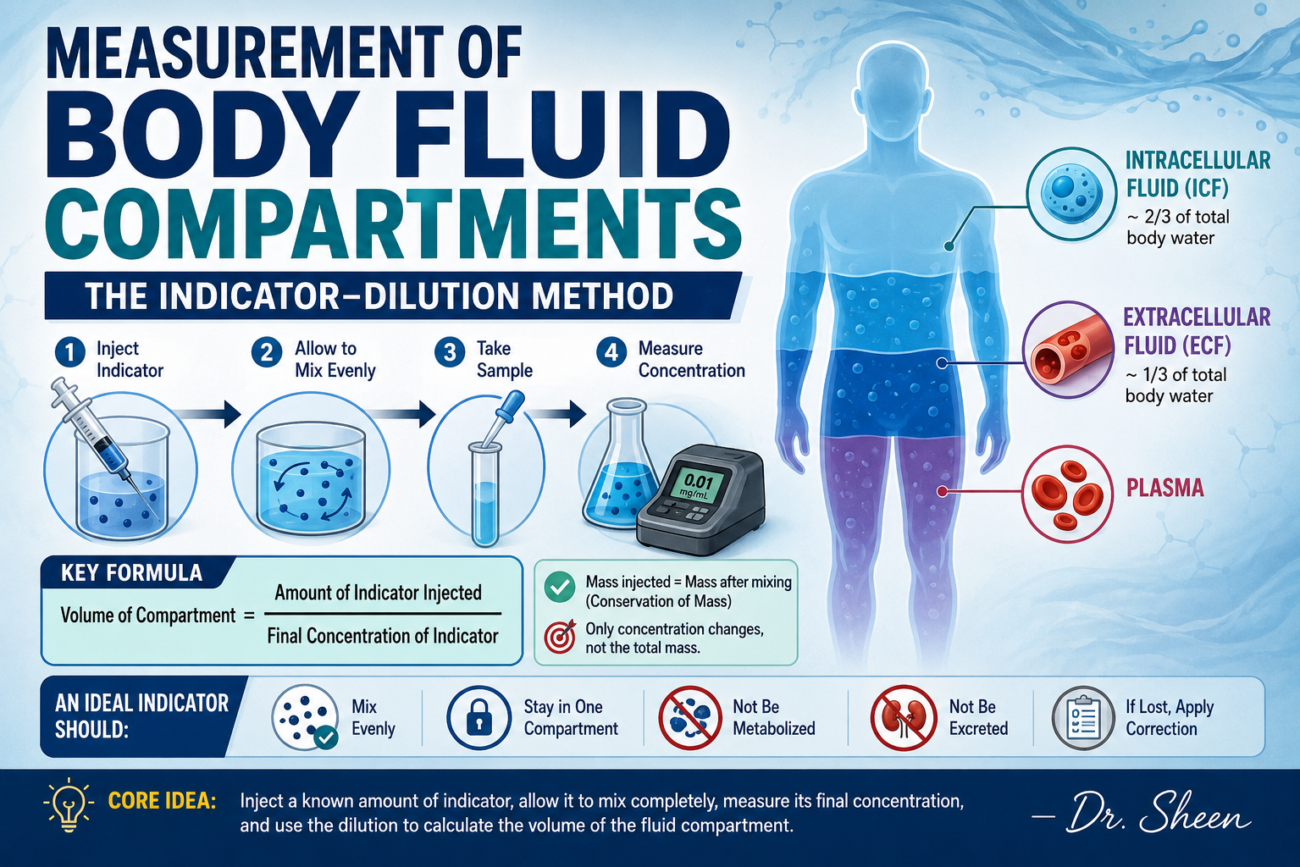
Measurement of Body Fluid Compartments
- The volume of a body fluid compartment can be measured using a special substance called an indicator.
- The indicator is introduced into the fluid compartment.
- The indicator is allowed to mix evenly throughout the fluid.
- After complete mixing, the concentration of the indicator is measured.
- The amount of dilution of the indicator helps determine the volume of the fluid compartment.
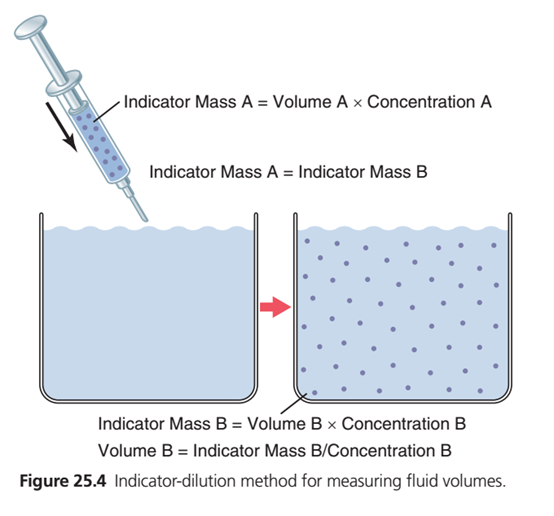
Indicator-Dilution Method
- This method is called the indicator-dilution method.
- It is used to measure the volume of different fluid compartments in the body.
- The method is based on the Conservation of Mass Principle.
Conservation of Mass Principle
- The total amount (mass) of the indicator does not change after it mixes with the fluid.
- The amount of indicator present after dispersion is equal to the amount originally injected.
- The indicator becomes more diluted, but its total mass remains the same.
Key Concept
👉 Mass injected = Mass present after complete mixing.
👉 Only the concentration changes, not the total amount of indicator.
Indicator-Dilution Method Process
- A dye or other indicator substance is injected into a fluid compartment.
- The indicator is allowed to spread and mix evenly throughout the compartment.
- After complete mixing, a sample of fluid is collected.
- The concentration of the indicator in the sample is then measured using laboratory methods.
- If none of the indicator leaves the compartment, the total amount of indicator remains unchanged.
- The total mass of indicator after mixing is equal to the total mass originally injected.
- This principle is used to calculate the unknown volume of the fluid compartment.
Formula

Key Concept
👉 Inject a known amount of indicator.
👉 Allow it to mix completely.
👉 Measure its final concentration.
👉 Use the dilution to calculate the volume of the compartment.
Requirements for Volume Calculation
- To calculate the volume of a fluid compartment, two values must be known.
- The first is the total amount of indicator substance injected into the compartment.
- This value is the numerator of the equation.
- The second is the concentration of the indicator after it has mixed evenly throughout the compartment.
- This value is the denominator of the equation.
Key Concept
👉 Volume of compartment depends on:
- Amount of indicator injected
- Final concentration of the indicator after mixing
Example of the Indicator-Dilution Method
- Suppose 1 mL of dye solution is injected into chamber B.
- The dye solution contains 10 mg of dye per mL.
- The dye is allowed to mix evenly throughout the chamber.
- After mixing, the final dye concentration in the chamber is 0.01 mg/mL.
- Using the indicator-dilution method, the volume of the chamber can be calculated from the amount of dye injected and its final concentration.
Key Concept
👉 A larger volume causes greater dilution of the dye.
👉 By measuring how much the dye is diluted, the unknown volume of the chamber can be determined.

Indicator-Dilution Method: Important Requirements
- This method can be used to measure the volume of almost any fluid compartment in the body.
- The indicator must spread evenly throughout the compartment.
- The indicator must remain only in the compartment being measured.
- The indicator should not be metabolized (broken down) by the body.
- The indicator should not be excreted (removed) from the body.
- If the indicator is metabolized or excreted, the measured value must be corrected for the amount lost.
- Different indicator substances can be used to measure the volumes of different body fluid compartments.
Key Concept
👉 An ideal indicator should:
- Mix evenly
- Stay in one compartment
- Not be metabolized
- Not be excreted
👉 If any indicator is lost from the body, a correction is required to obtain the true fluid volume.
Summary with Dr. Sheen
The volume of body fluid compartments can be measured by using a special substance called an indicator. A known amount of indicator is injected into a fluid compartment and allowed to mix completely with the fluid. After mixing, a sample is taken and the concentration of the indicator is measured. The degree of dilution helps determine the volume of that compartment.
This technique is known as the indicator-dilution method. It is based on the principle of conservation of mass, which states that the total amount of indicator remains the same after mixing. Although the indicator becomes diluted, its total mass does not change. Therefore, by knowing the amount of indicator injected and measuring its final concentration, the volume of the compartment can be calculated.
For example, imagine adding a spoonful of blue dye to a small glass of water. The color becomes dark because the dye is concentrated in a small volume. If the same amount of dye is added to a large bucket of water, the color becomes much lighter because the dye is spread throughout a larger volume. By observing how much the dye is diluted, the volume of water can be estimated.
For accurate measurement, the indicator should mix evenly throughout the compartment, remain only within that compartment, and should not be broken down or removed from the body. If some of the indicator is metabolized or excreted, corrections must be made to obtain the true fluid volume.
In simple terms, the indicator-dilution method works by adding a known amount of indicator, allowing it to distribute evenly, measuring its final concentration, and using the degree of dilution to determine the volume of the fluid compartment.
