


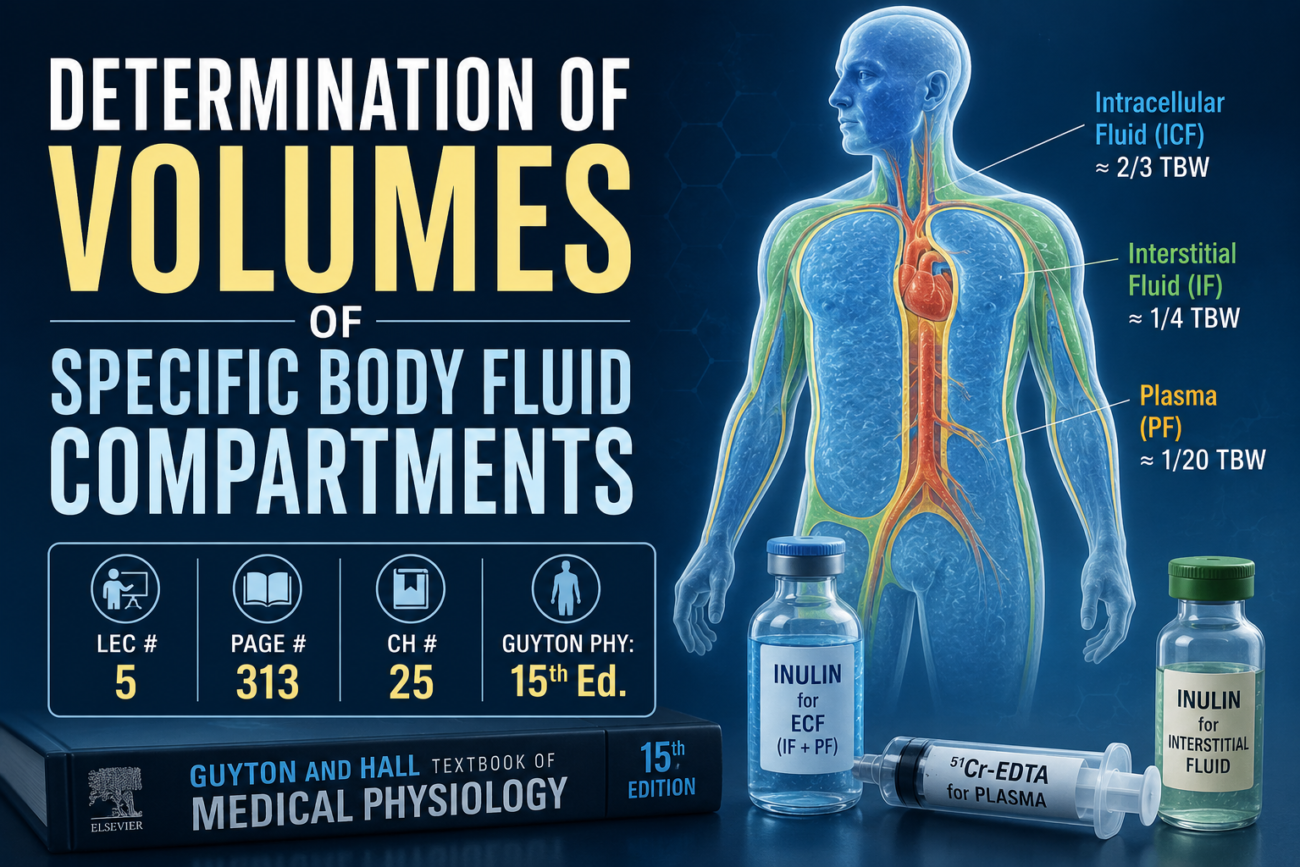
Measurement of Total Body Water
- Radioactive water (tritium, ³H₂O) can be used to measure total body water.
- Heavy water (deuterium, ²H₂O) can also be used to measure total body water.
- After injection into the blood, these forms of water mix with all the water in the body within a few hours.
- The indicator-dilution principle is then used to calculate the total body water volume.
- Another substance used to measure total body water is antipyrine.
- Antipyrine is highly lipid-soluble (fat-soluble).
- Because it is lipid-soluble, it crosses cell membranes very easily.
- Antipyrine spreads uniformly throughout both intracellular and extracellular fluid compartments.
Key Concept
👉 Substances used to measure total body water must be able to distribute throughout all body fluid compartments.
👉 Examples:
- Tritium water (³H₂O)
- Deuterium water (²H₂O)
- Antipyrine
Key Concept Image
🩸 Injection
⬇
🌊 Mixes with ECF
⬇
🧫 Enters Cells (ICF)
⬇
🌍 Distributed Everywhere
⬇
📏 Measure Dilution
⬇
💧 Calculate Total Body Water
Remember
✅ Tritium water (³H₂O) → Measures Total Body Water
✅ Deuterium water (²H₂O) → Measures Total Body Water
✅ Antipyrine → Measures Total Body Water because it enters both ECF and ICF easily.
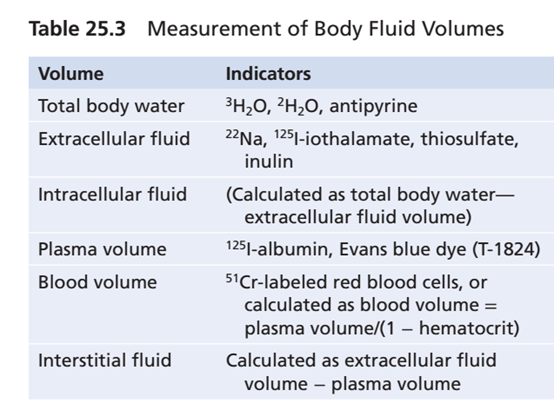
Measurement of Extracellular Fluid (ECF) Volume
- The volume of extracellular fluid (ECF) can be estimated using substances that spread in plasma and interstitial fluid.
- These substances do not easily cross the cell membrane.
- Examples include:
- Radioactive sodium
- Radioactive chloride
- Radioactive iothalamate
- Thiosulfate ion
- Inulin
- After injection into the blood, these substances spread almost completely throughout the extracellular fluid.
- This distribution usually occurs within 30 to 60 minutes.
- Some substances, such as radioactive sodium, may enter cells in small amounts.
- Therefore, the measured volume may not represent the exact extracellular fluid volume.
- For this reason, the measurement is often called “sodium space” or “inulin space” rather than the true extracellular fluid volume.
Key Concept
👉 ECF indicators spread through plasma + interstitial fluid.
👉 They mostly stay outside cells.
👉 Small entry into cells can cause slight measurement errors.
👉 Therefore, terms like sodium space and inulin space are commonly used.
Calculation of Intracellular Volume
The intracellular volume cannot be measured directly. However, it can be calculated as follows:

Measurement of Plasma Volume
- Plasma volume can be measured using substances that do not easily cross capillary membranes.
- These substances remain inside the blood vessels after injection.
- Because they stay within the vascular system, they can be used to measure plasma volume.
- One commonly used substance is serum albumin labeled with radioactive iodine (¹²⁵I-albumin).
- Another commonly used substance is Evans blue dye (T-1824).
- Evans blue dye binds strongly to plasma proteins.
- Because these indicators remain mainly in the plasma, they are useful for measuring plasma volume accurately.
Key Concept
👉 Plasma volume indicators must stay inside blood vessels.
👉 They should not cross capillary membranes easily.
👉 Common indicators:
- ¹²⁵I-albumin
- Evans blue dye (T-1824)
👉 Since they remain in plasma, they can be used to calculate plasma volume.
Calculation of Interstitial Fluid Volume
Interstitial fluid volume cannot be measured directly, but it can be calculated as follows:

Measurement of Blood Volume
Key Concept
👉 Blood is made up of plasma + blood cells.
👉 If you know:
- Plasma volume
- Hematocrit
👉 You can calculate total blood volume using the formula above.
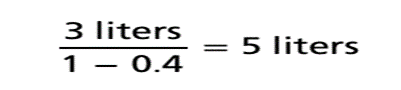
For example, if the plasma volume is 3 liters and hematocrit is 0.40, the total blood volume would be calculated as follows:
Another Method for Measuring Blood Volume
- Another method can be used to measure blood volume.
- This method is rarely used in clinical practice.
- A small sample of the person’s red blood cells (RBCs) is collected.
- These red blood cells are labeled with a radioactive substance.
- The labeled red blood cells are then injected back into the bloodstream.
- After injection, the labeled cells mix evenly throughout the circulation.
- A blood sample is then collected and its radioactivity is measured.
- The indicator-dilution principle is used to calculate the total blood volume.
- One commonly used radioactive label is radioactive chromium (⁵¹Cr).
- Radioactive chromium binds tightly to red blood cells.
Key Concept
👉 Remove a small amount of RBCs.
👉 Label them with ⁵¹Cr.
👉 Inject them back into the blood.
👉 Allow complete mixing.
👉 Measure radioactivity and calculate total blood volume using the indicator-dilution method.
