

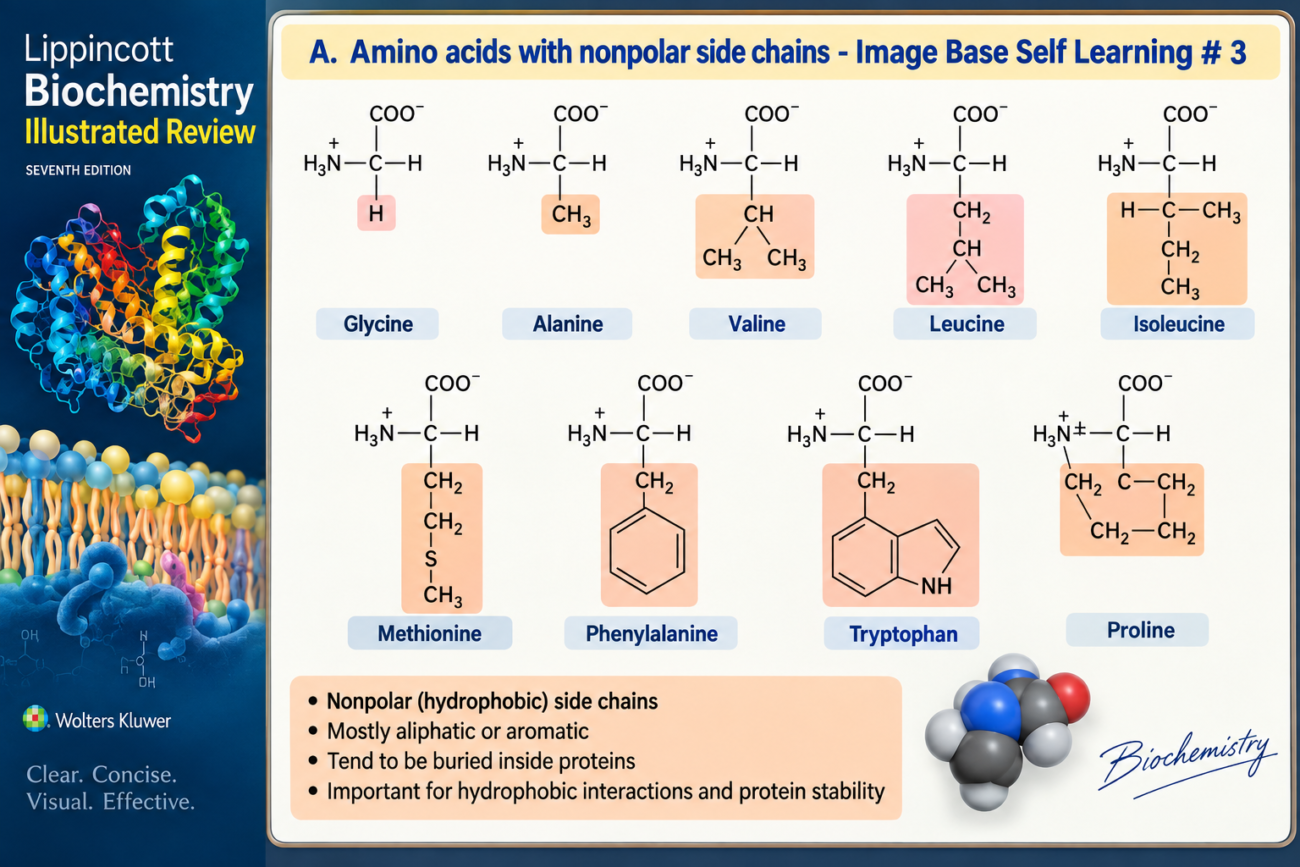
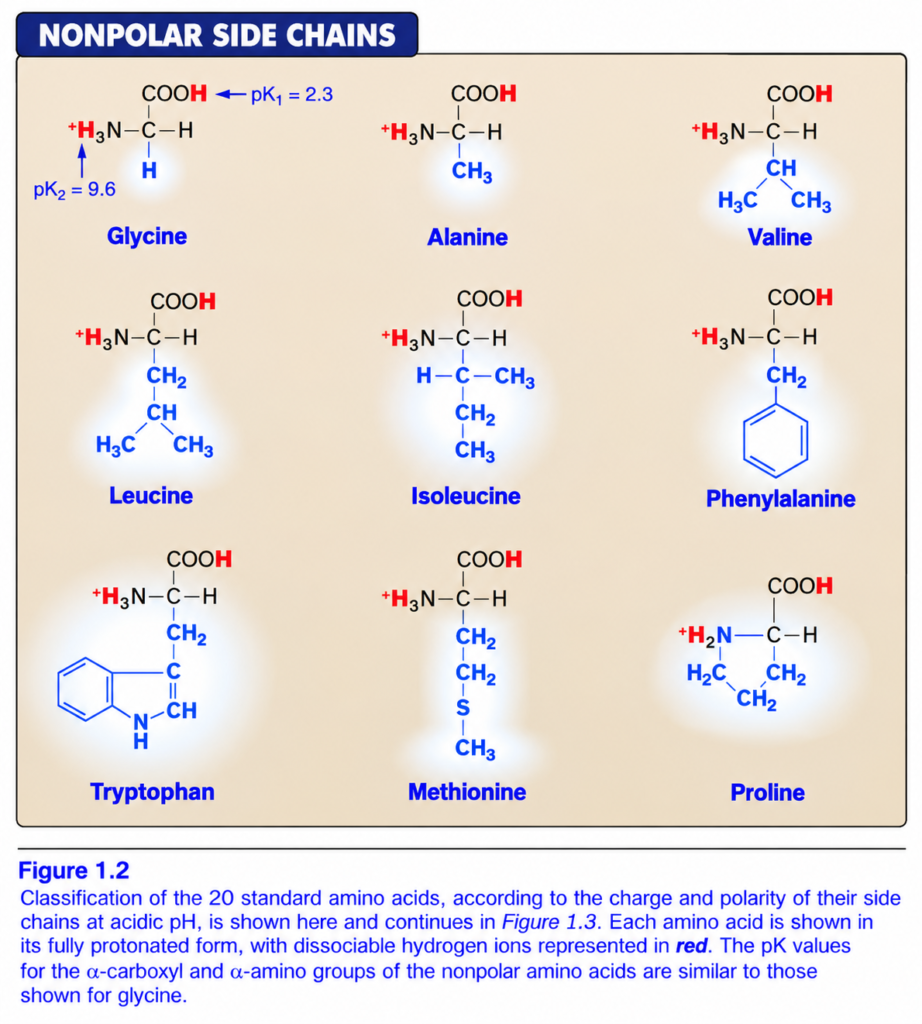
Figure 1.2 — NONPOLAR AMINO ACIDS
🧠 Simplest idea
All amino acids have the same basic backbone, but their blue R side chains are different.
These R groups are mainly nonpolar → they avoid water → they prefer the inside of proteins.
🎨 COLOR GUIDE
- 🔴 Red H = removable/dissociable hydrogen
- 🔵 Blue groups = R side chain
- ⚫ Black = common amino-acid backbone
- 🔵 Names = individual amino acids
⭐ Common backbone
Each amino acid has:
NH₃⁺ — Cα — COOH
and one variable:
🔵 R group
That R group decides the amino acid’s properties.
1️⃣ Glycine — R = H
🔵 Side chain = just H
➡️ Smallest amino acid
➡️ Very flexible
➡️ Only standard amino acid with no chiral α-carbon
pK values shown
- pK₁ ≈ 2.3 = α-carboxyl group loses H⁺
- pK₂ ≈ 9.6 = α-amino group loses H⁺
🧠 Glycine = tiny + flexible
2️⃣ Alanine — R = CH₃
One small methyl group.
➡️ Nonpolar
➡️ Hydrophobic
🧠 Alanine = simple CH₃
3️⃣ Valine
R group branches into:
—CH(CH₃)₂
➡️ Nonpolar
➡️ Branched-chain amino acid (BCAA)
🧠 Valine = V-shaped branch
4️⃣ Leucine
R group:
—CH₂—CH(CH₃)₂
➡️ Nonpolar
➡️ BCAA
➡️ Strongly hydrophobic
5️⃣ Isoleucine
Also branched:
—CH(CH₃)—CH₂—CH₃
➡️ Nonpolar
➡️ BCAA
Easy comparison
Valine + Leucine + Isoleucine = branched-chain amino acids
🧠 BCAA = VIL
Valine
Isoleucine
Leucine
6️⃣ Phenylalanine
🔵 Side chain contains a benzene ring.
➡️ Aromatic
➡️ Strongly hydrophobic/nonpolar
🧠 Phenyl = phenyl ring
7️⃣ Tryptophan
Large aromatic ring system with nitrogen.
➡️ Aromatic
➡️ Mostly nonpolar
➡️ Bulky amino acid
🧠 Tryptophan = biggest aromatic side chain here
8️⃣ Methionine
Side chain contains:
Sulfur (S)
But sulfur is in a thioether, so the side chain is still nonpolar.
➡️ Hydrophobic
➡️ Sulfur-containing amino acid
🧠 Methionine = sulfur but nonpolar
9️⃣ Proline — SPECIAL
Its side chain bends back and attaches to the amino nitrogen, making a ring.
➡️ Very rigid
➡️ Limits rotation of the protein backbone
➡️ Often introduces bends/kinks in proteins
🧠 Proline = protein “kink maker”
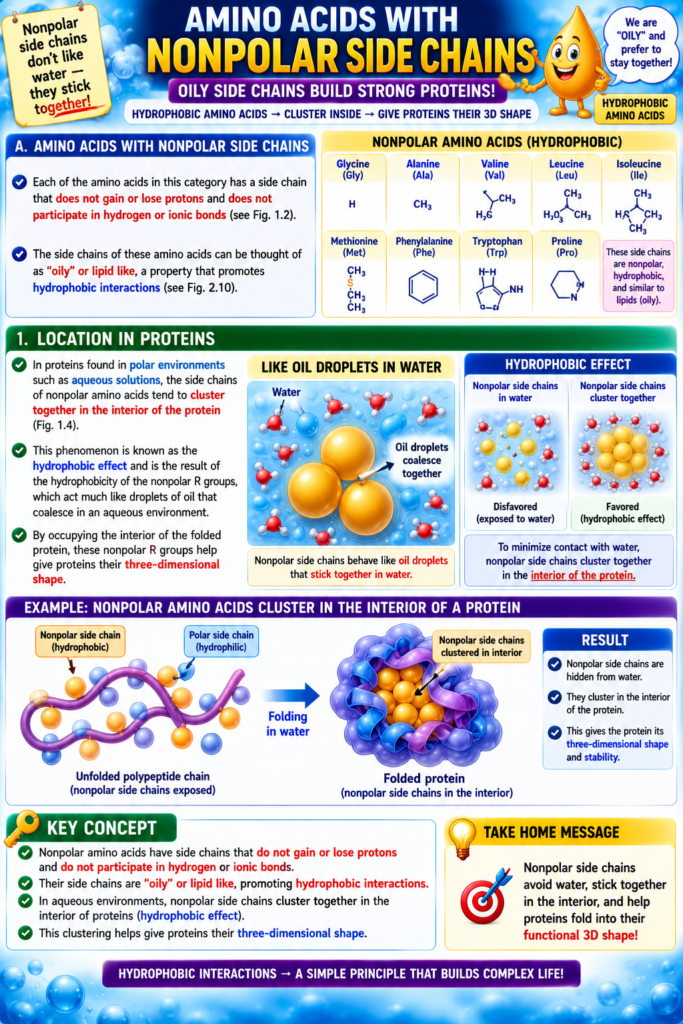
⭐ Why are these called NONPOLAR?
Their side chains generally:
- do not carry charge
- do not interact strongly with water
- prefer hydrophobic environments
So in a soluble protein:
Nonpolar amino acids → usually hide inside the protein
This helps stabilize protein structure through hydrophobic interactions.
🧠 Fastest exam recall
Nonpolar amino acids shown:
Glycine, Alanine, Valine, Leucine, Isoleucine, Phenylalanine, Tryptophan, Methionine, Proline
Special points:
- Glycine = smallest, achiral
- VIL = branched-chain
- Phenylalanine + Tryptophan = aromatic
- Methionine = sulfur-containing
- Proline = rigid ring, causes bends
⭐ One-line memory
Nonpolar R groups avoid water → cluster inside proteins → stabilize protein by hydrophobic interactions.
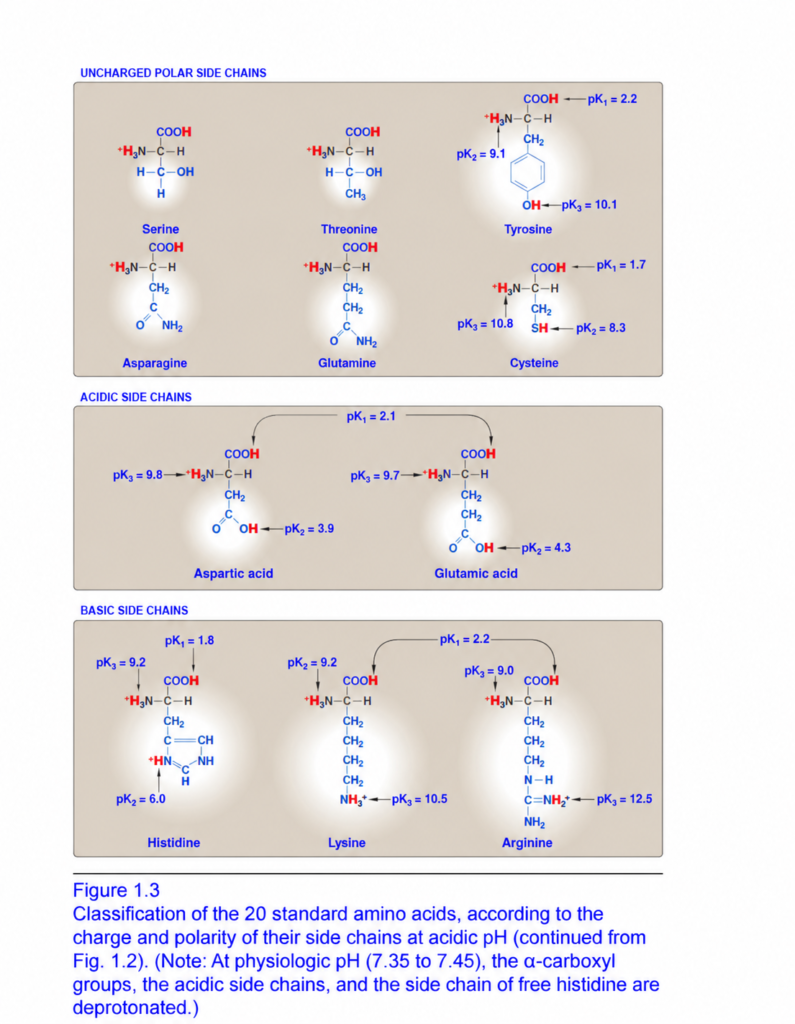
Figure 1.3 — POLAR, ACIDIC & BASIC AMINO ACIDS
🧠 Simplest idea
The R side chain decides whether an amino acid is neutral, negative, or positive.
At physiologic pH (~7.4):
- Uncharged polar → mostly 0 charge on R group
- Acidic → negative (−)
- Basic → usually positive (+), except histidine is mostly neutral
🎨 COLOR GUIDE
- 🔴 Red H = hydrogen that can be lost as H⁺
- 🔵 Blue structures = important side-chain groups
- ⚫ Black = common amino-acid backbone
- Arrows to pK values = show how easily a group gives up H⁺
🧠 pK rule
pH > pKa → H⁺ comes OFF
pH < pKa → H⁺ stays ON
1️⃣ TOP — UNCHARGED POLAR SIDE CHAINS
These side chains interact with water but have no major net charge at physiologic pH.
Serine
🔵 R group = –CH₂–OH
The OH makes it polar.
➡️ Can form hydrogen bonds.
Threonine
R group contains:
–OH + CH₃
➡️ Polar because of OH.
Tyrosine
Contains:
Aromatic ring + –OH
The phenolic OH has:
pKa ≈ 10.1
At pH 7.4:
pH < pKa → OH mostly keeps H
➡️ side chain remains uncharged.
Asparagine
Contains an:
Amide group –CONH₂
➡️ Polar
➡️ Uncharged
Glutamine
Also contains:
–CONH₂
Same concept as asparagine, but with an extra CH₂.
➡️ Polar + uncharged
Memory:
Asparagine & Glutamine = amides
Cysteine
Contains:
–SH = sulfhydryl group
Side-chain pKa ≈ 8.3
At pH 7.4, most cysteine remains:
–SH → uncharged
But it can lose H⁺ to become:
–S⁻
⭐ Two cysteines can form a disulfide bond (S–S).
⭐ Uncharged polar memory
S T C N Q Y
Serine
Threonine
Cysteine
AsparagiNe
Glutamine Q
Yrosine
2️⃣ MIDDLE — ACIDIC SIDE CHAINS
Only two:
Aspartic acid
Side chain:
–COOH
pKa ≈ 3.9
At physiologic pH 7.4:
pH > pKa → loses H⁺
So:
–COOH → –COO⁻
➡️ negative charge
Glutamic acid
Also has side-chain:
–COOH
pKa ≈ 4.3
At physiologic pH:
–COOH → –COO⁻
➡️ negative
🧠 Memory:
Acid gives H⁺ away → becomes negative
⭐ Acidic amino acids:
Aspartate (D) + Glutamate (E)
D, E = negatively chargedBOTTOM — BASIC SIDE CHAINS
These contain nitrogen that can accept H⁺.
Histidine
Contains an imidazole ring.
Side-chain pKa ≈ 6.0
At pH 7.4:
pH > pKa
→ much of the side chain has lost H⁺
→ histidine is mostly neutral, but a useful fraction can accept/donate H⁺.
⭐ This makes histidine excellent for enzyme active sites and buffering.
Memory:
Histidine = easy H⁺ exchanger
Lysine
Long side chain ends in:
–NH₃⁺
Side-chain pKa ≈ 10.5
At pH 7.4:
pH < pKa → keeps H⁺
➡️ strongly positive (+)
Arginine
Contains a guanidinium group.
Side-chain pKa ≈ 12.5
At physiologic pH:
➡️ strongly protonated
➡️ strongly positive (+)
Memory:
Arginine holds H⁺ very tightly
⭐ BASIC AMINO ACID MEMORY
H-K-R
Histidine
K = Lysine
R = Arginine
At physiologic pH:
- Lysine → +
- Arginine → +
- Histidine → mostly neutral, but can easily gain/lose H⁺
🔥 Most important physiological-pH concept
At about pH 7.4:
Common backbone
α-COOH → COO⁻
α-NH₂ → NH₃⁺
Side chains
Asp/Glu → COO⁻ → negative
Lys/Arg → protonated → positive
His → mostly unprotonated
🧠 Whole figure in 3 lines
Polar uncharged: Ser, Thr, Tyr, Cys, Asn, Gln → interact with water.
Acidic: Asp, Glu → lose H⁺ → negative.
Basic: His, Lys, Arg → accept H⁺; Lys/Arg are positive at physiologic pH.
⭐ Fastest exam recall
Acidic = D, E = negative
Basic = H, K, R = positive/basic
Polar uncharged = STCNQY
STCNQY is a short memory code for the 6 polar, uncharged amino acids:
- S = Serine
- T = Threonine
- C = Cysteine
- N = Asparagine
- Q = Glutamine
- Y = Tyrosine
These letters are their standard one-letter amino-acid codes. That is why N = Asparagine, Q = Glutamine, and Y = Tyrosine, even though their names do not start with those letters.
🧠 Easy grouping
OH group: Serine, Threonine, Tyrosine
Amide group: Asparagine, Glutamine
SH group: Cysteine
So remember:
STCNQY = Polar + Uncharged at physiologic pH.
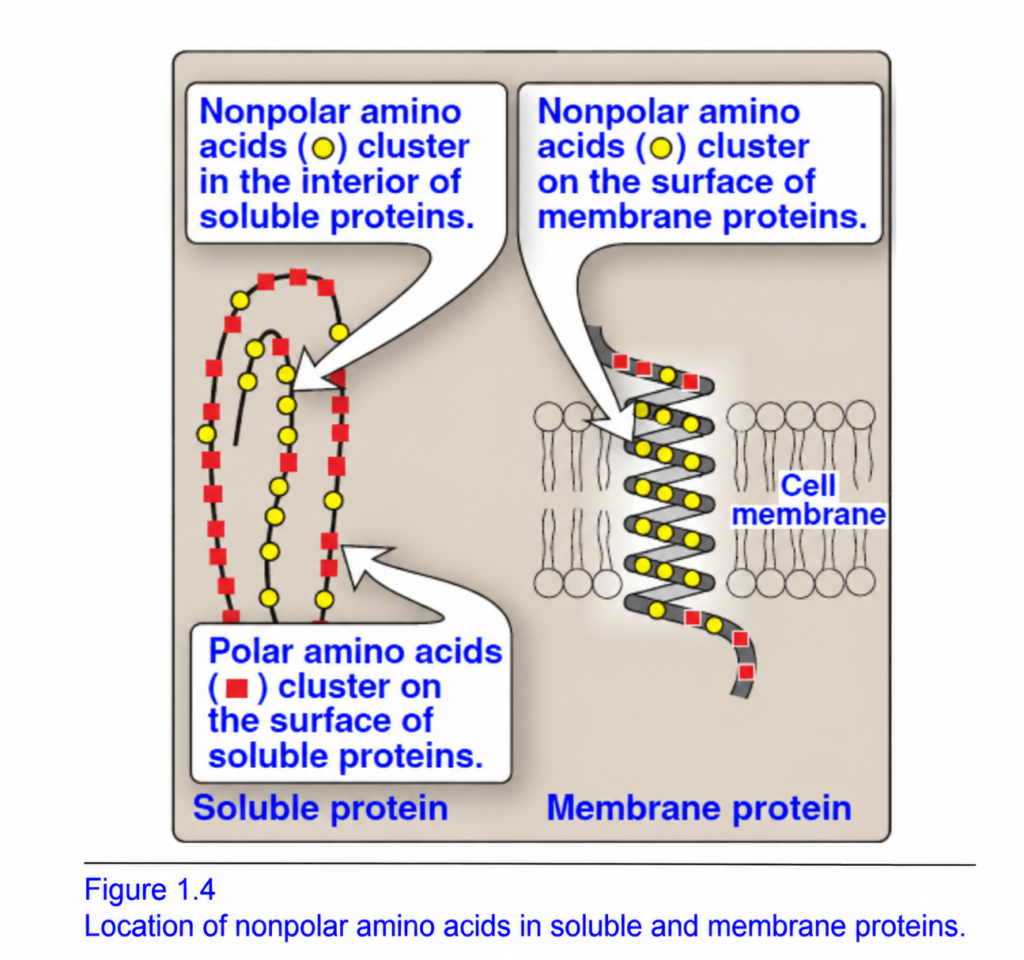
Figure 1.4 — Location of Nonpolar Amino Acids in Proteins
🧠 Simplest idea
Nonpolar amino acids avoid water.
So their location depends on where the protein is:
Soluble protein → nonpolar amino acids hide inside
Membrane protein → nonpolar amino acids face outward toward membrane lipids
🎨 COLOR KEY
- 🟡 Yellow circles = nonpolar amino acids
- 🟥 Red squares = polar amino acids
- ⚫ Black/gray chain = protein backbone
- ⚪ Cell membrane = lipid bilayer
1️⃣ LEFT — SOLUBLE PROTEIN
A soluble protein is surrounded by water.
🟡 Nonpolar amino acids
Nonpolar side chains do not like water.
So they:
move away from water → cluster inside the protein
🟥 Polar amino acids
Polar side chains interact well with water.
So they:
face outward → stay on the protein surface
Easy rule:
Water outside
→ polar outside
→ nonpolar inside
🧠 Memory:
Soluble protein = “nonpolar hides.”
2️⃣ RIGHT — MEMBRANE PROTEIN
The middle of the cell membrane contains fatty, hydrophobic lipid tails.
So the situation reverses.
🟡 Nonpolar amino acids
They like the hydrophobic membrane environment.
Therefore:
nonpolar amino acids face outward toward lipid tails
This helps hold the membrane protein inside the membrane.
🟥 Polar amino acids
Where the protein sticks out into watery fluid, polar amino acids can be exposed.
So:
polar residues prefer water-exposed regions⭐ Why the difference?
Soluble protein
Outside environment = water
So:
Nonpolar → inside
Polar → outside
Membrane protein
Outside of the membrane-spanning region = hydrophobic lipid
So:
Nonpolar → surface facing lipids
🧠 Whole figure in one line
Nonpolar amino acids always try to stay away from water:
Soluble protein → hide in the core
Membrane protein → face membrane lipids
🎯 Fastest exam recall
Soluble proteins:
🟡 Nonpolar inside
🟥 Polar outside
Membrane proteins:
🟡 Nonpolar outside toward lipid bilayer
⭐ Memory trick
“Nonpolar follows fat, avoids water.”
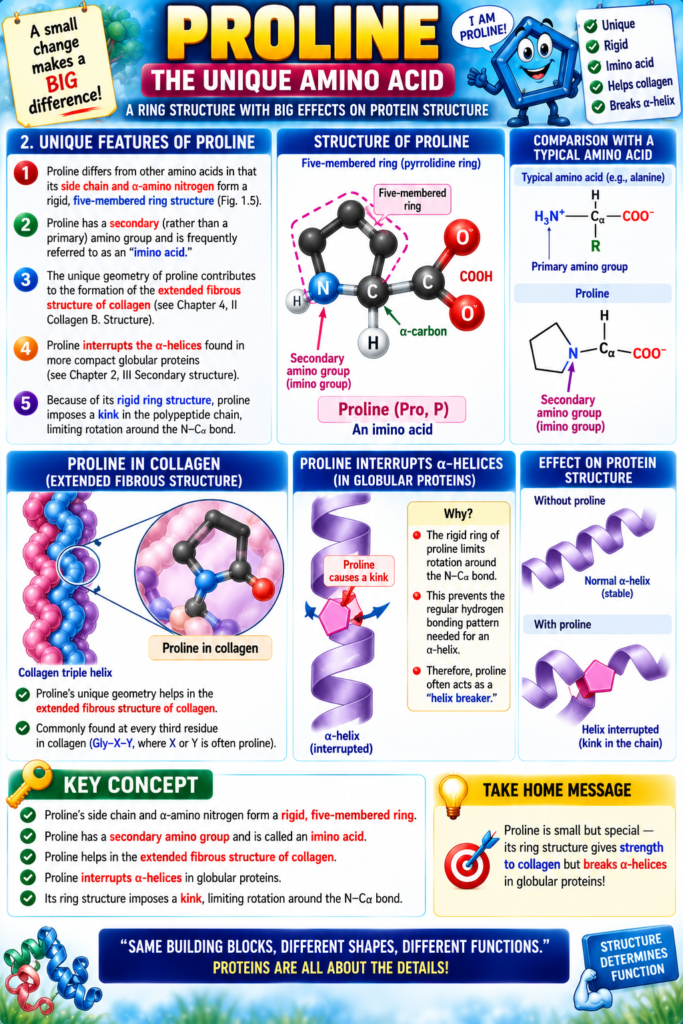
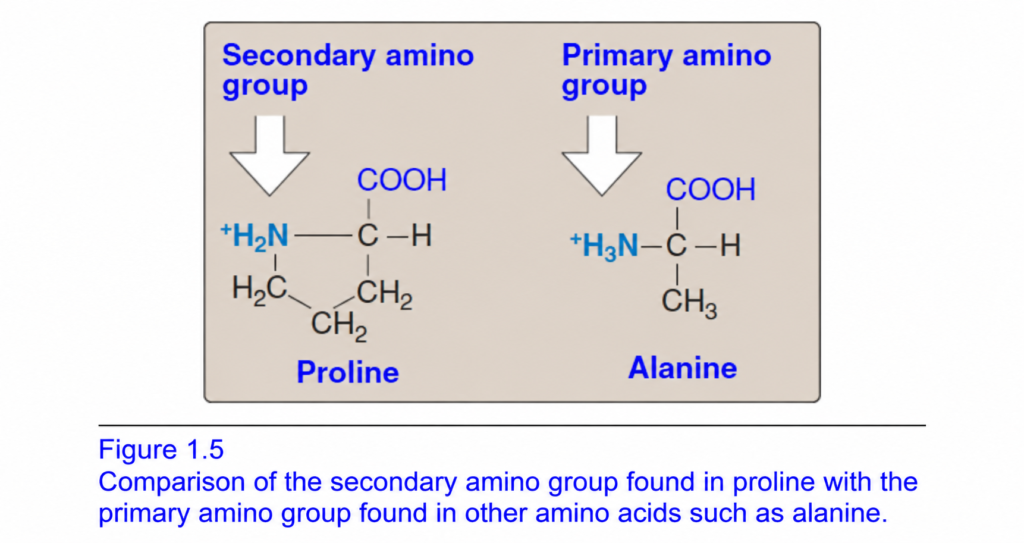
Figure 1.5 — Why Proline Is Different
🧠 Simplest idea
Most amino acids have a primary amino group, but proline has a secondary amino group because its side chain loops back and attaches to the amino nitrogen.
1️⃣ LEFT — PROLINE
The side chain of proline contains:
–CH₂–CH₂–CH₂–
and this chain bends back and attaches to the amino nitrogen.
➡️ This creates a 5-membered ring.
🔵 +H₂N = secondary amino group
Why “secondary”?
The nitrogen is attached to two carbon atoms:
- the α-carbon
- a carbon from the R side chain
So proline’s nitrogen is locked into the ring.
Result:
Ring structure → less freedom of rotation → proline is rigid
🧠 Memory:
Proline = Ring = Rigid
2️⃣ RIGHT — ALANINE
Alanine represents the usual amino-acid pattern.
Its amino nitrogen is attached directly to only one carbon, the α-carbon.
🔵 +H₃N = primary amino group
Its R group is simply:
–CH₃
There is no ring connecting back to nitrogen.
➡️ Therefore alanine is much more flexible than proline.
⭐ Main comparison
| Proline | Alanine |
|---|---|
| Secondary amino group | Primary amino group |
| Nitrogen attached to 2 carbons | Nitrogen attached to 1 carbon |
| Forms a 5-membered ring | No ring |
| Rigid | More flexible |
🔥 Why is this important in proteins?
Because proline is rigid:
Proline in a polypeptide chain
→ restricts backbone movement
→ often produces a bend/kink
Therefore proline can:
- interrupt α-helices
- help create turns
- contribute to the unusual structure of collagen
🧠 Fastest exam recall
Proline side chain returns to its amino nitrogen → 5-membered ring → secondary amino group → rigid amino acid.
⭐ One-line memory
Proline = secondary amino group + ring + rigidity + helix breaker.
