
- GH receptor (GHR) activation causes the liver, and to a much lesser extent other tissues, to produce insulin-like growth factors (IGFs), also called somatomedins.
- IGFs mediate many of the growth and metabolic effects of GH (Fig. 76.6).
- At least 4 IGFs have been identified, but the most important is IGF-1 (somatomedin C).
- IGF-1 has a molecular weight of about 7500, and its plasma concentration closely follows GH secretion.
- Children with IGF deficiency may fail to grow normally even when GH secretion is normal or high.
- The pygmy peoples of Africa have very small stature because they have a congenital inability to produce significant amounts of IGF-1.
- Their GH may be normal or high, but their IGF-1 is low, which contributes to their small stature.
- GH receptor insensitivity or mutations, such as Laron syndrome, also cause short stature because GH cannot effectively stimulate IGF-1 formation, even when GH levels are high.
- Most growth effects of GH are produced through IGF-1 and other IGFs, rather than directly by GH on bones and peripheral tissues.
- However, GH can also directly stimulate growth, because injecting GH into the epiphyseal cartilage of animals causes cartilage growth.
- One possible explanation is that GH produces enough local IGF-1 in the tissue to cause local growth.
- GH also has some IGF-independent effects, including stimulation of growth in certain tissues such as cartilage chondrocytes.
- GH has a short action in blood, while IGF-1 has a prolonged action.
- GH binds only weakly to plasma proteins, so it quickly leaves the blood and enters tissues, giving it a blood half-time of less than 20 minutes.
- IGF-1 binds strongly to carrier proteins, with about 98% of IGF-1 bound in the blood.
- GH also stimulates production of these IGF carrier proteins.
- Therefore, IGF-1 leaves the blood slowly and has a half-time of about 20 hours.
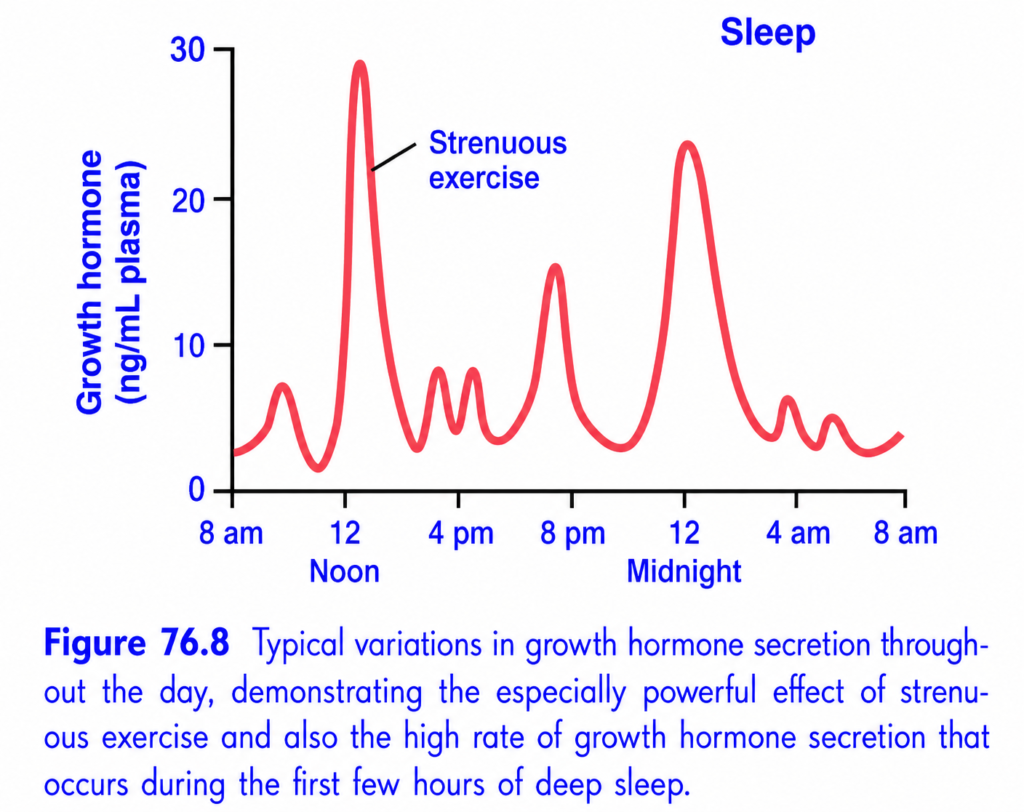
- This slow release prolongs the growth-promoting effects of short bursts of GH secretion (Fig. 76.8).
KEY CONCEPT
GH → GHR → mainly liver → IGF-1 → prolonged growth effects.
GH = short-lived (<20 min) | IGF-1 = long-lived (~20 h)
CONCEPTUAL EXAMPLES
- High GH + low IGF-1 → poor growth.
- Laron syndrome → GH receptor cannot respond properly → ↓ IGF-1 → short stature.
- GH burst → IGF-1 remains longer → prolonged growth effect.
Growth Hormone Secretion During the Day
🎯 BIG IDEA
Growth hormone (GH) is NOT released steadily all day.
It comes out in pulses — like little bursts. 💥
Most of the time → low GH
Certain situations → sudden GH spikes
📊 Understand the axes
➡️ X-axis = Time of day
From:
8 AM → Noon → 4 PM → 8 PM → Midnight → 4 AM → 8 AM
So we are watching GH throughout 24 hours.
⬆️ Y-axis = Growth hormone concentration in plasma
Measured in ng/mL.
Higher on the graph = more GH in blood.
🔴 What does the red line mean?
The red line shows the actual GH level changing throughout the day.
Notice it goes:
⬆️ spike → ⬇️ fall → ⬆️ spike → ⬇️ fall
This means:
GH secretion is pulsatile.
It is not continuously high.🏃 BIGGEST SPIKE = STRENUOUS EXERCISE
Around noon, the person performs strenuous exercise.
GH suddenly shoots up to almost:
30 ng/mL
🔥 This is a very powerful stimulus for GH release.
Think:
Hard exercise → GH 🚀
😴 BIG NIGHT SPIKE = DEEP SLEEP
Around midnight, the person enters deep sleep.
GH rises dramatically to about:
23–24 ng/mL
This is another major GH pulse.
⭐ Especially important:
The first few hours of deep sleep produce a large GH secretion.
Think:
🔵 What about the small spikes?
There are several smaller peaks during the day and night.
These represent normal pulsatile GH secretion.
So GH is basically:
Low → pulse → low → pulse → low → BIG pulse → low
🧠 WHY DOES GH COME IN PULSES?
The hypothalamus controls GH release using two opposing signals:
GHRH → stimulates GH ↑
Somatostatin → inhibits GH ↓
Their changing activity creates pulses rather than constant secretion.
🔥 MOST IMPORTANT CONCEPT
Two powerful GH stimulators shown here:
🏃 Strenuous exercise → large GH spike
😴 Deep sleep → large GH spike
🧠 10-SECOND MEMORY TRICK
“EXERCISE + SLEEP = GH SPIKES”
Hard exercise 🏃
→ GH ↑↑↑
Deep sleep 😴
→ GH ↑↑↑
Most daytime periods ☀️
→ GH relatively low
⭐ Exam line:
Growth hormone secretion is pulsatile, with particularly large surges after strenuous exercise and during the first few hours of deep sleep.
REGULATION OF GROWTH HORMONE SECRETION
- After adolescence, GH secretion gradually decreases with age and may fall to about 25% of the adolescent level in very old age.
- GH is secreted in a pulsatile pattern, meaning its level repeatedly rises and falls.
- Several factors related to nutrition or stress can increase GH secretion:
- Starvation, especially severe protein deficiency
- Hypoglycemia or low blood fatty acids
- Exercise
- Excitement
- Trauma
- Ghrelin from the stomach before meals
- Some amino acids, including arginine
- Deep sleep, especially during the first 2 hours (Fig. 76.8; Table 76.3)
- Normal plasma GH is about 1.6–3 ng/mL in adults and about 6 ng/mL in children/adolescents.
- During prolonged starvation, GH can rise to about 50 ng/mL after body protein or carbohydrate stores are depleted.
- During acute conditions, hypoglycemia is a much stronger stimulus for GH secretion than a short-term decrease in protein intake.
- During chronic conditions, GH secretion is more closely related to cellular protein depletion than to glucose deficiency.
- Therefore, the very high GH levels during prolonged starvation are closely related to the amount of protein depletion.
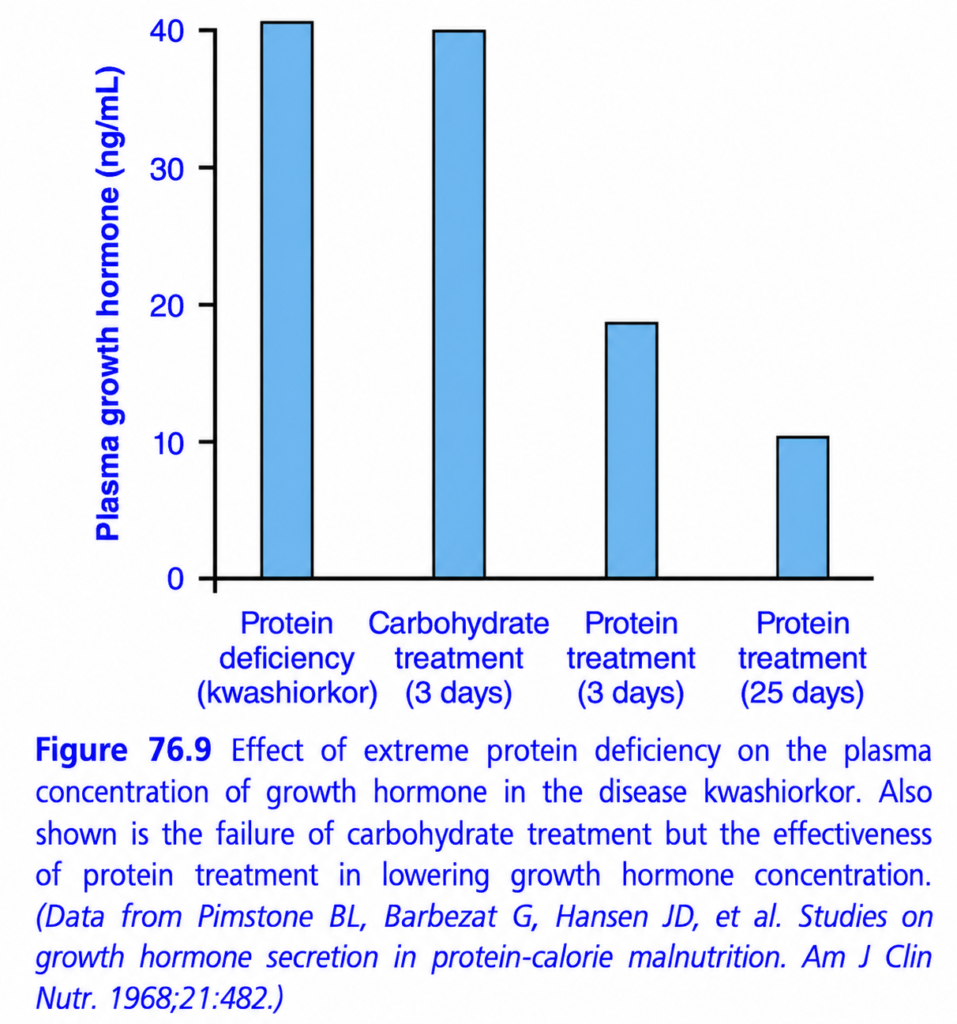
- In children with severe protein deficiency (kwashiorkor), GH levels are very high (Fig. 76.9).
- Giving enough carbohydrates alone for 3 days does not significantly lower the high GH level.
- Adding protein supplements for 3 days lowers GH, and continued protein treatment for 25 days lowers it further.
- Therefore, in severe protein malnutrition, adequate calories alone are not enough; the protein deficiency must also be corrected for GH levels to return toward normal.
KEY CONCEPT
GH secretion is pulsatile and increases with starvation, hypoglycemia, exercise, stress, ghrelin, amino acids, and deep sleep; severe chronic protein deficiency strongly increases GH.
CONCEPTUAL EXAMPLES
- Deep sleep → ↑ GH
- Hypoglycemia → strong ↑ GH
- Prolonged protein depletion → very high GH
- Carbohydrates alone → GH remains high
- Protein supplementation → ↓ GH toward normal
Hypothalamic Growth Hormone–Releasing Hormone Stimulates, and Somatostatin Inhibits Growth Hormone Secretion
- GHRH and somatostatin are the two major hypothalamic factors controlling GH secretion.
- GHRH stimulates GH, while somatostatin inhibits GH.
- Both are polypeptides: GHRH has 44 amino acids, while somatostatin has 14 amino acids.
- Hypothalamic neurons release these hormones, which travel through the hypothalamic-hypophysial portal vessels to the anterior pituitary, where they control GH release (Fig. 76.6).
- GHRH is secreted mainly by neurons in the arcuate and ventromedial nuclei of the hypothalamus.
- Somatostatin secretion is controlled by nearby periventricular neurons.
- These hypothalamic areas also respond to blood glucose, so signals related to hunger and satiety can also influence GH secretion.
- Emotions, stress, and trauma can affect hypothalamic control of GH.
- Catecholamines, dopamine, and serotonin can each increase GH secretion.
- Most GH control is probably through GHRH rather than somatostatin.
- GHRH binds to receptors on GH-producing cells in the anterior pituitary and activates the adenylyl cyclase system.
- This increases intracellular cAMP.
- Increased cAMP produces two main effects:
- Short-term: ↑ calcium entry → secretory vesicles fuse with the cell membrane → GH is released within minutes.
- Long-term: ↑ gene transcription in the nucleus → new GH synthesis.
- When GH is given directly into the blood for several hours, the body’s own GH secretion decreases.
- This shows negative feedback control of GH secretion.
- The major long-term controller of GH secretion is probably the nutritional state of the tissues, especially their protein nutrition.
- Nutritional deficiency or increased need for cellular protein, such as after severe exercise, can increase GH secretion.
- GH then promotes new protein synthesis while conserving existing cellular protein.
KEY CONCEPT
GHRH → cAMP → Ca²⁺ entry → rapid GH release + increased GH synthesis.
Somatostatin → inhibits GH secretion.
GH → negative feedback → ↓ GH secretion.
CONCEPTUAL EXAMPLES
- GHRH ↑ → cAMP ↑ → Ca²⁺ entry ↑ → GH release ↑
- Somatostatin ↑ → GH secretion ↓
- GH ↑ in blood → negative feedback → endogenous GH ↓
- Protein deficiency → GH ↑ → protein synthesis ↑ + protein conservation
Abnormalities of Growth Hormone Secretion
Panhypopituitarism—Decreased Secretion of All Anterior Pituitary Hormones
- Panhypopituitarism means decreased secretion of all anterior pituitary hormones.
- It may be congenital, or may develop suddenly or gradually during life, most commonly because a pituitary tumor destroys the gland.
Panhypopituitarism in Adults
- Adult panhypopituitarism usually results from:
- Craniopharyngioma or chromophobe tumor compressing and destroying anterior pituitary cells.
- Thrombosis of pituitary blood vessels, which can sometimes occur after severe circulatory shock following childbirth.
- Major effects include:
- Hypothyroidism
- ↓ glucocorticoid production by the adrenal glands
- ↓ gonadotropic hormones → loss of sexual functions
- The person may become lethargic, gain weight, and lose sexual functions because of reduced thyroid, adrenal, growth, and gonadal hormone effects.
- Except for abnormal sexual function, the condition can usually be treated satisfactorily with adrenocortical and thyroid hormones.
Panhypopituitarism During Childhood and Dwarfism
- Most cases of dwarfism result from generalized deficiency of anterior pituitary hormones during childhood.
- Body parts usually remain proportionate, but overall development occurs much more slowly.
- A 10-year-old may have the physical development of a 4- to 5-year-old, while a 20-year-old may have the development of a 7- to 10-year-old.
- Panhypopituitary dwarfism usually prevents puberty, because gonadotropic hormone secretion is insufficient for adult sexual development.
- In about one-third of people with dwarfism, only GH is deficient, so sexual maturation can occur and reproduction may sometimes occur.
- In Laron syndrome and African pygmies, GH secretion may be normal or high, but GH action is impaired because of GH receptor mutations or inability to form IGF-1.
Treatment With Human Growth Hormone
- GH from different animal species is sufficiently different that it generally does not produce growth in humans.
- Therefore, human growth hormone (hGH) is used for human treatment.
- Previously, hGH had to be obtained from human pituitary glands, making it difficult to obtain enough for treatment.
- Recombinant DNA technology now allows Escherichia coli bacteria to produce hGH in sufficient amounts.
- People with pure GH deficiency can be completely treated if therapy begins early in life.
Gigantism and Excess Growth Hormone Before Adolescence
- Excess activity or tumors of acidophilic GH-producing cells can cause very high GH secretion.
- If excess GH occurs before adolescence, while the epiphyses are still open, the bones and other tissues grow rapidly.
- The person develops gigantism and may reach about 8 feet tall.
- Gigantism commonly causes hyperglycemia, which can overwork and eventually damage pancreatic beta cells.
- About 10% of people with gigantism eventually develop diabetes mellitus.
- If the pituitary tumor remains untreated, it may destroy the gland and eventually cause panhypopituitarism, which can lead to death in early adulthood.
- Once diagnosed, further effects can often be prevented by microsurgical tumor removal or pituitary irradiation.
Acromegaly and Excess Growth Hormone After Adolescence
- If excess GH occurs after adolescence, the epiphyses have already fused, so the person cannot grow taller.
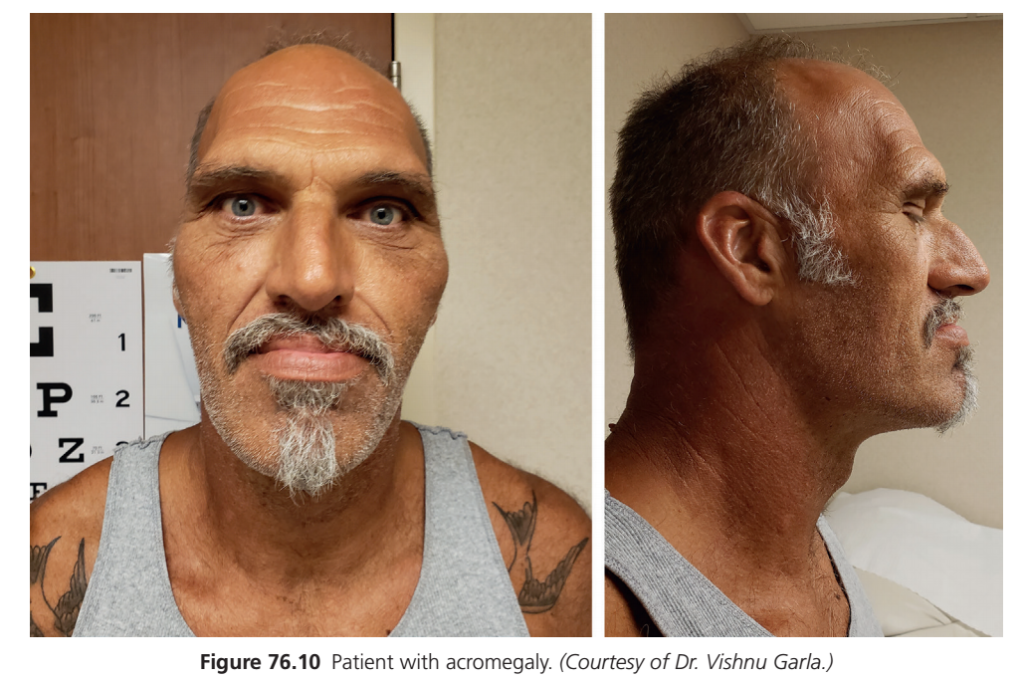
- Instead, bones become thicker and soft tissues continue to grow; this condition is called acromegaly (Fig. 76.10).
- Enlargement is especially marked in the hands, feet, skull, nose, forehead, supraorbital ridges, lower jaw, and vertebrae.
- The lower jaw protrudes, the forehead becomes more prominent, the nose enlarges, the feet may require size 14 or larger shoes, and the fingers become very thick.
- Vertebral changes can produce a hunched back (kyphosis).
- Soft tissues such as the tongue, liver, and especially kidneys can become greatly enlarged.
Possible Role of Decreased Growth Hormone Secretion in Causing Changes Associated With Aging
- Long-term loss of GH may accelerate some features of aging.
- Reduced GH may decrease protein deposition and increase fat deposition in tissues.
- This can contribute to wrinkled skin, reduced organ function, and decreased muscle mass and strength.
- Average plasma GH concentration decreases with age:
| Age | GH |
|---|---|
| 5–20 years | 6 ng/mL |
| 20–40 years | 3 ng/mL |
| 40–70 years | 1.6 ng/mL |
- Therefore, some normal aging changes may be related to decreased GH secretion.
- Some studies of GH therapy in older people found increased body protein, decreased fat deposits, and increased energy.
- However, other studies found undesirable effects, including insulin resistance, diabetes, edema, carpal tunnel syndrome, and joint pain (arthralgias).
- Therefore, recombinant GH therapy is generally not recommended for healthy elderly people with normal endocrine function.
KEY CONCEPT
GH deficiency → ↓ growth and protein deposition.
Excess GH before epiphyseal fusion → gigantism.
Excess GH after epiphyseal fusion → acromegaly.
CONCEPTUAL EXAMPLES
- Child + GH deficiency → slow but proportionate growth → dwarfism.
- Excess GH before adolescence → long bones lengthen → gigantism.
- Excess GH after adolescence → bones thicken + soft tissues enlarge → acromegaly.
- Laron syndrome → GH present but receptor response impaired → ↓ IGF-1 effect → short stature.
- Aging → ↓ GH → ↓ protein deposition + ↑ fat deposition.