


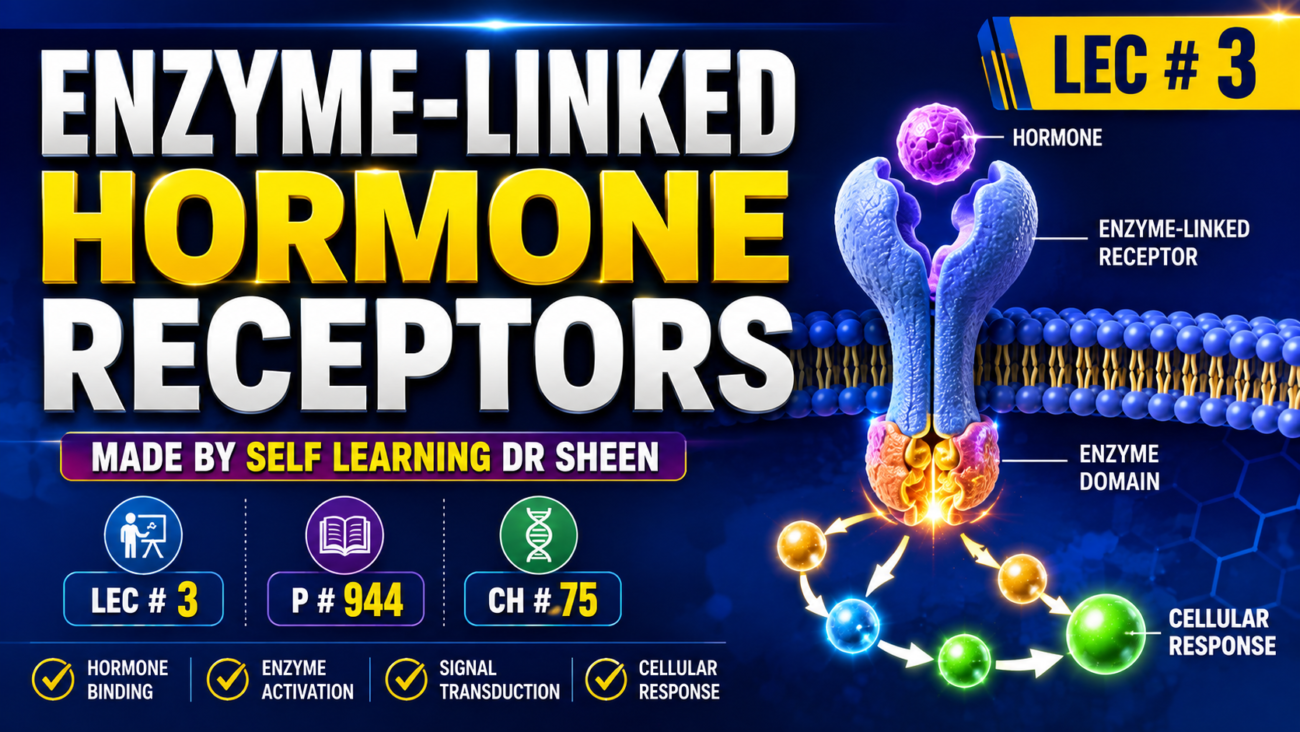
- Enzyme-linked receptors are membrane proteins that either work as enzymes themselves or are closely connected to enzymes that they activate.
- Unlike G protein–coupled receptors, which pass through the membrane 7 times, enzyme-linked receptors pass through the membrane only once.
- The hormone-binding site is on the outside of the cell membrane, while the enzyme or enzyme-binding site is on the inside.
- When a hormone binds outside the cell, it activates—or sometimes inactivates—an enzyme inside the membrane, which then produces changes in cell function.
- Some enzyme-linked receptors have their own enzyme activity, whereas others depend on associated enzymes.
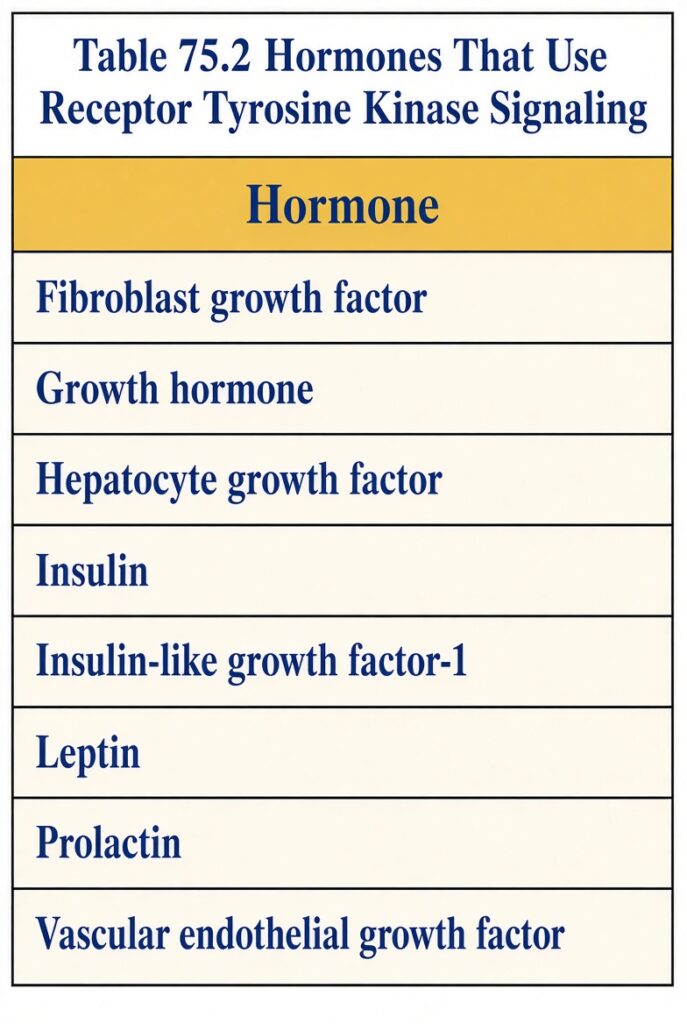
- Table 75.2 lists several peptide growth factors, cytokines, and hormones that use enzyme-linked receptor tyrosine kinases for signaling.
- One example is the leptin receptor (Fig. 75.5).
- Leptin is secreted by fat cells and is especially important for controlling appetite and energy balance.
- The leptin receptor belongs to a large family of cytokine receptors that do not have their own enzyme activity but signal through associated enzymes.
- Leptin signaling involves JAK2, a tyrosine kinase of the Janus kinase (JAK) family.
- The leptin receptor exists as a dimer, meaning it has two parts.
- When leptin binds to the outside of the receptor, the receptor changes shape and activates the attached JAK2 molecules.
- Activated JAK2 then adds phosphate groups to tyrosine residues in the leptin receptor–JAK2 complex, producing intracellular signals.
- These signals include phosphorylation of STAT proteins, which activates transcription of leptin-target genes and leads to new protein synthesis.
- JAK2 phosphorylation also activates other pathways, including MAPK and PI3K.
- Some leptin effects occur rapidly through activation of intracellular enzymes, while others occur more slowly because they require synthesis of new proteins.
- Another mechanism is when a hormone binds to a transmembrane receptor that activates adenylyl cyclase on the inside of the cell.
- Adenylyl cyclase produces cAMP, which produces many effects inside the cell and changes cell activity.
- cAMP is called a second messenger because the hormone itself does not directly cause the intracellular changes; instead, cAMP carries the signal inside the cell.
- In some peptide hormones, such as atrial natriuretic peptide (ANP), cGMP acts similarly as a second messenger.
KEY CONCEPT
- Hormone → membrane receptor → intracellular enzyme/signaling pathway → cell response
- Enzyme-linked receptors cross the membrane once and activate enzymes directly or through associated enzymes.
- Leptin → receptor → JAK2 → STAT/MAPK/PI3K → cellular effects
- Hormone → adenylyl cyclase → cAMP → intracellular effects
Conceptual Examples
- Leptin: binds its receptor → activates JAK2 → activates STAT/MAPK/PI3K pathways.
- Hormone using cAMP: binds receptor → activates adenylyl cyclase → produces cAMP → cAMP produces cellular effects.
- Atrial natriuretic peptide: uses cGMP as a second messenger.
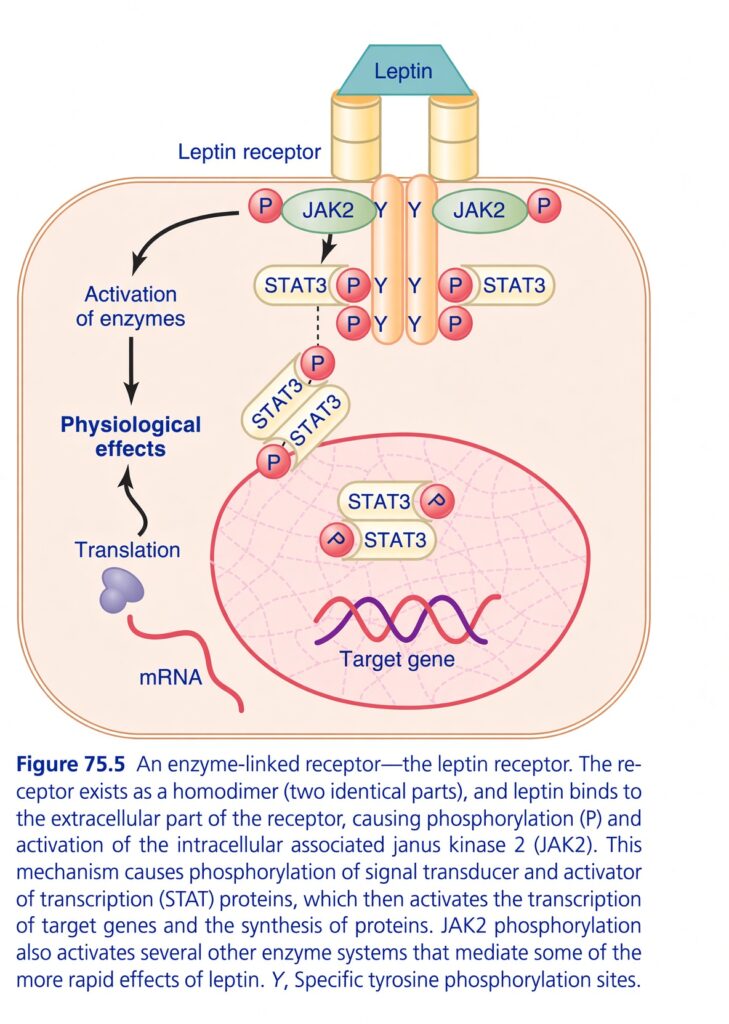
🧠 Figure 75.5 — Leptin Receptor: Super-Short Concept
⭐ BIG IDEA
Leptin → receptor → JAK2 → STAT3 → nucleus → genes → proteins → physiological effects
Think of it as:
Leptin gives the cell an instruction → JAK2 carries the signal → STAT3 takes the message to DNA → new proteins are made.
1. 🟦 Leptin binds its receptor
Leptin is outside the cell.
It binds to the leptin receptor.
The receptor is a homodimer:
2 identical receptor parts
So think of it as a two-part receptor that works together.
2. ⚡ JAK2 gets activated
Inside the cell, the receptor is associated with:
JAK2 = Janus kinase 2
When leptin binds:
JAK2 becomes activated and phosphorylates proteins.
Remember:
P = phosphorylation = activation signal
3. 🔴 JAK2 phosphorylates STAT3
JAK2 phosphorylates:
STAT3
STAT3 is a:
Signal Transducer and Activator of Transcription
Don’t get scared by the name.
Think:
STAT3 = messenger that carries the signal to DNA
4. 🚶 STAT3 moves to the nucleus
Activated/phosphorylated STAT3 molecules come together and move into the:
Nucleus
Then they interact with the target gene.
5. 🧬 Target gene → mRNA
STAT3 activates transcription of the target gene.
Therefore:
DNA → mRNA
This mRNA contains instructions for making a protein.
6. 🏭 mRNA → protein
The mRNA leaves the nucleus.
Then:
Translation → protein
These newly produced proteins contribute to the:
Physiological effects of leptin
🔥 Understand the entire picture in ONE LINE
Leptin
⬇️
Leptin receptor
⬇️
JAK2 activation
⬇️
STAT3 phosphorylation
⬇️
STAT3 enters nucleus
⬇️
Target gene activated
⬇️
mRNA
⬇️
Protein
⬇️
Physiological effects
🧠 ANALOGY
Imagine a company:
- Leptin = 📞 phone call
- Receptor = ☎️ phone
- JAK2 = 🏃 messenger
- STAT3 = 📩 message carrier
- Nucleus/DNA = 📚 instruction office
- mRNA = 📋 copied instructions
- Ribosome = 🏭 factory
- Protein = 🛠️ finished product
- Physiological effect = what the body actually does
⭐ What you MUST memorize
Leptin → JAK2 → STAT3 → Gene transcription → Protein synthesis → Effect
And the key distinction:
JAK2 = kinase that phosphorylates
STAT3 = transcription factor that carries the signal to DNA
🔑 Exam pearl:
Leptin receptor is an enzyme-linked receptor, but the receptor itself does NOT have intrinsic kinase activity. It is associated with JAK2, which provides the kinase activity.
That is the Intracellular Hormone Receptors and Activation of Genes
- Several hormones—including adrenal and gonadal steroid hormones, thyroid hormones, retinoid hormones, and vitamin D—bind to receptors inside the cell, rather than on the cell membrane.
- These hormones are lipid-soluble, so they can easily cross the cell membrane and bind to receptors in the cytoplasm or nucleus.
- The hormone binds to its intracellular receptor, forming an activated hormone–receptor complex.
- This complex binds to a specific regulatory DNA sequence called the hormone response element.
- The hormone–receptor complex can then activate or repress specific genes, changing the formation of messenger RNA (mRNA) (Fig. 75.6).
- The newly formed mRNA leads to the production of new proteins.
- These proteins appear minutes, hours, or even days after the hormone enters the cell and produce new or altered cellular functions.
- Different tissues may have the same intracellular hormone receptor, but the genes controlled by that receptor can be different in different tissues.
- A receptor can activate a gene only when the required combination of gene-regulatory proteins is present.
- Many of these regulatory proteins are tissue-specific, so different tissues can respond differently to the same hormone.
- Therefore, the response of a tissue depends not only on the hormone receptor, but also on which genes and regulatory proteins are present in that tissue.
KEY CONCEPT
Lipid-soluble hormone → crosses cell membrane → intracellular receptor → hormone–receptor complex → hormone response element on DNA → gene activation/repression → mRNA → new proteins → cellular response
Conceptual Examples
Same hormone + different tissues: same receptor may be present, but different regulatory proteins/genes → different tissue responses.central concept of Figure 75.5.
Steroid hormone: enters cell → binds intracellular receptor → acts on DNA → produces new proteins.
Thyroid hormone: enters cell → binds intracellular receptor → regulates specific genes → changes cell function.
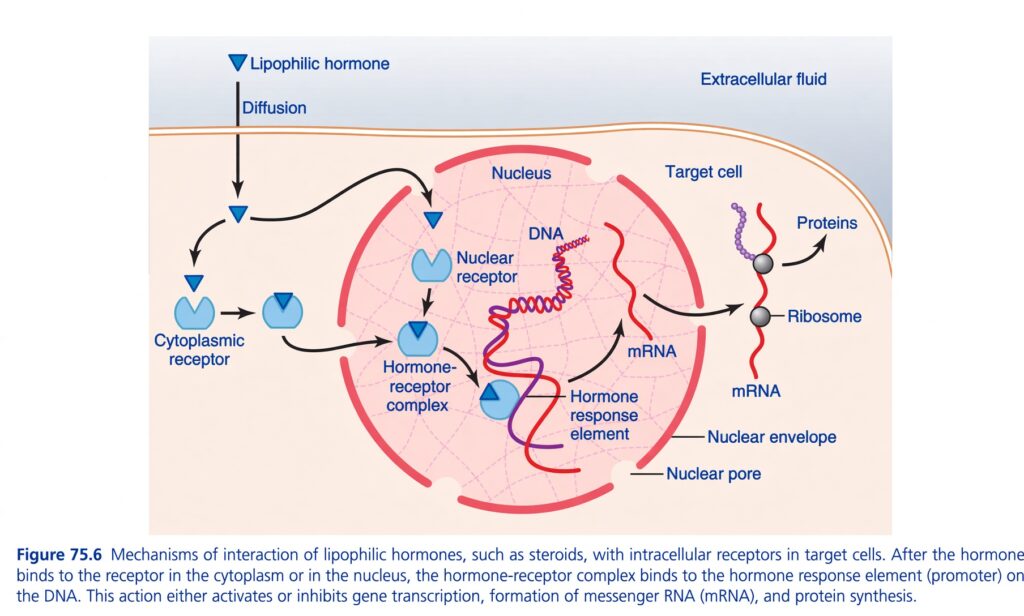
Figure 75.6 — Lipophilic Hormone Action
🧠 The BIG idea
Lipophilic hormone = fat-soluble hormone → can cross the cell membrane → enters the cell → acts on DNA → makes mRNA → makes proteins.
Think of it like a message entering a factory
1. Hormone travels in extracellular fluid
- Lipophilic hormone is fat-soluble.
- It can easily diffuse through the cell membrane.
- Examples: steroid hormones.
2. Hormone enters the target cell
- The hormone crosses the membrane by diffusion.
- It may first bind to a cytoplasmic receptor.
3. Hormone + receptor = hormone–receptor complex
- The hormone attaches to its specific receptor.
- This forms the hormone–receptor complex.
- The complex moves into the nucleus.
4. Inside the nucleus → DNA
- The complex binds to a specific part of DNA called the hormone response element (HRE).
- Think of HRE as the ON/OFF switch for a gene.
5. DNA → mRNA
- The hormone–receptor complex can:
- Activate gene transcription, or
- Inhibit gene transcription.
- If activated → DNA produces mRNA.
6. mRNA → ribosome → protein
- mRNA leaves the nucleus.
- It reaches the ribosome.
- Ribosome uses the mRNA instructions to make new proteins.
🔑 One-line flow
Lipophilic hormone → Cell membrane → Cytoplasmic/Nuclear receptor → Hormone–receptor complex → DNA/HRE → mRNA → Ribosome → Protein → Cellular response
⭐ Super-easy memory trick
“FAT hormone enters → RECEPTOR → DNA → mRNA → PROTEIN.”
Or:
H → R → D → mRNA → P
Hormone → Receptor → DNA → mRNA → Protein
🎯 What the figure is showing
- Extracellular fluid: hormone is outside the cell.
- Diffusion: hormone crosses the cell membrane.
- Cytoplasmic receptor: receptor can be in cytoplasm.
- Nuclear receptor: receptor can also be in nucleus.
- Nucleus: contains DNA.
- Hormone response element: specific DNA region controlled by the hormone–receptor complex.
- mRNA: carries DNA’s instructions out of the nucleus.
- Ribosome: makes the protein.
- Proteins: produce the final cellular effect.
🧠 Final concept
Lipophilic hormones do NOT need a membrane receptor to relay their message. They enter the cell themselves and ultimately change gene expression.
Therefore:
Lipophilic hormone → intracellular receptor → gene regulation → new protein → effect.
