
- Turner syndrome = primary hypogonadism in a phenotypic female caused by partial or complete loss of the short arm of an X chromosome.
- Main karyotypes:
- 57% → 45,X → one entire X chromosome missing
- 14% → structural abnormalities of X
- 29% → mosaicism
- Important structural abnormalities:
- 46,X,i(X)(q10) → isochromosome of Xq → loss of short arm
- 46,X,r(X) → ring X chromosome
- 46,X,del(Xp) or 46,X,del(Xq) → deletion of part of X chromosome
- Mosaic forms contain 45,X cells plus another cell population, such as:
- 45,X/46,XX
- 45,X/46,XY
- 45,X/47,XXX
- 45,X/46,X,i(X)(q10)
- About 5%–10% of mosaic patients contain Y-chromosome material.
- Y material → increased risk of gonadoblastoma.
Clinical Features
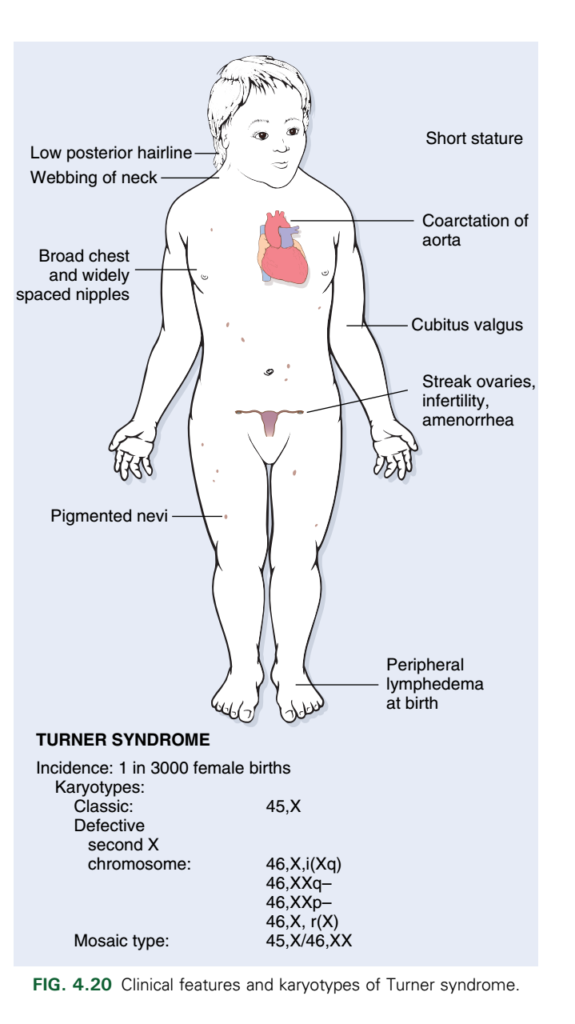
- Typical features include:
- short stature
- neck swelling in infancy → later webbed neck
- low posterior hairline
- cubitus valgus
- shield-like chest with widely spaced nipples
- high-arched palate
- lymphedema of hands and feet
- Important congenital abnormalities (Fig. 4.20):
- horseshoe kidney
- bicuspid aortic valve
- coarctation of aorta
- Cardiovascular abnormalities are an important cause of childhood death.
- At puberty:
- poor development of secondary sexual characteristics
- minimal breast development
- infantile genitalia
- little pubic hair
- primary amenorrhea
- Ovaries become streak ovaries:
loss of follicles → fibrous ovarian tissue → ovarian failure. - Intelligence is usually normal, although mild visual-spatial difficulties may occur.
- Autoimmune hypothyroidism is relatively common.
- In an adult female: short stature + primary amenorrhea → strongly suspect Turner syndrome
- Mosaic or deletion variants may have much milder features and may present only with primary amenorrhea.
- Diagnosis → karyotyping.
Pathogenesis
- Normally, both X chromosomes are active during oogenesis and are needed for normal ovarian development.
- Normal fetal ovaries contain millions of oocytes, which progressively decrease with age.
- In Turner syndrome: missing second X → accelerated oocyte loss → nearly complete by about 2 years → streak ovaries
- Therefore: oocyte depletion → ovarian failure → ↓ sex hormones → failure of normal puberty + primary amenorrhea
- Conceptually: “Menopause occurs before menarche.”
- Turner syndrome also affects growth and other tissues, showing that important somatic-development genes are present on the X chromosome.
- An important gene is SHOX (short stature homeobox) at Xp22.33.
- SHOX normally:
- escapes X inactivation
- remains active on both X chromosomes
- has an active equivalent on the short arm of the Y chromosome
- Therefore, normal males and females both have two active SHOX copies.
- In Turner syndrome: loss of one SHOX copy → reduced SHOX dosage → short stature
- SHOX deletions are also found in about 2%–5% of otherwise unaffected children with short stature.
- However, SHOX loss explains mainly the short stature, not:
- cardiac abnormalities
- endocrine abnormalities
- Therefore, other X-chromosome genes also contribute to the Turner phenotype.
KEY CONCEPT
- Turner syndrome = phenotypic female + partial/complete X monosomy, classically 45,X.
- Missing X → rapid loss of oocytes → streak ovaries → primary hypogonadism + primary amenorrhea.
- Loss of SHOX → short stature.
- Major findings:
short stature + webbed neck + streak ovaries + amenorrhea + congenital heart disease. - Mosaic forms are usually milder.
- Y-chromosome material → increased gonadoblastoma risk.
CONCEPTUAL EXAMPLES
- 45,X → accelerated oocyte loss → streak ovaries → ↓ estrogen → absent normal puberty.
- Loss of one SHOX gene → impaired skeletal growth → short stature.
- 45,X/46,XX mosaic → some normal cells remain → milder phenotype.
- Turner syndrome with Y material → increased risk of gonadal tumor.