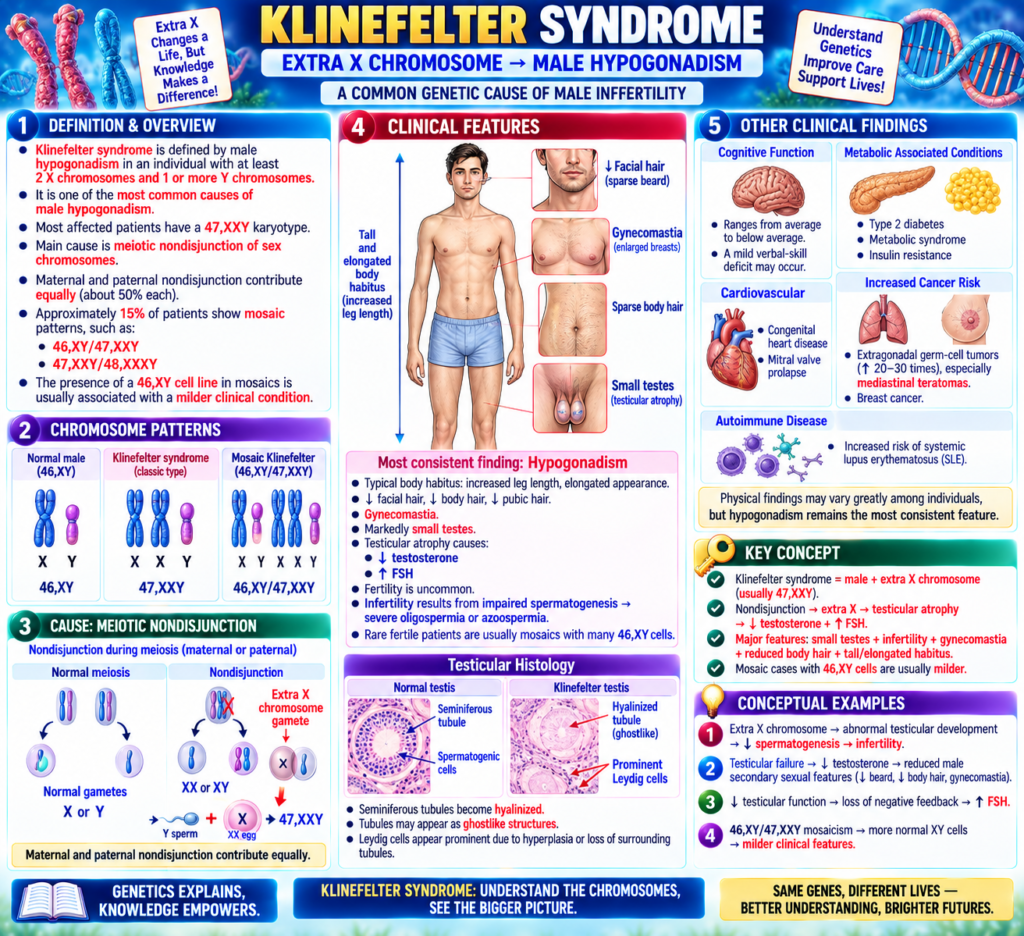

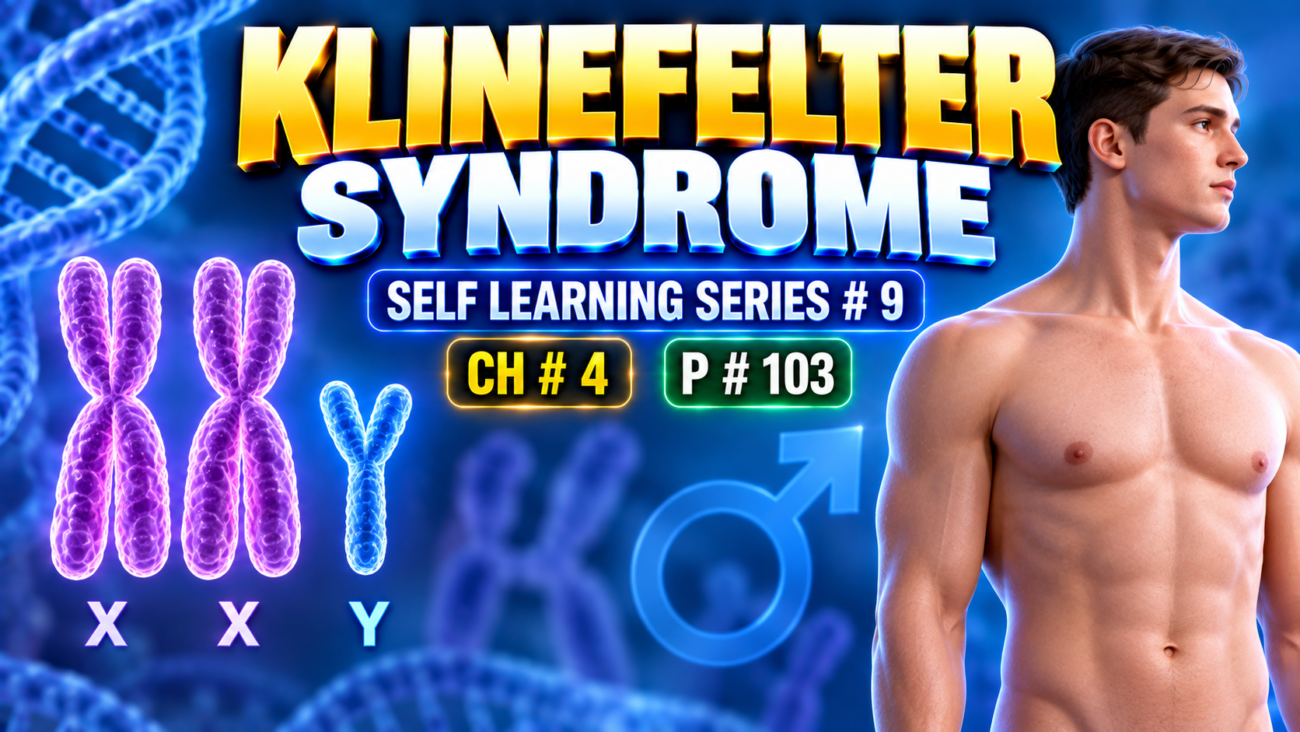
- Klinefelter syndrome = male hypogonadism in a person with at least 2 X chromosomes + 1 or more Y chromosomes.
- It is a common cause of male hypogonadism.
- Most patients have: 47,XXY
- Main cause:
meiotic nondisjunction of sex chromosomes. - Maternal and paternal nondisjunction contribute about equally.
- About 15% are mosaics, such as:
- 46,XY/47,XXY
- 47,XXY/48,XXXY
- Presence of a 46,XY cell line usually produces a milder phenotype.
Clinical Features
- The most consistent finding is hypogonadism.
- Typical body habitus:
- increased leg length
- elongated appearance
- Common physical features:
- ↓ facial hair
- ↓ body hair
- ↓ pubic hair
- gynecomastia
- markedly small testes
- Testicular atrophy causes:
- ↓ testosterone
- ↑ FSH
- Fertility is uncommon.
- Infertility results from:
impaired spermatogenesis → severe oligospermia or azoospermia. - Rare fertile patients are usually mosaics with many 46,XY cells.
- Testicular histology:
- seminiferous tubules become hyalinized
- tubules may appear as ghostlike structures
- Leydig cells appear prominent due to hyperplasia or loss of surrounding tubules
- Cognitive function ranges from average to below average.
- A mild verbal-skill deficit may occur.
- Associated conditions include:
- type 2 diabetes
- metabolic syndrome
- insulin resistance
- congenital heart disease
- mitral valve prolapse
- Risk of extragonadal germ-cell tumors is increased about 20–30 times, especially:
- mediastinal teratomas
- Other increased risks:
- breast cancer
- autoimmune disease such as systemic lupus erythematosus
- Physical findings may vary greatly, but hypogonadism remains the most consistent feature.
KEY CONCEPT
- Klinefelter syndrome = male + extra X chromosome, usually 47,XXY.
- Nondisjunction → extra X → testicular atrophy → ↓ testosterone + ↑ FSH.
- Major features:
small testes + infertility + gynecomastia + reduced body hair + tall/elongated habitus. - Mosaic cases with 46,XY cells are usually milder.
CONCEPTUAL EXAMPLES
- Extra X chromosome → abnormal testicular development → ↓ spermatogenesis → infertility.
- Testicular failure → ↓ testosterone → reduced male secondary sexual features.
- ↓ testicular function → loss of negative feedback → ↑ FSH.
- 46,XY/47,XXY mosaicism → more normal XY cells → milder clinical features.