


LEARNING OBJECTIVE
After studying this topic, students will be able to:
- Describe the primary taste sensations, their basic causes, taste thresholds, and taste blindness.
INTRODUCTION
- Taste is mainly a function of the taste buds, with smell, although small, texture,temperature, and stimulation of pain endings also contributing to the overall perception of taste.
- Taste helps a person select food according to personal desires and the metabolic needs of body tissues.
- The sense of smell also contributes strongly to taste perception.
- The texture of food is detected by the tactual senses of the mouth and also affects the taste experience.
- Some substances in food stimulate pain endings and change the taste experience.
- Example: pepper.
- Taste is important because it helps a person:
- Select food according to desires.
- Select food according to the body tissues’ metabolic need for specific substances.
PRIMARY TASTE SENSATIONS
- The specific chemicals that stimulate all the different taste receptors are not completely known.
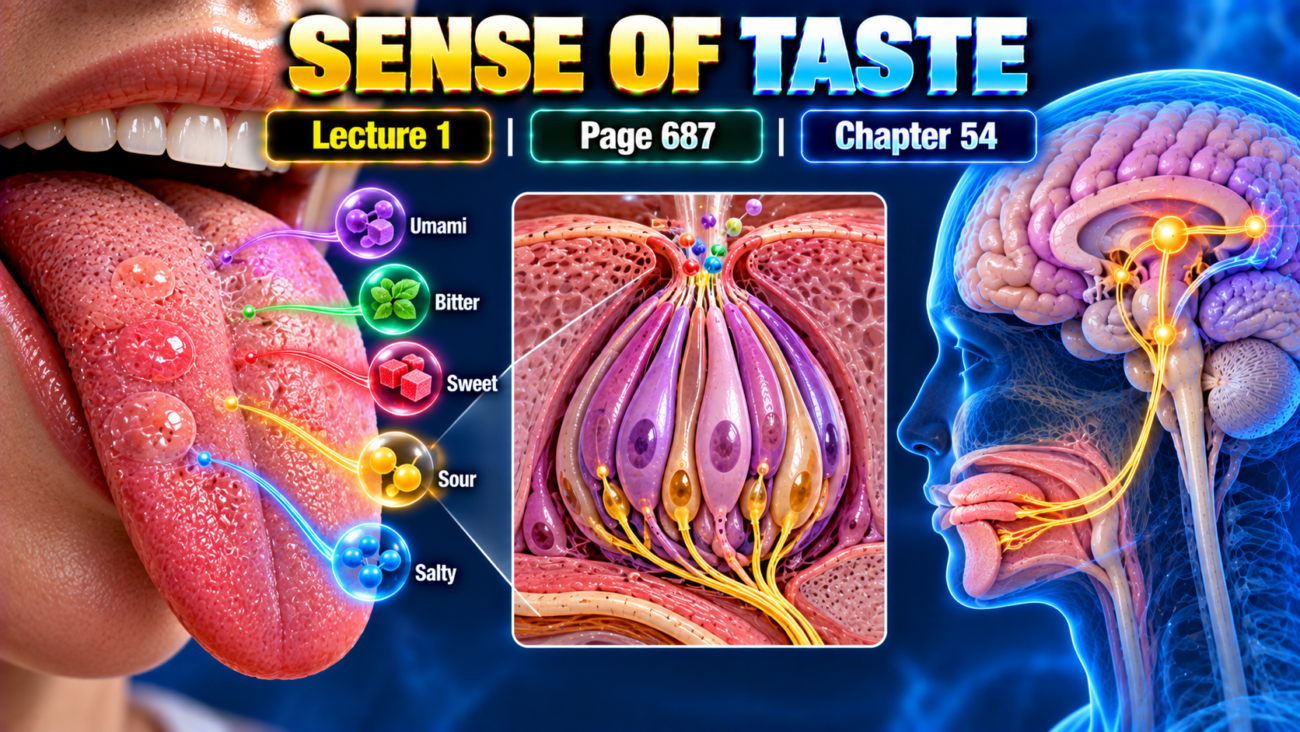
- For practical analysis, taste sensations are grouped into five main categories:
- Sour
- Salty
- Sweet
- Bitter
- Umami
- There is emerging evidence that fat taste may be another major taste modality.
- A person can perceive hundreds of different tastes.
- These different tastes are thought to result from combinations of the elementary taste sensations.
- This is similar to how all visible colors are combinations of the three primary colors, as described in Chapter 51.
Sour Taste
- Sour taste is caused by acids.
- It mainly depends on the hydrogen ion concentration.
- The intensity of sour taste is approximately proportional to the logarithm of hydrogen ion concentration.
- Therefore:
- More acidic food → stronger sour sensation.
Salty Taste
- Salty taste is produced by ionized salts.
- It mainly depends on the sodium ion concentration.
- The quality of salty taste may vary from one salt to another.
- This occurs because some salts can produce other taste sensations in addition to saltiness.
- The cations, especially sodium cations, are mainly responsible for salty taste.
- The anions also contribute, but to a lesser extent.
Sweet Taste
- Sweet taste is not produced by one single class of chemicals.
- Chemicals that may produce sweet taste include:
- Sugars
- Glycols
- Alcohols
- Aldehydes
- Ketones
- Amides
- Esters
- Some amino acids
- Some small proteins
- Sulfonic acids
- Halogenated acids
- Inorganic salts of lead and beryllium
- Most substances producing sweet taste are organic chemicals.
- Small changes in chemical structure can change the taste of a substance.
- For example:
- Addition of a simple radical may change a substance from sweet → bitter.
Bitter Taste
- Bitter taste, like sweet taste, is not caused by one single type of chemical.
- Most substances producing bitter taste are organic substances.
- Two groups are especially likely to produce bitter taste:
- Long-chain organic substances containing nitrogen.
- Alkaloids.
- Examples of alkaloids include:
- Quinine
- Caffeine
- Strychnine
- Nicotine
- Some substances may first taste sweet and later produce a bitter aftertaste.
- Example: saccharin.
- This bitter aftertaste makes saccharin objectionable to some people.
- High concentrations of salts may also produce a bitter taste.
- A strong bitter taste usually causes a person or animal to reject the food.
- This is important because many deadly toxins in poisonous plants are alkaloids.
- These alkaloids usually produce an intensely bitter taste.
- This bitter taste is usually followed by rejection of the food.
Umami Taste
- Umami is a Japanese word meaning “delicious.”
- It is a pleasant taste sensation.
- It is different from:
- Sour
- Salty
- Sweet
- Bitter
- Umami is the dominant taste of foods containing L-glutamate.
- Examples include:
- Meat extracts
- Aging cheese
- The pleasurable sensation of umami is thought to be important for nutrition.
- It promotes the ingestion of proteins.
CONCEPTUAL EXAMPLES
- More acidic food → more hydrogen ions → stronger sour taste.
- Sodium-containing ionized salts → salty taste.
- Sugars and many other organic chemicals → sweet taste.
- Alkaloids → bitter taste → possible rejection of food.
- L-glutamate in meat extracts and aging cheese → umami taste → promotes protein intake.
Threshold for taste
- The molar threshold for different taste sensations varies.
- Average threshold values are:
- Sour taste
- Hydrochloric acid = 0.0009 M
- Salty taste
- Sodium chloride = 0.01 M
- Sweet taste
- Sucrose = 0.01 M
- Bitter taste
- Quinine = 0.000008 M
- Sour taste
- The bitter taste sensation is much more sensitive than the other taste sensations.
- This high sensitivity provides an important protective function against many dangerous toxins in food.
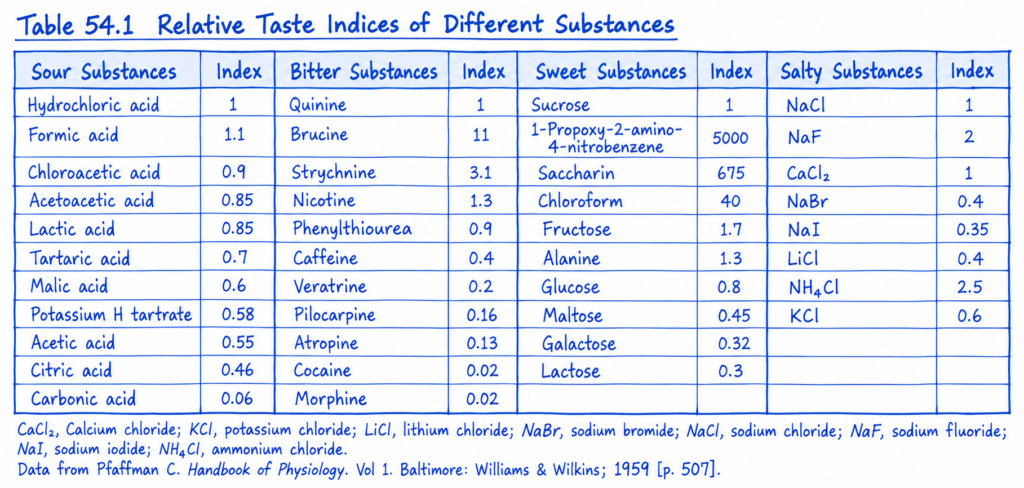
- Table 54.1 lists the relative taste indices of different substances.
- Relative taste indices are the reciprocals of the taste thresholds.
- In the table, the intensities of four primary taste sensations are compared with:
- Hydrochloric acid
- Quinine
- Sucrose
- Sodium chloride
- Each of these substances is arbitrarily given a taste index of 1.
Taste Blindness
- Some people are taste blind to certain substances.
- Taste blindness occurs especially with different types of thiourea compounds.
- Phenylthiocarbamide is commonly used by psychologists to demonstrate taste blindness.
- About 15% to 30% of people show taste blindness to phenylthiocarbamide.
- The exact percentage depends on:
- The method of testing.
- The concentration of the substance.
KEY CONCEPT
Taste perception = taste buds + smell + food texture + stimulation of pain endings.
- The five main taste sensations are:
- Sour
- Salty
- Sweet
- Bitter
- Umami
- Different tastes are produced by combinations of these elementary taste sensations.
- Taste helps the body select food according to desire and metabolic needs.
- Different taste sensations have different molar thresholds.
- Lower threshold → greater taste sensitivity.
- Bitter taste has a very low threshold and is therefore highly sensitive.
- This sensitivity helps protect against dangerous toxins in food.
- Some people may be unable to taste certain substances, which is called taste blindness.
CONCEPTUAL EXAMPLES
- Hydrochloric acid 0.0009 M → sour taste can be detected.
- Sodium chloride 0.01 M → salty taste can be detected.
- Sucrose 0.01 M → sweet taste can be detected.
- Quinine 0.000008 M → bitter taste can be detected at a much lower concentration.
- Phenylthiocarbamide → some people cannot taste it → taste blindness.
CLINICAL IMPORTANCE
- Taste helps in food selection according to personal desire and the metabolic needs of body tissues.
- Smell, food texture, and stimulation of pain endings can strongly modify the overall taste experience.
- Bitter taste has an important protective role because it is much more sensitive than other tastes and helps detect many dangerous toxins in food.
- Many poisonous plant toxins are alkaloids, which usually produce an intensely bitter taste and lead to rejection of the food.
- Umami taste is important for nutrition because it promotes the ingestion of proteins.
- Taste blindness occurs in some people for certain substances, especially thiourea compounds.
- About 15%–30% of people show taste blindness to phenylthiocarbamide, depending on the testing method and concentration used.
HIGH-YIELD POINTS
- Taste is mainly produced by taste buds in the mouth.
- Smell contributes strongly to taste perception.
- Food texture also changes the taste experience.
- Substances that stimulate pain endings, such as pepper, can alter taste.
- Taste helps a person select food according to desire and metabolic needs.
- The five main taste sensations are:
- Sour
- Salty
- Sweet
- Bitter
- Umami
- Fat taste may be another major taste modality.
- Hundreds of different tastes are produced by combinations of the basic taste sensations.
- Sour taste is produced by acids.
- Sour taste mainly depends on hydrogen ion concentration.
- More acidic food → stronger sour taste.
- Salty taste is produced by ionized salts.
- Salty taste mainly depends on sodium ion concentration.
- Sodium cations are mainly responsible for salty taste.
- Anions also contribute to salty taste, but to a lesser extent.
- Sweet taste is not produced by one single class of chemicals.
- Most substances producing sweet taste are organic chemicals.
- Sugars, glycols, alcohols, aldehydes, ketones, amides, esters, some amino acids, and some small proteins can produce sweet taste.
- Small changes in chemical structure can change a substance from sweet to bitter.
- Bitter taste is also not produced by one single type of chemical.
- Most substances producing bitter taste are organic substances.
- Two important groups producing bitter taste are:
- Long-chain nitrogen-containing organic substances
- Alkaloids
- Important alkaloids mentioned are:
- Quinine
- Caffeine
- Strychnine
- Nicotine
- Some substances may taste sweet first and bitter later.
- Saccharin can produce a bitter aftertaste.
- High concentrations of salts may also produce a bitter taste.
- Strong bitter taste usually causes rejection of food.
- Bitter taste has an important protective function.
- Many deadly toxins in poisonous plants are alkaloids.
- These alkaloids usually produce an intensely bitter taste.
- Umami means “delicious.”
- Umami is a pleasant taste that is different from sour, salty, sweet, and bitter.
- Umami is mainly associated with foods containing L-glutamate.
- Examples of umami-containing foods include:
- Meat extracts
- Aging cheese
- Umami taste is important for nutrition because it promotes protein ingestion.
- Different tastes have different molar thresholds.
- Sour taste threshold for hydrochloric acid = 0.0009 M.
- Salty taste threshold for sodium chloride = 0.01 M.
- Sweet taste threshold for sucrose = 0.01 M.
- Bitter taste threshold for quinine = 0.000008 M.
- Bitter taste has the lowest threshold among the tastes listed.
- Therefore, bitter taste is much more sensitive than the other taste sensations.
- This high sensitivity helps protect against dangerous toxins in food.
- Table 54.1 shows the relative taste indices of different substances.
- Relative taste indices are the reciprocals of taste thresholds.
- Hydrochloric acid, quinine, sucrose, and sodium chloride are each assigned a taste index of 1 in the table.
- Taste blindness means that a person cannot taste certain substances.
- Taste blindness is especially seen with some thiourea compounds.
- Phenylthiocarbamide is commonly used to demonstrate taste blindness.
- About 15%–30% of people show taste blindness to phenylthiocarbamide.
- The percentage of taste blindness depends on:
- Method of testing
- Concentration of the substance
QUICK REVISION
Taste mainly depends on taste buds, but smell, food texture, and pain stimulation also influence the taste experience.The five main taste sensations are:
- Sour
- Salty
- Sweet
- Bitter
- Umami
Fat taste may also be an important taste modality.Different tastes are formed by combinations of basic taste sensations.
- Sour taste
- Caused by acids.
- Depends mainly on hydrogen ion concentration.
- More acidity → stronger sour taste.
Salty taste
- Caused by ionized salts.
- Depends mainly on sodium ions.
- Sodium cations contribute more than anions.
Sweet taste
- Is not caused by one single chemical group.
- Most sweet substances are organic chemicals.
- Small chemical changes may convert a substance from sweet to bitter.
Bitter taste
- Is mainly produced by organic substances.
- Important bitter substances include alkaloids.
- Examples: quinine, caffeine, strychnine, and nicotine.
- Strong bitter taste usually causes rejection of food.
- This provides protection against many poisonous substances.
Saccharin may taste sweet first but leave a bitter aftertaste.High concentrations of salts may also produce a bitter taste.Umami
- Means “delicious.”
- Is mainly associated with L-glutamate.
- Found in foods such as meat extracts and aging cheese.
- Promotes protein ingestion.
Taste thresholds:
- Hydrochloric acid for sour = 0.0009 M
- Sodium chloride for salty = 0.01 M
- Sucrose for sweet = 0.01 M
- Quinine for bitter = 0.000008 M
Bitter taste has the lowest threshold and is therefore the most sensitive among these taste sensations.High sensitivity to bitter taste provides an important protective function against dangerous toxins.Relative taste index = reciprocal of taste threshold.Table 54.1 shows the relative taste indices of different substances.Taste blindness
- Means inability to taste certain substances.
- Commonly occurs with some thiourea compounds.
- Phenylthiocarbamide is commonly used to test taste blindness.
- About 15%–30% of people may show taste blindness to it.
- The percentage depends on the testing method and concentration.
Reference: Guyton and Hall Textbook of Medical Physiology, 15th Edition
