


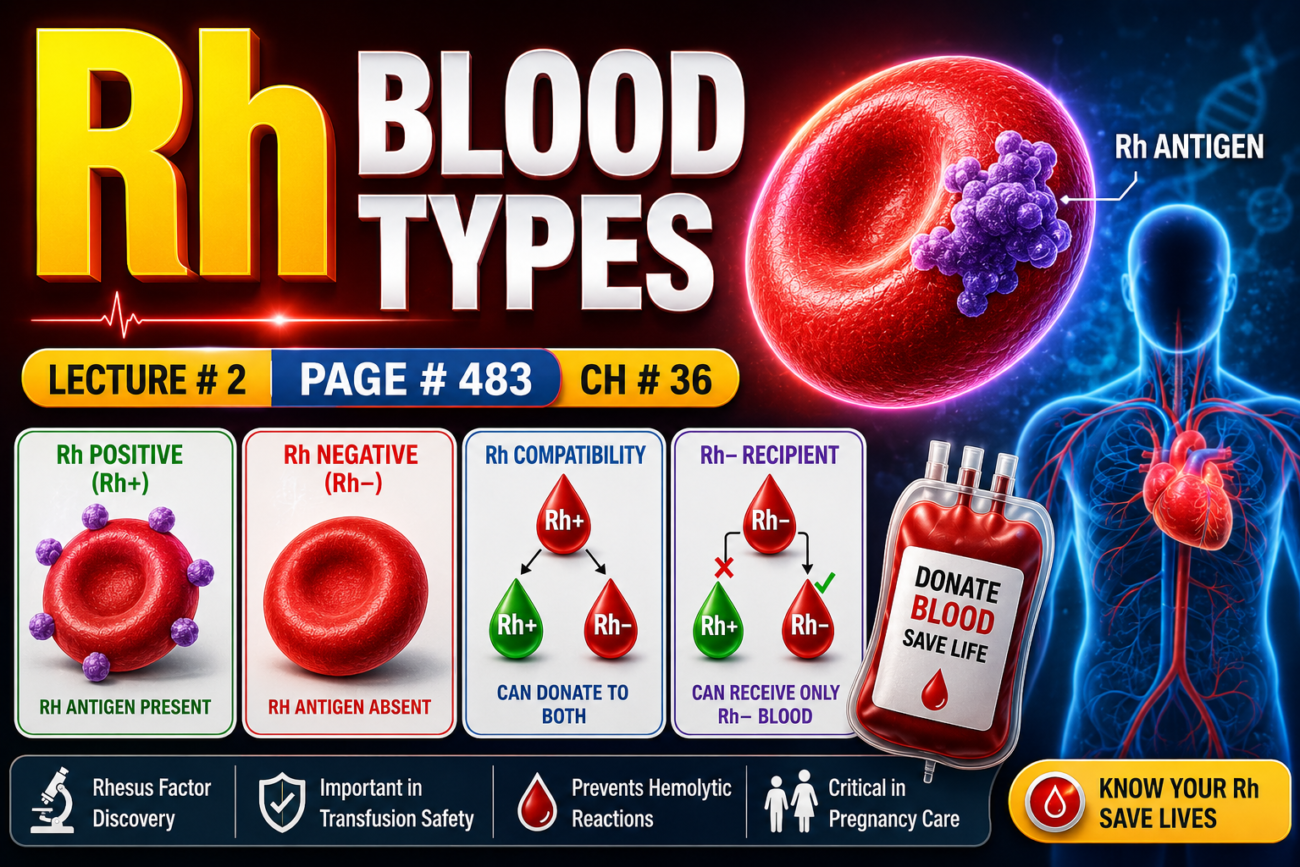
- Along with the O-A-B blood type system, the Rh blood type system is also important in blood transfusion.
- In the O-A-B system, plasma agglutinins that cause transfusion reactions develop spontaneously.
- In the Rh system, spontaneous agglutinins almost never develop.
- A person must first be massively exposed to an Rh antigen before producing enough agglutinins to cause a significant transfusion reaction.
- One example of such exposure is transfusion of blood containing the Rh antigen.
Key Concept
- The Rh blood type system is important in blood transfusion.
- O-A-B agglutinins develop spontaneously.
- Rh agglutinins do not develop spontaneously.
- Exposure to the Rh antigen is required before enough agglutinins are formed to cause a significant transfusion reaction.
Rh Antigens—Rh-Positive and Rh-Negative
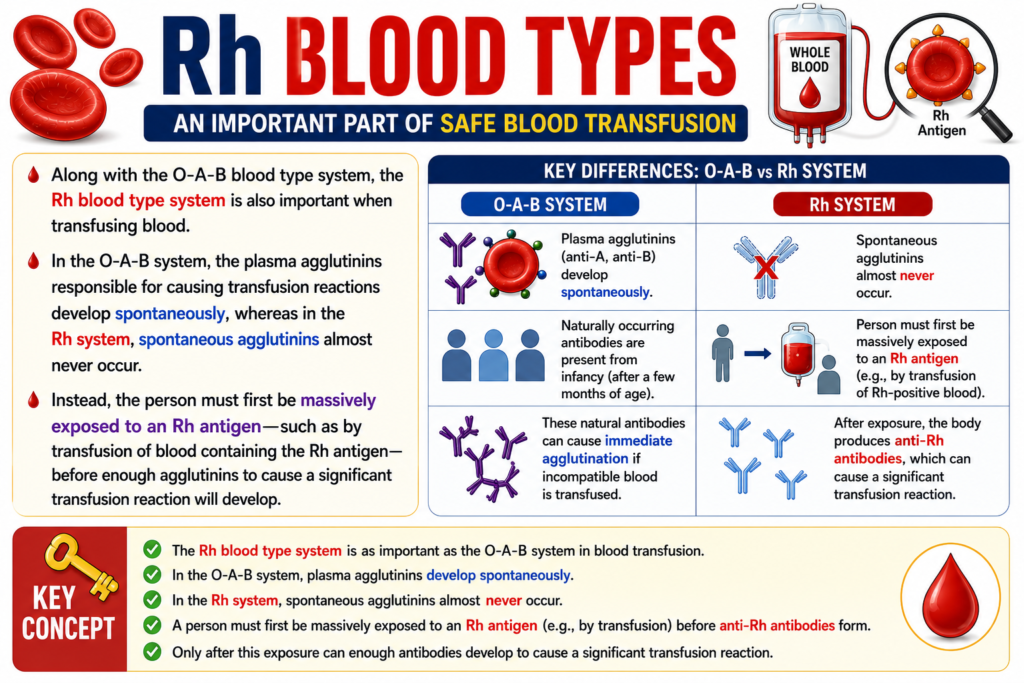
- There are six common Rh antigens.
- Each Rh antigen is called an Rh factor.
- The six Rh factors are:
- C
- D
- E
- c
- d
- e
- A person who has the C antigen does not have the c antigen.
- A person who does not have the C antigen always has the c antigen.
- The same relationship exists for the D–d and E–e antigen pairs.
- Because of inheritance, each person has one antigen from each of the three antigen pairs.
- The D antigen is the most common Rh antigen in the population.
- The D antigen is more antigenic than the other Rh antigens.
- A person who has the D antigen is called Rh positive.
- A person who does not have the D antigen is called Rh negative.
- Even Rh-negative people may have other Rh antigens.
- These other Rh antigens can also cause transfusion reactions.
- However, these reactions are usually milder.
- About 85% of Whites are Rh positive.
- About 15% of Whites are Rh negative.
- About 95% of Black Americans are Rh positive.
- Nearly 100% of Black Africans are Rh positive.
- More than 95% of Native Americans and Asians living in China, Japan, and Korea are Rh positive.
- Worldwide, the estimated frequency is:
- Rh positive: 95%
- Rh negative: 6%
Key Concept
- The Rh system has six Rh factors: C, D, E, c, d, and e.
- The D antigen is the most important and most antigenic Rh factor.
- Rh positive = D antigen present.
- Rh negative = D antigen absent.
- Other Rh antigens can also cause transfusion reactions, but they are usually milder.
- Most people worldwide are Rh positive.
RH IMMUNE RESPONSE
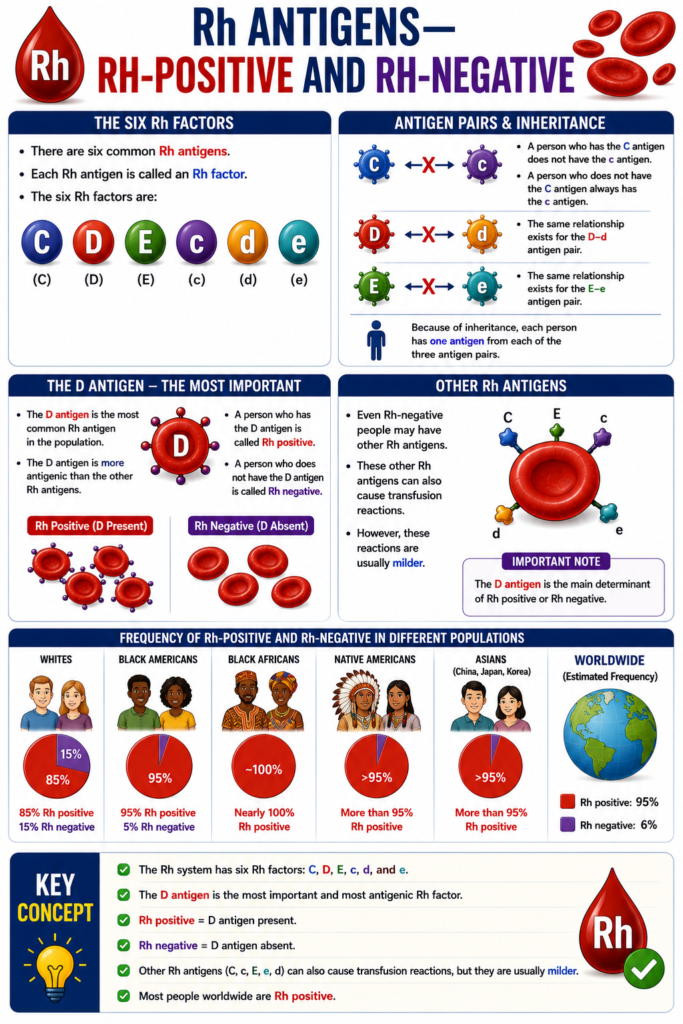
- When Rh-positive RBCs are injected into an Rh-negative person, the immune system starts producing anti-Rh agglutinins.
- Anti-Rh agglutinins develop slowly.
- They usually reach their maximum concentration about 2 to 4 months after exposure.
- The strength of this immune response varies among individuals.
- Some people develop a stronger immune response than others.
- With multiple exposures to the Rh factor, an Rh-negative person becomes strongly sensitized to the Rh factor.
Key Concept
- Rh-positive RBC exposure in an Rh-negative person stimulates the production of anti-Rh agglutinins.
- Anti-Rh agglutinins develop slowly, reaching maximum levels in 2–4 months.
- Repeated exposure causes strong Rh sensitization.
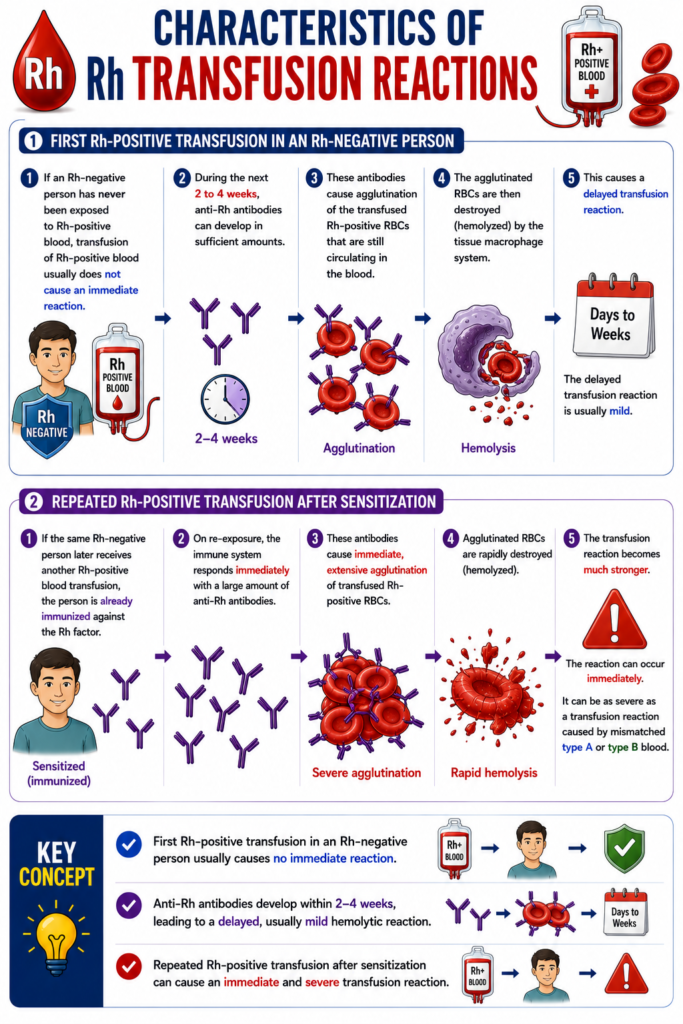
Characteristics of Rh Transfusion Reactions
- If an Rh-negative person has never been exposed to Rh-positive blood, transfusion of Rh-positive blood usually does not cause an immediate reaction.
- During the next 2 to 4 weeks, anti-Rh antibodies can develop in sufficient amounts.
- These antibodies cause agglutination of the transfused Rh-positive RBCs that are still circulating in the blood.
- The agglutinated RBCs are then destroyed (hemolyzed) by the tissue macrophage system.
- This causes a delayed transfusion reaction.
- The delayed transfusion reaction is usually mild.
- If the same Rh-negative person later receives another Rh-positive blood transfusion, the person is already immunized against the Rh factor.
- The transfusion reaction becomes much stronger.
- The reaction can occur immediately.
- It can be as severe as a transfusion reaction caused by mismatched type A or type B blood.
Key Concept
- First Rh-positive transfusion in an Rh-negative person usually causes no immediate reaction.
- Anti-Rh antibodies develop within 2–4 weeks, leading to a delayed, usually mild hemolytic reaction.
- Repeated Rh-positive transfusion after sensitization can cause an immediate and severe transfusion reaction.
MADE BY SELF LEARNING CEO AND FOUNDER DR SHEEN
