

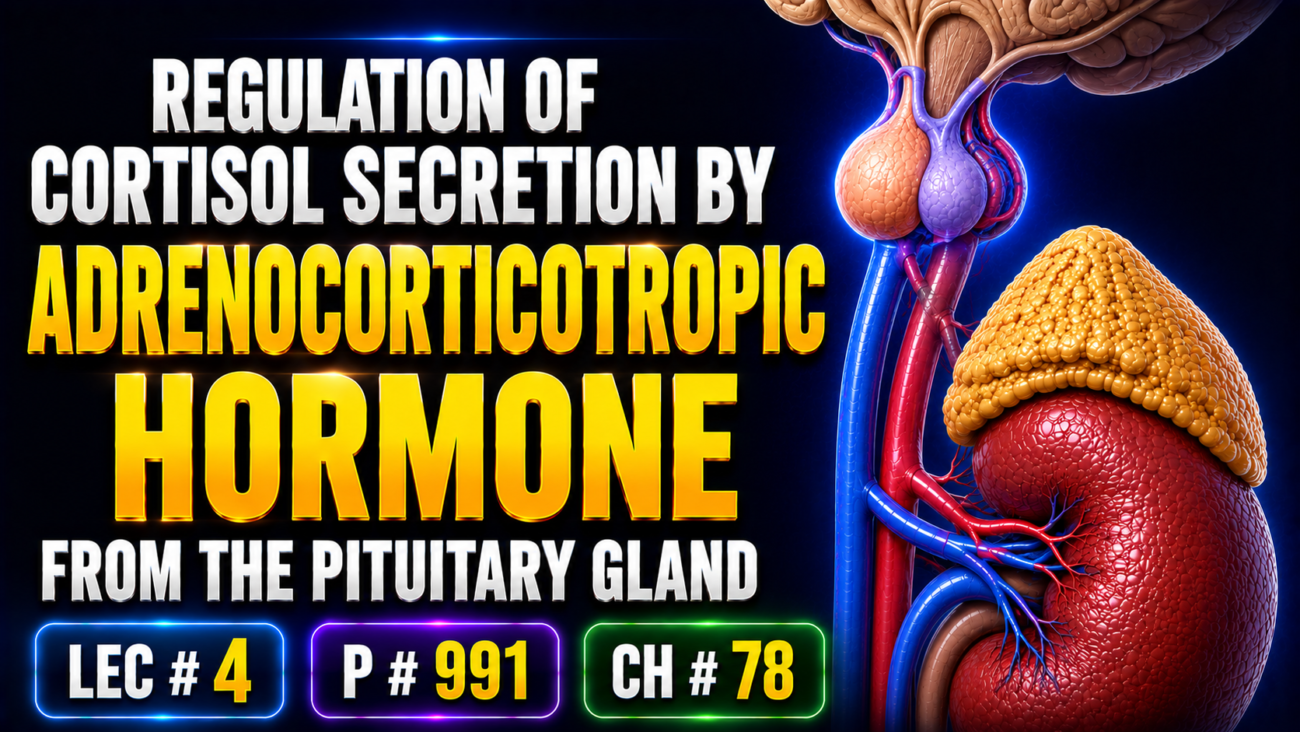
- ACTH Stimulates Cortisol Secretion: cortisol secretion is controlled almost entirely by ACTH from the anterior pituitary.
- ACTH also increases production of adrenal androgens.
- Unlike cortisol, aldosterone is mainly controlled directly by K⁺ and angiotensin II acting on the adrenal cortex.
- Chemistry of ACTH: ACTH is a 39-amino-acid polypeptide.
- A smaller 24-amino-acid fragment of ACTH can produce all the effects of the complete ACTH molecule.
- ACTH Secretion Is Controlled By Corticotropin-Releasing Hormone From the Hypothalamus: the hypothalamus releases CRH, which stimulates the anterior pituitary to release ACTH.
- CRH contains 41 amino acids and enters the hypophysial portal system, which carries it to the anterior pituitary.
- CRH is produced mainly by neurons in the paraventricular nucleus of the hypothalamus.
- Without CRH, the anterior pituitary releases only small amounts of ACTH.
- Therefore, most conditions causing increased ACTH begin with signals from the brain → hypothalamus → CRH → pituitary → ACTH.
- ACTH Activates Adrenocortical Cells to Produce Steroids By Increasing cAMP: ACTH activates adenylyl cyclase → ↑ cAMP → activation of intracellular enzymes → ↑ adrenal steroid synthesis.
- cAMP reaches its maximal effect in about 3 minutes and acts as a second messenger.
- The key step is activation of protein kinase A (PKA).
- PKA promotes cholesterol → pregnenolone, the rate-limiting first step in adrenal steroid synthesis.
- Because this first step is required for all adrenal steroids, ACTH is normally necessary for adrenal steroid formation.
- Long-term ACTH stimulation causes increased secretion + hypertrophy + hyperplasia of adrenal cortical cells, especially the zona fasciculata and zona reticularis.
KEY CONCEPT
CRH → ACTH → cAMP/PKA → cholesterol → pregnenolone → adrenal steroids, especially cortisol.
CONCEPTUAL EXAMPLES
- ↑ CRH → ↑ ACTH → ↑ cortisol
- ACTH → ↑ cAMP → PKA → ↑ steroid synthesis
- Long-term ↑ ACTH → adrenal cortex hypertrophy + hyperplasia
Physiological Stress Increases ACTH and Adrenocortical Secretion
- Almost any physical or mental stress rapidly increases ACTH → cortisol.
- Cortisol secretion may increase up to 20-fold during severe stress (Fig. 78.6).
- Physical stress/pain → brain stem → paraventricular nucleus → hypothalamus → CRH → hypophysial portal system → ACTH → cortisol.
- This entire pathway can produce a large increase in blood cortisol within minutes.
- Mental stress can also rapidly increase ACTH, mainly through increased activity of the limbic system, especially the amygdala and hippocampus, which signal the posterior medial hypothalamus.
- Feedback Inhibitory Effect of Cortisol on the Hypothalamus and Anterior Pituitary to Decrease ACTH Secretion: when cortisol becomes high, it produces negative feedback.
- Cortisol acts on the hypothalamus → ↓ CRH.
- Cortisol also acts on the anterior pituitary → ↓ ACTH.
- Therefore, ↑ cortisol → ↓ CRH + ↓ ACTH → cortisol returns toward normal.
KEY CONCEPT
Stress → CRH → ACTH → cortisol ↑; then high cortisol feeds back to ↓ CRH and ↓ ACTH.
CONCEPTUAL EXAMPLES
- Physical injury → CRH ↑ → ACTH ↑ → cortisol ↑
- Mental stress → limbic system → hypothalamus → CRH ↑ → ACTH ↑
- Cortisol becomes excessive → negative feedback → CRH ↓ + ACTH ↓
Summary of the Cortisol Control System
- Stress is the main trigger: different types of stress excite the hypothalamus and activate the cortisol-control system (Fig. 78.8).
- Stress → hypothalamus → CRH → ACTH → adrenal cortex → cortisol ↑.
- Cortisol then produces metabolic effects that help reduce the damaging effects of stress.
- When stress is absent, cortisol provides negative feedback to the hypothalamus and anterior pituitary, helping lower blood cortisol.
- However, stress signals are stronger than this feedback, so they can override cortisol’s inhibition.
- Therefore, stress can cause repeated cortisol increases during the day (Fig. 78.9) or continuously high cortisol during chronic stress.
KEY CONCEPT
Stress turns cortisol ON; high cortisol normally turns the system DOWN, but strong or chronic stress can override this feedback.
CONCEPTUAL EXAMPLES
- Stress → CRH ↑ → ACTH ↑ → cortisol ↑
- No stress + cortisol ↑ → CRH ↓ + ACTH ↓ → cortisol ↓
- Chronic stress → repeated/continuous cortisol ↑ despite feedback
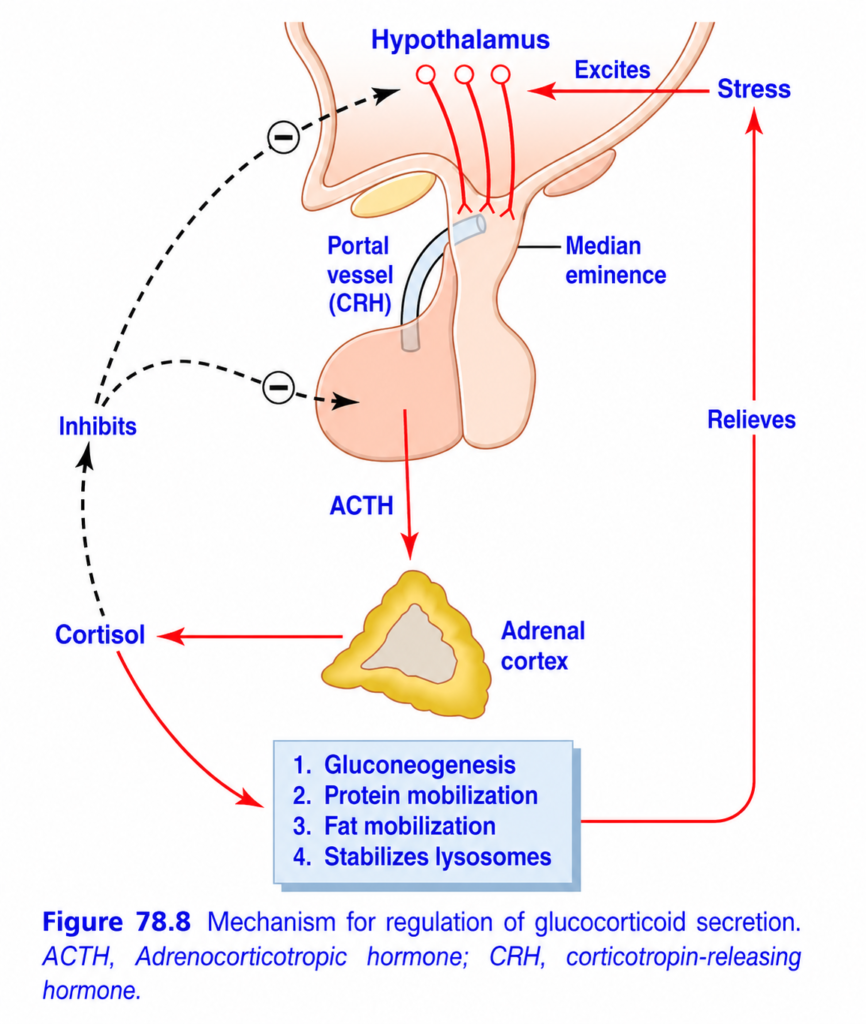
Cortisol Control System
The whole figure in ONE line:
Stress → Hypothalamus → CRH → Pituitary → ACTH → Adrenal cortex → Cortisol → helps the body handle stress.
🔥 FOLLOW THE ARROWS
1️⃣ STRESS
Stress excites the hypothalamus.
Think:
“Danger/stress → we need emergency energy!”
⬇️
2️⃣ Hypothalamus releases CRH
CRH = Corticotropin-Releasing Hormone
CRH travels through the hypothalamic portal blood vessels to the anterior pituitary.
⬇️
3️⃣ Anterior pituitary releases ACTH
CRH stimulates the pituitary.
ACTH = Adrenocorticotropic Hormone
⬇️
ACTH travels in blood to the:
🟡 Adrenal cortex
⬇️
4️⃣ Adrenal cortex releases CORTISOL
Now cortisol acts throughout the body.
💪 WHAT DOES CORTISOL DO?
The figure gives 4 major effects:
1. ↑ Gluconeogenesis
Makes new glucose → provides energy during stress.
2. ↑ Protein mobilization
Breaks/mobilizes protein → provides building blocks for energy and glucose production.
3. ↑ Fat mobilization
Releases fatty acids → provides another energy source.
4. Stabilizes lysosomes
Helps prevent excessive tissue-damaging effects during severe stress/inflammation.
🛡️ WHY DOES CORTISOL “RELIEVE STRESS”?
Cortisol helps provide fuel and protection during stress.
So:
Stress → cortisol ↑ → energy availability ↑ + tissue protection
This helps the body cope with the stressful situation.
🛑 MOST IMPORTANT: NEGATIVE FEEDBACK
Look at the black dashed arrows with − signs.
Cortisol goes back and inhibits:
Cortisol ⛔ Hypothalamus
↓ CRH
and
Cortisol ⛔ Anterior pituitary
↓ ACTH
Therefore:
Cortisol ↑ → CRH ↓ + ACTH ↓ → cortisol production ↓
This prevents cortisol from becoming excessively high.
🧩 STORY
Imagine an emergency factory:
Stress = emergency alarm 🚨
Hypothalamus = alarm controller
↓
CRH = message
↓
Pituitary = manager
↓
ACTH = order
↓
Adrenal cortex = factory
↓
Cortisol = emergency fuel/protection package 📦
Once enough cortisol is produced:
“Okay, emergency response is enough.” 🛑
Cortisol switches down the hypothalamus and pituitary.
🎯 EXAM-READY FLOW
Stress
↓
Hypothalamus
↓ CRH
Anterior pituitary
↓ ACTH
Adrenal cortex
↓
Cortisol
↓
↑ Gluconeogenesis + ↑ protein mobilization + ↑ fat mobilization + lysosomal stabilization
Then:
Cortisol ⛔ CRH + ⛔ ACTH
= Negative feedback
🏆 MASTER MEMORY
“CRH calls, ACTH commands, adrenal cortex makes cortisol, cortisol handles stress—and then cortisol shuts CRH/ACTH down.”
Circadian Rhythm of Glucocorticoid Secretion
- CRH, ACTH, and cortisol are highest in the early morning and lowest in the late evening.
- Therefore, plasma cortisol follows the same 24-hour circadian pattern (Fig. 78.9).
- Cortisol is about 20 μg/dL roughly 1 hour before waking and falls to about 5 μg/dL around midnight.
- This daily pattern is caused by 24-hour changes in hypothalamic signals controlling cortisol secretion.
- Therefore, a cortisol blood test is meaningful only when its time of measurement is considered.
- When sleep habits change, the cortisol rhythm also shifts toward the new sleep pattern.
- For example, night-shift workers develop altered cortisol patterns matching their sleep schedule, although the circadian system usually does not adapt completely.
KEY CONCEPT
Morning → CRH/ACTH/cortisol ↑; midnight → cortisol ↓. The cortisol rhythm follows the body’s 24-hour hypothalamic clock.
CONCEPTUAL EXAMPLES
- Before waking → cortisol ≈ 20 μg/dL → highest
- Midnight → cortisol ≈ 5 μg/dL → lowest
- Night-shift work → cortisol rhythm shifts toward the altered sleep pattern
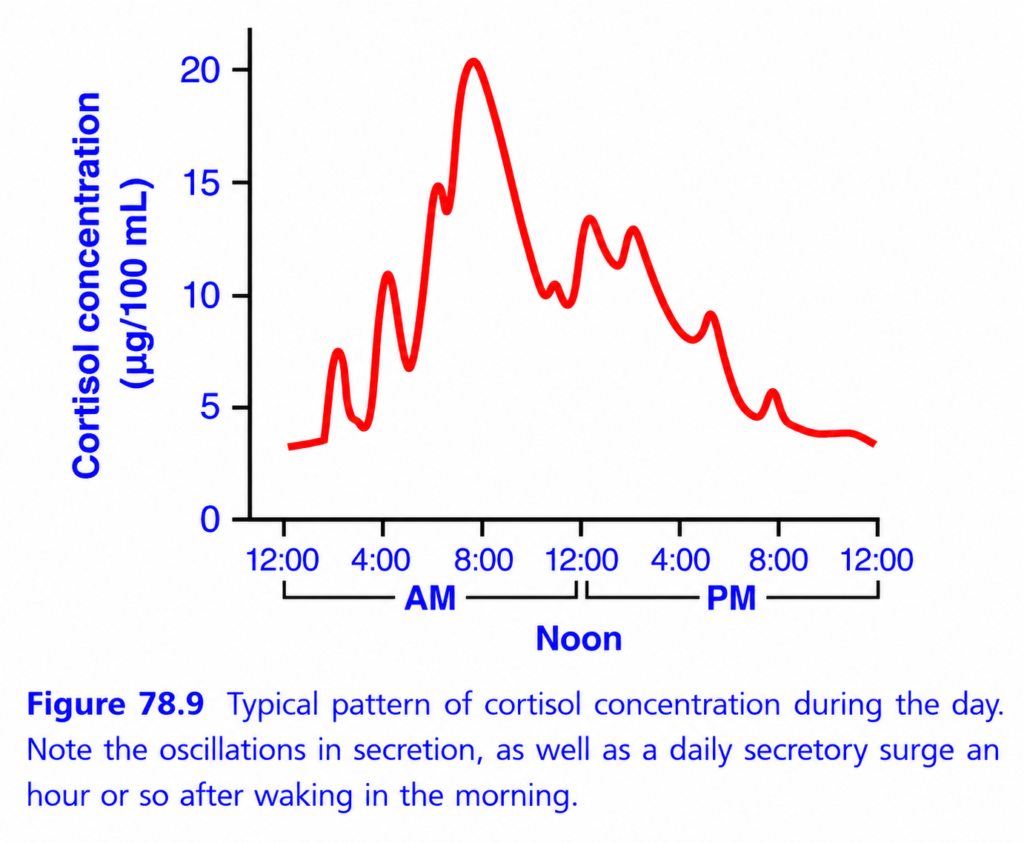
CORTISOL THROUGHOUT THE DAY
🎯 BIG IDEA
Cortisol is not constant all day.
It comes in small pulses, but there is one major daily pattern:
🌅 Highest in the morning → 🌙 Lowest at night
📊 Axes
⬆️ Y-axis = Cortisol concentration
Higher = more cortisol in blood.
➡️ X-axis = Time
12 AM → morning → noon → afternoon → 12 AM
🌙 Night → Low cortisol
Around midnight:
➡️ Cortisol is relatively low (~3–4 μg/100 mL).
🌅 Morning → HUGE SURGE ⭐
After waking:
🚀 Cortisol rapidly rises.
Peak is around 7–8 AM, reaching roughly:
20 μg/100 mL
This is the daily cortisol surge.
👉 The graph specifically highlights that this happens about 1 hour after waking.
☀️ Daytime → Gradual decrease
After the morning peak:
20 → 15 → 10 → 5 μg/100 mL
So cortisol generally falls throughout the day.
But notice the little ups and downs:
📈📉📈📉
These are small pulses/oscillations of cortisol secretion.
🌙 Evening/night → LOW
By evening and midnight:
➡️ Cortisol returns to a low level.
Then the cycle repeats the next morning. 🔄
⭐ WHY ARE THERE SMALL SPIKES?
Cortisol is secreted pulsatilely.
So the adrenal gland doesn’t release:
❌ one constant amount
Instead:
✅ small bursts + overall daily rhythm
🧠 10-SECOND MEMORY
🌙 Night
LOW
⬇️
🌅 Wake up
BIG CORTISOL SURGE 🚀
⬇️
☀️ Day
Gradually ↓ + small pulses
⬇️
🌙 Night
LOW again
🔥 Ultimate concept:
Cortisol follows a circadian rhythm: low at night, a strong surge shortly after waking, then progressively lower levels during the day, with additional small pulsatile fluctuations.
Synthesis and Secretion of ACTH in Association With Melanocyte-Stimulating Hormone, Lipotropin, and Endorphin
- When the anterior pituitary releases ACTH, several structurally related hormones can be produced at the same time.
- The POMC gene first produces a large precursor protein called pro-opiomelanocortin (POMC).
- POMC is then split into several peptides, including ACTH, MSH, β-lipotropin, and β-endorphin (Fig. 78.10).
- Normally, these other POMC-derived hormones are produced in amounts too small to have major effects, but high ACTH secretion can increase their production.
- POMC is produced in several tissues, including anterior pituitary corticotrophs, hypothalamic arcuate-nucleus neurons, skin, and lymphoid tissue.
- Different tissues have different processing enzymes, so they produce different POMC-derived peptides.
- In pituitary corticotrophs, PC1 produces ACTH and β-lipotropin.
- In the hypothalamus, PC2 produces α-MSH, β-MSH, γ-MSH, and β-endorphin, but not ACTH.
- Hypothalamic α-MSH has an important role in appetite regulation.
- MSH acts on skin melanocytes to increase formation and dispersion of melanin, causing darker skin.
- ACTH also contains an MSH sequence and has about 1/30 of MSH’s melanocyte-stimulating effect.
- Because humans secrete much more ACTH than pure MSH, ACTH is probably more important than MSH for normal skin melanin.
- In some animals, the pituitary pars intermedia produces large amounts of MSH, and its secretion can change with environmental light.
- For example, some Arctic animals have darker fur in summer and white fur in winter.
- Adrenal androgens normally have weak effects in humans, but they contribute to early male sexual development.
- In females, adrenal androgens contribute to pubic and axillary hair growth before puberty and throughout life.
- Some adrenal androgens are converted in extra-adrenal tissues into testosterone, contributing to their androgenic effects.
KEY CONCEPT
POMC → ACTH + MSH + β-lipotropin + β-endorphin; different tissues process POMC differently, so different peptides are produced.
CONCEPTUAL EXAMPLES
- High ACTH → increased POMC-derived products → possible increased pigmentation.
- Pituitary PC1 → ACTH + β-lipotropin.
- Hypothalamic PC2 → MSHs + β-endorphin, not ACTH.
- Adrenal androgens → some converted to testosterone → androgenic effects.
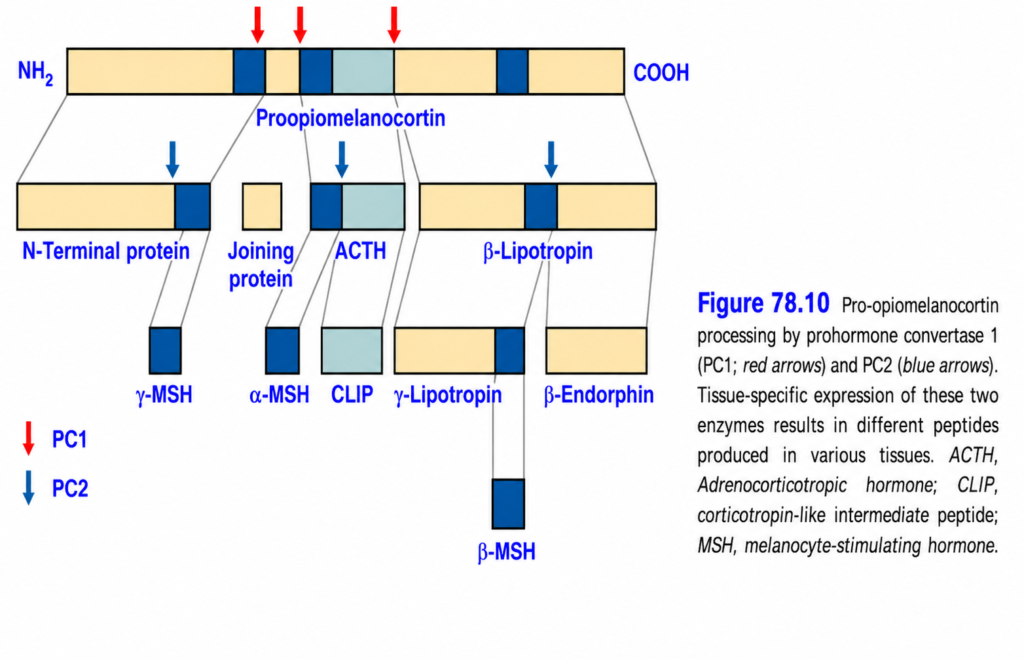
🧠 POMC Processing
The BIG IDEA:
POMC is one big “protein package” that gets cut into many different hormones/peptides. ✂️
Think of POMC = one large chocolate bar 🍫
Different enzymes cut it at different places → different pieces = different hormones.
1️⃣ START: Pro-opiomelanocortin (POMC)
The top long bar is:
POMC
It contains the information for several smaller peptides.
But POMC itself is not simply released as one final hormone.
It must be cut/processed.
✂️ 2️⃣ TWO IMPORTANT ENZYMES
The image shows:
🔴 PC1
Prohormone convertase 1
🔵 PC2
Prohormone convertase 2
Think:
PC1 and PC2 = molecular scissors ✂️
Different tissues contain different amounts of these scissors.
Therefore:
Different tissue → different cuts → different products.🧩 3️⃣ WHAT DOES PC1 PRODUCE?
PC1 processing produces major pieces including:
ACTH
and
β-lipotropin
So remember:
PC1 → ACTH + β-lipotropin
🧩 4️⃣ ACTH CAN BE PROCESSED FURTHER
ACTH contains sequences that can give rise to:
α-MSH
and
CLIP
So:
ACTH → α-MSH + CLIP
🧩 5️⃣ β-LIPOTROPIN CAN ALSO BE CUT
β-lipotropin can produce:
γ-lipotropin
and
β-endorphin
And β-endorphin can be further processed to:
β-MSH
So:
β-lipotropin → γ-lipotropin + β-endorphin → β-MSH
🎯 WHY DOES THE BODY DO THIS?
Because the same POMC molecule can serve as a precursor for multiple biologically active peptides.
The important concept is:
One precursor → many peptides
And:
Different tissues use different enzymes → different peptides are produced.
🧠 SUPER-SIMPLE MAP
POMC │ ┌─────┴─────┐ ↓ ↓ ACTH β-lipotropin │ │ ┌───┴───┐ ┌───┴────────┐ ↓ ↓ ↓ ↓ α-MSH CLIP γ-lipotropin β-endorphin │ ↓ β-MSH
🚨 HIGH-YIELD POINT
🔴 PC1 = first major cutter
Produces:
ACTH + β-lipotropin
🔵 PC2 = further processing
Produces smaller peptides such as:
α-MSH, β-MSH, CLIP, β-endorphin, γ-lipotropin
🏆 MASTER MEMORY
POMC = BIG PRECURSOR.
PC1 & PC2 = SCISSORS. ✂️
Different scissors/tissues make different peptide products.
Most important chain:
POMC → ACTH → α-MSH
and
POMC → β-lipotropin → β-endorphin → β-MSH
🔑 One-line exam answer:
Pro-opiomelanocortin (POMC) is a large precursor protein that is tissue-specifically cleaved by prohormone convertases PC1 and PC2 to produce ACTH, MSH peptides, β-endorphin, and other biologically active peptides.
