


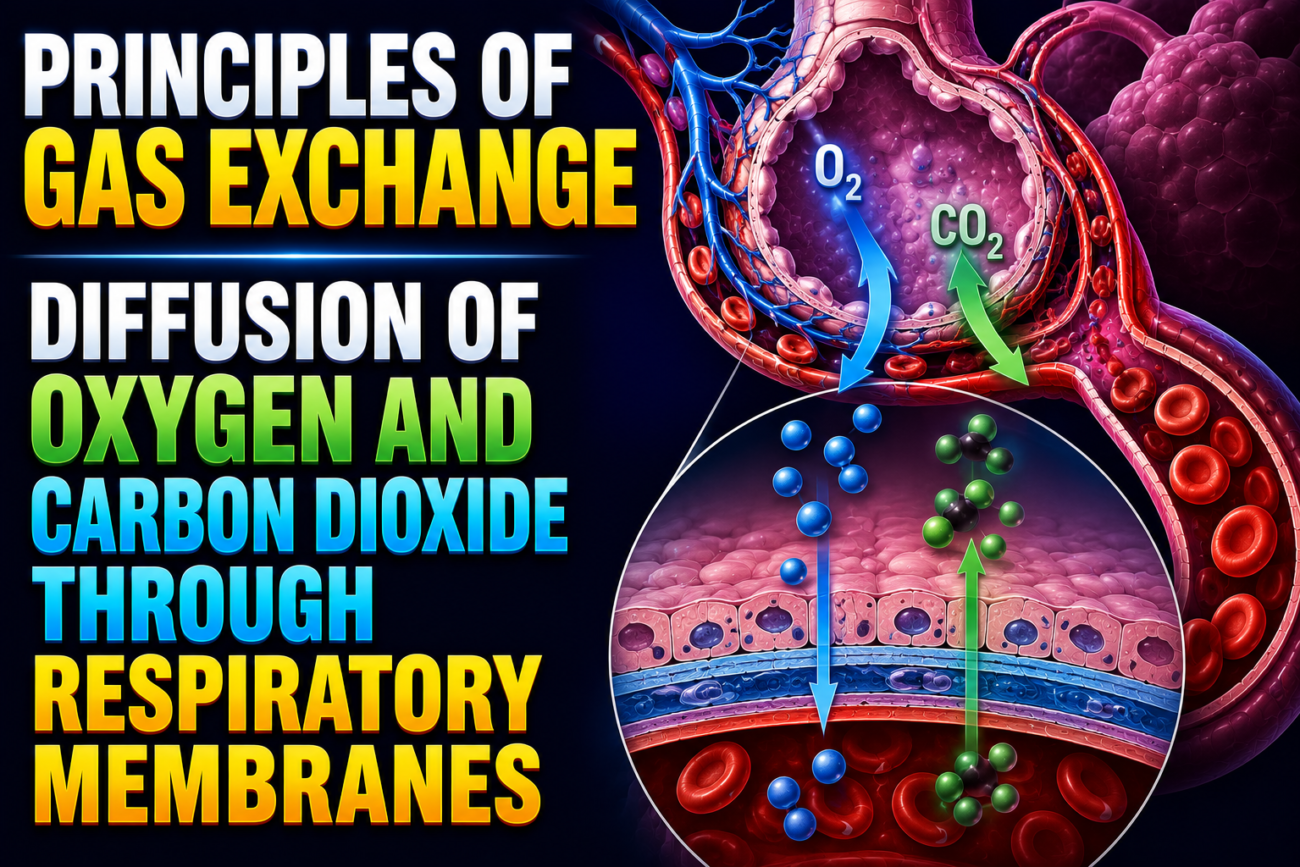
After the Alveoli Are Ventilated With Fresh Air
Slide 1: Next Step After Alveolar Ventilation
- After the alveoli receive fresh air, the next step of respiration begins.
- Oxygen (O₂) diffuses from the alveoli into the pulmonary blood.
- Carbon dioxide (CO₂) diffuses from the pulmonary blood into the alveoli.
- This exchange happens in opposite directions at the same time.
Slide 2: Process of Diffusion
- Diffusion is the random movement of gas molecules.
- Molecules move in all directions.
- They pass through the respiratory membrane and the nearby fluids.
Slide 3: Diffusion in Respiratory Physiology
- In respiratory physiology, it is important to understand:
- How diffusion occurs.
- How fast diffusion occurs.
Slide 4: Rate of Diffusion
- The basic mechanism of diffusion is simple.
- The rate of diffusion is more complex.
- Understanding the rate of diffusion requires:
- A deeper knowledge of the physics of diffusion.
- An understanding of gas exchange across the respiratory membranes.
Key Concept
- After alveolar ventilation, oxygen diffuses from the alveoli into the pulmonary blood, while carbon dioxide diffuses from the blood into the alveoli. Diffusion is the random movement of molecules through the respiratory membrane, and understanding the rate of diffusion requires knowledge of the physics of diffusion and gas exchange.
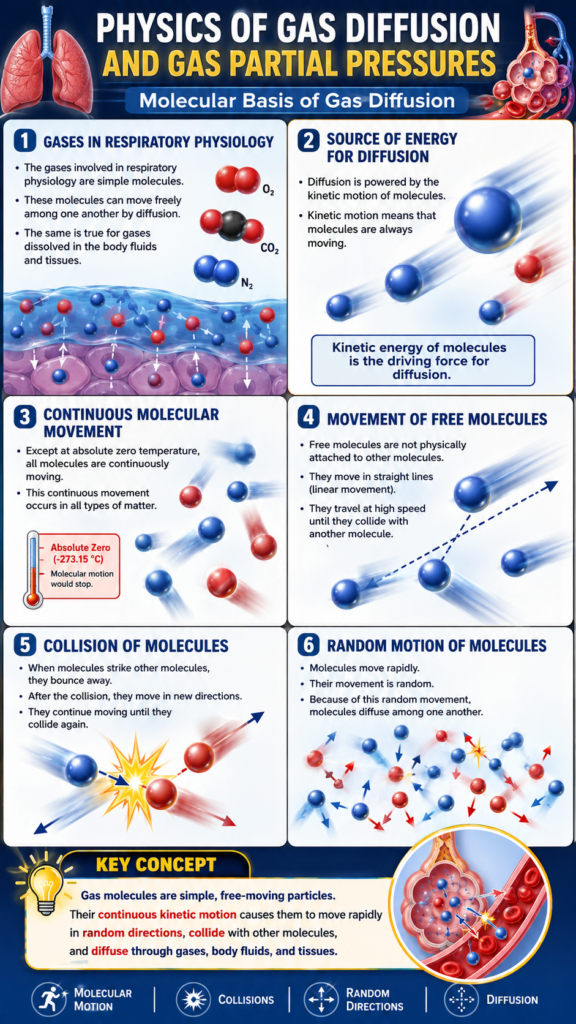
Physics of Gas Diffusion and Gas Partial Pressures
Molecular Basis of Gas Diffusion
Slide 1: Gases in Respiratory Physiology
- The gases involved in respiratory physiology are simple molecules.
- These molecules can move freely among one another by diffusion.
- The same is true for gases dissolved in the body fluids and tissues.
Slide 2: Source of Energy for Diffusion
- Diffusion is powered by the kinetic motion of molecules.
- Kinetic motion means that molecules are always moving.
Slide 3: Continuous Molecular Movement
- Except at absolute zero temperature, all molecules are continuously moving.
- This continuous movement occurs in all types of matter.
Slide 4: Movement of Free Molecules
- Free molecules are not physically attached to other molecules.
- They move in straight lines (linear movement).
- They travel at high speed until they collide with another molecule.
Slide 5: Collision of Molecules
- When molecules strike other molecules, they bounce away.
- After the collision, they move in new directions.
- They continue moving until they collide again.
Slide 6: Random Motion of Molecules
- Molecules move rapidly.
- Their movement is random.
- Because of this random movement, molecules diffuse among one another.
Key Concept
- Gas molecules are simple, free-moving particles. Their continuous kinetic motion causes them to move rapidly in random directions, collide with other molecules, and diffuse through gases, body fluids, and tissues.
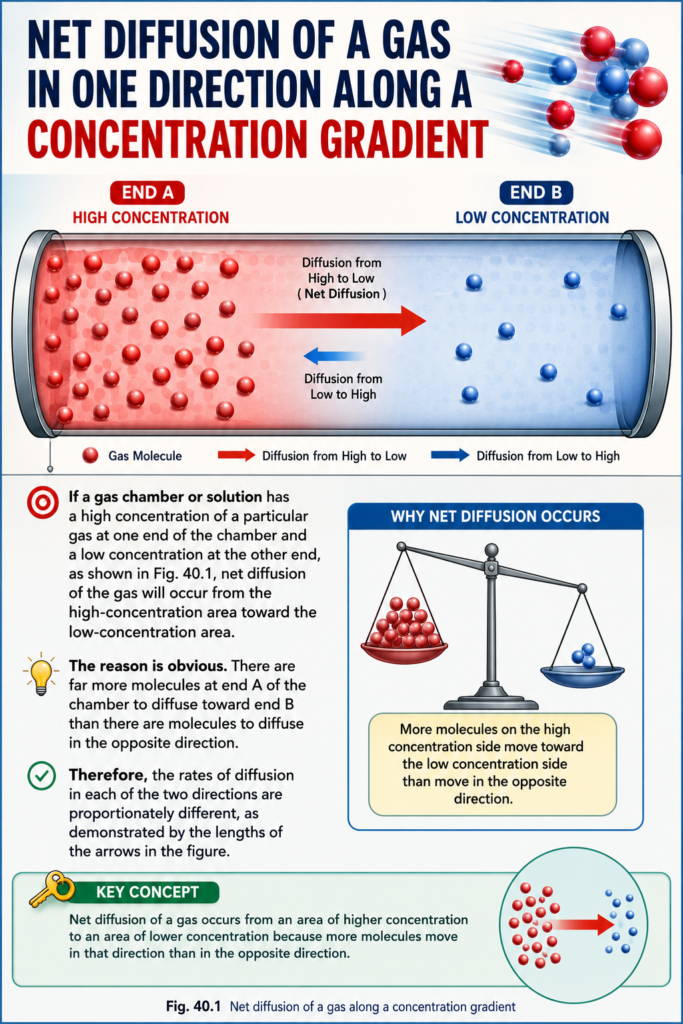
Net Diffusion of a Gas in One Direction Along a Concentration Gradient
Figure: Fig. 40.1
Concentration Gradient
- A gas chamber or solution may have:
- A high concentration of a gas at one end.
- A low concentration of the same gas at the other end.
- (Fig. 40.1)
Direction of Net Diffusion
- Net diffusion occurs from the high-concentration area.
- The gas moves toward the low-concentration area.
- (Fig. 40.1)
Reason for Net Diffusion
- There are many more gas molecules at end A.
- These molecules diffuse toward end B.
- Fewer molecules are present at end B to diffuse back toward end A.
Difference in Diffusion Rates
- Diffusion occurs in both directions.
- The diffusion rate from A to B is greater.
- The diffusion rate from B to A is lower.
- Therefore, there is net diffusion from A to B.
- (Fig. 40.1)
Representation in the Figure
- The different diffusion rates are shown by arrows of different lengths.
- Longer arrows represent a higher diffusion rate.
- Shorter arrows represent a lower diffusion rate.
- (Fig. 40.1)
Key Concept
- When a gas has a higher concentration at one end and a lower concentration at the other, net diffusion occurs from the high-concentration area to the low-concentration area because more molecules move from the high-concentration side than from the low-concentration side.
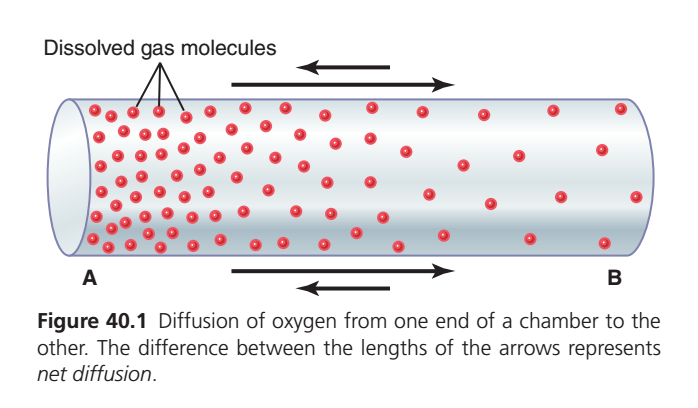
Figure 40.1 – Net Diffusion of a Gas (Guyton Physiology)
Super Easy Concept
What is happening?
- The tube contains oxygen molecules dissolved in fluid.
- Side A has many oxygen molecules (high concentration).
- Side B has fewer oxygen molecules (low concentration).
➡️ Molecules are always moving randomly in both directions.
Why is there net movement from A → B?
- Since Side A has many more molecules, more molecules leave A every second.
- Since Side B has fewer molecules, fewer molecules move back to A.
Therefore:
Movement A → B > Movement B → A
✅ Result = Net diffusion from A to B
Easy Memory Formula
High Concentration ➜ Low Concentration
or
More Molecules ➜ Fewer Molecules
until both sides become equal.
What do the arrows mean?
- Long arrow (A → B): More oxygen molecules moving.
- Short arrow (B → A): Fewer oxygen molecules moving back.
➡️ Difference between the two arrows = Net diffusion
Not all molecules move only one way—they move both ways, but more move from the high-concentration side to the low-concentration side.
Simple Analogy
Imagine 100 students in Room A and 20 students in Room B.
- Every minute, some students walk between both rooms.
- Since Room A has many more students, more students leave A.
- Room B has fewer students, so fewer return.
➡️ Overall movement is A → B until both rooms have about the same number of students.
Exam Concept (One Line)
Net diffusion is the overall movement of gas molecules from an area of higher concentration to an area of lower concentration because more molecules move in that direction than in the opposite direction.
Ultra-Short Revision
- A = High concentration
- B = Low concentration
- Molecules move both ways
- More move from A → B
- Net diffusion = High concentration → Low concentration
- Continues until concentrations become equal
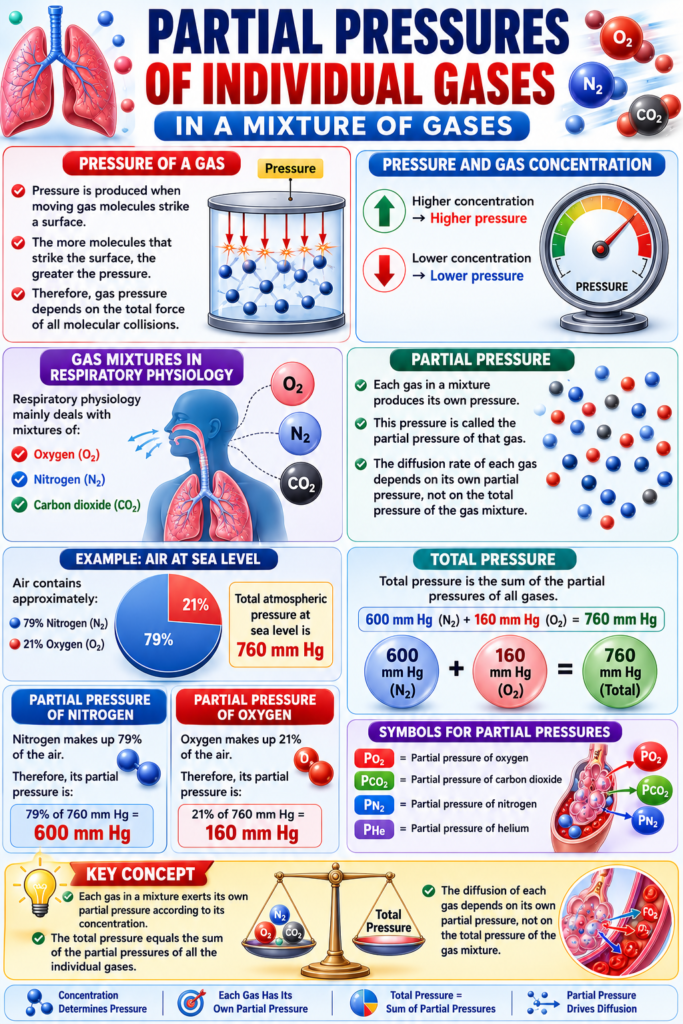
Partial Pressures of Individual Gases in a Mixture of Gases
Pressure of a Gas
- Pressure is produced when moving gas molecules strike a surface.
- The more molecules that strike the surface, the greater the pressure.
- Therefore, gas pressure depends on the total force of all molecular collisions.
Pressure and Gas Concentration
- Gas pressure is directly proportional to the concentration of gas molecules.
- Higher concentration → Higher pressure
- Lower concentration → Lower pressure
Gas Mixtures in Respiratory Physiology
- Respiratory physiology mainly deals with mixtures of:
- Oxygen (O₂)
- Nitrogen (N₂)
- Carbon dioxide (CO₂)
Partial Pressure
- Each gas in a mixture produces its own pressure.
- This pressure is called the partial pressure of that gas.
- The diffusion rate of each gas depends on its own partial pressure, not on the total pressure of the gas mixture.
Example: Air at Sea Level
- Air contains approximately:
- 79% Nitrogen (N₂)
- 21% Oxygen (O₂)
- The total atmospheric pressure at sea level is 760 mm Hg.
Partial Pressure of Nitrogen
- Nitrogen makes up 79% of the air.
- Therefore, its partial pressure is:
- 79% of 760 mm Hg = 600 mm Hg
Partial Pressure of Oxygen
- Oxygen makes up 21% of the air.
- Therefore, its partial pressure is:
- 21% of 760 mm Hg = 160 mm Hg
Total Pressure
- Total pressure is the sum of the partial pressures of all gases.
- 600 mm Hg (N₂) + 160 mm Hg (O₂) = 760 mm Hg
Symbols for Partial Pressures
- PO₂ = Partial pressure of oxygen
- PCO₂ = Partial pressure of carbon dioxide
- PN₂ = Partial pressure of nitrogen
- PHe = Partial pressure of helium
Key Concept
- Each gas in a mixture exerts its own partial pressure according to its concentration. The total pressure equals the sum of the partial pressures of all the individual gases, and the diffusion of each gas depends on its own partial pressure.
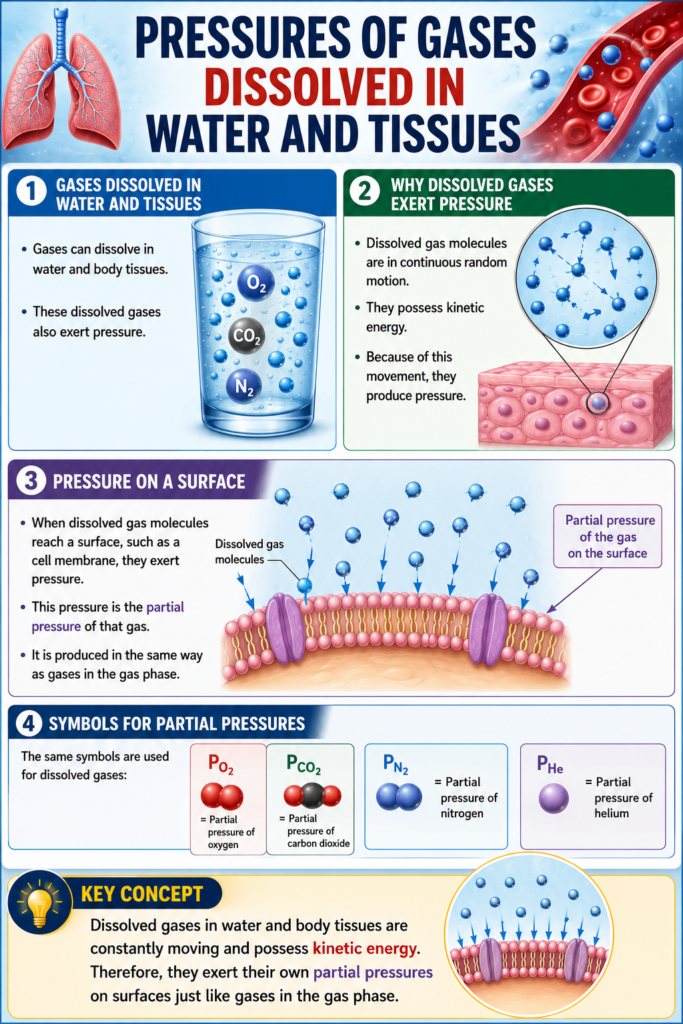
Pressures of Gases Dissolved in Water and Tissues
Gases Dissolved in Water and Tissues
- Gases can dissolve in water and body tissues.
- These dissolved gases also exert pressure.
Why Dissolved Gases Exert Pressure
- Dissolved gas molecules are in continuous random motion.
- They possess kinetic energy.
- Because of this movement, they produce pressure.
Pressure on a Surface
- When dissolved gas molecules reach a surface, such as a cell membrane, they exert pressure.
- This pressure is the partial pressure of that gas.
- It is produced in the same way as gases in the gas phase.
Symbols for Partial Pressures
- The same symbols are used for dissolved gases:
- PO₂ = Partial pressure of oxygen
- PCO₂ = Partial pressure of carbon dioxide
- PN₂ = Partial pressure of nitrogen
- PHe = Partial pressure of helium
Key Concept
- Dissolved gases in water and body tissues are constantly moving and possess kinetic energy. Therefore, they exert their own partial pressures on surfaces just like gases in the gas phase.
Factors That Determine Partial Pressure of a Gas Dissolved in a Fluid
Factors Determining Partial Pressure
- The partial pressure of a dissolved gas depends on:
- The concentration of the gas
- The solubility coefficient of the gas
Effect of Solubility
- Some gases, especially carbon dioxide (CO₂), are attracted to water molecules.
- Because of this attraction, a large amount of CO₂ can dissolve without producing a high partial pressure.
Gases With Low Solubility
- Some gases are repelled by water molecules.
- These gases produce a high partial pressure even when only a small amount is dissolved.
Henry’s Law
Partial Pressure=Solubility CoefficientConcentration of Dissolved Gas
Easy Concept of Henry’s Law
- Higher concentration → Higher partial pressure
- Higher solubility coefficient → Lower partial pressure
- Therefore:
- A gas that dissolves easily produces less partial pressure.
- A gas that dissolves poorly produces more partial pressure.
Solubility Coefficients at Body Temperature
- Oxygen (O₂) = 0.024
- Carbon dioxide (CO₂) = 0.57
- Carbon monoxide (CO) = 0.018
- Nitrogen (N₂) = 0.012
- Helium (He) = 0.008
Comparison of CO₂ and O₂
- CO₂ is more than 20 times as soluble as O₂.
- Therefore, for the same dissolved concentration:
- CO₂ produces less than one-twentieth (5%) of the partial pressure produced by O₂.
Key Concept
- The partial pressure of a dissolved gas depends on both its concentration and its solubility. According to Henry’s law, partial pressure increases with concentration but decreases as solubility increases. Because CO₂ is much more soluble than O₂, it produces a much lower partial pressure at the same dissolved concentration.
Henry’s Law
Partial Pressure=Solubility CoefficientConcentration of Dissolved Gas
Easy Concept
Think of partial pressure as the “escaping force” of a dissolved gas.
- Concentration tells us how much gas is dissolved.
- Solubility coefficient tells us how easily that gas stays dissolved in the fluid.
Rule 1: If Concentration Increases
- More gas molecules are present.
- More molecules try to escape from the fluid.
- Partial pressure increases (↑).
Easy Memory
- More dissolved gas → More pressure
Rule 2: If Solubility Increases
- The gas dissolves more easily.
- More molecules remain dissolved in the fluid.
- Fewer molecules try to escape.
- Partial pressure decreases (↓).
Easy Memory
- More soluble gas → Less pressure
Rule 3: If Solubility Decreases
- The gas does not dissolve easily.
- Molecules escape more readily.
- Partial pressure increases (↑).
Easy Memory
- Less soluble gas → More pressure
Easy Comparison
| Gas | Solubility | Partial Pressure (for the same dissolved amount) |
|---|---|---|
| CO₂ | Very High | Very Low |
| O₂ | Lower | Higher |
Super Easy Trick
Imagine two students in a classroom:
- CO₂ likes the classroom (water).
- It stays inside quietly.
- It does not try to leave.
- Low partial pressure.
- O₂ does not like the classroom.
- It wants to leave quickly.
- It pushes against the door.
- High partial pressure.
One-Line Formula Memory
- ↑ Concentration = ↑ Partial Pressure
- ↑ Solubility = ↓ Partial Pressure
- ↓ Solubility = ↑ Partial Pressure
Key Concept
- Partial pressure depends on two things: the amount of dissolved gas and how easily the gas dissolves. More dissolved gas increases partial pressure, while greater solubility decreases partial pressure because the gas remains dissolved instead of escaping.
Diffusion of Gases Between Gas Phase in Alveoli and Dissolved Phase in Pulmonary Blood
Gas Diffusion From Alveoli to Blood
- Each gas in the alveoli has its own partial pressure.
- This partial pressure pushes gas molecules into the blood of the pulmonary capillaries.
Gas Diffusion From Blood to Alveoli
- Gas molecules already dissolved in the blood are also moving randomly.
- Some of these molecules escape back into the alveoli.
- The rate of escape depends on the partial pressure of the gas in the blood.
Direction of Net Diffusion
- Net diffusion depends on the difference in partial pressures between the alveoli and the blood.
Oxygen (O₂) Diffusion
- Normally, the partial pressure of O₂ is higher in the alveoli than in the blood.
- Therefore, more O₂ diffuses from the alveoli into the blood than from the blood into the alveoli.
Carbon Dioxide (CO₂) Diffusion
- Normally, the partial pressure of CO₂ is higher in the blood than in the alveoli.
- Therefore, more CO₂ diffuses from the blood into the alveoli than from the alveoli into the blood.
Rule of Gas Diffusion
- A gas always diffuses from higher partial pressure to lower partial pressure until equilibrium is reached.
Key Concept
- The direction of gas diffusion is determined by the difference in partial pressures. Oxygen normally diffuses from the alveoli to the blood because its partial pressure is higher in the alveoli, while carbon dioxide diffuses from the blood to the alveoli because its partial pressure is higher in the blood.
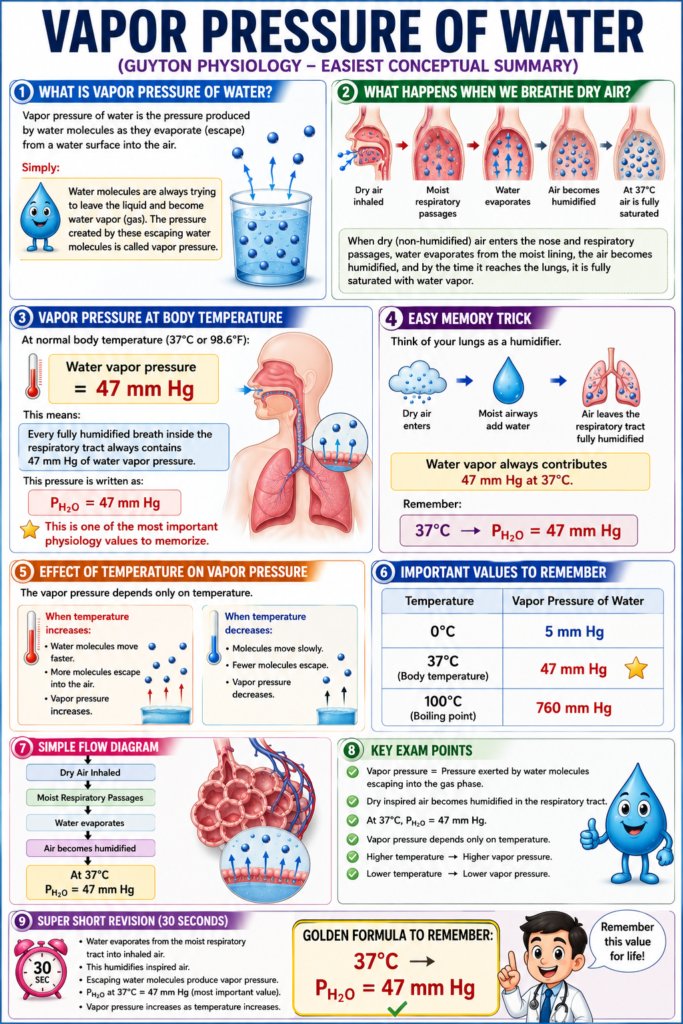
Vapor Pressure of Water (Guyton Physiology) – Easiest Conceptual Summary
🌊 What is Vapor Pressure of Water?
Vapor pressure of water is the pressure produced by water molecules as they evaporate (escape) from a water surface into the air.
👉 Simply:
Water molecules are always trying to leave the liquid and become water vapor (gas).
The pressure created by these escaping water molecules is called vapor pressure.
💨 What Happens When We Breathe Dry Air?
When dry (non-humidified) air enters the nose and respiratory passages:
- The air is initially dry.
- Water evaporates from the moist lining of the respiratory tract.
- The inhaled air becomes humidified.
- Eventually, the air becomes fully saturated with water vapor.
So, by the time air reaches the lungs, it contains water vapor.
🌡️ Vapor Pressure at Body Temperature
At normal body temperature (37°C or 98.6°F):
- Water vapor pressure = 47 mm Hg
This means:
Every fully humidified breath inside the respiratory tract always contains 47 mm Hg of water vapor pressure.
This pressure is written as:
PH₂O = 47 mm Hg
⭐ This is one of the most important physiology values to memorize.
🧠 Easy Memory Trick
Think of your lungs as a humidifier.
- Dry air enters.
- Moist airways add water.
- Air leaves the respiratory tract fully humidified.
- Water vapor always contributes 47 mm Hg at 37°C.
Remember:
37°C → PH₂O = 47 mm Hg
🌡️ Effect of Temperature on Vapor Pressure
The vapor pressure depends only on temperature.
Why?
When temperature increases:
- Water molecules move faster.
- More molecules escape into the air.
- Vapor pressure increases.
When temperature decreases:
- Molecules move slowly.
- Fewer molecules escape.
- Vapor pressure decreases.
📊 Important Values to Remember
| Temperature | Vapor Pressure of Water |
|---|---|
| 0°C | 5 mm Hg |
| 37°C (Body temperature) | 47 mm Hg ⭐ |
| 100°C (Boiling point) | 760 mm Hg |
🎯 Simple Flow Diagram
Dry Air Inhaled
        │
        ▼
Moist Respiratory Passages
        │
Water evaporates
        │
        ▼
Air becomes humidified
        │
        ▼
At 37°C
PH₂O = 47 mm Hg
Key Exam Points
- Vapor pressure = Pressure exerted by water molecules escaping into the gas phase.
- Dry inspired air becomes humidified in the respiratory tract.
- At 37°C, PH₂O = 47 mm Hg.
- Vapor pressure depends only on temperature.
- Higher temperature → Higher vapor pressure.
- Lower temperature → Lower vapor pressure.
Super Short Revision (30 Seconds)
- Water evaporates from the moist respiratory tract into inhaled air.
- This humidifies inspired air.
- Escaping water molecules produce vapor pressure.
- PH₂O at 37°C = 47 mm Hg (most important value).
- Vapor pressure increases as temperature increases.
Golden Formula to Remember:
37°C ⟶ PH₂O = 47 mm Hg ✅
pressure Difference Causes Net Diffusion of Gases Through Fluids (Guyton Physiology) – Easiest Conceptual Summary
🌬️ Main Concept
Gases always diffuse (move) from an area of higher partial pressure to an area of lower partial pressure.
👉 Simply:
High Pressure → Low Pressure
This pressure difference is the driving force for gas diffusion.
🧠 Why Does This Happen?
Imagine there are two rooms connected by an open door.
Room A
- Many oxygen molecules
- High partial pressure
Room B
- Few oxygen molecules
- Low partial pressure
Because Room A has more gas molecules, more molecules randomly move into Room B than the other way around.
Result:
➡️ Net movement is from Room A to Room B.
⚖️ Molecules Move in Both Directions
An important point:
Gas molecules never move in only one direction.
They are always moving randomly.
So,
- Some molecules move High → Low ✅
- Some molecules move Low → High ✅
But…
Because there are many more molecules in the high-pressure area,
➡️ More molecules travel High → Low than Low → High.
Therefore,
Net diffusion = High Pressure → Low Pressure
📊 What is Net Diffusion?
Net diffusion means the overall movement after subtracting movement in both directions.
Formula
Net Diffusion = (High → Low movement) − (Low → High movement)
🚗 Easy Everyday Example
Imagine:
Station A
👨👨👨👨👨👨👨👨👨👨 (100 people)
Station B
👨👨 (20 people)
Both stations allow people to walk randomly.
- 40 people go from A → B.
- 10 people go from B → A.
Net Movement
40 − 10 = 30 people move from A to B
Exactly the same happens with gas molecules.
🌬️ In the Lungs
Alveoli
- Oxygen partial pressure = High
Pulmonary Blood
- Oxygen partial pressure = Low
Therefore,
Oxygen diffuses from alveoli → blood.
Carbon Dioxide
Blood
- CO₂ partial pressure = High
Alveoli
- CO₂ partial pressure = Low
Therefore,
CO₂ diffuses from blood → alveoli.
📈 What Determines the Speed of Diffusion?
The pressure difference (partial pressure difference) determines how much net diffusion occurs.
Small Pressure Difference
High Pressure ───► Low Pressure

Slow diffusion
Large Pressure Difference
Very High Pressure ─────────► Very Low Pressure

Fast diffusion
Rule
Greater pressure difference = Faster net diffusion
🎯 Simple Flow Diagram
High Partial Pressure
        │
        ▼
More molecules move forward
        │
Some molecules move backward
        │
        ▼
Forward movement > Backward movement
        │
        ▼
Net Diffusion
        │
        ▼
High Pressure → Low Pressure
Key Exam Points
- Gas molecules move randomly in all directions.
- Molecules move both ways, but the net movement is from higher to lower partial pressure.
- Pressure difference is the driving force for diffusion.
- Larger pressure difference → Greater and faster diffusion.
- Net diffusion = Forward movement − Backward movement.
Super Short Revision (30 Seconds)
- Gases diffuse because of partial pressure differences.
- Molecules move in both directions randomly.
- More molecules move from high pressure to low pressure.
- Net diffusion is the difference between forward and backward movement.
- Greater pressure difference = Faster diffusion.
⭐ Golden Rule
High Partial Pressure → Low Partial Pressure = Net Gas Diffusion ✅
Quantifying Net Rate of Diffusion in Fluids
📖 Figure Mentioned: Figure 40.1
- The rate of gas diffusion depends on five factors:
- Partial pressure difference (ΔP)
- Solubility of the gas (S)
- Cross-sectional area (A)
- Diffusion distance (d)
- Molecular weight (MW)
- In the human body, temperature remains almost constant, so it usually does not need to be considered.
- A gas with higher solubility has more molecules available to diffuse at the same partial pressure difference.
- A larger cross-sectional area allows more gas molecules to diffuse at the same time.
- A longer diffusion distance makes diffusion slower because molecules take more time to travel.
- Gas molecules with lower molecular weight move faster.
- The speed of molecular movement is inversely proportional to the square root of the molecular weight.
- Therefore, gases with lower molecular weight diffuse faster.
Diffusion Formula
D=d×MWΔP×A×S
Easy Concept of the Formula
- D = Rate of diffusion
- ΔP = Partial pressure difference
- A = Cross-sectional area available for diffusion
- S = Solubility of the gas
- d = Distance through which the gas diffuses
- √MW = Square root of the molecular weight of the gas
Formula Made Easy
Diffusion increases (↑) when:
- ↑ Partial pressure difference (ΔP)
- ↑ Cross-sectional area (A)
- ↑ Solubility (S)
Diffusion decreases (↓) when:
- ↑ Diffusion distance (d)
- ↑ Molecular weight (MW)
Diffusion Coefficient
- The solubility and molecular weight of a gas together determine its diffusion coefficient.
- Diffusion coefficient is proportional to:
MWS
- Gases with a higher diffusion coefficient diffuse faster at the same partial pressure.
Relative Diffusion Coefficients
- Oxygen (O₂) = 1.0
- Carbon dioxide (CO₂) = 20.3
- Carbon monoxide (CO) = 0.81
- Nitrogen (N₂) = 0.53
- Helium (He) = 0.95
KEY CONCEPT
- Gas diffusion depends on partial pressure difference, solubility, cross-sectional area, diffusion distance, and molecular weight.
- Higher ΔP, larger area, and greater solubility increase diffusion.
- Greater diffusion distance and higher molecular weight decrease diffusion.
- Diffusion coefficient = Solubility ÷ √Molecular weight.
- Carbon dioxide diffuses much faster than oxygen because it has a much higher diffusion coefficient.
D=d×MW ΔP×A×S solve this EQUATION INTO EASIEST AND CONCEPTUAL UNDERSTANDING WAY
Diffusion Equation – Easiest Conceptual Understanding
The diffusion equation is:D=d×MWΔP×A×S
Understand the Equation Like a “Traffic Road”
Imagine gas molecules are cars traveling from one city to another.
Factors That Increase Diffusion (Numerator ↑)
The top part of the equation contains factors that increase diffusion.ΔP×A×S
- ΔP (Pressure Difference) ↑
- Bigger pressure difference = Stronger pushing force
- ✅ More diffusion
- A (Cross-sectional Area) ↑
- Wider road = More cars can pass together
- ✅ More diffusion
- S (Solubility) ↑
- Gas dissolves more easily in the fluid
- ✅ More molecules available to diffuse
- ✅ More diffusion
Factors That Decrease Diffusion (Denominator ↑)
The bottom part contains factors that slow diffusion.
- d (Distance) ↑
- Longer distance = Molecules travel farther
- ❌ Slower diffusion
- √MW (Square Root of Molecular Weight) ↑
- Heavier gas molecules move more slowly
- ❌ Slower diffusion
Easy Memory Formula
           MORE DIFFUSION
      ↑ Pressure Difference (ΔP)
      ↑ Area (A)
      ↑ Solubility (S)
──────────────────────────────────
      ↓ Distance (d)
      ↓ Molecular Weight (√MW)
Super Easy Trick
Think of diffusion like people walking through a hallway.
Faster Diffusion ✔
- Bigger push behind them (↑ ΔP)
- Wider hallway (↑ A)
- People can move easily (↑ S)
- Short hallway (↓ d)
- Lightweight people running (↓ MW)
➡️ Diffusion becomes FAST
Slower Diffusion ❌
- Small push (↓ ΔP)
- Narrow hallway (↓ A)
- Gas dissolves poorly (↓ S)
- Long hallway (↑ d)
- Heavy molecules (↑ MW)
➡️ Diffusion becomes SLOW
One-Line Exam Rule
Diffusion is directly proportional to Pressure Difference, Area, and Solubility, but inversely proportional to Diffusion Distance and the Square Root of Molecular Weight.
Quick Memory Shortcut
“PAS ↑ = Diffusion ↑”
- P = Pressure Difference (ΔP)
- A = Area
- S = Solubility
“DM ↓ = Diffusion ↓”
- D = Distance
- M = Molecular Weight (√MW)
Golden Formula:
- ↑ ΔP, ↑ A, ↑ S → ↑ Diffusion
- ↑ d, ↑ √MW → ↓ Diffusion ✅
The expression is:MWS
This represents the Diffusion Coefficient of a gas.
Easiest Conceptual Understanding
Think of it as:
How easily a gas can diffuse through a fluid.
Top of the Formula (S)
S = Solubility
- Higher solubility = Gas dissolves more easily in the fluid.
- More dissolved gas molecules are available to diffuse.
✅ Higher S = Faster Diffusion
Bottom of the Formula (√MW)
√MW = Square Root of Molecular Weight
- Lower molecular weight = Lighter gas molecules move faster.
- Higher molecular weight = Heavier gas molecules move slower.
✅ Lower √MW = Faster Diffusion
Easy Rule
           S
Diffusion ∝ ─────
          √MW
If Solubility Increases (↑S)
⬆️ Diffusion Coefficient Increases
➡️ Gas diffuses faster
If Molecular Weight Increases (↑MW)
⬇️ Diffusion Coefficient Decreases
➡️ Gas diffuses slower
Everyday Example
Imagine two runners:
- 🏃 Runner A is lightweight (low MW) and runs on a smooth road (high S).
- ✅ Runs very fast.
- 🚶 Runner B is heavy (high MW) and runs on a rough road (low S).
- ❌ Runs slowly.
Gas molecules behave in a similar way during diffusion.
Key Concept
- S (Solubility) ↑ → Diffusion Coefficient ↑ → Faster diffusion
- MW (Molecular Weight) ↑ → Diffusion Coefficient ↓ → Slower diffusion
- Diffusion Coefficient ∝ S / √MW
- A gas diffuses fastest when it has high solubility and low molecular weight.
Diffusion of Gases Through Tissues
- Respiratory gases are highly soluble in lipids (fats).
- Therefore, these gases pass through cell membranes very easily.
- Cell membranes do not significantly slow the movement of gases.
- The main factor that limits gas movement is diffusion through the water present in tissues.
- Gases diffuse more slowly through tissue water than through cell membranes.
- Therefore, gas diffusion through tissues, including the respiratory membrane, is almost the same as diffusion through water.
KEY CONCEPT
- Respiratory gases are highly lipid-soluble, so they cross cell membranes easily.
- The main barrier to gas diffusion is tissue water, not the cell membrane.
- Gas diffusion through tissues ≈ Gas diffusion through water.
MADE BY SELF LEARNING CEO AND FOUNDER DR SHEEN
