


- To understand the optical system of the eye, we first need the basic principles of optics.
- Important concepts include:
- Refraction of light → bending of light when it passes from one medium to another
- Focusing → bringing light rays together to form a clear image
- Depth of focus → range over which an image remains acceptably clear ( Depth of focus means the range over which the image remains clear even if the exact focus shifts slightly.
- In the eye:
- Greater depth of focus → small focusing error → image still looks clear.
- A small pupil increases depth of focus, because it blocks many peripheral light rays and allows mainly central rays to enter.
- Easy example: Like a camera with a small aperture—more objects at slightly different distances stay in focus. )
- These basic physical principles help explain how the eye focuses light and forms images.
KEY CONCEPT
- Optics of the eye depends mainly on refraction + focusing + depth of focus.
- First understand basic light physics → then the optical function of the eye becomes easier.
CONCEPTUAL EXAMPLE
- Light enters the eye → bends at optical surfaces → becomes focused on the retina → clear vision.
Refraction of Light
Refractive Index of a Transparent Substance
- Light travels fastest in air at about 300,000 km/sec.
- In transparent solids and liquids, light travels more slowly.
- Refractive index tells us how much a substance slows down light.
- Formula: Refractive index = Velocity of light in air ÷ Velocity of light in the substance
- Refractive index of air = 1.00.
- Example for glass: 300,000 ÷ 200,000 = 1.50
- Therefore, the refractive index of this glass is 1.50.
KEY CONCEPT
- Higher refractive index → light travels more slowly in that substance.
- Air = 1.00
- Glass example = 1.50
CONCEPTUAL EXAMPLE
- Air → light speed 300,000 km/sec
- Glass → light speed 200,000 km/sec
- So: 300,000 / 200,000 = 1.5 → refractive index of glass = 1.5
Refraction of Light Rays at an Interface Between Two Media With Different Refractive Indices
- When light passes from one medium to another, what happens depends on the angle of the interface and the refractive indices of the two media.
- If light strikes the interface perpendicularly, as in Fig. 50.1A:
- light continues straight
- there is no bending
- speed decreases in the second medium
- wavelength becomes shorter
- Therefore: Perpendicular entry → ↓ speed + ↓ wavelength → no change in direction
- If light strikes an angled interface, as in Fig. 50.1B, and the two media have different refractive indices → the light bends.
- Example:
- Air refractive index = 1.00
- Glass refractive index = 1.50
- Light speed in air ≈ 300,000 km/sec
- Light speed in glass ≈ 200,000 km/sec
- At the angled surface, the lower part of the light beam enters glass first.
- That lower part immediately slows: 300,000 → 200,000 km/sec
- The upper part is still traveling faster in air.
- Therefore: one part slows before the other → wave front becomes tilted → direction of the whole light beam changes
- Light always travels perpendicular to its wave front, ( Wave front = the “front line” of a light wave.
- Think of water waves:
- One wave line moving forward = wave front
- For light:
- Wave front shows where the light wave has reached at that moment.
- Very easy rule:
- Light ray moves at 90° to the wave front.
- In refraction:
- One side of wave front slows first → wave front tilts → light bends.
- Memory:
- Wave front = front edge of the wave.) when the wave front tilts, the light ray also changes direction.
- This bending of light at an angled interface is called refraction.
- The amount of refraction becomes greater when:
- the difference/ratio between the refractive indices of the two media becomes greater
- the angle between the entering wave front and the interface becomes greater
KEY CONCEPT
- Same direction + perpendicular interface → no bending.
- Angled interface + different refractive indices → refraction.
- Different parts of the wave front slow at different times → wave front tilts → light bends.
- Greater refractive-index difference + greater angulation → greater refraction.
CONCEPTUAL EXAMPLES
- Light enters glass straight at 90° → slows down but continues straight.
- Light enters glass at an angle → one side slows first → beam bends.
- Air (1.00) → glass (1.50) → light slows considerably → refraction occurs when entry is angled.
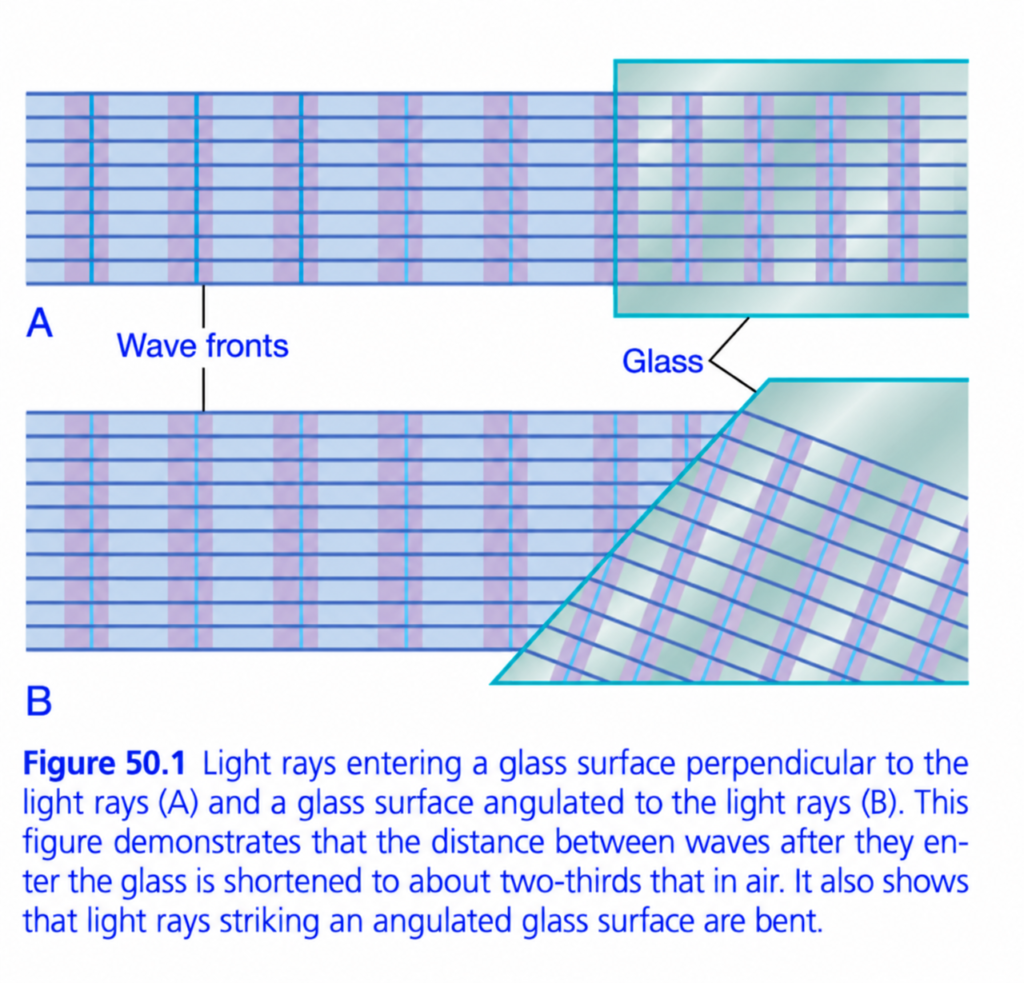
Figure 50.1 — Refraction of Light at an Air–Glass Interface
This figure explains why light bends when it enters glass at an angle, and why it does not bend when it enters straight/perpendicular.
First: what is a wave front?
A wave front is an imaginary line joining points of a light wave that are at the same stage of vibration.
In this figure, the repeated vertical pink/blue bands represent successive wave fronts.
The distance between two neighboring wave fronts is the:
Wavelength (λ)
So:
Wave fronts far apart → longer wavelength
Wave fronts close together → shorter wavelength
The horizontal blue lines show the direction in which the light rays are traveling.
Panel A — Light enters glass straight
Look at the upper diagram A.
The light is traveling:
Air → Glass
The glass surface is exactly perpendicular (90°) to the direction of the light rays.
Step 1
The blue light rays travel horizontally toward the glass.
Step 2
The entire wave front reaches the glass surface at essentially the same time.
This point is very important.
Because:
upper part enters glass at same time as lower part
there is no unequal slowing from one side to the other.
Step 3
Light enters glass.
Glass has a higher refractive index than air.
Therefore:
Light speed decreases inside glass.
What is refractive index?
Refractive index tells us how much a material slows light.
Approximately:
Air: n ≈ 1.0
Glass: n ≈ 1.5
And:
Speed of light in medium = c / n
So in glass:
speed ≈ c / 1.5 ≈ 2/3 of its speed in air
That is why the caption says the spacing between waves in glass becomes about two-thirds of that in air.
Why do the wave fronts become closer together?
Remember:
v = fλ
where:
- v = velocity
- f = frequency
- λ = wavelength
When light crosses from air into glass:
Frequency stays the same.
But:
Velocity decreases.
Therefore:
Wavelength must decrease.
So:
Air → glass → speed ↓ → wavelength ↓
That is why the vertical wave fronts become closer together inside the glass.oes light bend in Panel A?
No.
Because the light strikes the surface perpendicularly.
The ray enters along the normal.
Therefore:
Angle of incidence = 0°
and:
Angle of refraction = 0°
So:
Speed changes and wavelength changes, but direction does NOT change.
Panel A memory
Straight in → slow down → no bend.
Panel B — Light enters an angled glass surface
Now look at diagram B.
The incoming rays are still moving horizontally.
But the glass surface is now slanted/angulated.
This changes everything.
Step 1 — Lower part reaches glass first
Look carefully at the sloping cyan glass border.
The lower part of the light wave reaches the glass first.
At that moment: 2 — Lower part slows first
Because glass has a higher refractive index:
Lower part enters glass → slows down
But the upper part is still in air, so it continues moving faster.
So temporarily:
Upper part = fast
Lower part = slow 3 — Wave front rotates
Imagine several people walking side by side.
If the person on one side suddenly walks more slowly while the other side continues fast, the whole row will turn.
Exactly the same idea happens here.
One side of wave front slows first
→ other side keeps moving faster
→ wave front rotates
→ direction of light changes.
This change in direction is:
Refraction
Step 4 — Ray bends inside glass
Since light is going from:
Air = lower refractive index
to:
Glass = higher refractive index
the ray bends:
Toward the normal
Normal
The normal is an imaginary line drawn at 90° to the glass surface.
So the rule is:
Low refractive index → high refractive index
→ light slows
→ bends toward normal
Why are the wave fronts tilted inside the glass?
Before entering glass, the vertical wave fronts are straight and vertical.
After entering the angled surface:
one side slows first
→ wave front rotates
→ wave fronts become tilted.
The tilted wave fronts show the new direction of propagation.
Why are they also closer together?
Even in Panel B, light is traveling in glass.
Therefore:
velocity ↓
while:
frequency remains unchanged
So:
wavelength ↓
Therefore the wave fronts inside glass are:
- closer together
- rotated
Closer = shorter wavelength
Rotated = refraction/bending
Understand the colors
These colors are mainly for teaching; light and glass do not literally look exactly like this microscopically.
- Light green area = glass
- Cyan outline = glass surface/interface
- Horizontal blue lines before glass = direction of light rays
- Slanted blue lines inside Panel B glass = refracted light-ray direction
- Pink/purple repeating vertical bands = successive wave fronts
- Closer wave fronts inside glass = shorter wavelength
Panel A vs Panel B
| Panel A | Panel B |
|---|---|
| Surface perpendicular to rays | Surface angled to rays |
| Entire wave front enters together | One side enters first |
| Entire wave front slows together | One side slows first |
| No rotation of wave front | Wave front rotates |
| No bending | Light bends |
| Speed ↓ | Speed ↓ |
| Wavelength ↓ | Wavelength ↓ |
| Frequency unchanged | Frequency unchanged |
The most important concept
Panel A
Light hits glass straight
→ all parts slow together
→ wavelength becomes shorter
→ no bending
Panel B
Light hits glass at an angle
→ one side enters first
→ that side slows first
→ wave front rotates
→ light bends
Easy memory trick
Straight = Slow but Same direction
Slanted = Slow + Swing
“Swing” means the ray changes direction.
Key Exam Points
- Refraction = bending of light when it passes between media with different refractive indices.
- Glass has a higher refractive index than air.
- Therefore light travels slower in glass.
- Frequency of light does not change at the boundary.
- Because speed decreases while frequency stays constant, wavelength decreases.
- At perpendicular incidence, light does not bend.
- At angled incidence from air to glass, light bends toward the normal.
- Bending happens because one part of the wave front enters the slower medium before the other part.
2-line exam recall
Air → glass: velocity ↓, frequency unchanged, wavelength ↓.
Perpendicular entry → no bending; angled entry → one side slows first → wave front rotates → ray refracts toward the normal.
