

Intravenous Nutritional Solutions
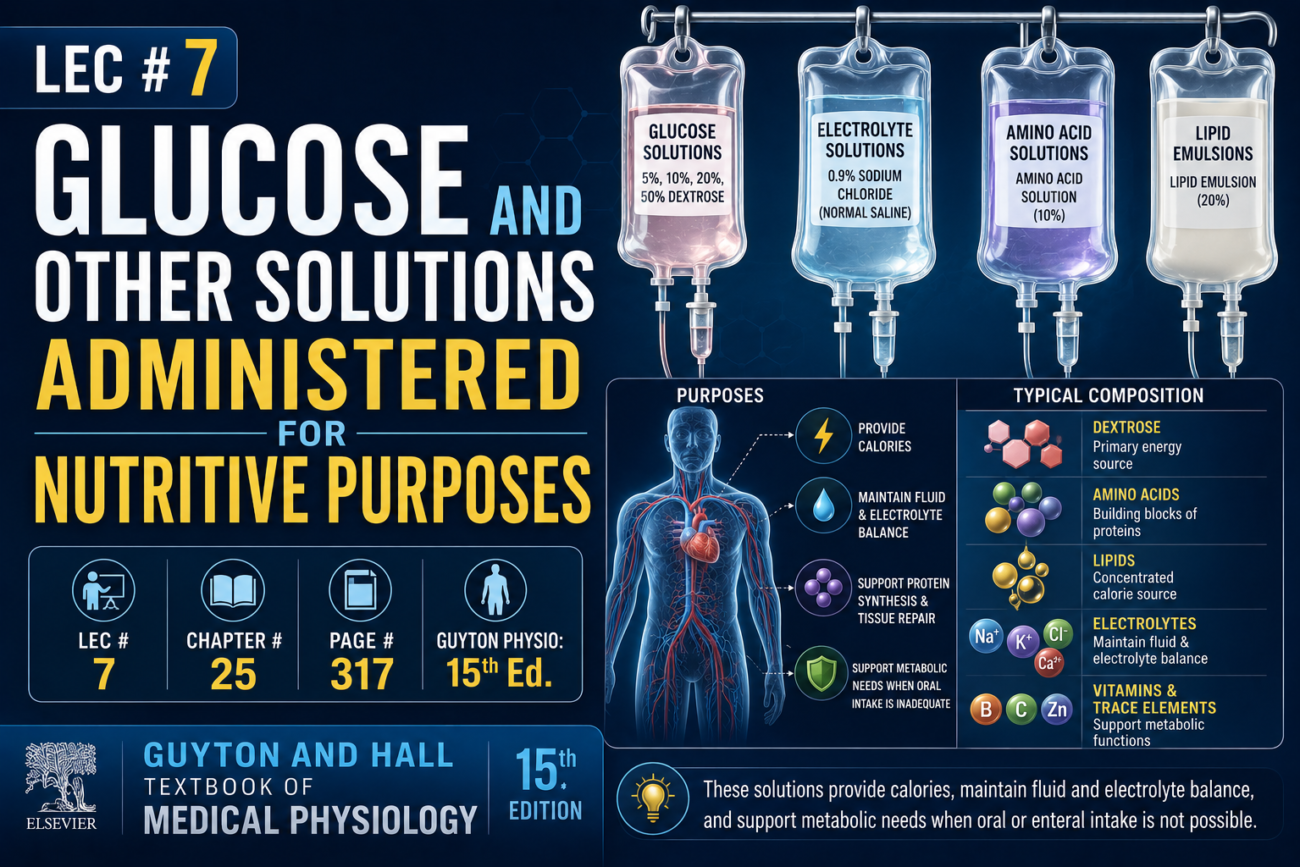
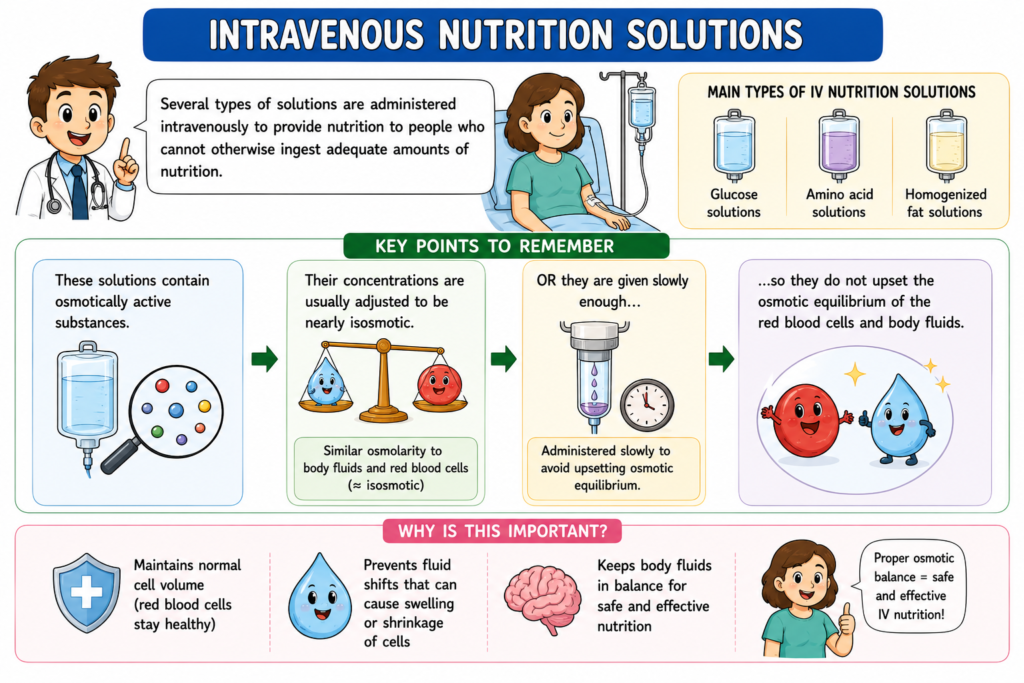
- Several types of intravenous (IV) solutions are given to provide nutrition to people who cannot eat enough food.
- Glucose solutions are the most commonly used nutritional IV solutions.
- Amino acid solutions are also used to provide nutrition.
- Homogenized fat solutions may be used as another source of nutrition.
- These nutritional solutions are usually adjusted so that their concentration of osmotically active substances is nearly isosmotic with body fluids.
- Sometimes these solutions are given slowly to prevent sudden osmotic changes.
- This helps maintain the osmotic equilibrium of red blood cells and body fluids.
Key Concept
👉 IV nutritional solutions provide nutrients when normal eating is not possible.
👉 Common IV nutrients:
- Glucose
- Amino acids
- Fats
👉 These solutions are usually nearly isosmotic or infused slowly.
👉 This prevents swelling or shrinking of red blood cells and helps maintain normal fluid balance[A1] .
Effect of IV Glucose After Metabolism
- After glucose or other nutrients are metabolized by the body, extra water often remains.
- This is especially true if the person is also drinking additional fluids.
- Normally, the kidneys remove the excess water by producing dilute urine.
- As a result, the body mainly retains the nutrients, while the extra water is excreted.
- Therefore, the overall effect is the addition of nutrients to the body.
5% Glucose Solution in Dehydration
As the glucose is removed from the extracellular
A 5% glucose solution is nearly isosmotic with body fluids.
It is commonly used to treat dehydration.
Because the solution is isosmotic, it can be infused intravenously without causing red blood cells to swell.
In contrast, infusion of pure water would cause red blood cells to swell.
The glucose in the solution is rapidly transported into the cells.
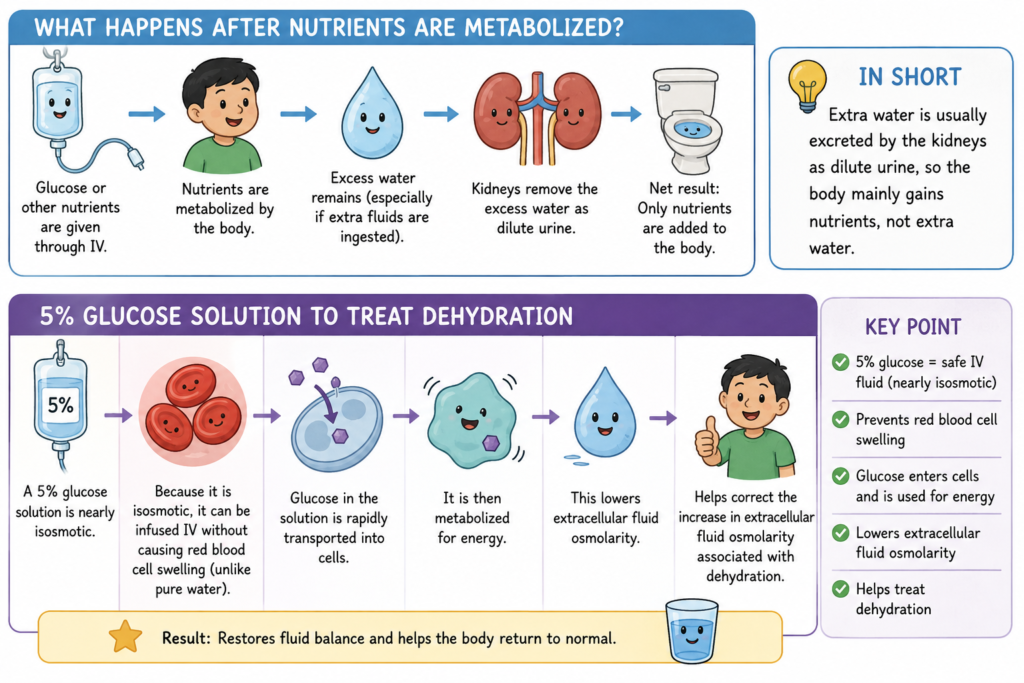
After entering the cells, the glucose is metabolized.
