



Blood as a Separate Fluid Compartment
- Blood contains plasma fluid, which is a type of extracellular fluid (ECF).
- Blood also contains fluid inside red blood cells (RBCs), which is a type of intracellular fluid (ICF).
- Even though blood contains both ECF and ICF, it is considered a separate fluid compartment.
- This is because blood is contained within its own special chamber called the circulatory system.
- Blood volume is very important for the control of cardiovascular dynamics.
- It helps regulate blood flow, blood pressure, and overall circulation.
Average Blood Volume
- In adults, blood volume is about 7% of total body weight.
- The average adult has about 5 liters of blood.
- About 60% of blood is plasma.
- About 40% of blood consists of red blood cells (RBCs).
- These percentages can vary from person to person.
- Factors that affect blood composition include sex, body weight, and other individual characteristics.
Hematocrit (Packed Red Blood Cell Volume)
- Hematocrit is the fraction of blood made up of red blood cells (RBCs).
- It is measured by spinning blood in a hematocrit tube using a centrifuge until the cells become tightly packed at the bottom of the tube.
- The centrifuge does not completely pack the red blood cells together perfectly.
- About 3% to 4% of plasma remains trapped between the packed cells.
- Because of this trapped plasma, the true hematocrit is about 96% of the measured hematocrit.
Hematocrit Values in Health and Disease
- In men, the normal measured hematocrit is about 0.42 (42%).
- In women, the normal measured hematocrit is about 0.38 (38%).
- In severe anemia, the hematocrit may fall as low as 0.10 (10%), which is barely enough to sustain life.
- In polycythemia, there is excess production of red blood cells.
- In polycythemia, the hematocrit may rise as high as 0.65 (65%).
Constituents of Extracellular and Intracellular Fluids
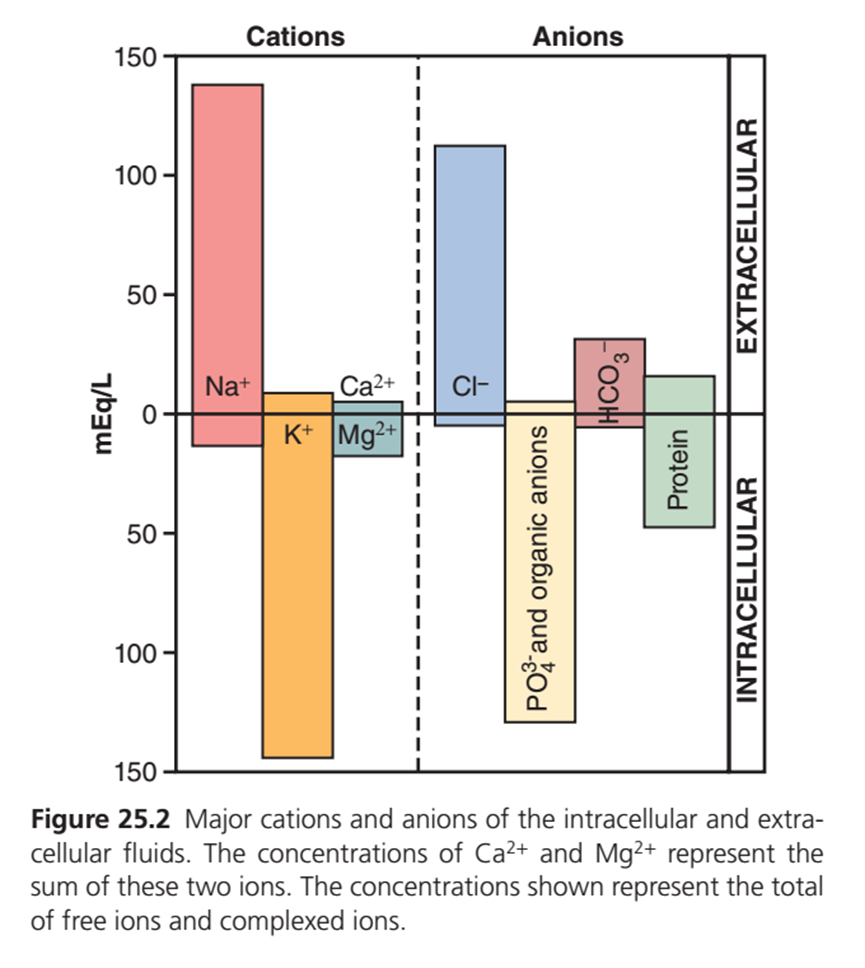
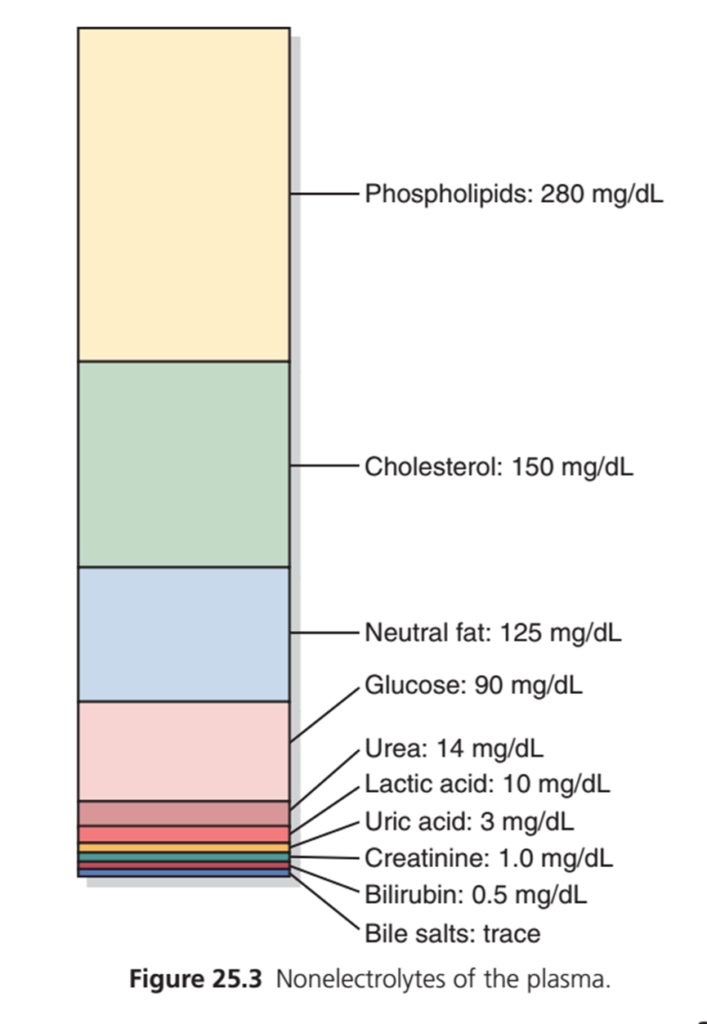
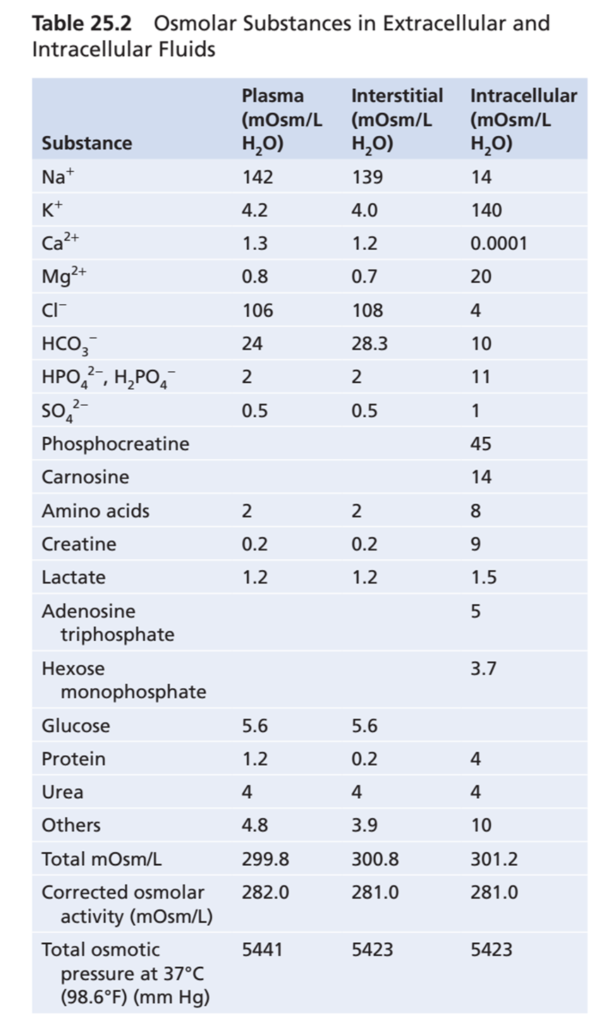
- The composition of extracellular fluid is compared in different parts of the body.
- This includes both plasma and interstitial fluid.
- The comparison also includes intracellular fluid (ICF).
- These comparisons are shown in Figures 25.2 and 25.3.
- The same information is also presented in Table 25.2.
Plasma and Interstitial Fluid Have Similar Ionic Composition
Plasma vs Interstitial Fluid
- Plasma and interstitial fluid are separated only by highly permeable capillary membranes.
- Because of this, their ionic (electrolyte) composition is very similar.
- The main difference between them is the concentration of proteins.
- Plasma contains a much higher amount of proteins than interstitial fluid.
- Capillaries are poorly permeable to proteins.
- Therefore, only a small amount of protein leaks into the interstitial fluid in most tissues.
Donnan Effect (Plasma vs Interstitial Fluid)
- Because of the Donnan effect, the concentration of positively charged ions (cations) is slightly higher (about 2%) in plasma than in interstitial fluid.
- Plasma proteins carry a negative charge.
- These negative charges attract positive ions (cations) such as sodium and potassium, causing more cations to remain in plasma.
- At the same time, negatively charged plasma proteins repel negatively charged ions (anions).
- As a result, anion concentration is slightly higher in interstitial fluid than in plasma.
- For practical purposes, however, the ion concentrations in plasma and interstitial fluid are considered almost equal.
Composition of Extracellular Fluid (ECF)
- The extracellular fluid (plasma + interstitial fluid) contains large amounts of sodium (Na⁺) and chloride (Cl⁻) ions.
- It also contains a moderate amount of bicarbonate (HCO₃⁻) ions.
- Only small amounts of potassium, calcium, magnesium, phosphate, and organic acid ions are present.
- The composition of extracellular fluid is carefully regulated by the body.
- The kidneys play a major role in maintaining this balance.
- This regulation ensures that cells are surrounded by fluid containing the correct electrolytes and nutrients.
- As a result, cells can function properly and efficiently at all times.
Intracellular Fluid (ICF) Constituents
Intracellular Fluid (ICF) Composition
- Cells also contain a large amount of proteins, approximately four times more than plasma.
- Intracellular fluid is separated from extracellular fluid by the cell membrane.
- The cell membrane is highly permeable to water.
- However, it is relatively impermeable to most electrolytes.
- Compared with extracellular fluid, intracellular fluid contains very small amounts of sodium and chloride ions.
- It contains almost no calcium ions.
- Instead, intracellular fluid contains large amounts of potassium (K⁺) and phosphate (PO₄³⁻) ions.
- It also contains moderate amounts of magnesium (Mg²⁺) and sulfate (SO₄²⁻) ions.
- These ions are present in much lower concentrations in extracellular fluid.
Summary
Blood is a unique fluid compartment of the body because it circulates within the blood vessels. It contains plasma, which is part of the extracellular fluid, and fluid inside red blood cells, which is part of the intracellular fluid. Blood is important for maintaining blood pressure, blood flow, and the transport of oxygen and nutrients throughout the body.
In an average adult, blood makes up about 7% of body weight and totals about 5 liters. The proportion of red blood cells in blood is called the hematocrit. A normal hematocrit is higher in men than in women. It decreases in anemia because there are fewer red blood cells and increases in polycythemia when too many red blood cells are produced.
Body fluids are divided into extracellular fluid and intracellular fluid. The extracellular fluid includes plasma and interstitial fluid, which have very similar compositions because substances can easily move across capillary walls. Both contain large amounts of sodium and chloride ions. In contrast, intracellular fluid contains high levels of potassium and phosphate ions and very little sodium and calcium.
For example, when a person becomes dehydrated, the kidneys help regulate the composition of extracellular fluid to maintain the correct balance of water and electrolytes, allowing body cells to continue functioning normally.
By: Dr Sheen
