


LEARNING OBJECTIVES
After studying this lecture, students will be able to:
- Identify the main types of synaptic transmitters.
- Explain the basic features of small-molecule, rapidly acting transmitters.
- Describe the recycling of small-molecule vesicles and acetylcholine.
- Recognize the major small-molecule transmitters and their effects.
INTRODUCTION
Synaptic transmitters are chemical substances that carry signals between neurons.
More than 50 chemical substances have been proved or suggested to function as synaptic transmitters. They mainly include small-molecule, rapidly acting transmitters and neuropeptides. Small-molecule transmitters mainly produce rapid nervous system responses, whereas neuropeptides usually produce slower and more prolonged effects. Some gaseous molecules, including nitric oxide, hydrogen sulfide, and carbon monoxide, may also act as transmitter modulators. This lecture focuses mainly on the formation, release, recycling, and important characteristics of small-molecule transmitters.
- More than 50 chemical substances have been proved or suggested to work as synaptic transmitters.
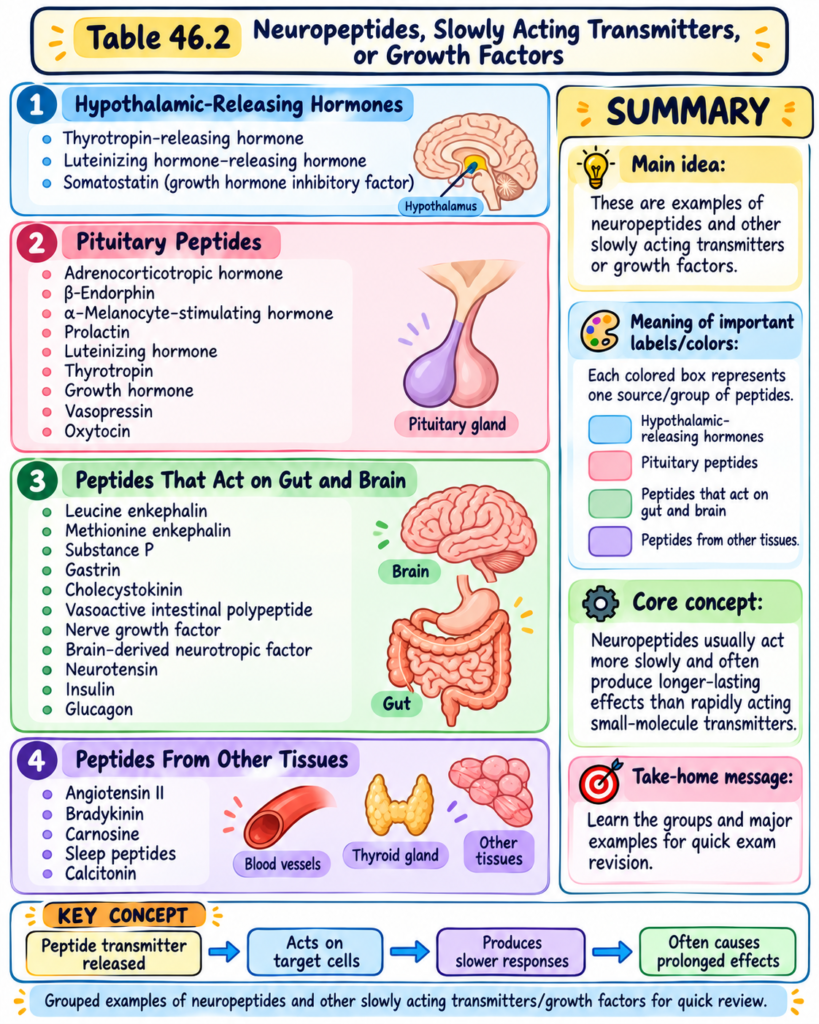
- Tables 46.1 and 46.2 divide these synaptic transmitters into two groups:
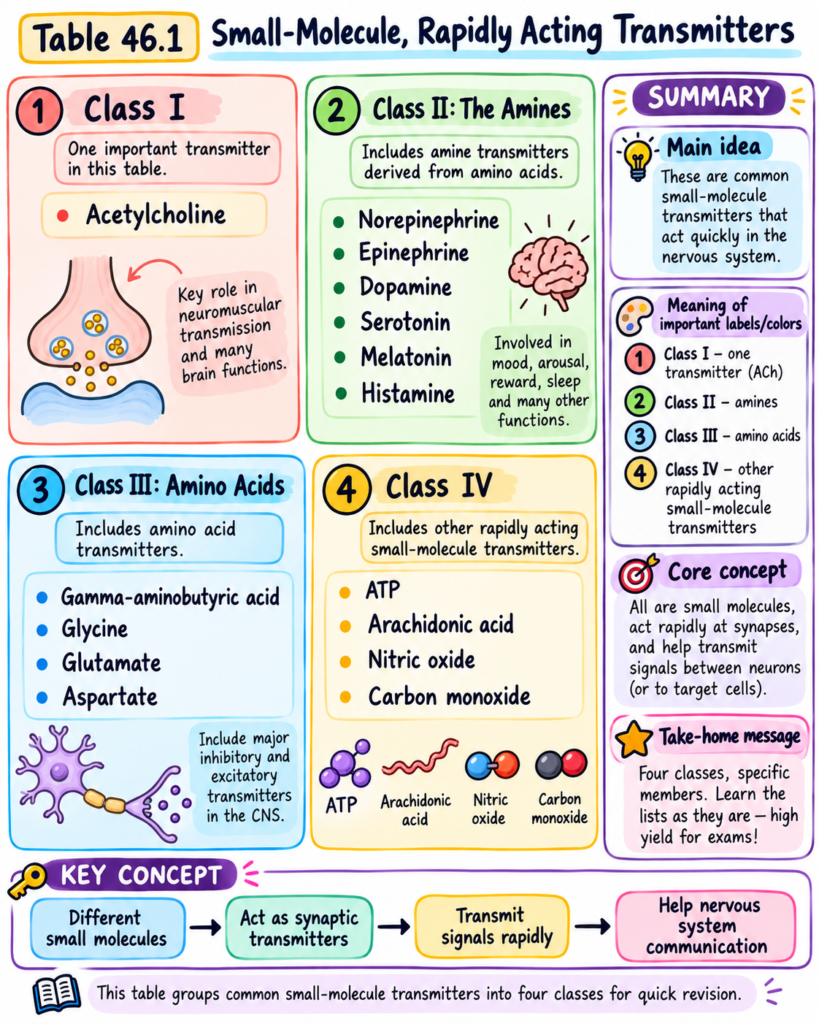
- Small-molecule, rapidly acting transmitters
- Neuropeptides
- Small-molecule transmitters act rapidly.
- Neuropeptides are:
- Much larger molecules
- Usually slower acting
- A few gaseous molecules may also act as transmitter modulators, ( Modulators: substances that change or adjust the effect of neurotransmitters.
Easiest meaning:
Modulators = chemicals that control or modify how strongly a nerve signal works. )
- including:
- Nitric oxide (NO)
- Hydrogen sulfide (H₂S)
- Carbon monoxide (CO)
- However, their role as true neurotransmitters is still unclear.
- Small-molecule, rapidly acting transmitters cause most acute nervous system responses.
- These include:
- Transmission of sensory signals → brain
- Transmission of motor signals → muscles
- In contrast, neuropeptides usually produce more prolonged actions.
- These prolonged actions may include:
- Long-term changes in the number of neuronal receptors
- Long-term opening or closing of certain ion channels
- Possible long-term changes in the number of synapses
- Possible long-term changes in the size of synapses
KEY CONCEPT
Small-molecule transmitters → rapid action → acute nervous system responses
Neuropeptides → slower action → prolonged changes in neurons and synapses
Easy examples Sensory signal → brain = rapid action
- Motor signal → muscles = rapid action
- Change in receptor number or synapse size → prolonged action
SMALL-MOLECULE, RAPIDLY ACTING TRANSMITTERS
- In most cases, small-molecule transmitters are made in the cytosol of the presynaptic terminals.
- They are then moved by active transport into many transmitter vesicles present in the presynaptic terminals.
- When an action potential reaches the presynaptic terminal:
- A few vesicles release their transmitter into the synaptic cleft.
- This transmitter release usually occurs within 1 millisecond or less.
- The released small-molecule transmitter then acts on membrane receptors of the postsynaptic neuron.
- This action also usually occurs within another 1 millisecond or less.
- Most commonly, the transmitter changes the conductance of ion channels.
- Excitation:
- ↑ Sodium (Na⁺) conductance → excitation
- Inhibition:
- ↑ Potassium (K⁺) conductance → inhibition
- ↑ Chloride (Cl⁻) conductance → inhibition
KEY CONCEPT
Small-molecule transmitter made in presynaptic terminal → stored in vesicles → action potential arrives → transmitter released into synaptic cleft → acts rapidly on postsynaptic receptors → changes ion-channel conductance
Easy examples from the provided text:
- ↑ Na⁺ conductance → excitation
- ↑ K⁺ or Cl⁻ conductance → inhibition
RECYCLING OF SMALL-MOLECULE TYPES OF VESICLES
- Vesicles that store and release small-molecule transmitters are continuously recycled and reused.
- After a vesicle fuses with the synaptic membrane and releases its transmitter:
- Its membrane first becomes part of the synaptic membrane.
- Within seconds to minutes:
- This vesicle membrane folds inward into the presynaptic terminal.
- It then pinches off.
- A new vesicle is formed.
- The new vesicle membrane still contains the required:
- Enzyme proteins
- Transport proteins
- These proteins help to:
- Synthesize new transmitter substances
- And/or concentrate transmitters inside the vesicle
- Acetylcholine is a typical small-molecule transmitter that follows this process of synthesis and release.
- Acetylcholine is synthesized in the presynaptic terminal from:
- Acetyl coenzyme A
- Choline
- This reaction occurs in the presence of the enzyme choline acetyltransferase.
- The newly formed acetylcholine is then transported into its specific vesicles.
- During synaptic neuronal signal transmission:
- Vesicles release acetylcholine into the synaptic cleft.
- In the synaptic cleft, acetylcholine is rapidly broken down into:
- Acetate
- Choline
- This breakdown is caused by the enzyme cholinesterase.
- Cholinesterase is present in the proteoglycan reticulum that fills the synaptic cleft.
- Inside the presynaptic terminal:
- The vesicles are recycled again.
- Choline is actively transported back into the terminal.
- The returned choline is then reused to make new acetylcholine.
KEY CONCEPT
Vesicle releases transmitter → vesicle membrane becomes part of synaptic membrane → membrane folds inward → new vesicle forms → vesicle is reused
Acetyl coenzyme A + choline → acetylcholine → stored in vesicle → released into synaptic cleft → broken into acetate + choline → choline returns to presynaptic terminal → new acetylcholine is formed
CHARACTERISTICS OF SOME IMPORTANT SMALL-MOLECULE TRANSMITTERS
- Acetylcholine is released by neurons in many parts of the nervous system.
- It is especially released from:
- Terminals of the large pyramidal cells of the motor cortex
- Different neurons in the basal ganglia
- Motor neurons supplying skeletal muscles
- Preganglionic neurons of the autonomic nervous system
- Postganglionic neurons of the parasympathetic nervous system
- Some postganglionic neurons of the sympathetic nervous system
- In most places, acetylcholine has an excitatory effect.
- However, it can also have an inhibitory effect at some peripheral parasympathetic nerve endings.
- Example:
- Vagus nerves → inhibit the heart
- Norepinephrine is released from terminals of many neurons whose cell bodies are present in the:
- Brain stem
- Hypothalamus
- Norepinephrine-secreting neurons in the locus ceruleus of the pons send fibers to widespread areas of the brain.
- These fibers help control:
- Overall brain activity
- Mood
- Wakefulness
- In most brain areas, norepinephrine activates excitatory receptors.
- In some areas, it activates inhibitory receptors.
- Norepinephrine is also released by most postganglionic sympathetic neurons.
- In these organs, it:
- Excites some organs
- Inhibits other organs
- Dopamine is released by neurons that start in the substantia nigra.
- These neurons mainly end in the striatal region of the basal ganglia.
- Dopamine usually has an inhibitory effect.
- Glycine is released mainly at synapses in the spinal cord.
- It is believed to always act as an inhibitory transmitter.
- Gamma-aminobutyric acid (GABA) is released by nerve terminals in:
- Spinal cord
- Cerebellum
- Basal ganglia
- Many areas of the cerebral cortex
- GABA is the main inhibitory neurotransmitter in the adult central nervous system.
- However, during early brain development, including:
- Embryonic period
- First week after birth
- GABA is thought to act as an excitatory neurotransmitter.
- Glutamate is released by presynaptic terminals in:
- Many sensory pathways entering the CNS
- Many areas of the cerebral cortex
- Glutamate probably always causes excitation.
- Serotonin is released by nuclei that originate in the median raphe of the brain stem.
- These neurons project to many areas of the:
- Brain
- Spinal cord
- They especially project to:
- Dorsal horns of the spinal cord
- Hypothalamus
- Serotonin acts as an inhibitor of pain pathways in the spinal cord.
- Its inhibitory action in higher areas of the nervous system is believed to help control:
- Mood
- Possibly sleep
- Nitric oxide (NO) is produced by nerve terminals in brain areas responsible for:
- Long-term behavior
- Memory
- Therefore, nitric oxide may help explain some functions of behavior and memory that are not yet fully understood.
- Nitric oxide is different from other small-molecule transmitters.
- It is not made in advance and stored in vesicles.
- Instead:
- It is made almost immediately when needed.
- It then diffuses out of the presynaptic terminal over several seconds.
- It is not released in vesicular packets.
- Nitric oxide then diffuses into nearby postsynaptic neurons.
- In the postsynaptic neuron, it usually does not greatly change the membrane potential.
- Instead, it changes intracellular metabolic functions.
- These changes can modify neuronal excitability for:
- Seconds
- Minutes
- Possibly even longer
KEY CONCEPT
Acetylcholine → usually excitation, but may also cause inhibition
Norepinephrine → excitation in many areas, inhibition in some areas
Dopamine → usually inhibition
Glycine → inhibition
GABA → main inhibitory transmitter in adult CNS → can be excitatory during early brain development
Glutamate → excitation
Serotonin → inhibits pain pathways → also helps control mood and possibly sleep
Nitric oxide → made only when needed → diffuses directly → changes intracellular functions → modifies neuronal excitability for a longer time
SHORT CONCEPTUAL STORY — SMALL-MOLECULE TRANSMITTERS
Think of the nervous system as using different chemical messengers:
Acetylcholine usually says “GO” → excitation, but at some places like the heart through vagus nerves, it says “SLOW DOWN.”
Norepinephrine helps the brain stay active, awake, and involved in mood → it may excite or inhibit depending on the area.
Dopamine comes mainly from the substantia nigra → basal ganglia → usually causes inhibition.
Glycine works mainly in the spinal cord → inhibition.
GABA is the main “STOP” transmitter of the adult CNS → inhibition. But in early brain development, it can cause excitation.
Glutamate is mainly a “GO” transmitter → excitation.
Serotonin helps inhibit pain pathways and is related to mood and possibly sleep.
Nitric oxide (NO) is different: it is made only when needed, is not stored in vesicles, diffuses directly to nearby neurons, and changes their internal metabolic functions and excitability.
EASIEST MEMORY LINE
ACh → mostly Excites
NE → Excites or Inhibits
Dopamine → Inhibits
Glycine → Inhibits
GABA → Inhibits adult CNS
Glutamate → Excites
Serotonin → Inhibits pain
NO → Made when needed → long-lasting internal effect
CLINICAL / PHYSIOLOGICAL IMPORTANCE
- Small-molecule transmitters are important for rapid and acute nervous system responses, including:
- Sensory signals traveling to the brain
- Motor signals traveling to the muscles
- Neuropeptides are important for long-lasting neuronal effects, including:
- Changes in the number of neuronal receptors
- Prolonged opening or closing of ion channels
- Changes in the number or size of synapses
- Rapid small-molecule transmission depends on transmitter release from presynaptic vesicles and its quick action on postsynaptic receptors.
- Changes in ion conductance determine whether a neuron is excited or inhibited:
- ↑ Na⁺ conductance → excitation
- ↑ K⁺ or Cl⁻ conductance → inhibition
- Recycling of synaptic vesicles allows vesicles to be used repeatedly for continued transmitter storage and release.
- Acetylcholine recycling is important because:
- Acetylcholine is released into the synaptic cleft.
- It is rapidly broken down into acetate and choline.
- Choline is transported back into the presynaptic terminal.
- Choline is reused to form new acetylcholine.
- Acetylcholine is important in:
- Motor cortex pathways
- Basal ganglia
- Skeletal muscle motor neurons
- Autonomic nervous system
- It usually causes excitation, but can cause inhibition, such as vagal inhibition of the heart.
- Norepinephrine is important in controlling:
- Overall brain activity
- Mood
- Wakefulness
- It can produce either excitation or inhibition depending on the area or organ.
- Dopamine is associated mainly with the pathway from the substantia nigra to the striatal region of the basal ganglia and usually produces inhibition.
- Glycine is important as an inhibitory transmitter, mainly at synapses in the spinal cord.
- GABA is the main inhibitory neurotransmitter in the adult CNS.
- During early brain development, it is thought to act as an excitatory neurotransmitter.
- Glutamate is important in:
- Many sensory pathways entering the CNS
- Many areas of the cerebral cortex
- It probably always causes excitation.
- Serotonin is important because it:
- Inhibits pain pathways in the spinal cord
- Helps control mood
- May also help cause sleep.
- Nitric oxide (NO) is important in brain areas involved in:
- Long-term behavior
- Memory
- Unlike other small-molecule transmitters, nitric oxide:
- Is produced when needed
- Is not stored in vesicles
- Diffuses directly into nearby postsynaptic neurons
- Changes intracellular metabolic functions
- Can modify neuronal excitability for seconds, minutes, or even longer.
KEY PHYSIOLOGICAL IMPORTANCE
Synaptic transmitters → control rapid or prolonged neuronal responses → produce excitation or inhibition → regulate sensory signals, motor activity, autonomic functions, pain, mood, wakefulness, sleep, behavior, and memory.
HIGH-YIELD POINTS
- More than 50 chemical substances may function as synaptic transmitters.
- Synaptic transmitters are mainly divided into:
- Small-molecule, rapidly acting transmitters
- Neuropeptides
- Small-molecule transmitters act rapidly.
- Neuropeptides are larger and usually act more slowly.
- Nitric oxide, hydrogen sulfide, and carbon monoxide may act as transmitter modulators.
- Small-molecule transmitters mainly produce acute nervous system responses.
- These include:
- Sensory signals → brain
- Motor signals → muscles
- Neuropeptides mainly produce prolonged effects on receptors, ion channels, and synapses.
- Small-molecule transmitters are usually made in the cytosol of presynaptic terminals.
- They are transported into transmitter vesicles.
- When an action potential reaches the presynaptic terminal:
- Vesicles release transmitter into the synaptic cleft.
- Release usually occurs within 1 millisecond or less.
- The transmitter then acts rapidly on postsynaptic membrane receptors.
- Main ion-channel effects:
- ↑ Na⁺ conductance → excitation
- ↑ K⁺ conductance → inhibition
- ↑ Cl⁻ conductance → inhibition
- Small-molecule vesicles are continuously recycled and reused.
- After transmitter release:
- Vesicle membrane becomes part of the synaptic membrane.
- It folds inward.
- It pinches off.
- A new vesicle forms.
- New vesicles retain the proteins needed for transmitter synthesis or concentration.
- Acetylcholine is formed from:
- Acetyl coenzyme A
- Choline
- Enzyme involved:
- Choline acetyltransferase
- Acetylcholine is stored in vesicles and released into the synaptic cleft.
- It is broken down by cholinesterase into:
- Acetate
- Choline
- Choline is transported back into the presynaptic terminal and reused.
- Acetylcholine
- Usually causes excitation
- May cause inhibition
- Example: vagus nerves inhibit the heart
- Norepinephrine
- Helps control brain activity, mood, and wakefulness
- May excite or inhibit
- Dopamine
- Originates mainly from substantia nigra
- Ends mainly in striatal basal ganglia
- Usually inhibitory
- Glycine
- Mainly in the spinal cord
- Inhibitory transmitter
- GABA
- Main inhibitory neurotransmitter in the adult CNS
- Can be excitatory during early brain development
- Glutamate
- Present in many sensory pathways and cerebral cortex
- Probably always excitatory
- Serotonin
- Inhibits pain pathways
- Helps control mood
- May help cause sleep
- Nitric oxide
- Related to long-term behavior and memory
- Not stored in vesicles
- Made when needed
- Diffuses directly into nearby neurons
- Changes intracellular metabolic functions
- Can alter neuronal excitability for a prolonged period
QUICK REVISION
- Synaptic transmitters are mainly:
- Small-molecule transmitters
- Neuropeptides
- Small-molecule transmitters act rapidly.
- Neuropeptides act slowly and for longer periods.
- Small-molecule transmitters mainly carry:
- Sensory signals → brain
- Motor signals → muscles
- Neuropeptides can cause long-term changes in:
- Receptors
- Ion channels
- Synapse number
- Synapse size
- Small-molecule transmitters are made in the presynaptic terminal.
- They are stored in vesicles.
- Action potential arrives → vesicles release transmitter into the synaptic cleft.
- Release occurs within about 1 millisecond or less.
- Main effects:
- ↑ Na⁺ → excitation
- ↑ K⁺ or Cl⁻ → inhibition
- Synaptic vesicles are recycled and reused.
- Acetylcholine is formed from:
- Acetyl CoA + choline
- Enzyme:
- Choline acetyltransferase
- Acetylcholine is broken down by:
- Cholinesterase
- Breakdown products:
- Acetate + choline
- Choline is taken back into the presynaptic terminal and reused.
- Acetylcholine → mostly excitatory
- Norepinephrine → excitation or inhibition; related to activity, mood, wakefulness
- Dopamine → usually inhibitory
- Glycine → inhibitory
- GABA → main inhibitory transmitter in adult CNS
- Glutamate → excitatory
- Serotonin → inhibits pain; helps control mood and possibly sleep
- Nitric oxide → made when needed; related to behavior, memory, and prolonged neuronal effects
SHORT CONCEPTUAL STORY — SYNAPTIC TRANSMITTERS
Imagine a neuron sending a message to the next neuron.
The nervous system uses chemical messengers called synaptic transmitters. More than 50 substances may work as these transmitters. They are mainly of two types: small-molecule transmitters, which act quickly, and neuropeptides, which act more slowly and produce longer-lasting effects. Some gases such as NO, H₂S, and CO may also modify transmitter action.
When a rapid message is needed—such as a sensory signal going to the brain or a motor signal going to muscles—small-molecule transmitters are used. Neuropeptides, in contrast, can produce longer-lasting changes in receptors, ion channels, and synapses.
A small-molecule transmitter is usually made inside the presynaptic terminal and packed into vesicles. When an action potential arrives, a few vesicles open and release the transmitter into the synaptic cleft. This happens very rapidly, usually within 1 millisecond or less.
The transmitter then reaches receptors on the postsynaptic neuron and changes ion conductance:
More Na⁺ conductance → excitation
More K⁺ or Cl⁻ conductance → inhibition.
The vesicles are not wasted after release. Their membrane becomes part of the synaptic membrane, then folds back inward, pinches off, and forms a new vesicle. So the same vesicle system can be recycled and reused again and again.
Now think of acetylcholine as an example. It is made from acetyl coenzyme A + choline with the help of choline acetyltransferase. It is stored in vesicles and released into the synaptic cleft. There, cholinesterase breaks it into acetate + choline. The choline returns to the presynaptic terminal and is reused to make new acetylcholine.
So the cycle continues:
Make → store → release → break down → recycle → make again.
Different small-molecule transmitters then perform different jobs:
Acetylcholine usually says “GO”, causing excitation, although in some places it can inhibit—for example, the vagus nerves inhibit the heart.
Norepinephrine helps control brain activity, mood, and wakefulness and may either excite or inhibit.
Dopamine mainly travels from the substantia nigra to the striatal basal ganglia and usually causes inhibition.
Glycine mainly works in the spinal cord and causes inhibition.
GABA is the main inhibitory transmitter of the adult CNS, although during early brain development it may act as an excitatory transmitter.
Glutamate is found in many sensory pathways and cerebral cortex and probably causes excitation.
Serotonin helps inhibit pain pathways, helps control mood, and may also help cause sleep.
Finally, nitric oxide is different. It is not stored in vesicles. It is made only when needed, then diffuses directly into nearby neurons. Instead of greatly changing membrane potential, it changes intracellular metabolic functions, affecting neuronal excitability for seconds, minutes, or even longer. It is also associated with long-term behavior and memory.
STORY IN ONE FLOW
Transmitter is made → stored in vesicle → action potential arrives → transmitter is released → postsynaptic neuron is excited or inhibited → vesicle is recycled → transmitter is made again → different transmitters control movement, sensation, mood, wakefulness, pain, sleep, behavior, and memory.
Reference: Guyton and Hall Textbook of Medical Physiology, 15th Edition, Chapter 46 – Basic Functions of Synapses, and Neurotransmitters.
