

Clinical Application 1.1: Slower, Longer-Acting Insulin Created by Substituting Amino Acids
- Insulin glargine is a laboratory-modified, longer-acting insulin first approved in the United States in 2000.
- It is made by changing normal insulin in two ways:
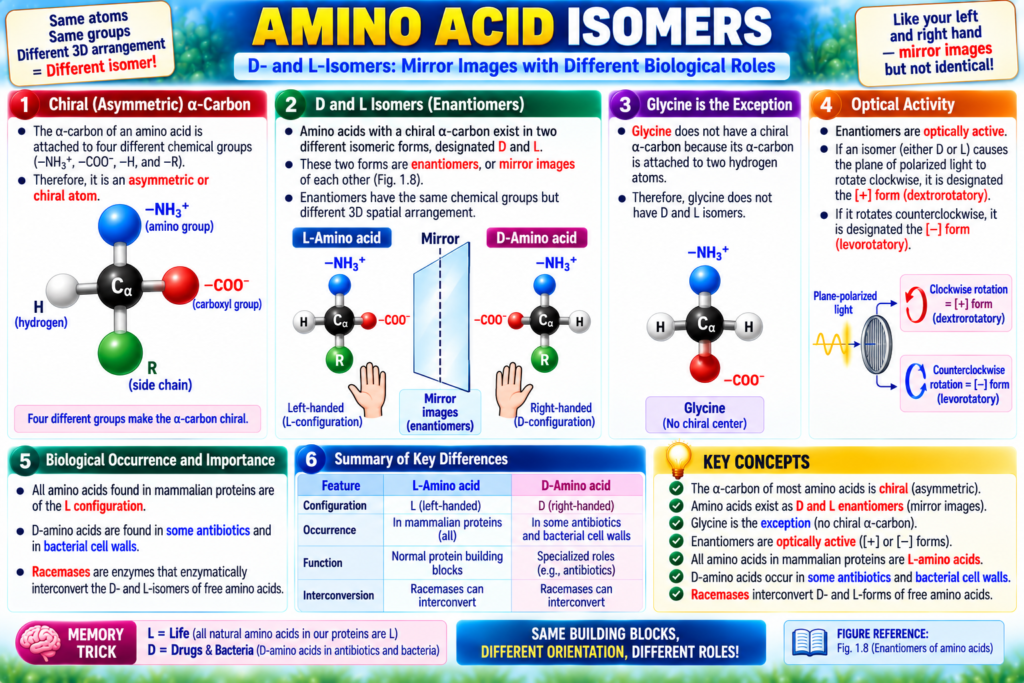
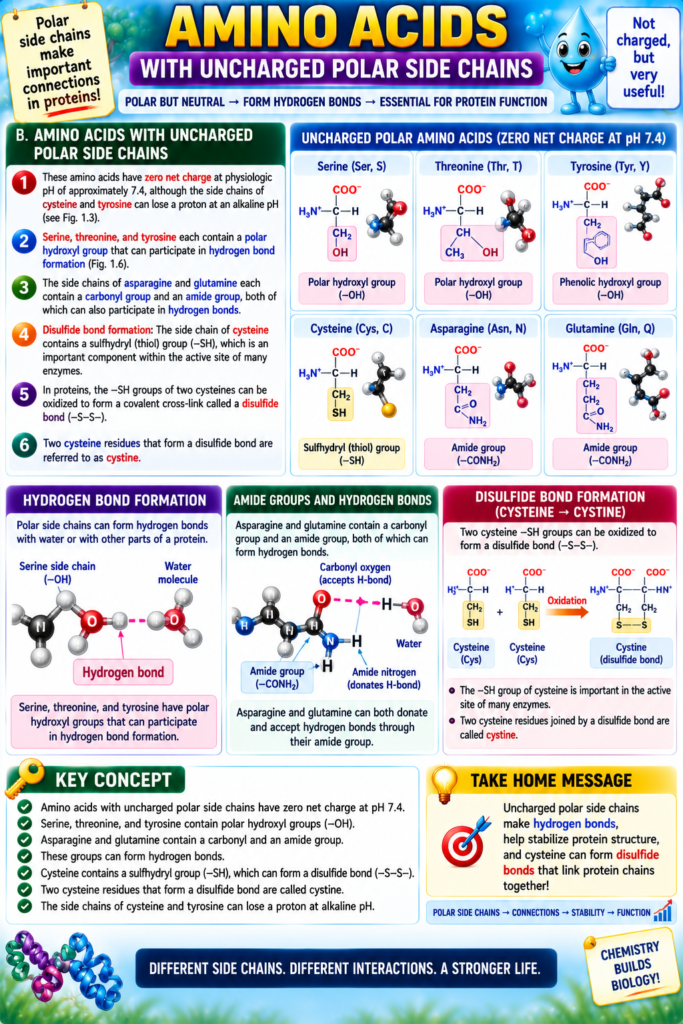
- A-chain position 21: asparagine → glycine
- B-chain C-terminus: add 2 arginine residues
- These amino-acid changes make insulin glargine less water soluble at neutral pH.
- Its net charge becomes about +0.2, closer to zero → slower absorption from the injection site.
- Replacing asparagine with glycine prevents instability caused by deamidation of the original asparagine.
- Adding 2 arginines changes the isoelectric point: pH 5.4 → pH 6.7
- Therefore, insulin glargine is:
- more soluble in acidic solution
- less soluble at the neutral pH of subcutaneous tissue
- After subcutaneous injection: neutral pH → ↓ solubility → slower absorption → prolonged insulin action
- Because it is absorbed slowly, insulin glargine:
- acts for a longer time
- requires less frequent injections
- can improve glycemic control in diabetes mellitus
KEY CONCEPT
- Insulin glargine = Asn²¹ → Gly + 2 extra Arg residues.
- Extra Arg → isoelectric point shifts 5.4 → 6.7.
- Neutral subcutaneous pH → reduced solubility → slow absorption → long-lasting action.
CONCEPTUAL EXAMPLES
- Normal insulin modification → less soluble after injection → insulin remains at the injection site longer → slow, prolonged release.
- Two extra positively charged arginines → alter the molecule’s charge and pH behavior → longer duration of action.
E. Abbreviations and Symbols for Commonly Occurring Amino Acids
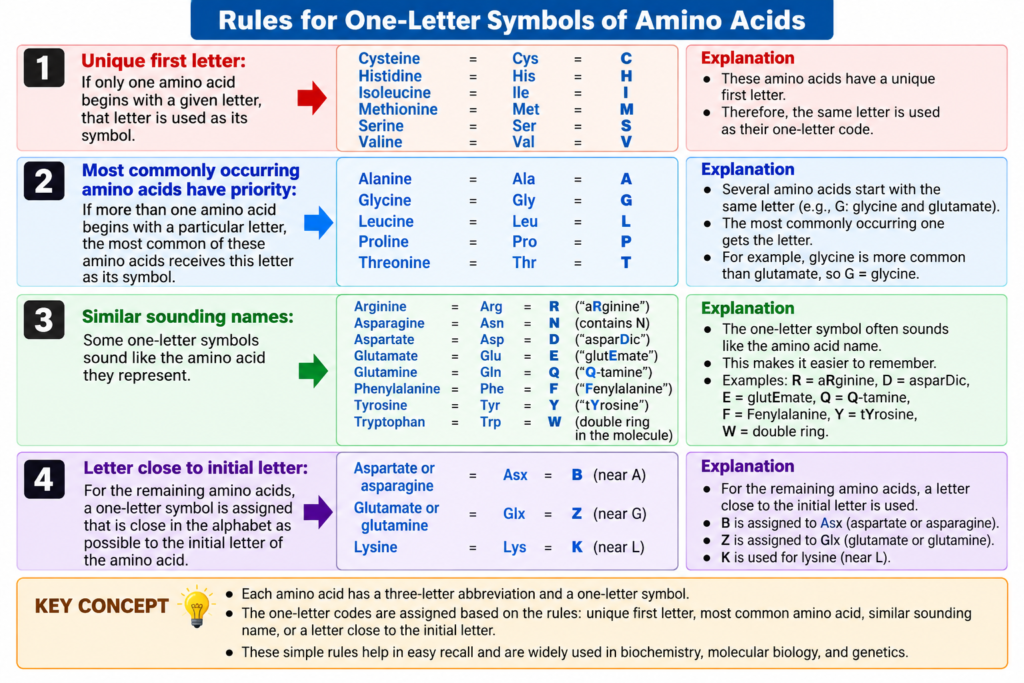
- Every amino acid has:
- a 3-letter abbreviation
- a 1-letter symbol (Fig. 1.7)
- The 1-letter codes follow these rules:
- Unique first letter
- If only one amino acid begins with that letter, the same letter is used.
- Example: V = Valine
- Most common amino acid gets priority
- If several amino acids begin with the same letter, the more common one gets that letter.
- Example: G = Glycine rather than glutamate.
- Similar-sounding letter
- Some symbols are chosen because they sound similar to the amino acid name.
- Example: F = Phenylalanine
- Letter close to the initial letter
- If the obvious letter is already used, a nearby alphabet letter is chosen.
- Example: K = Lysine
- Special symbols:
- B = Asx → aspartic acid or asparagine
- Z = Glx → glutamic acid or glutamine
- W = Tryptophan
- X = unidentified amino acid
KEY CONCEPT
- 3-letter abbreviation = easy identification
- 1-letter symbol = short protein-sequence notation
- Main idea:
unique letter → use it directly; shared letter → common amino acid gets priority; otherwise use a similar/nearby letter
CONCEPTUAL EXAMPLES
- Valine → V because V is uniquely available.
- Glycine → G because it gets priority over glutamate.
- Phenylalanine → F because F sounds close to “phenyl.”
- Lysine → K because L is not used for lysine.
- X means the amino acid is unknown/unidentified.