

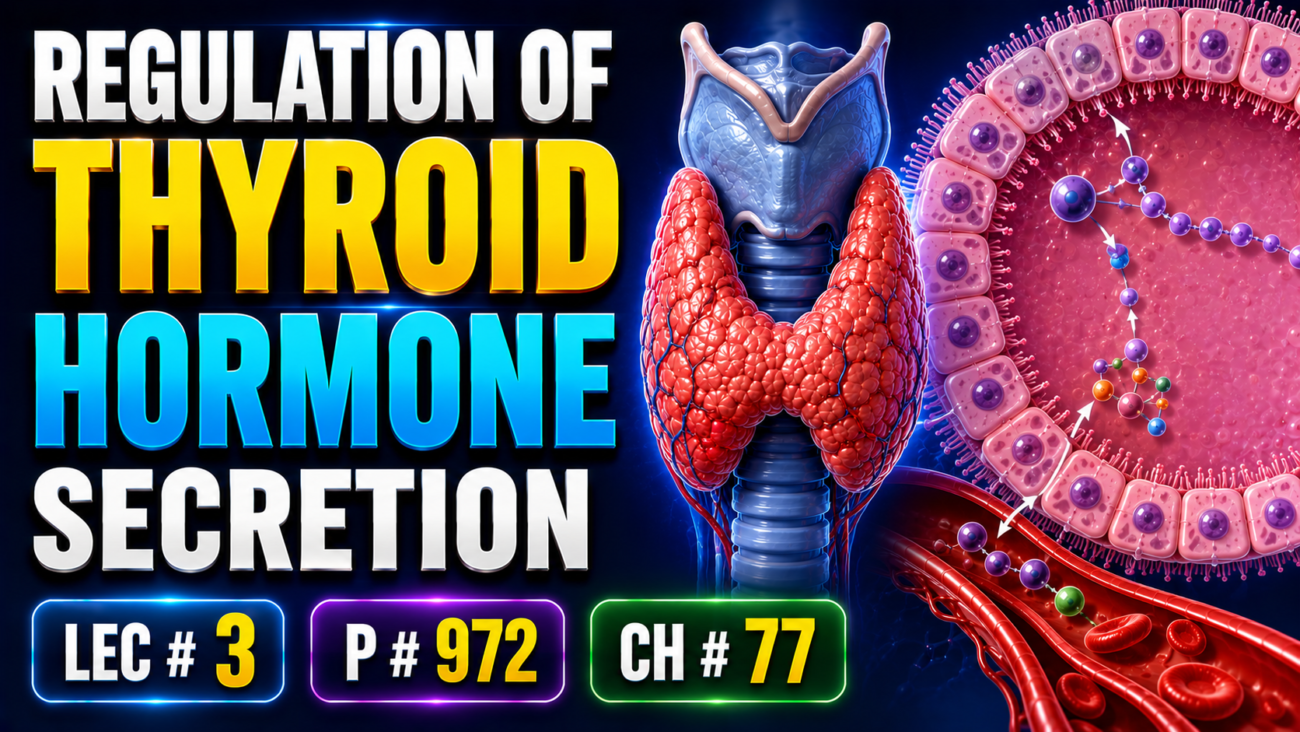
- Normal body metabolism requires precisely controlled thyroid hormone secretion.
- The hypothalamus and anterior pituitary gland use feedback mechanisms to control the rate of thyroid hormone secretion.
- TSH (thyrotropin) is an anterior pituitary glycoprotein hormone with a molecular weight of about 28,000.
- TSH increases thyroid secretion of thyroxine (T₄) and triiodothyronine (T₃).
- TSH increases thyroid activity in several ways:
- ↑ Proteolysis of stored thyroglobulin → ↑ T₄ and T₃ release into blood.
- ↑ Iodide pump activity → ↑ iodide trapping by thyroid cells.
- ↑ Iodination of tyrosine → ↑ thyroid hormone formation.
- ↑ Size and secretory activity of thyroid cells.
- ↑ Number of thyroid cells, with cells changing from cuboidal to columnar and the follicular epithelium becoming more folded.
- Therefore, TSH increases essentially all secretory activities of thyroid cells.
- The earliest major effect of TSH is proteolysis of thyroglobulin.
- This releases T₄ and T₃ into the blood within about 30 minutes.
- The other effects develop more slowly, over hours, days, or weeks.
- Most TSH effects occur through the cAMP second-messenger system.
- TSH first binds to G protein-coupled TSH receptors on the basal membrane of thyroid cells.
- The receptor activates adenylyl cyclase.
- Adenylyl cyclase increases cAMP inside the cell.
- cAMP acts as a second messenger and activates protein kinase.
- Protein kinase causes multiple protein phosphorylations inside the cell.
- These changes produce both an immediate increase in thyroid hormone secretion and prolonged growth of thyroid tissue.
KEY CONCEPT
TSH → TSH receptor → G protein → adenylyl cyclase → ↑ cAMP → protein kinase → phosphorylation → ↑ thyroid hormone secretion + thyroid growth
- Fast effect: Proteolysis of thyroglobulin → T₄/T₃ release within ~30 min.
- Slow effects: ↑ iodide trapping, ↑ iodination, ↑ cell size/activity, ↑ cell number.
CONCEPTUAL EXAMPLES
- TSH ↑ → proteolysis ↑ → stored T₄/T₃ released → blood.
- TSH ↑ → iodide pump ↑ → iodide trapping ↑.
- TSH → cAMP ↑ → protein kinase ↑ → thyroid secretion ↑.
- TSH → cAMP → prolonged stimulation → thyroid tissue growth.
ANTERIOR PITUITARY SECRETION OF TSH IS REGULATED BY THYROTROPIN-RELEASING HORMONE FROM THE HYPOTHALAMUS
- TRH (thyrotropin-releasing hormone) from the hypothalamus controls TSH secretion from the anterior pituitary.
- TRH is made by neurons in the paraventricular nucleus (PVN) of the hypothalamus.
- These neurons release TRH into the median eminence.
- TRH then travels through the hypothalamic-hypophysial portal blood to the anterior pituitary.
- TRH is a tripeptide amide: pyroglutamyl-histidyl-proline-amide.
- TRH stimulates anterior pituitary cells to increase TSH secretion.
- If the hypothalamic–pituitary portal blood supply is blocked, TSH secretion falls greatly but does not reach zero.
- TRH first binds to TRH receptors on pituitary cell membranes.
- This activates the phospholipase C second-messenger system.
- Phospholipase C produces a cascade involving Ca²⁺ and diacylglycerol (DAG).
- These second messengers ultimately cause TSH release.
- Cold exposure is an important stimulus for increasing TRH and therefore TSH secretion.
- Cold likely stimulates hypothalamic centers responsible for body-temperature control.
- Severe cold exposure in rats can increase thyroid hormone output to more than 100% of normal and increase BMR by up to 50%.
- People moving to Arctic regions may develop BMRs about 15–20% above normal.
- TRH neurons in the PVN also receive signals from leptin-responsive neurons in the arcuate nucleus that regulate energy balance.
- During prolonged fasting, leptin levels fall.
- Low leptin decreases POMC activity, increases NPY/AGRP activity, and may directly inhibit TRH neurons.
- These effects reduce TRH → TSH → thyroid hormone secretion.
- The resulting lower metabolic rate helps conserve energy when food is scarce.
- Emotional states can also affect TRH and TSH secretion.
- Excitement and anxiety can cause an acute decrease in TSH secretion, possibly because increased metabolic activity and body heat affect the hypothalamic heat-control center.
KEY CONCEPT
Hypothalamus (TRH) → anterior pituitary → TSH → thyroid → T₄/T₃
- TRH → phospholipase C → Ca²⁺ + DAG → TSH release.
- Cold → TRH ↑ → TSH ↑ → thyroid hormones ↑.
- Prolonged fasting → leptin ↓ → TRH ↓ → TSH ↓ → thyroid hormones ↓ → energy conservation.
CONCEPTUAL EXAMPLES
- TRH reaches pituitary → PLC activated → Ca²⁺/DAG → TSH released.
- Cold exposure → TRH ↑ → TSH ↑ → thyroid hormones ↑ → metabolic activity ↑.
- Fasting → leptin ↓ → TRH ↓ → TSH ↓ → thyroid hormones ↓.
- Anxiety/excitement → acute TSH ↓.
FEEDBACK EFFECT OF THYROID HORMONE TO DECREASE ANTERIOR PITUITARY SECRETION OF TSH
- When thyroid hormone levels increase, TSH secretion from the anterior pituitary decreases.
- When thyroid hormone secretion reaches about 1.75 × normal, TSH secretion falls to almost zero.
- Most of this negative feedback occurs even when the anterior pituitary is separated from the hypothalamus.
- Therefore, increased thyroid hormone mainly inhibits TSH secretion through a direct effect on the anterior pituitary (Fig. 77.7).
- Thyroid hormone also provides negative feedback to the hypothalamus, reducing TRH secretion.
- These feedback mechanisms help maintain an almost constant level of free thyroid hormones in the blood.
KEY CONCEPT
Thyroid hormone ↑ → pituitary TSH ↓ + hypothalamic TRH ↓ → thyroid hormone returns toward normal.
- ~1.75 × normal thyroid hormone → TSH ≈ zero.
- Main feedback site: anterior pituitary.
- Additional feedback site: hypothalamus.
CONCEPTUAL EXAMPLES
- T₃/T₄ ↑ → TSH ↓ → thyroid stimulation ↓.
- T₃/T₄ ↑ → TRH ↓ → TSH ↓.
- Purpose: Keep free thyroid hormone levels nearly constant.
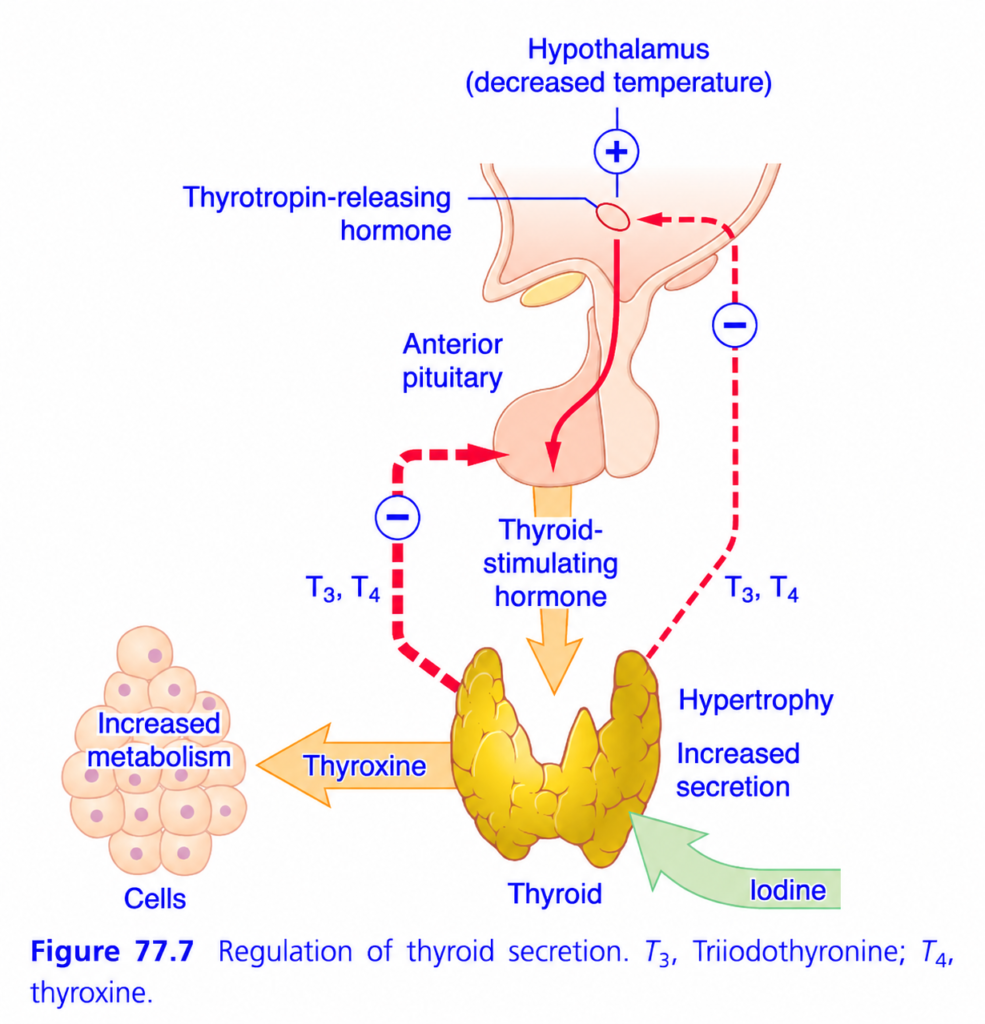
🧠 BIG IDEA — Thyroid Regulation
This figure is simply showing the thermostat system of thyroid hormone:
Cold → Hypothalamus → TRH → Pituitary → TSH → Thyroid → T₃/T₄ → ↑ Metabolism
And when T₃/T₄ become high:
T₃/T₄ → STOP hypothalamus + pituitary ⛔
This is negative feedback.
🔥 FOLLOW THE ARROWS
1️⃣ Temperature falls ❄️
At the top:
Hypothalamus detects decreased temperature
⬇️
It becomes more active.
Think:
Cold = “We need more heat!”
2️⃣ HYPOTHALAMUS RELEASES TRH
Hypothalamus releases:
TRH
= Thyrotropin-Releasing Hormone
⬇️
TRH travels to the:
Anterior pituitary3️⃣ ANTERIOR PITUITARY RELEASES TSH
TRH stimulates the anterior pituitary.
The pituitary releases:
TSH
= Thyroid-Stimulating Hormone
⬇️
TSH travels through blood to the:
Thyroid glandTIMULATES THYROID
TSH tells the thyroid:
“Work harder!”
Therefore thyroid:
↑ Thyroid hormone secretion
Mainly:
T₄ + T₃
And TSH also causes:
Thyroid hypertrophy
Meaning:
Thyroid cells grow/enlarge when stimulation is prolonged.
5️⃣ T₃ + T₄ INCREASE METABOLISM 🔥
T₃/T₄ travel through blood to body cells.
They increase:
Cellular metabolism
⬆️ metabolism
⬇️
⬆️ energy use
⬇️
⬆️ heat production
So in cold conditions:
❄️ Cold → thyroid hormone ↑ → metabolism ↑ → heat ↑ 🔥 6️⃣ NOW THE MOST IMPORTANT PART: NEGATIVE FEEDBACK
Look at the red dashed lines with − signs.
They represent:
Negative feedback
When T₃ and T₄ increase sufficiently:
T₃/T₄ ⛔ Hypothalamus
and
T₃/T₄ ⛔ Anterior pituitary
Therefore:
↓ TRH
↓ TSH
↓ thyroid stimulation
↓ T₃/T₄ production
🔄 WHY IS THIS CALLED NEGATIVE FEEDBACK?
Because the final product:
T₃/T₄
goes back and reduces the signals that produced it.
Think of a thermostat:
Room cold ❄️
→ heater ON 🔥
Room warm enough 🌡️
→ heater OFF ⛔
Exactly the same basic principle.
🧠 WHAT DOES IODINE DO HERE?
The green arrow says:
Iodine → thyroid
Iodine is the raw material needed to make T₃ and T₄.
So:
TSH = tells thyroid “make more”
Iodine = provides the material to make it
Don’t confuse them.
🎯 EVERY PART OF THE IMAGE
❄️ Decreased temperature
Stimulates hypothalamus.
↓
🧠 Hypothalamus
Releases TRH
↓
🏛️ Anterior pituitary
Releases TSH
↓
🦋 Thyroid
TSH stimulates:
- ↑ T₃/T₄ secretion
- ↑ thyroid growth/hypertrophy
↓
🔥 Body cells
T₃/T₄ cause:
↑ metabolism
↓
🌡️ More heat production
🛑 FEEDBACK LOOP
Once T₃/T₄ rise:
T₃/T₄
→ inhibit hypothalamus
→ inhibit anterior pituitary
→ ↓ TRH
→ ↓ TSH
→ ↓ thyroid stimulation
= Negative feedback
🧩 STORY
Imagine your body has a heater with a thermostat.
Hypothalamus = thermostat 🌡️
TRH = message to manager 📩
Pituitary = manager 👨💼
TSH = order to heater 📢
Thyroid = heater 🔥
T₃/T₄ = heat-producing hormones
Body cells = places receiving the heat effect
When it’s cold:
“Turn the heater ON!”
When enough heat is produced:
“Okay, turn it DOWN!”
That’s the whole figure.
🚨 HIGH-YIELD EXAM POINTS
TRH comes from → Hypothalamus
TSH comes from → Anterior pituitary
T₃/T₄ come from → Thyroid
T₃/T₄ effect → ↑ metabolism
T₃/T₄ feedback → ↓ TRH + ↓ TSH
Iodine → required to synthesize thyroid hormones
TSH → stimulates thyroid growth + hormone secretion
🏆 ONE-LINE MASTER MEMORY
❄️ Cold → TRH → TSH → Thyroid → T₃/T₄ → ↑ metabolism/heat → ⛔ TRH & TSH
🔑 Remember:
TRH = Hypothalamus
TSH = Pituitary
T₃/T₄ = Thyroid
T₃/T₄ = negative feedback
Cold = turns the system ON
Antithyroid Substances Suppress Thyroid Secretion
- Important antithyroid substances include thiocyanate, propylthiouracil, and high concentrations of inorganic iodides.
- Each suppresses thyroid secretion by a different mechanism.
- Thiocyanate ions decrease iodide trapping.
- The iodide pump can also transport thiocyanate, perchlorate, and nitrate ions.
- High concentrations of these ions competitively inhibit iodide transport into thyroid cells.
- Less iodide enters the thyroid, so thyroglobulin is still formed but cannot be adequately iodinated.
- Therefore, thyroid hormone formation decreases.
- Low thyroid hormone then causes TSH to increase.
- Increased TSH stimulates thyroid growth, producing an enlarged thyroid called a goiter.
- Propylthiouracil (PTU) decreases thyroid hormone formation.
- PTU, along with methimazole and carbimazole, interferes with thyroid hormone formation from iodide and tyrosine.
- It partly blocks peroxidase, reducing tyrosine iodination.
- It also partly blocks coupling of iodinated tyrosines, reducing formation of T₄ and T₃.
- PTU does not stop thyroglobulin formation.
- Reduced T₄ and T₃ causes TSH to increase, which can enlarge the thyroid and produce a goiter.
- High concentrations of iodides decrease thyroid activity and gland size.
- At about 100 times the normal plasma iodide concentration, most thyroid activities decrease.
- This is called the Wolff–Chaikoff effect.
- High iodide reduces iodide trapping, so iodination and thyroid hormone formation decrease.
- It also stops normal endocytosis of colloid, which is the first step in releasing stored thyroid hormones.
- Therefore, thyroid hormone secretion into blood is rapidly reduced.
- After several days to weeks, the thyroid usually escapes from the Wolff–Chaikoff effect, probably because the sodium-iodide symporter is downregulated.
- Normal thyroid function then resumes.
- Because high iodide decreases many thyroid activities, it can slightly reduce thyroid size and especially reduce thyroid blood flow.
- Therefore, iodides are often given for 2–3 weeks before thyroid surgery to reduce the amount of surgery and especially bleeding.
- Iodides can also be used to treat thyroid storm (thyrotoxic crisis), in which the thyroid releases a large amount of hormone rapidly.
KEY CONCEPT
- Thiocyanate → ↓ iodide trapping → ↓ iodination → ↓ thyroid hormones → ↑ TSH → goiter.
- PTU → ↓ peroxidase + ↓ coupling → ↓ T₃/T₄ → ↑ TSH → goiter.
- High iodide → Wolff–Chaikoff effect → ↓ iodide trapping + ↓ colloid endocytosis → ↓ thyroid hormone release.
- High iodide → ↓ thyroid size + ↓ blood flow.
CONCEPTUAL EXAMPLES
- Thiocyanate: blocks iodide entry → thyroid cannot obtain enough iodide for hormone formation.
- PTU: blocks hormone-making steps → T₃/T₄ formation falls.
- High iodide: temporarily shuts down thyroid activity → hormone release falls rapidly.
- Thiocyanate/PTU: low T₃/T₄ → TSH rises → goiter.
- High iodide before surgery: thyroid blood flow ↓ → less bleeding.
