

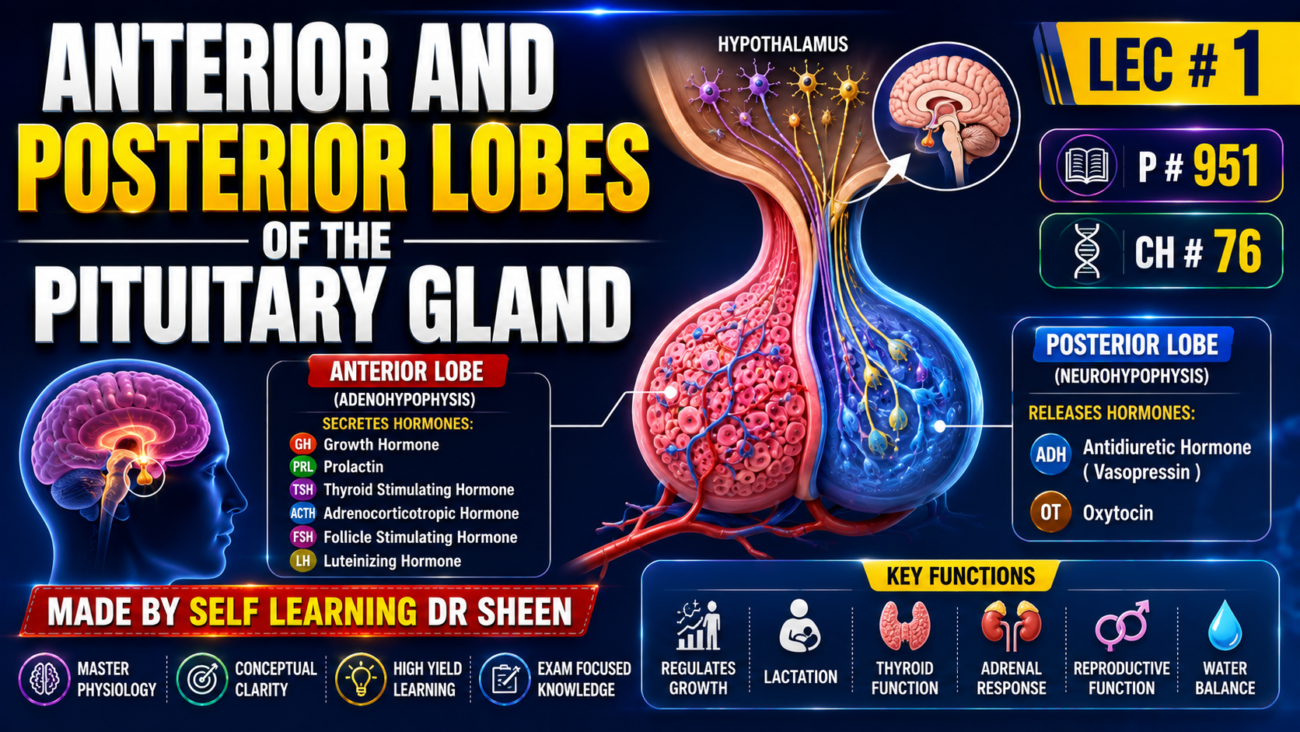
ANTERIOR AND POSTERIOR LOBES OF THE PITUITARY GLAND- Lec # 1 P# 951 Ch # 76
- The pituitary gland (hypophysis) is a small gland about 1 cm in diameter and 0.5–1 g in weight.
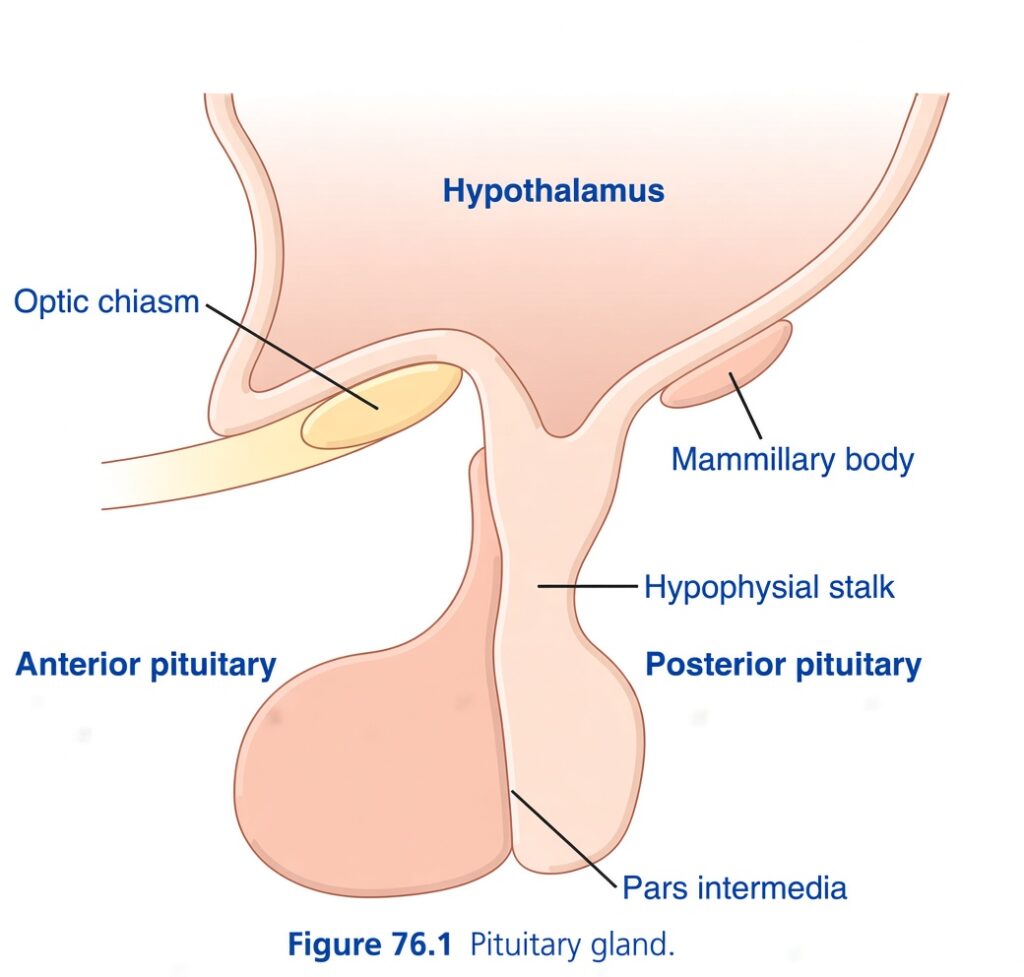
- It lies in the sella turcica, a bony cavity at the base of the skull, and is connected to the hypothalamus by the pituitary stalk (Fig. 76.1).
- Physiologically, the pituitary has two main portions:
- Anterior pituitary (adenohypophysis)
- Posterior pituitary (neurohypophysis)
- Between them is the pars intermedia, a small, relatively blood-poor zone that is less developed in humans but more functional in some animals.
- The two portions develop from different embryonic sources:
- Anterior pituitary → Rathke’s pouch → pharyngeal epithelium
- Posterior pituitary → neural tissue outgrowth from the hypothalamus
- Therefore, anterior pituitary cells have an epithelioid nature, while the posterior pituitary contains many glial-type cells.
- The anterior pituitary secretes 6 major peptide hormones plus several less important hormones.
- The posterior pituitary secretes 2 important peptide hormones.
- Anterior pituitary hormones:
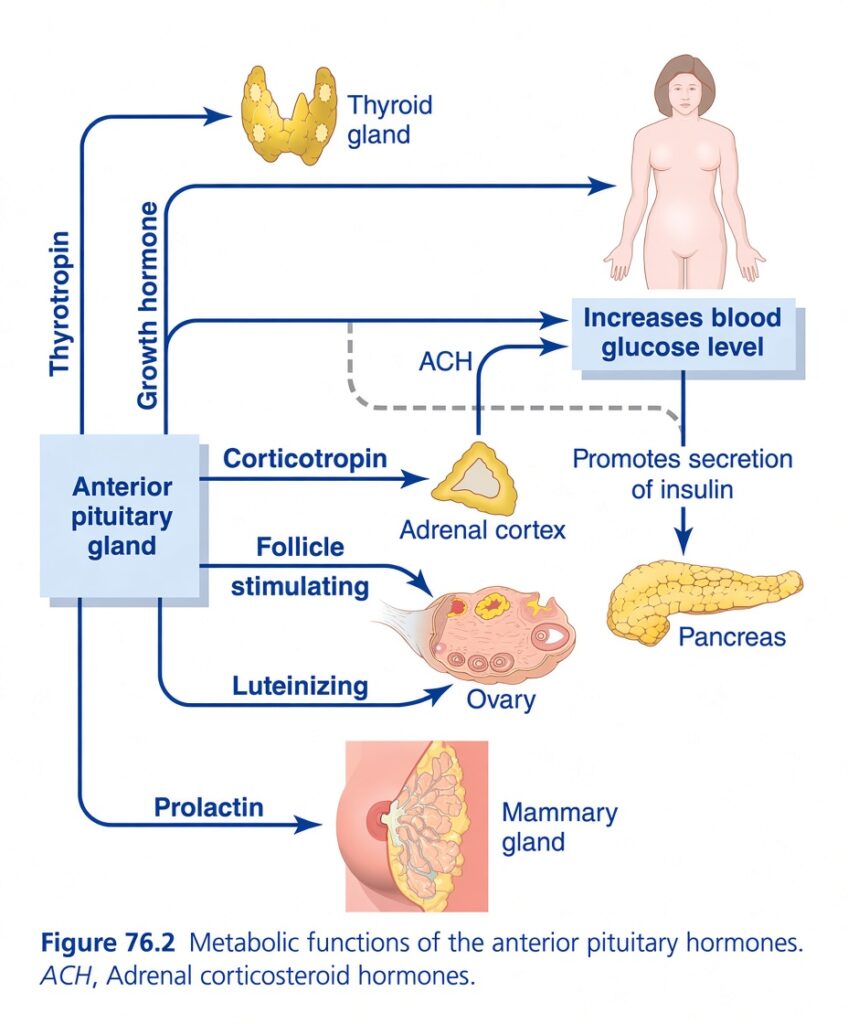
- Growth hormone (GH) → promotes body growth by affecting protein formation, cell multiplication, and cell differentiation.
- Adrenocorticotropic hormone (ACTH/corticotropin) → controls secretion of adrenocortical hormones, which affect glucose, protein, and fat metabolism.
- Thyroid-stimulating hormone (TSH/thyrotropin) → controls secretion of T₄ and T₃ by the thyroid; these hormones regulate most intracellular chemical reactions.
- Prolactin → promotes mammary gland development and milk production.
- Follicle-stimulating hormone (FSH) and luteinizing hormone (LH) → control ovarian and testicular growth, as well as their hormonal and reproductive functions.
- Posterior pituitary hormones:
- Antidiuretic hormone (ADH/vasopressin) → controls water excretion in urine, helping regulate water concentration in body fluids.
- Oxytocin → helps milk ejection during suckling and assists delivery of the baby at the end of pregnancy.
KEY CONCEPT
Pituitary = anterior + posterior lobes → anterior controls growth, metabolism, thyroid, milk production, and reproduction; posterior controls water balance and milk ejection/childbirth.
CONCEPTUAL EXAMPLES
- GH → body growth
- TSH → thyroid → T₃/T₄
- Prolactin → milk production
- FSH/LH → ovaries/testes → reproductive functions
- ADH → ↓ water loss in urine
- Oxytocin → milk ejection + childbirth
The Anterior Pituitary Gland Contains Several Different Cell Types That Synthesize and Secrete Hormones
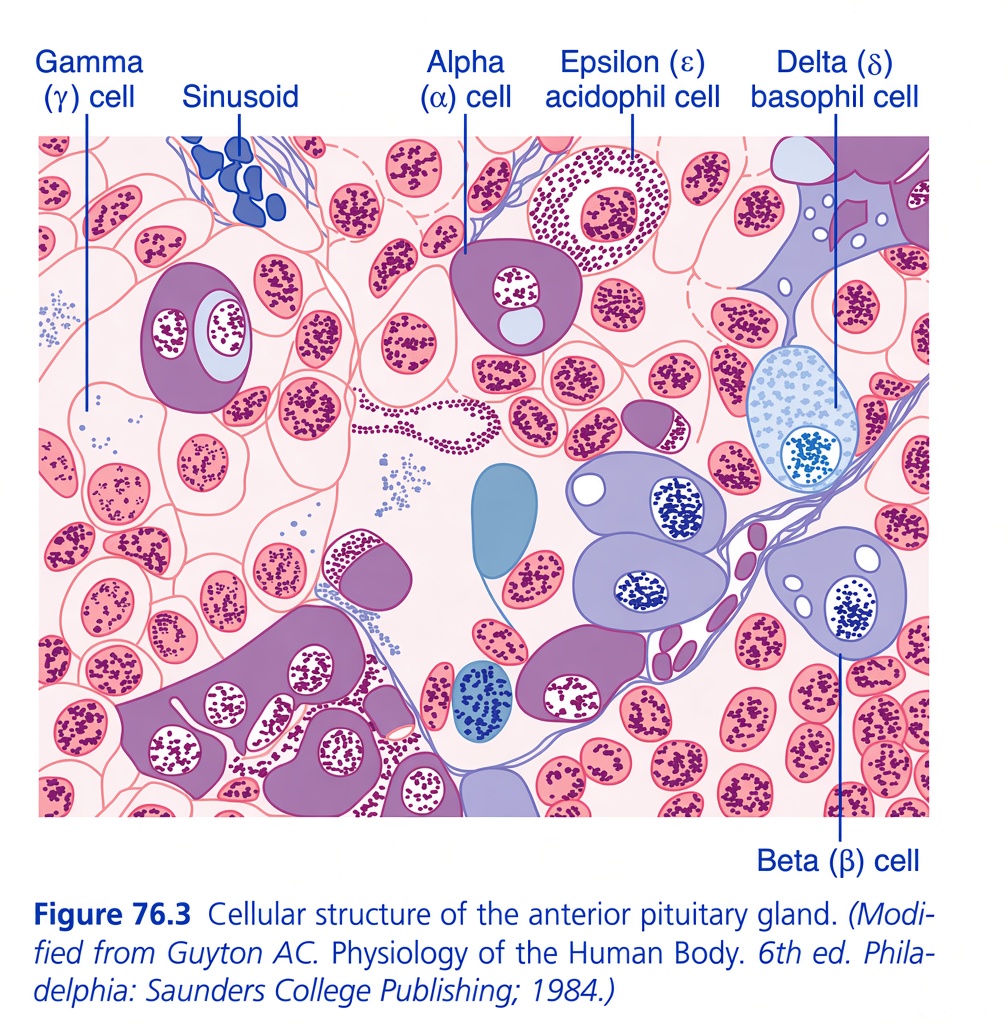
- The anterior pituitary contains several different cell types, and usually one cell type produces one major hormone.
- Using special stains with antibodies that specifically bind to hormones, at least 5 cell types can be identified (Fig. 76.3; Table 76.1).
- Five major cell types:
- Somatotropes → human growth hormone (hGH/GH)
- Corticotropes → adrenocorticotropic hormone (ACTH)
- Thyrotropes → thyroid-stimulating hormone (TSH)
- Gonadotropes → luteinizing hormone (LH) + follicle-stimulating hormone (FSH)
- Lactotropes → prolactin (PRL)
- About 30%–40% of anterior pituitary cells are somatotropes, which secrete GH.
- About 20% are corticotropes, which secrete ACTH.
- The other cell types each make up about 3%–5%, but they produce powerful hormones controlling thyroid function, sexual functions, and milk secretion.
- Somatotropes stain strongly with acid dyes, so they are called acidophils.
- Therefore, pituitary tumors that produce large amounts of hGH are called acidophilic tumors.
Posterior Pituitary Hormones Are Synthesized By Cell Bodies in the Hypothalamus
- The cells that produce posterior pituitary hormones are not located in the pituitary gland.
- They are large neurons called magnocellular neurons, located in the supraoptic and paraventricular nuclei of the hypothalamus.
- These neurons produce the hormones, which are then transported along the nerve fibers (axoplasm) from the hypothalamus to the posterior pituitary gland.
KEY CONCEPT
Anterior pituitary → different cell types produce different hormones.
Posterior pituitary hormones → produced by hypothalamic neurons → transported to posterior pituitary.
CONCEPTUAL EXAMPLES
- Somatotrope → GH → growth
- Corticotrope → ACTH → adrenal cortex
- Thyrotrope → TSH → thyroid
- Gonadotrope → LH + FSH → reproductive functions
- Lactotrope → PRL → milk production
- Hypothalamic magnocellular neuron → posterior pituitary hormone → transported through nerve fibers