



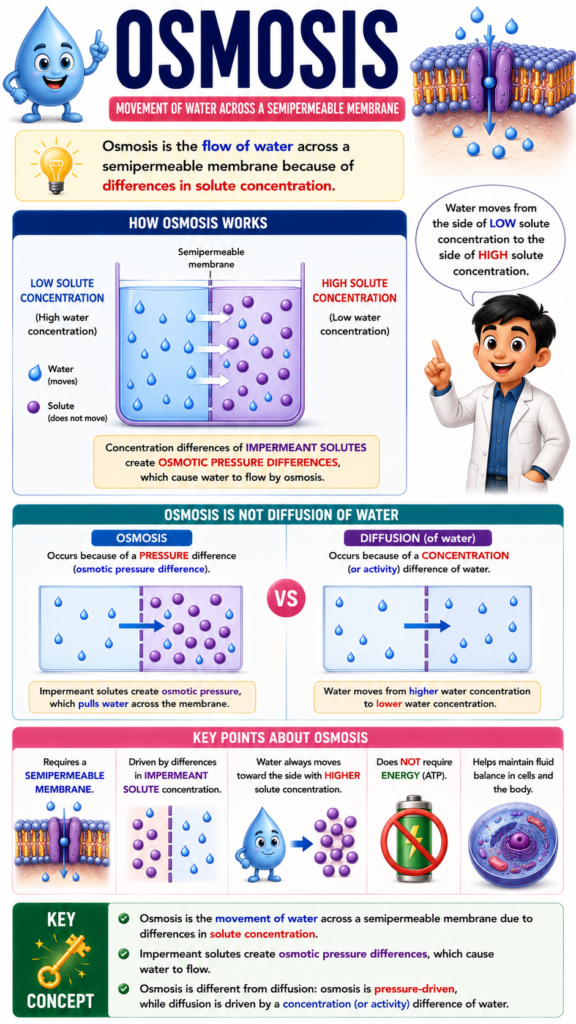
- Osmosis is the movement of water across a semipermeable membrane.
- Water moves because there is a difference in solute concentration on the two sides of the membrane.
- Impermeant (non-diffusible) solutes create a difference in osmotic pressure.
- This osmotic pressure difference causes water to move by osmosis
- Osmosis is not the same as diffusion of water.
- Osmosis occurs because of an osmotic pressure difference across a semipermeable membrane.
- Diffusion of water occurs because of a difference in water concentration (water activity).
KEY CONCEPT
- Osmosis is the movement of water across a semipermeable membrane.
- Water moves because impermeant solutes create an osmotic pressure difference.
- Osmosis is driven by pressure difference, whereas diffusion is driven by a concentration (water activity) difference.
Osmolarity
- Osmolarity is the concentration of osmotically active particles in a solution.
- It is expressed as osmoles per liter (Osm/L) or milliosmoles per liter (mOsm/L).
- To calculate osmolarity, you must know:
- The solute concentration.
- Whether the solute dissociates (breaks apart) in solution.
- Glucose does not dissociate in solution.
- Therefore, 1 glucose molecule forms 1 particle.
- NaCl theoretically dissociates into 2 particles:
- Na⁺
- Cl⁻
- CaCl₂ theoretically dissociates into 3 particles:
- 1 Ca²⁺
- 2 Cl⁻
- The symbol g represents the number of particles formed in solution.
- It also shows whether dissociation is complete or partial.
- If NaCl dissociates completely, g = 2.0.
- If NaCl dissociates only partially, g is between 1.0 and 2.0.
- Osmolarity is calculated by the formula:
Osmolarity = g × C
Where:
- Osmolarity = Concentration of particles (mOsm/L)
- g = Number of particles formed per mole in solution (Osm/mol)
- C = Solute concentration (mmol/L)
Easy Formula Understanding
- Glucose:
- g = 1
- If concentration = 100 mmol/L
- Osmolarity = 1 × 100 = 100 mOsm/L
- NaCl (complete dissociation):
- g = 2
- If concentration = 100 mmol/L
- Osmolarity = 2 × 100 = 200 mOsm/L
- CaCl₂ (complete dissociation):
- g = 3
- If concentration = 100 mmol/L
- Osmolarity = 3 × 100 = 300 mOsm/L
- If two solutions have the same osmolarity, they are called isosmotic.
- If one solution has a higher osmolarity, it is called hyperosmotic.
- If one solution has a lower osmolarity, it is called hyposmotic.
KEY CONCEPT
- Osmolarity measures the total concentration of osmotically active particles in a solution.
- Formula: Osmolarity = g × C
- g = Number of particles formed after dissociation.
- C = Solute concentration.
- Glucose: g = 1; NaCl: g = 2 (complete dissociation); CaCl₂: g = 3 (complete dissociation).
- Isosmotic: Same osmolarity.
- Hyperosmotic: Higher osmolarity.
- Hyposmotic: Lower osmolarity.
Osmolality
- Osmolality is similar to osmolarity.
- It is the concentration of osmotically active particles.
- Osmolality is expressed as osmoles (or milliosmoles) per kilogram (kg) of water.
- 1 kg of water is approximately equal to 1 liter (L) of water.
- Therefore, osmolarity and osmolality have almost the same numerical value.
KEY CONCEPT
- Osmolality = Concentration of osmotically active particles per kilogram of water.
- Osmolarity = Concentration of osmotically active particles per liter of solution.
- Because 1 kg of water ≈ 1 L of water, osmolality and osmolarity are usually almost equal in numerical value.

Sample Problem
- Solution A contains 2 mmol/L urea.
- Solution B contains 1 mmol/L NaCl.
- Assume g for NaCl = 1.85.
- Question: Are the two solutions isosmotic?
- Isosmotic means both solutions have the same calculated osmolarity.
- Calculate the osmolarity of both solutions and compare them.
- Solution A contains urea.
- Urea does not dissociate in solution.
- Therefore:
- g = 1
- Concentration = 2 mmol/L
- Osmolarity = g × C
- Osmolarity = 1 × 2 = 2 mOsm/L
- Solution B contains NaCl.
- NaCl dissociates partially, not completely.
- Therefore:
- g = 1.85
- Concentration = 1 mmol/L
- Osmolarity = g × C
- Osmolarity = 1.85 × 1 = 1.85 mOsm/L
Easy Comparison
| Solution | Osmolarity |
|---|---|
| A (Urea) | 2 mOsm/L |
| B (NaCl) | 1.85 mOsm/L |
- The two solutions do not have the same osmolarity.
- Therefore, they are not isosmotic.
- Solution A has the higher osmolarity, so it is hyperosmotic.
- Solution B has the lower osmolarity, so it is hyposmotic.
KEY CONCEPT
- Formula: Osmolarity = g × C
- Urea: g = 1 → 1 × 2 = 2 mOsm/L
- NaCl: g = 1.85 → 1.85 × 1 = 1.85 mOsm/L
- Since 2 ≠ 1.85, the two solutions are not isosmotic.
- Solution A = Hyperosmotic
- Solution B = Hyposmotic
Osmotic Pressure
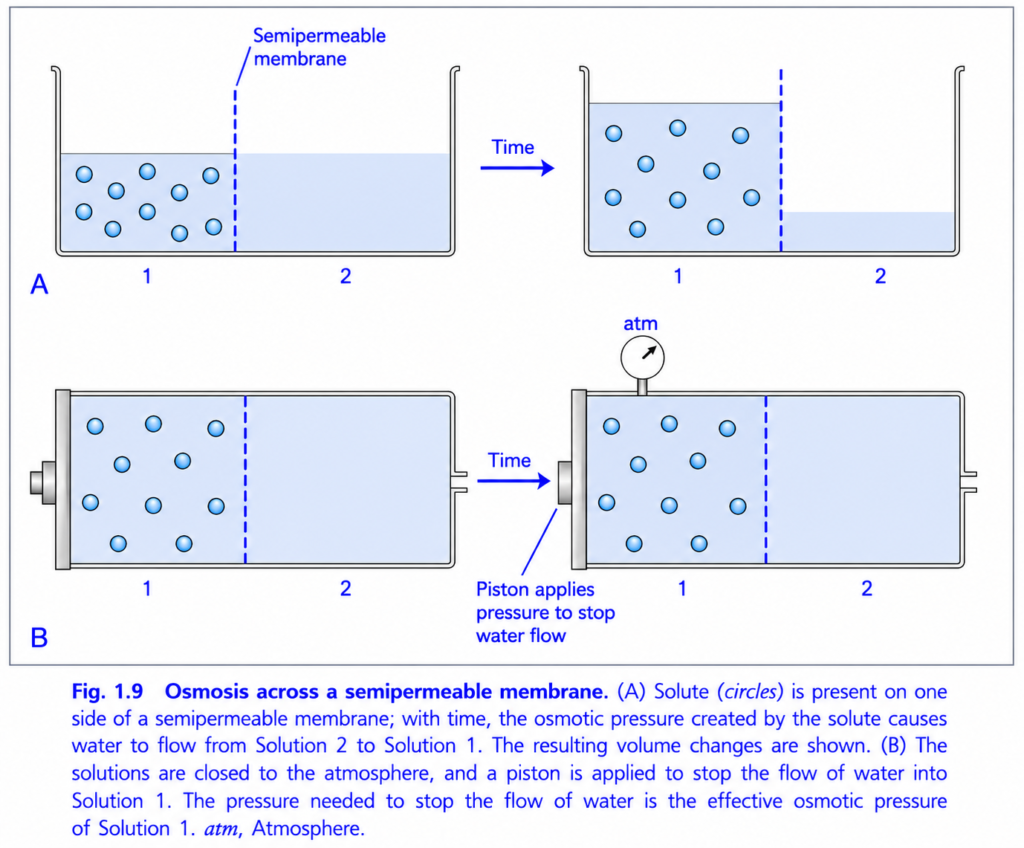
- Osmosis is the movement of water across a semipermeable membrane due to a difference in solute concentration.
- This difference creates an osmotic pressure difference across the membrane.
- The osmotic pressure difference is the driving force for water movement.
- Fig. 1.9A shows two aqueous solutions separated by a semipermeable membrane.
- The membrane allows water to pass but does not allow the solute to pass.
- At first, solute is present only in Solution 1.
- The solute in Solution 1 creates osmotic pressure.
- This reduces the hydrostatic pressure in Solution 1.
- A hydrostatic pressure difference develops across the membrane.
- Water flows from Solution 2 into Solution 1.
- Over time:
- Solution 1 volume increases.
- Solution 2 volume decreases.
- Fig. 1.9B shows the same setup, but a piston applies pressure to stop water movement into Solution 1.
- The pressure needed to stop water flow is called the osmotic pressure of Solution 1.
- The osmotic pressure (π) of Solution 1 depends on:
- The concentration of osmotically active particles.
- Whether the solute can cross the membrane.
- Osmotic pressure is calculated by the van’t Hoff equation:
Formula
π = g × C × σ × R × T
Where:
- π = Osmotic pressure (atm or mm Hg)
- g = Number of particles formed per mole in solution (Osm/mol)
- C = Solute concentration (mmol/L)
- σ (reflection coefficient) = Ability of the membrane to prevent solute passage (0 to 1)
- R = Gas constant (0.082 L·atm/mol·K)
- T = Absolute temperature (Kelvin, K)
Easy Formula Understanding
- Higher g → More particles → Higher osmotic pressure.
- Higher C → More solute → Higher osmotic pressure.
- Higher σ → Solute crosses less easily → Higher osmotic pressure.
- Higher T → Slightly higher osmotic pressure.
- The reflection coefficient (σ) ranges from 0 to 1.
- It shows how easily a solute crosses a membrane.
- σ = 1.0 (Fig. 1.10A)
- The membrane is completely impermeable to the solute.
- The solute stays in the original solution.
- The solute produces its maximum osmotic effect.
- Water movement is maximum.
- Examples: Serum albumin and intracellular proteins.
- σ = 0 (Fig. 1.10C)
- The membrane is freely permeable to the solute.
- The solute diffuses freely until both sides have equal concentration.
- The solute behaves like water.
- No effective osmotic pressure develops.
- No osmotic water movement occurs.
- In the van’t Hoff equation:
- σ = 0
- π = g × C × 0 × R × T = 0
- Urea is an example of a solute with σ ≈ 0.
- σ between 0 and 1 (Fig. 1.10B)
- Most solutes have a reflection coefficient between 0 and 1.
- The membrane is partially permeable to these solutes.
- The effective osmotic pressure is less than the maximum but greater than zero.
- In the van’t Hoff equation:
- 0 < σ < 1
- Effective osmotic pressure is between 0 and its maximum value.
- If two solutions have the same effective osmotic pressure, they are isotonic.
- In isotonic solutions, no net water movement occurs.
- If two solutions have different effective osmotic pressures:
- The solution with lower effective osmotic pressure is hypotonic.
- The solution with higher effective osmotic pressure is hypertonic.
- Water always flows from the hypotonic solution to the hypertonic solution (Box 1.2).
KEY CONCEPT
- Osmotic pressure is the force that drives water across a semipermeable membrane.
- It depends on:
- Number of particles (g)
- Solute concentration (C)
- Reflection coefficient (σ)
- Gas constant (R)
- Absolute temperature (T)
- Formula: π = g × C × σ × R × T
- σ = 1: Maximum osmotic effect.
- σ = 0: No osmotic effect.
- 0 < σ < 1: Partial osmotic effect.
- Isotonic: Same effective osmotic pressure → No net water movement.
- Hypotonic → Hypertonic: Water flows from lower to higher effective osmotic pressure.
For physiology formulas, you can simplify them by explaining what happens when each variable changes rather than doing a numerical calculation (unless values are given).
Osmotic Pressure Formula
π = g × C × σ × R × T
Easy Conceptual Solution of the Formula
- Step 1: Count the number of particles (g).
- More particles (↑ g) → ↑ Osmotic pressure (π)
- Fewer particles (↓ g) → ↓ Osmotic pressure (π)
- Step 2: Check the solute concentration (C).
- Higher concentration (↑ C) → ↑ Osmotic pressure (π)
- Lower concentration (↓ C) → ↓ Osmotic pressure (π)
- Step 3: Check the reflection coefficient (σ).
- σ = 1 → Solute cannot cross the membrane → Maximum osmotic pressure
- σ = 0 → Solute crosses freely → Osmotic pressure = 0
- 0 < σ < 1 → Partial osmotic pressure
- Step 4:R (Gas constant) is a fixed value.
- R = 0.082 L·atm/mol·K
- It does not change.
- Step 5: Check the temperature (T).
- Higher temperature (↑ T) → ↑ Osmotic pressure (π)
- Lower temperature (↓ T) → ↓ Osmotic pressure (π)
Easy Memory Rule
- ↑ g → ↑ π
- ↑ C → ↑ π
- ↑ σ → ↑ π
- ↑ T → ↑ π
- R is constant.
Example 1
Given:
- g = 2
- C = 100 mmol/L
- σ = 1
- R = constant
- T = constant
Since R and T are constant:
π ∝ 2 × 100 × 1 = 200
Example 2
Given:
- g = 1
- C = 100 mmol/L
- σ = 0
Since:
π ∝ 1 × 100 × 0 = 0
Result: No effective osmotic pressure because the solute crosses the membrane freely.
KEY CONCEPT
- Osmotic Pressure (π) increases when g, C, σ, or T increase.
- If σ = 1, osmotic pressure is maximum.
- If σ = 0, osmotic pressure is zero.
- R is a constant and does not change.
- When numerical values are provided, multiply all the values together to calculate osmotic pressure.
Reflection Coefficient (σ) (Figure 1.10)
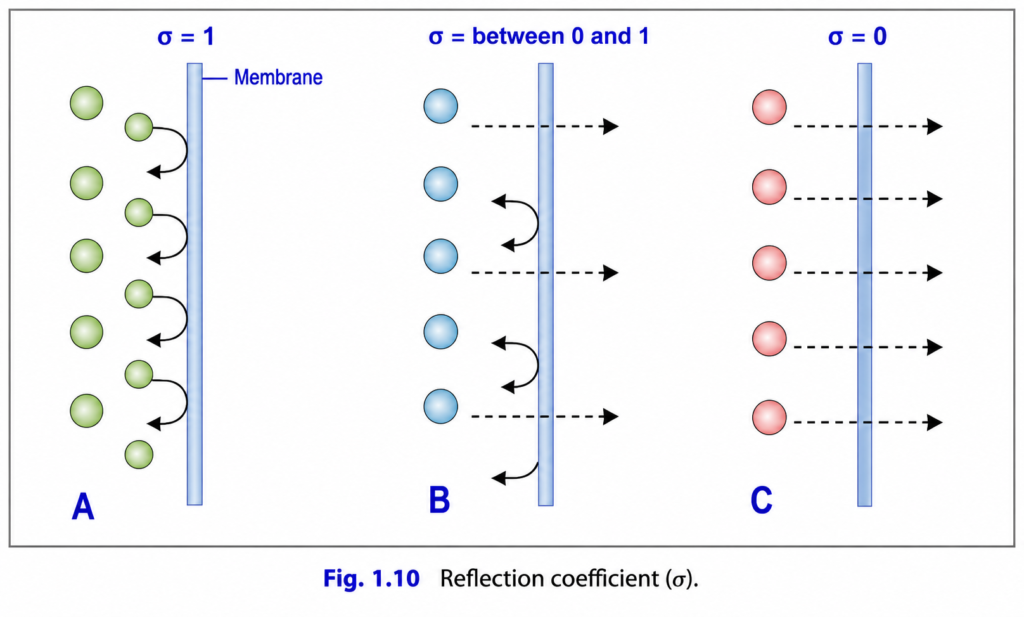
This figure explains the Reflection Coefficient (σ, sigma), which describes how well a semipermeable membrane prevents a solute from crossing it.
It compares three different situations:
- A: σ = 1 (Complete reflection)
- B: σ = Between 0 and 1 (Partial reflection)
- C: σ = 0 (No reflection)
The figure demonstrates one major principle:
The higher the reflection coefficient (σ), the less the solute can cross the membrane and the greater its osmotic effect.
Basic Concept
When a solute reaches a membrane, three things can happen:
- The membrane blocks it completely.
- The membrane allows some of it to pass.
- The membrane allows all of it to pass.
The reflection coefficient (σ) tells us how effectively the membrane reflects (blocks) the solute.
Definition
The reflection coefficient (σ) is a number between 0 and 1 that indicates how impermeable a membrane is to a particular solute.
- σ = 1 → Completely impermeable
- σ = 0 → Completely permeable
- σ = 0–1 → Partially permeable
Understanding the Figure
The blue vertical bar represents the:
Semipermeable Membrane
The colored circles represent:
Solute molecules
The arrows show whether the solute:
- Is reflected back.
- Passes through the membrane.
A – σ = 1 (Complete Reflection)
This is the left side of the figure.
What happens?
Every solute molecule reaches the membrane,
but none can cross it.
All molecules are reflected back.
The curved arrows indicate complete reflection.
Why?
The membrane is completely impermeable to this solute.
What does σ = 1 mean?
The membrane reflects 100% of the solute.
Therefore,
the solute remains entirely on one side.
Osmotic Effect
Since the solute cannot cross,
it pulls water strongly toward itself.
This produces the maximum osmotic pressure.
Easy Concept
Imagine a brick wall.
You throw tennis balls at it.
Every ball bounces back.
None crosses the wall.
That is σ = 1.
Examples
- Plasma proteins across normal capillary walls
- Albumin across most capillary membranes
Key Point
σ = 1
- Solute cannot cross.
- Maximum osmotic effect.
- Maximum water movement.
B – σ Between 0 and 1 (Partial Reflection)
This is the middle part of the figure.
What happens?
Some solute molecules cross the membrane.
Some are reflected back.
Both straight arrows and curved arrows are shown.
Why?
The membrane is partially permeable.
Some molecules fit through membrane pores,
while others do not.
What does σ between 0 and 1 mean?
Only part of the solute is reflected.
Therefore,
the osmotic effect is only partial.
Osmotic Effect
Since some solute escapes,
it cannot pull as much water.
Its osmotic pressure is reduced.
Easy Concept
Imagine a fence with small gaps.
Some balls pass through.
Others bounce back.
This represents partial reflection.
Examples
- Urea across many biological membranes
- Some electrolytes across partially permeable membranes
Key Point
0 < σ < 1
- Some solute crosses.
- Some remains.
- Moderate osmotic effect.
C – σ = 0 (No Reflection)
This is the right side of the figure.
What happens?
Every solute molecule passes freely through the membrane.
None is reflected back.
Only straight arrows are shown.
Why?
The membrane is completely permeable.
The solute moves freely.
What does σ = 0 mean?
The membrane reflects none of the solute.
Osmotic Effect
Since the solute moves equally to both sides,
there is no concentration difference.
Therefore,
it cannot pull water.
The osmotic pressure is zero.
Easy Concept
Imagine an open doorway.
Everyone walks through easily.
No one is stopped.
This is σ = 0.
Examples
- Water across aquaporins
- Lipid-soluble substances across cell membranes
Key Point
σ = 0
- Solute crosses freely.
- No osmotic pressure.
- No effective water movement.
Why Is Reflection Coefficient Important?
The reflection coefficient determines:
- How much osmotic pressure a solute can generate.
- How much water will move across the membrane.
The relationship is:
Higher σ → Greater osmotic pressure → More water movement
Relation to Osmotic Pressure
The effective osmotic pressure produced by a solute is:πeffective=σ×π
Where:
- πeffective = Effective osmotic pressure
- σ = Reflection coefficient
- π = Calculated osmotic pressure
Examples
σ = 1
Effective osmotic pressure
= 1 × π
= 100% of osmotic pressure
σ = 0.5
Effective osmotic pressure
= 0.5 × π
= 50% of osmotic pressure
σ = 0
Effective osmotic pressure
= 0 × π
= No osmotic pressure
Comparison of the Three Conditions
| Reflection Coefficient (σ) | Solute Movement | Osmotic Effect |
|---|---|---|
| σ = 1 | No solute crosses | Maximum |
| σ = 0–1 | Some solute crosses | Partial |
| σ = 0 | Solute crosses freely | None |
Clinical Importance
Capillary Membranes
Albumin has a reflection coefficient close to 1.
Therefore,
albumin remains in plasma,
creating plasma oncotic pressure that keeps water inside blood vessels.
Kidney Filtration
Different solutes have different reflection coefficients.
Large proteins:
High σ
Remain in blood.
Small solutes:
Low σ
Filter more easily.
Dialysis
Dialysis membranes are designed with specific permeabilities.
Small waste products (e.g., urea) pass through,
whereas large proteins are retained.
Quick Memory Table
| σ Value | Membrane Permeability | Water-Pulling Ability |
|---|---|---|
| 1 | Completely impermeable | Maximum |
| 0.5 | Partially permeable | Moderate |
| 0 | Completely permeable | None |
Easy Memory Trick
σ = 1 → “ONE = None Pass” 🚫
- No solute crosses.
- Maximum osmotic pressure.
σ = 0.5 → “HALF Pass” ⚖️
- Some cross.
- Moderate osmotic effect.
σ = 0 → “ZERO Stops” 🚪
- Everything crosses.
- No osmotic pressure.
Key Concept
The reflection coefficient (σ) measures how effectively a semipermeable membrane prevents a specific solute from crossing and ranges from 0 to 1. When σ = 1, the membrane is completely impermeable to the solute, so all solute molecules are reflected back, producing the maximum osmotic pressure and the greatest water movement. When σ is between 0 and 1, the membrane is partially permeable, allowing some solute molecules to cross while reflecting others, resulting in a partial osmotic effect. When σ = 0, the membrane is completely permeable, the solute crosses freely, no concentration gradient is maintained, and the solute produces no effective osmotic pressure. Therefore, the higher the reflection coefficient, the greater the solute’s ability to generate osmotic pressure and draw water across the membrane.
BOX 1.2 Clinical Physiology: Hyposmolarity With Brain Swelling
DESCRIPTION OF CASE
- A 72-year-old man was recently diagnosed with oat cell carcinoma of the lung.
- He tried to stay busy with consulting work, but the disease sapped his energy.
- One evening, his wife noticed that he seemed confused and lethargic.
- Then he suddenly suffered a grand mal seizure.
- In the emergency department, his plasma Na⁺ concentration was 113 mEq/L (normal, 140 mEq/L).
- His plasma osmolarity was 230 mOsm/L (normal, 290 mOsm/L).
- He was treated immediately with an infusion of hypertonic NaCl.
- He was released from the hospital a few days later with strict instructions to limit his water intake.
EXPLANATION OF CASE
- The man’s oat cell carcinoma autonomously secretes antidiuretic hormone (ADH).
- This causes syndrome of inappropriate antidiuretic hormone (SIADH).
- In SIADH, the high circulating levels of ADH cause excessive water reabsorption by the principal cells of the late distal tubule and collecting ducts.
- The excess water that is reabsorbed and retained in the body dilutes the Na⁺ concentration and osmolarity of the extracellular fluid (ECF).
- The decreased osmolarity means there is also decreased effective osmotic pressure of ECF.
- Briefly, the osmotic pressure of ECF is less than the osmotic pressure of intracellular fluid (ICF).
- The effective osmotic pressure difference across cell membranes causes osmotic water flow from ECF to ICF.
- This results in cell swelling.
- Because the brain is contained in a fixed structure (the skull), swelling of brain cells can cause seizure.
TREATMENT
- Treatment of the patient with hypertonic NaCl infusion was designed to quickly raise his ECF osmolarity and osmotic pressure.
- This eliminates the effective osmotic pressure difference across the brain cell membranes.
- It stops osmotic water flow and brain cell swelling.
KEY CONCEPT Excess ADH from lung cancer causes water retention that lowers body fluid osmolarity, driving water into brain cells and producing seizures; hypertonic saline rapidly reverses the osmotic shift.
Sample Problem
- A 1 mol/L NaCl solution is separated from a 2 mol/L urea solution by a semipermeable membrane.
- Assume:
- NaCl is completely dissociated → g = 2
- σ (NaCl) = 0.3
- σ (Urea) = 0.05
- Question:
- Are the two solutions isosmotic?
- Are they isotonic?
- Will water move? If yes, in which direction?
Step 1: Check Whether the Solutions Are Isosmotic
Formula:
Osmolarity = g × C
NaCl
- g = 2
- C = 1 mol/L
Osmolarity = 2 × 1 = 2 Osm/L
Urea
- g = 1
- C = 2 mol/L
Osmolarity = 1 × 2 = 2 Osm/L
Compare
- NaCl = 2 Osm/L
- Urea = 2 Osm/L
Result: Both solutions have the same osmolarity.
✅ They are isosmotic.
Step 2: Check Whether the Solutions Are Isotonic
- At 37°C (310 K):
RT = 25.45 L·atm/mol
Formula:
π = g × C × σ × RT
NaCl
- g = 2
- C = 1 mol/L
- σ = 0.3
- RT = 25.45
Calculation:
- π = 2 × 1 × 0.3 × 25.45
- π = 0.6 × 25.45
- π = 15.27 atm ≈ 15.3 atm
Urea
- g = 1
- C = 2 mol/L
- σ = 0.05
- RT = 25.45
Calculation:
- π = 1 × 2 × 0.05 × 25.45
- π = 0.1 × 25.45
- π = 2.545 atm ≈ 2.5 atm
Compare
| Solution | Osmotic Pressure (π) |
|---|---|
| NaCl | 15.3 atm |
| Urea | 2.5 atm |
- The effective osmotic pressures are not equal.
❌ They are not isotonic.
Water Movement
- NaCl has the higher effective osmotic pressure (15.3 atm).
- Urea has the lower effective osmotic pressure (2.5 atm).
- Therefore, water moves from the urea solution to the NaCl solution.
- Water always moves from the hypotonic solution to the hypertonic solution.
Why?
- Although both solutions are isosmotic, they have different reflection coefficients (σ).
- NaCl (σ = 0.3) produces a greater effective osmotic pressure than urea (σ = 0.05).
- Therefore, NaCl acts as the hypertonic solution.
KEY CONCEPT
- Step 1: Calculate Osmolarity = g × C.
- NaCl = 2 × 1 = 2 Osm/L
- Urea = 1 × 2 = 2 Osm/L
- Result: ✅ Isosmotic
- Step 2: Calculate Osmotic Pressure = g × C × σ × RT.
- NaCl = 2 × 1 × 0.3 × 25.45 = 15.3 atm
- Urea = 1 × 2 × 0.05 × 25.45 = 2.5 atm
- Result: ❌ Not isotonic
- Water flows from the urea solution (hypotonic) to the NaCl solution (hypertonic).
Made by self learning CEO and founder Dr sheen.
