


- The word pharmacology comes from:
- Pharmacon = an active principle or drug.
- Logus = discourse or study.
- Pharmacology is the science that studies substances that interact with living systems through chemical processes.
- These substances work mainly by binding to regulatory molecules.
- They can activate or inhibit normal body functions.
- These substances are usually given as drugs to produce beneficial therapeutic effects in patients.
- Pharmacology is a branch of medicine that combines several biomedical sciences, including:
- Chemistry
- Biochemistry
- Physiology
- Clinical medicine
- Pharmacology is both:
- A basic science.
- An applied science.
- Pharmacology is the foundation of rational drug therapy.
- Pharmacology studies:
- Sources of drugs.
- Biochemical effects of drugs.
- Physiological effects of drugs.
- Mechanism of action of drugs.
- Therapeutic uses of drugs.
- Adverse effects of drugs.
- Pharmacology also explains:
- What effects drugs produce.
- How drugs produce those effects.
- Example: Paracetamol
- Lowers body temperature during fever.
- It works by inhibiting the enzyme cyclooxygenase (COX) in the CNS.
- This reduces the production of inflammatory mediators.
- Example: Penicillin
- Treats certain bacterial infections.
- It inhibits a key enzyme needed for bacterial cell wall synthesis.
- As a result, bacterial cell walls cannot form properly.
- In 1966, the World Health Organization (WHO) defined a drug as:
- Any substance or product used or intended to modify or study physiological systems or pathological conditions for the benefit of the patient.
- According to the New Drugs and Clinical Trials Rules, 2018 (India):
- An Active Pharmaceutical Ingredient (API) is any substance used in a pharmaceutical formulation.
- It provides pharmacological activity.
- It may also directly help in:
- Diagnosis
- Cure
- Mitigation
- Treatment
- Prevention of disease
- Restoring normal physiological functions
- Correcting physiological functions
- Modifying physiological functions
- It can be used in both humans and animals.
- Drugs are chemical substances that affect living organisms.
- Clinicians use drugs to:
- Diagnose diseases.
- Prevent diseases.
- Treat diseases.
- Safe use of drugs requires knowledge of:
- Mechanism of action.
- Drug doses.
- Routes of administration.
- Adverse drug effects.
- Drug interactions.
- Medicinal or organic chemists create a new candidate molecule called a New Chemical Entity (NCE).
- Pharmacologists test the NCE:
- In vitro.
- On isolated tissues.
- In cell cultures.
- In animals (in vivo).
- In humans.
- Successful testing can lead to the discovery of new therapeutic drugs.
- General pharmacology includes the study of:
- Sources of drugs.
- Routes of drug administration.
- Drug absorption.
- Factors affecting absorption.
- Drug distribution.
- Drug biotransformation (metabolism).
- Drug excretion.
- Drug–receptor interaction.
- Mechanism of drug action.
- Adverse drug effects.
- Preclinical evaluation.
- Clinical evaluation.
KEY CONCEPT
- Pharmacology is the science of drugs and their effects on living systems.
- It combines chemistry, biochemistry, physiology, and clinical medicine.
- It explains drug sources, actions, uses, adverse effects, and mechanisms.
- Drugs act by interacting with regulatory molecules to activate or inhibit body functions.
- Safe drug therapy requires understanding drug action, dose, administration, adverse effects, and interactions.
- New drugs are developed by creating New Chemical Entities (NCEs) and testing them from laboratory studies to human trials.
- General pharmacology mainly covers drug sources, administration, absorption, distribution, metabolism, excretion, receptor interaction, adverse effects, and drug evaluation.
A. Branches of Pharmacology
- Pharmacology has two main branches:
- Pharmacokinetics
- Pharmacodynamics
1. Pharmacokinetics (What the body does to the drug)
- Pharmacokinetics studies what happens to a drug inside the body.
- It describes the movement of the drug through the body.
- It includes:
- Absorption
- Distribution
- Biotransformation (metabolism)
- Excretion
- Example: Chlorpromazine
- It is absorbed faster by the parenteral route than by the oral route.
- It binds to plasma proteins and tissue proteins.
- It is metabolized in the liver.
- It is excreted within 15–30 hours.
2. Pharmacodynamics (What the drug does to the body)
- Pharmacodynamics studies how a drug acts on the body.
- It explains the:
- Molecular actions of the drug.
- Biological actions of the drug.
- Therapeutic actions of the drug.
- Example: Pantoprazole
- It inhibits the proton pump (H⁺/K⁺ ATPase).
- This decreases acid secretion in the stomach.
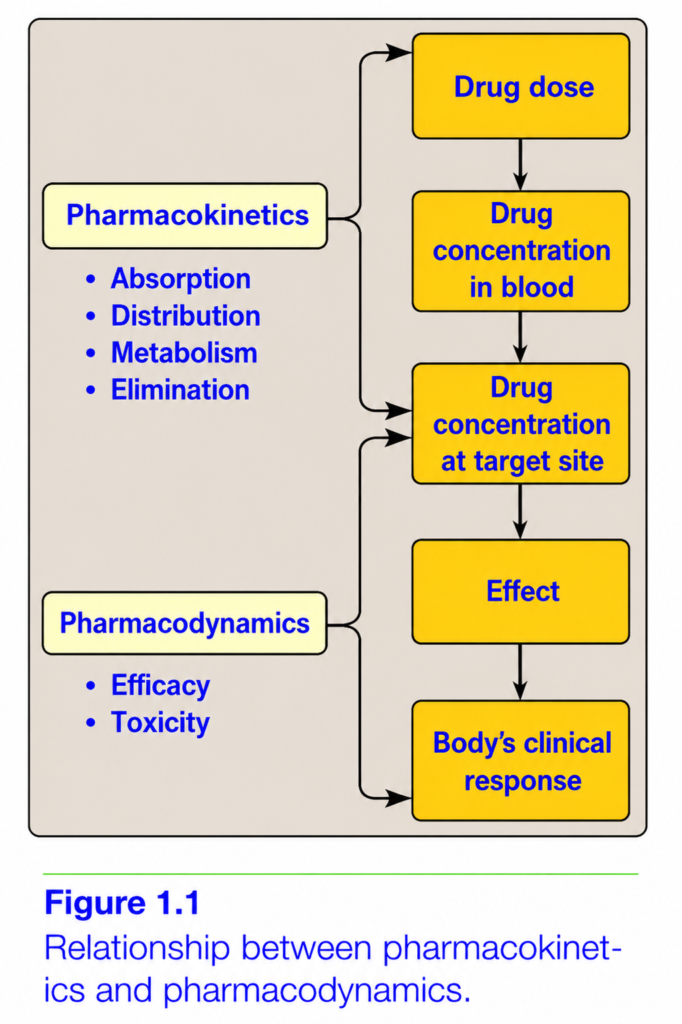
- The relationship between pharmacokinetics and pharmacodynamics is shown in Figure 1.1.
KEY CONCEPT
- Pharmacology has two major branches:
- Pharmacokinetics = What the body does to the drug (Absorption, Distribution, Biotransformation, Excretion).
- Pharmacodynamics = What the drug does to the body (Drug action and therapeutic effects).
- Chlorpromazine is an example of pharmacokinetics.
- Pantoprazole is an example of pharmacodynamics.
- Figure referenced: Figure 1.1.
B. Other Branches
1. Pharmacotherapeutics
- Pharmacotherapeutics is the branch of medicine that applies pharmacokinetic and pharmacodynamic principles in clinical practice.
- It is used for:
- Treatment of disease.
- Diagnosis of disease.
- Prevention of disease.
2. Toxicology
- Toxicology is the science of poisons.
- Poisons are substances that are harmful, dangerous, or can cause death in humans and animals.
- Many drugs can act as poisons when given in large doses.
- Example: Aspirin
- In low doses, it acts as an anticoagulant.
- It works by inhibiting thromboxane A₂.
- It is useful for heart patients.
- In high doses, it can cause gastric ulceration.
- Severe bleeding may occur and can be fatal.
3. Chemotherapy
- Chemotherapy studies the effects of drugs on microorganisms and parasites living inside the body.
- It is also used to treat cancer by targeting cancer cells.
4. Clinical Pharmacology
- Clinical pharmacology studies drugs and their clinical use.
- It provides information about:
- Drug potency.
- Drug usefulness.
- Drug doses.
- Drug toxicity.
- It helps ensure the safe clinical use of drugs.
- It includes:
- Clinical trials of new drugs in humans.
- Identification of adverse drug reactions.
- Reporting of adverse drug reactions.
- Rational use of drugs.
- Essential drug concept.
5. Pharmacoepidemiology
- Pharmacoepidemiology studies the effects of drugs on populations.
6. Pharmacoeconomics
- Pharmacoeconomics studies:
- Cost-effectiveness of drug treatment.
- Cost of medications.
- It is especially important for groups such as:
- Elderly patients.
- AIDS patients.
7. Pharmacogenetics
- Pharmacogenetics studies genetic variations that cause different drug responses among individuals and populations.
- Some people show greater-than-normal sensitivity to standard drug doses.
- Genetic screening before prescribing may help provide individualized therapy.
8. Pharmacogenomics
- Pharmacogenomics applies genomic technologies to:
- Discover new drugs.
- Further study and improve older drugs.
9. Pharmacognosy
- Pharmacognosy studies drugs obtained from:
- Plants.
- Animals.
10. Pharmacy
- Pharmacy is the art and science of preparing suitable dosage forms for drug administration in humans and animals.
- It also involves:
- Dispensing drugs.
- Identification of medicinal substances.
- Selection of medicinal substances.
- Collection of medicinal substances.
- Purification of medicinal substances.
- Isolation of medicinal substances.
- Standardization of medicinal substances.
- Quality control of medicinal substances.
11. Clinical Pharmacy
- Clinical pharmacy is a health science in which pharmacists provide patient care to optimize drug therapy.
- It promotes:
- Health.
- Wellness.
- Disease prevention.
- It is patient-oriented.
- It includes advising patients on the proper use of:
- Prescribed drugs.
- Over-the-counter (OTC) drugs.
12. Pharmacovigilance
- Pharmacovigilance involves:
- Monitoring adverse drug events.
- Detecting adverse drug events.
- Reporting adverse drug events.
- Taking remedial measures.
KEY CONCEPT
- Pharmacotherapeutics: Clinical use of drugs for treatment, diagnosis, and prevention.
- Toxicology: Study of poisons and toxic effects of drugs.
- Chemotherapy: Drugs used against microorganisms, parasites, and cancer cells.
- Clinical Pharmacology: Safe clinical use of drugs, including clinical trials and adverse drug reaction monitoring.
- Pharmacoepidemiology: Study of drug effects in populations.
- Pharmacoeconomics: Study of the cost-effectiveness of drug therapy.
- Pharmacogenetics: Study of genetic differences affecting drug response.
- Pharmacogenomics: Use of genomic technology in drug discovery and development.
- Pharmacognosy: Study of drugs from plant and animal sources.
- Pharmacy: Preparation, dispensing, and quality control of medicines.
- Clinical Pharmacy: Patient-centered pharmacy care and medication counseling.
- Pharmacovigilance: Monitoring, detecting, reporting, and preventing adverse drug events.
C. Definitions
1. Pharmacopoeia
- Pharmacopoeia is an official reference book.
- It contains a selected list of established drugs and medicinal preparations.
- It describes:
- Physical properties of drugs.
- Tests for drug identity.
- Drug purity.
- Drug potency.
- It sets the official standards for drug preparations.
- Some well-known pharmacopoeias are:
- British Pharmacopoeia (BP)
- Indian Pharmacopoeia (IP)
- International Pharmacopoeia (IP)
- United States Pharmacopoeia (USP)
- The description of a drug preparation in a pharmacopoeia is called a monograph.
- A monograph includes:
- Drug description.
- Identification characteristics.
- Standards of purity.
- Standards of strength.
- Limits of impurities.
- Drug assay method.
- Storage instructions.
- Other instructions.
2. National Formulary
- A National Formulary is a collection of drugs recognized as legal standards.
- It specifies the standards of:
- Purity.
- Quality.
- Strength.
- It is published by the government or authorized health agency of a country.
- Examples:
- National Formulary of India — published by the Government of India.
- British National Formulary (BNF) — jointly published by the British Medical Association (BMA) and the Royal Pharmaceutical Society.
3. Essential Medicines
- According to the WHO, Essential Medicines are those that meet the priority healthcare needs of the population.
- These medicines should be:
- Available at all times.
- Available in adequate amounts.
- Supplied in appropriate dosage forms.
- Of assured quality.
- Provided with adequate information.
- Affordable for individuals and the community.
- Available within a functioning healthcare system.
4. Orphan Drugs
- Orphan drugs are:
- Drugs.
- Vaccines.
- Biological products.
- They are used for:
- Diagnosis.
- Prevention.
- Treatment of rare diseases.
- Treatment of some common diseases that are mainly found in poor countries.
- Pharmaceutical companies have little interest in developing these drugs because they provide very little commercial profit.
- Developing orphan drugs requires:
- Very high development costs.
- Low expected sales.
- Therefore, the development cost is often not recovered.
- In India, an orphan drug is intended to treat a disease affecting not more than 5 lakh people.
- Clinical studies in children are highly restricted because of ethical and legal reasons.
- Many rare diseases occur in children.
- Diseases affecting very small patient populations are called orphan diseases because only a few approved treatment options are available.
- Rare (or orphan) diseases affect about 6–8% of the world’s population.
- Examples of orphan diseases:
- Infantile spinal muscular atrophy.
- Cystic fibrosis.
- Patent ductus arteriosus (PDA).
- Lysosomal storage disorders.
- Familial adenomatous polyposis (FAP).
- Acute intermittent porphyria.
- Examples of orphan drugs:
- Miglustat — Type 1 Gaucher disease.
- Iloprost — Pulmonary arterial hypertension in patients with NYHA Class III or IV symptoms.
- Bosentan — WHO Class II–IV pulmonary arterial hypertension symptoms.
- Pegvisomant — Acromegaly.
- Busulfan — Allogeneic hematopoietic progenitor cell transplantation for chronic myelogenous leukemia.
- Many countries have made laws to encourage orphan drug development.
- These countries provide incentives and support for developing orphan drugs.
KEY CONCEPT
- Pharmacopoeia: Official book that sets standards for drugs and medicinal preparations through monographs.
- National Formulary: Government-approved reference that defines the legal standards of drug purity, quality, and strength.
- Essential Medicines: WHO-listed medicines that should always be available, affordable, effective, and of assured quality.
- Orphan Drugs: Drugs developed for rare diseases or diseases with little commercial interest.
- Orphan Diseases: Rare diseases affecting small populations, often with limited treatment options.
- Many governments encourage orphan drug development by providing legal and financial support.
D. Pharmacoeconomics
- Pharmacoeconomics is the description and analysis of the costs of drug therapy for healthcare systems and society.
- It helps use limited healthcare resources to provide the maximum benefit to:
- Patients.
- Healthcare payers.
- Society.
- Pharmacoeconomics is used to:
- Develop healthcare guidelines.
- Support healthcare policy decisions.
- Plan national health policies.
- Information from pharmacoeconomics is important for national healthcare spending.
- It helps choose the best treatment options when resources are limited.
- The main purpose of pharmacoeconomics is to:
- Analyze healthcare costs.
- Allocate resources appropriately.
- Guide research and investment in specific drugs or drug groups.
- Compare the cost of one drug or drug therapy with another.
- Pharmacoeconomics is a subdivision of health economics.
Need of Pharmacoeconomics
- Minimize healthcare expenditure while achieving the best healthcare outcomes.
- Reduce the cost of drugs and healthcare-related services.
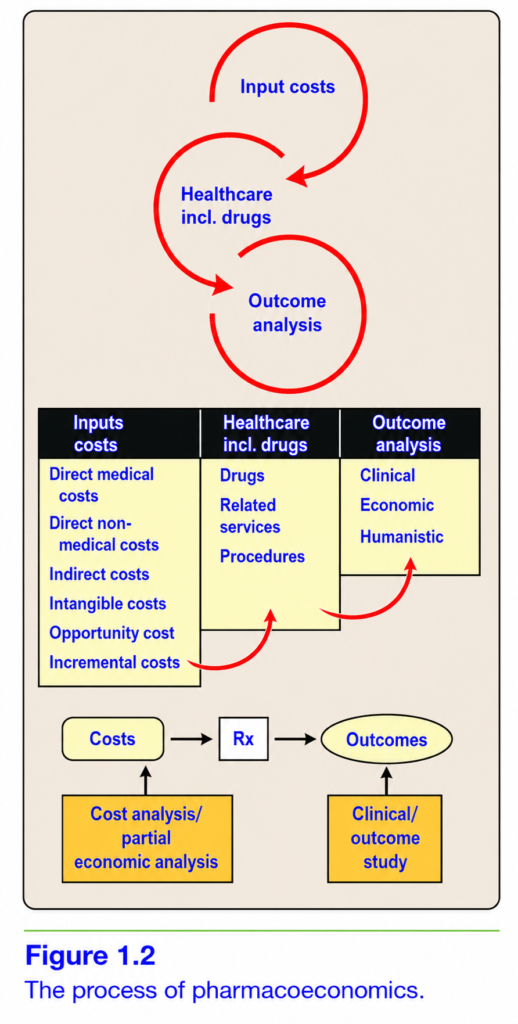
- The relevant components are shown in Figure 1.2.
- Pharmacoeconomics considers:
- Direct costs.
- Indirect costs.
- Other healthcare expenses.
- It evaluates healthcare from the perspective of:
- Patients.
- Healthcare providers.
- Payers.
- Society.
- Both direct and indirect costs are included in pharmacoeconomic analysis.
- Outcome analysis includes:
- Clinical outcomes
- Disease outcomes.
- Treatment outcomes.
- Morbidity.
- Mortality.
- Economic outcomes
- Direct costs.
- Indirect costs.
- Tangible costs.
- Humanistic outcomes
- Patient preferences.
- Quality of life.
- Clinical outcomes
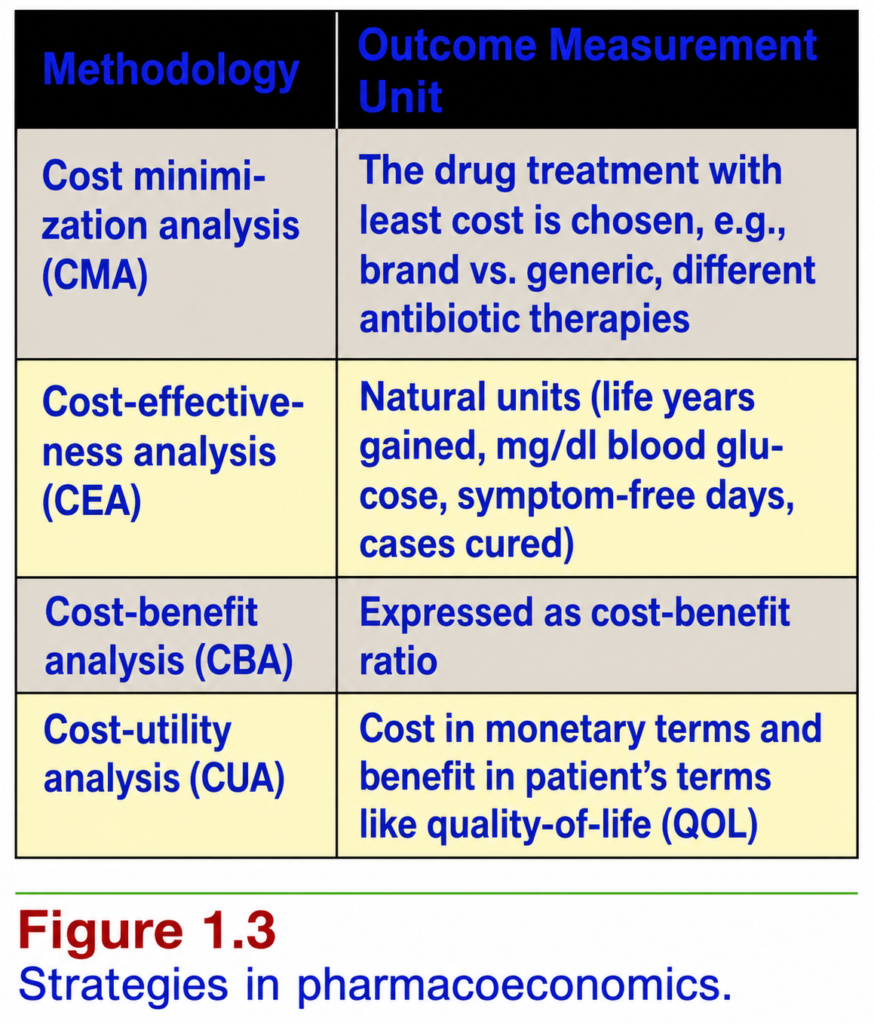
- Different pharmacoeconomic methods are shown in Figure 1.3.
KEY CONCEPT
- Pharmacoeconomics studies the cost and value of drug therapy.
- It helps use limited healthcare resources efficiently.
- It supports healthcare guidelines, policy decisions, and national health planning.
- It compares the costs of different drugs and treatment options.
- It considers:
- Direct costs.
- Indirect costs.
- Clinical outcomes (disease, treatment, morbidity, mortality).
- Economic outcomes (direct, indirect, and tangible costs).
- Humanistic outcomes (patient preference and quality of life).
- Pharmacoeconomics is a subdivision of health economics.
E. Sources of Drugs (Figure 1.4)
- Drugs are mainly obtained from:
- Plants.
- Animals.
- Microorganisms.
- Minerals.
- Today, most therapeutic drugs are produced from:
- Synthetic products.
- Semisynthetic products.
1. Animal Sources
- Drugs obtained from animals include:
- Insulin.
- Heparin.
- Gonadotrophins.
- Thyroid extract.
- Antitoxic sera (e.g., antisnake venom).
2. Mineral Sources
- Drugs obtained from minerals include:
- Liquid paraffin.
- Ferrous sulfate.
- Magnesium sulfate.
- Magnesium trisilicate.
- Kaolin.
3. Microorganisms (Bacteria and Fungi)
- Many important antibiotics are obtained from microorganisms, including:
- Penicillin.
- Streptomycin.
- Erythromycin.
- Polymyxin B.
- Bacitracin.
- Chloramphenicol.
- Nystatin.
- Griseofulvin.
- Other useful products produced by microorganisms include:
- Streptokinase
- An enzyme produced by Streptococcus pyogenes (gram-positive cocci).
- Vitamin B₁₂ (Cyanocobalamin)
- Produced by Streptomyces griseus.
- Streptokinase
KEY CONCEPT
- Drugs are obtained mainly from:
- Plants.
- Animals.
- Microorganisms.
- Minerals.
- Most modern drugs are synthetic or semisynthetic.
- Animal sources: Insulin, heparin, gonadotrophins, thyroid extract, antisnake venom.
- Mineral sources: Liquid paraffin, ferrous sulfate, magnesium sulfate, magnesium trisilicate, kaolin.
- Microorganisms: Produce many antibiotics and other products such as streptokinase and vitamin B₁₂.
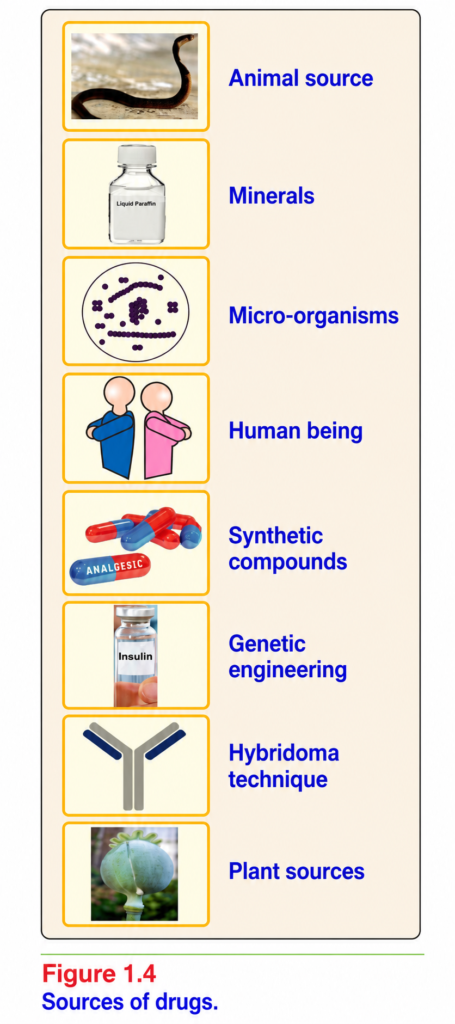
E. Sources of Drugs (Figure 1.4)
- Drugs are mainly obtained from:
- Plants.
- Animals.
- Microorganisms.
- Minerals.
- Today, most therapeutic drugs are produced from:
- Synthetic products.
- Semisynthetic products.
1. Animal Sources
- Drugs obtained from animals include:
- Insulin.
- Heparin.
- Gonadotrophins.
- Thyroid extract.
- Antitoxic sera (e.g., antisnake venom).
2. Mineral Sources
- Drugs obtained from minerals include:
- Liquid paraffin.
- Ferrous sulfate.
- Magnesium sulfate.
- Magnesium trisilicate.
- Kaolin.
3. Microorganisms (Bacteria and Fungi)
- Many important antibiotics are obtained from microorganisms, including:
- Penicillin.
- Streptomycin.
- Erythromycin.
- Polymyxin B.
- Bacitracin.
- Chloramphenicol.
- Nystatin.
- Griseofulvin.
- Other useful products produced by microorganisms include:
- Streptokinase
- An enzyme produced by Streptococcus pyogenes (gram-positive cocci).
- Vitamin B₁₂ (Cyanocobalamin)
- Produced by Streptomyces griseus.
- Streptokinase
KEY CONCEPT
- Drugs are obtained mainly from:
- Plants.
- Animals.
- Microorganisms.
- Minerals.
- Most modern drugs are synthetic or semisynthetic.
- Animal sources: Insulin, heparin, gonadotrophins, thyroid extract, antisnake venom.
- Mineral sources: Liquid paraffin, ferrous sulfate, magnesium sulfate, magnesium trisilicate, kaolin.
- Microorganisms: Produce many antibiotics and other products such as streptokinase and vitamin B₁₂.
E. Sources of Drugs (Figure 1.4)
- Gum Resins
- Asafetida
- Used as a carminative.
- Used as an antispasmodic.
- Asafetida
- Oleo Gum Resin
- Myrrh
- Has local stimulant properties.
- Has antiseptic properties.
- Commonly used in mouthwash.
- Myrrh
- Balsams
- Benzoin
- Used internally as an expectorant.
- Used externally as an astringent.
- Balsam Tolu
- Used as a stimulating expectorant.
- Benzoin
- Gums
- Gums are secretory products of plants.
- On hydrolysis, they produce simple sugar-like polysaccharides.
- They are pharmacologically inert.
- They are mainly used as:
- Suspending agents.
- Emulsifying agents.
- Common examples:
- Gum acacia.
- Tragacanth.
- Tannins
- Tannins are non-nitrogenous plant constituents.
- Chemically, they are phenolic derivatives.
- They are known for their astringent action.
- They are commonly used in the treatment of:
- Diarrhea.
- Burns.
- Important plant sources include:
- Hirda (used in combination as Triphala).
- Amla.
- Behera.
- Ashoka bark.
- Black catechu.
KEY CONCEPT
- Asafetida (Gum resin): Carminative and antispasmodic.
- Myrrh (Oleo gum resin): Local stimulant, antiseptic, and used in mouthwash.
- Benzoin (Balsam): Expectorant internally and astringent externally.
- Balsam Tolu: Stimulating expectorant.
- Gums: Plant secretions that are pharmacologically inert and used as suspending and emulsifying agents.
- Tannins: Phenolic plant compounds with astringent action, used for diarrhea and burns.
Note: This text is part of Figure 1.4 (Sources of Drugs). MADE BY SELF LEARNING DR SHEEN
