


- Many modern methods are available to assess kidney function.
- However, clearance of substances from plasma is still a useful way to measure kidney function.
- Clearance helps quantify how effectively the kidneys remove substances from the body.
- Clearance can be used to measure:
- Glomerular filtration rate (GFR)
- Renal blood flow
- Tubular reabsorption
- Tubular secretion
- Renal clearance = the volume of plasma completely cleared of a substance by the kidneys per unit time.
Clearance Equation
Cs×Ps=Us×V˙
Where:
- Cs = Clearance of substance
- Ps = Plasma concentration of the substance
- Us = Urine concentration of the substance
- V̇ = Urine flow rate
Solving for Clearance
Original equation:Cs×Ps=Us×V˙
Divide both sides by Ps:Cs=PsUs×V˙
Easy Meaning
- Amount entering kidneys through plasma:
Cs×Ps
- Amount leaving in urine:
Us×V˙
- These two amounts are equal.
Example of Clearance Principle
- Suppose plasma contains 1 mg of a substance in each mL.
- Suppose kidneys excrete 1 mg of that substance each minute in urine.
- Then:
Clearance=1mL/min
- This means 1 mL of plasma is completely cleared of the substance every minute.
Clearance Formula Used in Practice
Cs=PsUs×V˙
- Renal clearance is calculated by dividing the urinary excretion rate by the plasma concentration of the substance.
KEY CONCEPT
- Clearance measures how efficiently kidneys remove a substance from plasma.
- Clearance = Volume of plasma cleared of a substance per unit time.
- Urinary excretion rate:
Us×V˙
- Clearance equation:
Cs=PsUs×V˙
- Clearance is useful for measuring GFR, renal blood flow, tubular reabsorption, and tubular secretion.
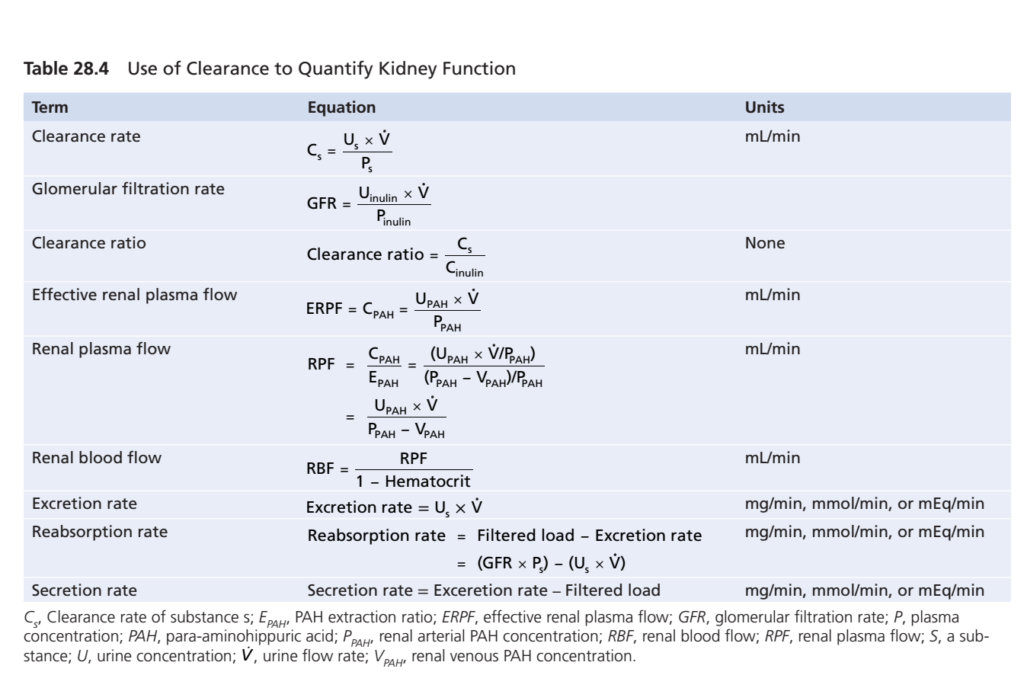
USE OF CLEARANCE TO QUANTIFY KIDNEY FUNCTION — EASY FORMULA GUIDE
Think of Clearance = Kidney Cleaning Power
👉 Question every clearance formula asks:
“How much plasma is completely cleaned of this substance each minute?”
1. CLEARANCE RATE (Cs)
Formula
Cs=PsUs×V˙
Easy Meaning
Clearance=Amount present in plasmaAmount leaving in urine
Example
Given:Us=100mg/mL V˙=2mL/min Ps=4mg/mL
Step 1:Us×V˙ 100×2=200
Step 2:Cs=4200 Cs=50mL/min
Interpretation
Kidneys completely clear 50 mL plasma/min of this substance.
2. GLOMERULAR FILTRATION RATE (GFR)
Formula
GFR=PInulinUInulin×V˙
Easy Meaning
Inulin is:
- Freely filtered
- Not reabsorbed
- Not secreted
Therefore:Inulin Clearance = GFR
Example
Given:UInulin=125mg/mL V˙=1mL/min PInulin=1mg/mL GFR=1125×1 GFR=125mL/min
Interpretation
Kidneys filter 125 mL plasma/min
(Normal GFR ≈ 125 mL/min)
3. CLEARANCE RATIO
Formula
Clearance Ratio=CInulinCs
Example
Substance clearance:Cs=250
nulin clearance:CInulin=125 Ratio=125250=2
Interpretation
Ratio > 1
➡ Substance is secreted.
Another Example125125=1
Ratio = 1
➡ Filtered only.
Another Example12560=0.48
Ratio < 1
➡ Reabsorbed.
4. EFFECTIVE RENAL PLASMA FLOW (ERPF)
Formula
ERPF=PPAHUPAH×V˙
Easy Meaning
PAH is almost completely removed from plasma in one kidney passage.
Therefore:PAH Clearance≈ERPF
Example
UPAH=600 V˙=1 PPAH=1 ERPF=1600×1 ERPF=600mL/min
Interpretation
About 600 mL plasma reaches kidneys each minute
5. RENAL PLASMA FLOW (RPF)
Formula
RPF=PPAH−VPAHUPAH×V˙
Easy Meaning
PAH is not removed 100%.
So correct ERPF using venous PAH.
Example
UPAH=600 V˙=1 PPAH=1 VPAH=0.1
Step 1:1−0.1=0.9
Step 2:RPF=0.9600 RPF=667mL/min
Interpretation
Actual plasma flow ≈ 667 mL/min
6. RENAL BLOOD FLOW (RBF)
Formula
RBF=1−HematocritRPF
Easy Meaning
Plasma is only part of blood.
Need to convert plasma flow into total blood flow.
Example
RPF=600 Hematocrit=0.45
Step 1:1−0.45=0.55
Step 2:RBF=0.55600 RBF=1090mL/min
Interpretation
Kidneys receive about 1.1 L blood/min
7. EXCRETION RATE
Formula
Excretion Rate=Us×V˙
Example
Us=50 V˙=2 50×2=100 Excretion=100mg/min
Interpretation
100 mg leaves body each minute.
8. REABSORPTION RATE
Formula
Reabsorption=Filtered Load−Excretion
or=(GFR×Ps)−(Us×V˙)
Example
GFR=125 Ps=2
Filtered Load:125×2=250
Excretion:50
Reabsorption:250−50=200mg/min
Interpretation
200 mg/min returned to blood.
9. SECRETION RATE
Formula
Secretion=Excretion−Filtered Load
Example
Excretion:300
Filtered Load:250 300−250=50mg/min
Interpretation
Kidney tubules added 50 mg/min into urine.
KEY CONCEPT (EXAM MEMORY TRICK)
Compare Clearance with Inulin
| Clearance Value | Meaning |
|---|---|
| = Inulin Clearance | Only filtered |
| < Inulin Clearance | Reabsorbed |
| > Inulin Clearance | Secreted |
| = 0 | Completely reabsorbed |
| = RPF (~600 mL/min) | PAH |
| = GFR (~125 mL/min) | Inulin |
Super Shortcut
ExcretionU×V
ClearancePU×V
Filtered LoadGFR×P
ReabsorptionFiltered Load−Excretion
SecretionExcretion−Filtered Load
Inulin → GFR
PAH → RPF
RPF → RBF using Hematocrit
INULIN CLEARANCE CAN BE USED TO ESTIMATE GLOMERULAR FILTRATION RATE (GFR)
- If a substance is filtered freely through the glomerulus like water, it enters the filtrate easily.
- If that substance is not reabsorbed by the tubules, none of it returns to the blood.
- If that substance is not secreted by the tubules, no extra amount is added to the urine.
- Therefore, the amount filtered by the kidneys equals the amount excreted in the urine.
Relationship Between Filtration and Excretion
GFR×Ps=Us×V˙
Where:
- GFR = Glomerular filtration rate
- Ps = Plasma concentration
- Us = Urine concentration
- V̇ = Urine flow rate
Solving for GFR
Start with:GFR×Ps=Us×V˙
Divide both sides by PsGFR=PsUs×V˙
Easy Concept
GFR=Clearance
for any substance that is:
Why Inulin Is Used
- Inulin is a polysaccharide molecule.
- Molecular weight ≈ 5200.
- It is not produced naturally in the body.
- It must be given intravenously.
- Inulin is freely filtered by the glomerulus.
- Inulin is not reabsorbed.
- Inulin is not secreted.
Therefore
Inulin Clearance=GFR
Inulin Example
Given
Plasma concentration:PInulin=1mg/mL
Urine concentration:UInulin=125mg/mL
Urine flow rate:V˙=1mL/min
Step 1: Calculate Excretion Rate
UInulin×V˙ 125×1 =125mg/min
Meaning
- 125 mg of inulin appears in urine every minute.
Step 2: Calculate Inulin Clearance
CInulin=PInulinUInulin×V˙
Substitute values:=1125×1 =125mL/min
Interpretation
- 125 mL of plasma is completely cleared of inulin each minute.
- Because inulin is neither reabsorbed nor secreted:
GFR=125mL/min
Visual Memory Trick
Inulin Journey
Blood → Glomerulus → Filtrate → Urine
✅ Freely filtered
❌ No reabsorption
❌ No secretion
Therefore:Filtered Amount=Excreted Amount
Thus:Inulin Clearance=GFR
Other Substances Used to Estimate GFR
- Iothalamate
- Chromium-EDTA
- Cystatin C
- Creatinine
KEY CONCEPT
- An ideal GFR marker must be:
- Freely filtered
- Not reabsorbed
- Not secreted
- Inulin fulfills all these conditions.
- Filtration rate equals excretion rate:
GFR×Ps=Us×V˙
- GFR equation:
GFR=PsUs×V˙
- Therefore:
Inulin Clearance=GFR
- Normal inulin clearance (GFR) ≈
125mL/min
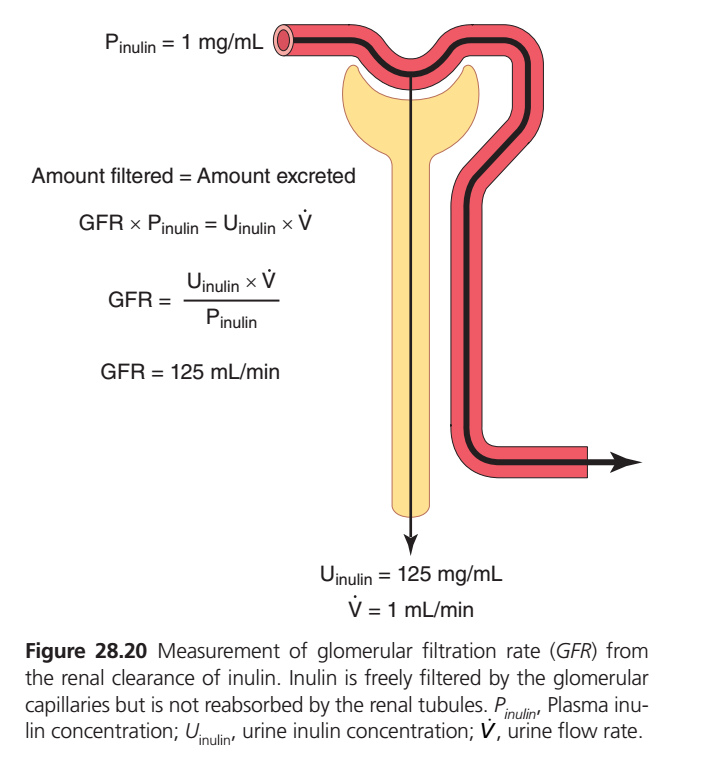
This figure explains:
How Inulin Clearance is used to measure Glomerular Filtration Rate (GFR).
Because:
✅ Inulin is freely filtered
❌ Not reabsorbed
❌ Not secreted
Therefore:
Amount Filtered = Amount Excreted
This makes Inulin the perfect substance for measuring GFR.
STEP 1: WHAT IS GFR?
GFR (Glomerular Filtration Rate)
= Amount of filtrate formed by all glomeruli per minute.
Normal:
GFR = 125 mL/min
Meaning:
The kidneys filter about 125 mL of plasma every minute.
STEP 2: WHY IS INULIN SPECIAL?
Most substances are:
- Reabsorbed
OR - Secreted
Therefore they cannot accurately measure filtration.
Inulin
After filtration:
❌ Not reabsorbed
❌ Not secreted
❌ Not metabolized
Only filtered.
Therefore
Everything filtered appears in urine.
Filtered = Excreted
This is the key concept.
STEP 3: UNDERSTAND THE EQUATION
Since:
Amount Filtered = Amount Excreted
We can write:GFR×Pinulin=Uinulin×V˙
What Does Each Term Mean?
GFR
Amount filtered per minute
(mL/min)
P₍inulin₎
Plasma inulin concentration
(mg/mL)
U₍inulin₎
Urine inulin concentration
(mg/mL)
V̇
Urine flow rate
(mL/min)
EASY MEMORY
Filtered Side
GFR × Plasma Concentration
↓
Amount entering nephron
Excreted Side
Urine Concentration × Urine Flow
↓
Amount leaving body
Since filtered = excreted:
Both are equal.
STEP 4: SOLVING THE EQUATION
Start with:GFR×Pinulin=Uinulin×V˙
Move Plasma Inulin to the other side:GFR=PinulinUinulin×V˙
This is the famous GFR equation.
SOLVING THE FIGURE EXAMPLE
Given
Plasma Inulin:Pinulin=1mg/mL
Urine Inulin:Uinulin=125mg/mL
Urine Flow:V˙=1mL/min
Step 1
Write formulaGFR=PU×V˙
Step 2
Insert valuesGFR=1125×1
Step 3
CalculateGFR=125
ANSWER
GFR = 125 mL/min
✅ Normal GFR
EXAMPLE 2
Suppose:
Plasma Inulin
P=2mg/mL
Urine Inulin
U=200mg/mL
Urine Flow
V=2mL/min
Formula
GFR=PU×V
Put values
GFR=2200×2 GFR=2400 GFR=200
ANSWER
GFR = 200 mL/min
EXAMPLE 3
Suppose:
Plasma Inulin
P=4
Urine Inulin
U=100
Urine Flow
V=5
Formula
GFR=4100×5 GFR=4500 GFR=125
ANSWER
GFR = 125 mL/min
SUPER EASY CONCEPTUAL STORY
Imagine:
🩸 Blood contains 1 mg of inulin in each mL
The kidneys filter:
125 mL/min
Therefore:
Amount filtered each minute:125×1=125mg/min
Because inulin is NOT reabsorbed and NOT secreted:
The same amount must appear in urine.
So:125mg/min
is excreted.
This is exactly what the urine data shows:125mg/mL×1mL/min=125mg/min
Filtered = Excreted
Therefore:
GFR = 125 mL/min
EXAM SHORTCUT
For any substance:Clearance=PU×V
For Inulin:Inulin Clearance=GFR
Because:
✅ Freely filtered
❌ Not reabsorbed
❌ Not secreted
KEY CONCEPT
Inulin is the ideal marker of GFR because everything that is filtered is excreted unchanged. Therefore, the amount of inulin filtered by the glomerulus equals the amount excreted in urine, and GFR can be calculated using:GFR=PinulinUinulin×V
Easy Memory:
“Inulin goes in, gets filtered, and comes out exactly the same—so Inulin Clearance = GFR.” 🎯
CREATININE CLEARANCE AND PLASMA CREATININE CONCENTRATION CAN BE USED TO ESTIMATE GLOMERULAR FILTRATION RATE
- Creatinine is a by-product of muscle metabolism.
- Creatinine is removed from body fluids mainly by glomerular filtration.
- Therefore, creatinine clearance can be used to estimate GFR.
- Measuring creatinine clearance does not require intravenous infusion.
- For this reason, creatinine clearance is used more commonly than inulin clearance in clinical practice.
- Creatinine clearance is not a perfect measure of GFR.
- A small amount of creatinine is secreted by the renal tubules.
- Therefore, the amount of creatinine excreted is slightly greater than the amount filtered.
- There is also a small error that tends to overestimate plasma creatinine concentration.
- These two errors tend to offset each other.
- Therefore, creatinine clearance provides a reasonably accurate estimate of GFR.
- In some patients, urine collection for creatinine clearance measurement may not be practical.
- In such cases, changes in GFR can be estimated by measuring plasma creatinine concentration.
- Plasma creatinine concentration is inversely related to GFR.
EASY EQUATION
- GFR ≈ Creatinine Clearance
GFR≈PCrUCr×V
Where:
- UCr = Urine creatinine concentration
- V = Urine flow rate
- PCr = Plasma creatinine concentration
- GFR = Glomerular filtration rate
EASY CONCEPT
- ↑ Plasma Creatinine = ↓ GFR
- ↓ Plasma Creatinine = ↑ GFR
- If GFR suddenly decreases by 50%, the kidneys filter less creatinine.
- The kidneys also excrete less creatinine.
- Creatinine begins to accumulate in the body fluids.
- Plasma creatinine concentration rises.
- Plasma creatinine continues to rise until a new balance is reached.
- At the new balance, filtered creatinine equals excreted creatinine.
- At the new balance, creatinine production equals creatinine excretion.
EASY MATHEMATICAL RELATIONSHIP
Normal Condition
- GFR = 100%
- Plasma Creatinine = 1×
If GFR Falls to 50%
- GFR = 1/2 of normal
- Plasma Creatinine = 2× normal
Easy Concept
GFR↓50%⇒PCr↑2×
If GFR Falls to 25%
- GFR = 1/4 of normal
- Plasma Creatinine = 4× normal
Easy Concept
GFR↓75%⇒PCr↑4×
If GFR Falls to 12.5%
- GFR = 1/8 of normal
- Plasma Creatinine = 8× normal
Easy Concept
GFR↓87.5%⇒PCr↑8×
MEMORY RULE
| GFR | Plasma Creatinine |
|---|---|
| Normal | 1× |
| 1/2 Normal | 2× |
| 1/4 Normal | 4× |
| 1/8 Normal | 8× |
- Under steady-state conditions, creatinine excretion equals creatinine production.
- This balance is maintained even when GFR decreases.
- However, maintaining this balance requires a higher plasma creatinine concentration.
- Therefore, plasma creatinine rises as GFR falls.
KEY CONCEPT
- Creatinine is filtered mainly by the glomerulus.
- Creatinine clearance is commonly used to estimate GFR.
- GFR ≈ (Urine Creatinine × Urine Flow Rate) ÷ Plasma Creatinine.
- Plasma creatinine is inversely related to GFR.
- ↓ GFR → ↑ Plasma Creatinine.
- 50% fall in GFR → 2× rise in plasma creatinine.
- 75% fall in GFR → 4× rise in plasma creatinine.
- 87.5% fall in GFR → 8× rise in plasma creatinine.
- High plasma creatinine usually indicates reduced kidney filtration function.
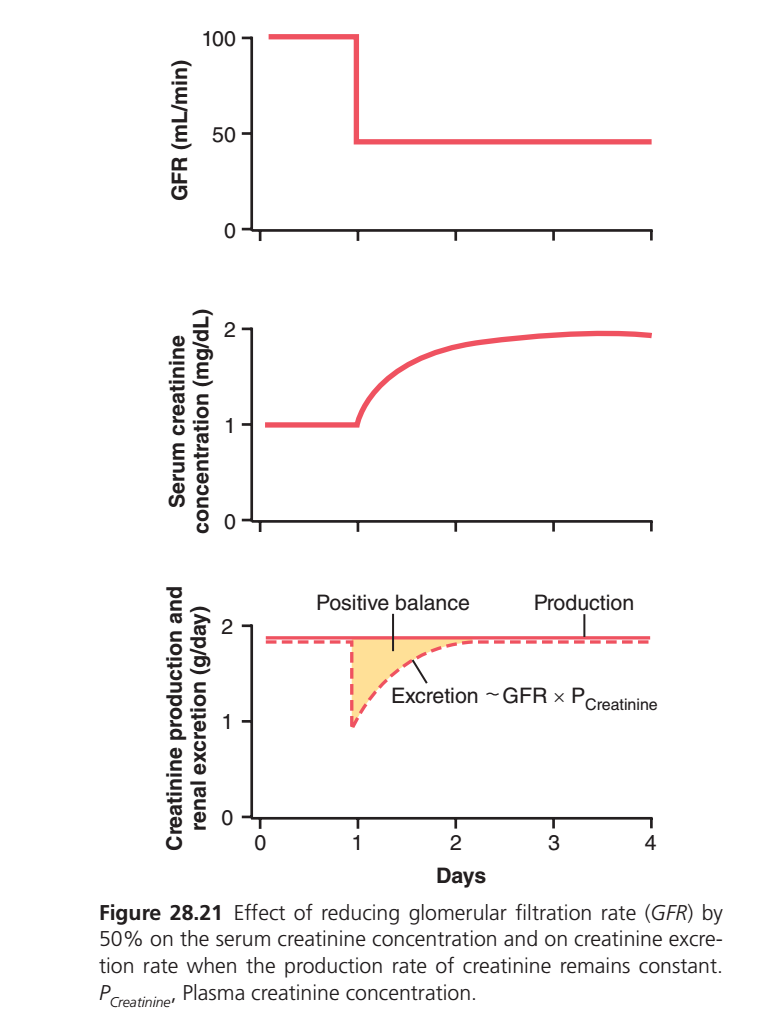
Figure 28.21
This graph shows what happens when GFR suddenly falls by 50% while the body continues to produce creatinine at the same rate.
1️⃣ TOP GRAPH: GFR (Glomerular Filtration Rate)
Red Line (Top)
100 mL/min  ──────────┐
                      │
                      │ Sudden drop
                      ▼
45-50 mL/min ─────────────────────
What does this mean?
- Before Day 1, kidneys filter about 100 mL/min.
- On Day 1, GFR suddenly drops to about 50 mL/min.
- After that, GFR stays low.
Simple Concept
Think of kidneys as a water filter.
Before:
- Filter works at 100% speed.
After:
- Filter suddenly works at only 50% speed.
Therefore:
✅ Less creatinine can be removed from blood.
2️⃣ MIDDLE GRAPH: Serum Creatinine Concentration
Red Curved Line
1 mg/dL ────────
                \
                 \
                  \
                   \
                    2 mg/dL
What happens?
Before Day 1:
- Serum creatinine = 1 mg/dL
Immediately after GFR falls:
- Creatinine removal decreases.
- But creatinine production remains normal.
So:
More creatinine enters blood than leaves blood.
Therefore:
Blood creatinine starts accumulating.
Why does the curve rise gradually?
Because creatinine does not instantly double.
Day by day:
- Extra creatinine accumulates.
- Blood level slowly rises.
So the curve climbs gradually.
Why does it stop near 2 mg/dL?
Because eventually a new equilibrium is reached.
At that point:
Creatinine Excretion = Creatinine Production
Again.
Easy Memory Trick
| GFR | Serum Creatinine |
|---|---|
| 100 mL/min | 1 mg/dL |
| 50 mL/min | 2 mg/dL |
Rule
GFR ↓ by 50% → Serum Creatinine doubles
This is a very important clinical concept.
3️⃣ BOTTOM GRAPH: Creatinine Production and Excretion
This graph is the most important.
Solid Horizontal Red Line
“Production”
This upper solid line represents:
Creatinine Production
≈ 1.8 g/dayMuscles keep producing creatinine continuously.
The body does NOT know GFR has fallen.
So production remains constant.
Dotted Red Line
“Excretion”
This dotted line shows:
Creatinine Excretion by kidneys
Remember:
Excretion ≈ GFR × Plasma Creatinine
Before Day 1
Production = Excretion
Produced = 1.8 g/day
Excreted = 1.8 g/day
Balance exists.
No accumulation.
At Day 1
GFR suddenly falls by 50%.
The kidneys can now remove only about half as much creatinine.
Therefore:
Dotted line suddenly drops downward
Excretion
1.8 g/day
      ↓
~1.0 g/day
This sharp vertical fall in the dotted line shows:
👉 Kidney filtering ability suddenly decreased.
Why Does the Dotted Line Rise Again?
After Day 1:
Blood creatinine starts increasing.
Remember:
Excretion = GFR × Plasma Creatinine
Although GFR is low,
Plasma creatinine becomes higher.
So:
Low GFR × Higher Creatininegradually increases excretion again.
Therefore the dotted curve rises upward.
Eventually
Serum creatinine becomes about 2 mg/dL.
Now:
50% GFR × 2× Creatininegives almost the same excretion as before.
So:
Excretion ≈ 1.8 g/dayagain.
The dotted line reaches the production line.
A new steady state is achieved.
🟨 YELLOW Shaded Area (Most Important Part)
The yellow area is labeled:
“Positive Balance”
This area represents:
Creatinine retained inside the body
What is happening in this yellow area?
For a short period:
Production > ExcretionExample:
Produced = 1.8 g/day
Excreted = 1.0 g/day
Difference:
0.8 g/daystays inside the body.
That retained creatinine accumulates in blood.
This accumulation is shown by the yellow shaded region.
So:
🟨 Yellow Area = Total creatinine retained in the body during adaptation.
Easy Example
Imagine:
A water tank receives:
Inflow = 10 liters/dayBut outlet suddenly becomes:
5 liters/dayThen:
5 liters/dayaccumulates inside the tank.
The accumulated water is equivalent to the:
🟨 Yellow shaded area.
Meaning of the Dotted Line
Dotted Line = Creatinine Excretion
- Starts equal to production.
- Suddenly drops when GFR falls.
- Gradually rises as serum creatinine increases.
- Finally reaches production again.
Complete Story of the Figure
Step 1
Normal state
GFR = 100
Creatinine = 1 mg/dL
Production = Excretion
↓
Step 2
GFR falls by 50%
100 → 50 mL/min↓
Step 3
Excretion suddenly falls
(Dotted line drops)
↓
Step 4
Production remains unchanged
(Solid line stays flat)
↓
Step 5
Production > Excretion
🟨 Positive balance develops
↓
Step 6
Creatinine accumulates in blood
Serum creatinine rises
↓
Step 7
Higher serum creatinine increases excretion
(Dotted line rises)
↓
Step 8
New steady state
GFR = 50 mL/min
Serum Creatinine ≈ 2 mg/dL
Production = Excretion
KEY CONCEPT
✅ GFR suddenly decreases by 50%.
✅ Creatinine production remains constant.
✅ Creatinine excretion initially falls (dotted line drops).
✅ Production becomes greater than excretion, creating the 🟨 positive balance area.
✅ Retained creatinine accumulates in blood, causing serum creatinine to rise.
✅ As serum creatinine rises, excretion gradually increases again.
✅ A new equilibrium is reached when:
Creatinine Production = Creatinine Excretion
and serum creatinine stabilizes at approximately double the original value (2 mg/dL).
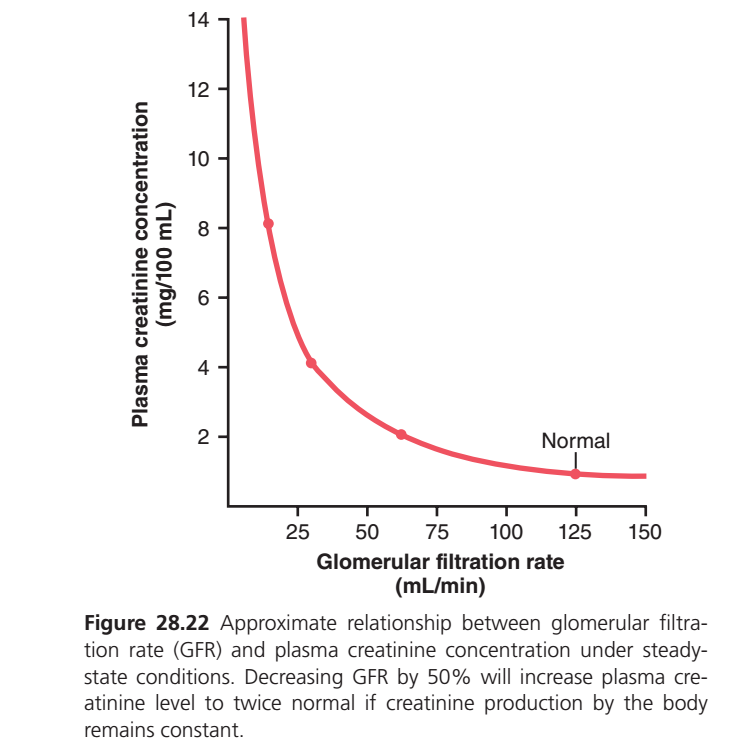
Figure 28.22
This figure shows the relationship between:
X-axis
GFR (Glomerular Filtration Rate)
and
Y-axis
Plasma Creatinine Concentration
The Main Message of This Graph
GFR and Plasma Creatinine have an INVERSE relationship
Meaning:
GFR ↓  → Creatinine ↑

GFR ↑  → Creatinine ↓
Think of Creatinine Like Garbage
Imagine:
- Creatinine = Garbage
- Kidneys = Garbage removal system
- GFR = Speed of garbage collection
Normal Situation
Garbage Produced = Garbage RemovedNo accumulation occurs.
Therefore:
Plasma Creatinine ≈ 1 mg/dL
GFR ≈ 125 mL/min
This is the point marked:
“Normal”
on the graph.
Understanding Every Point on the Curve
Point 1 (Normal)
GFR = 125 mL/min
Creatinine = 1 mg/dL
Kidneys work normally.
Creatinine is removed efficiently.
Point 2
GFR ≈ 60 mL/min
Creatinine ≈ 2 mg/dL
Notice:
GFR becomes HALF
125 → 60But creatinine becomes DOUBLE
1 → 2IMPORTANT RULE
GFR ↓ by 50%
↓
Plasma Creatinine ↑ 2 times
This is the most tested concept.
Point 3
GFR ≈ 30 mL/min
Creatinine ≈ 4 mg/dL
Again:
GFR halves
60 → 30Creatinine doubles
2 → 4Point 4
GFR ≈ 15 mL/min
Creatinine ≈ 8 mg/dL
Again:
GFR halves
30 → 15Creatinine doubles
4 → 8Point 5
GFR ≈ 7.5 mL/min
Creatinine ≈ 16 mg/dL
Very severe kidney failure.
Very little filtration occurs.
Creatinine accumulates massively.
Why Is the Curve Not a Straight Line?
Notice:
The curve bends.
It is not:
Instead it is:
shaped.
Reason
Creatinine and GFR are related by:Plasma Creatinine∝GFR1
orPCr=GFRK
where K is constant creatinine production.
Easy Formula
If creatinine production remains constant:GFR×Plasma Creatinine=Constant
Example
Normal:
125 × 1
=
125
After GFR falls to 60:
60 × 2
=
120
Approximately same.
After GFR falls to 30:
30 × 4
=
120
Still same.
Why Does Creatinine Rise So Much at Low GFR?
Look at the left side of the graph.
A small decrease in GFR causes a huge rise in creatinine.
Example
125 → 100 mL/minCreatinine:
1 → 1.2 mg/dLOnly small change.
But:
15 → 7.5 mL/minCreatinine:
8 → 16 mg/dLHuge change.
Clinical Meaning
In early kidney disease:
Creatinine may look almost normal.
Even though GFR has already fallen significantly.
Why Creatinine Is a Good Marker of Kidney Function
Because:
Low GFR
↓
Less filtration
↓
Less creatinine excretion
↓
Creatinine accumulates
↓
Plasma creatinine rises
Thus:
High Creatinine = Low GFR
Visual Story of the Graph
Imagine a sink.
Normal Kidney
Tap = Creatinine production

Drain = GFR
Drain is wide open.
Water doesn’t accumulate.
Creatinine = 1 mg/dLGFR Falls
Drain becomes narrow.
Water starts collecting.
Creatinine risesGFR Falls Further
Drain becomes almost blocked.
Water accumulates rapidly.
Creatinine rises dramaticallyQuick Memory Table
| GFR (mL/min) | Plasma Creatinine (mg/dL) |
|---|---|
| 125 | 1 |
| 60 | 2 |
| 30 | 4 |
| 15 | 8 |
| 7.5 | 16 |
Exam Shortcut
Whenever GFR is halved:
| GFR Change | Creatinine Change |
|---|---|
| 125 → 60 | 1 → 2 |
| 60 → 30 | 2 → 4 |
| 30 → 15 | 4 → 8 |
Rule:
✅ GFR ↓ 50% → Plasma Creatinine ↑ 100% (doubles)
✅ Plasma Creatinine and GFR are inversely proportional.
KEY CONCEPT
- The graph shows an inverse relationship between GFR and plasma creatinine.
- Normal GFR ≈ 125 mL/min corresponds to plasma creatinine ≈ 1 mg/dL.
- When GFR decreases, creatinine accumulates in blood.
- If GFR falls by 50%, plasma creatinine approximately doubles.
- Therefore, high plasma creatinine indicates reduced kidney filtration and impaired renal function.
PARA-AMINOHIPPURIC ACID CLEARANCE CAN BE USED TO ESTIMATE RENAL PLASMA FLOW
- If a substance is completely removed from the plasma by the kidneys, its clearance equals the renal plasma flow (RPF).
- In this situation, the amount of substance delivered to the kidneys equals the amount excreted in the urine.
- Therefore, renal plasma flow can be calculated from the clearance of that substance.
EASY EQUATION
RPF=PsUs×V
Where:
- Us = Urine concentration of the substance
- V = Urine flow rate
- Ps = Plasma concentration of the substance
- RPF = Renal Plasma Flow
- GFR is only about 20% of total renal plasma flow.
- Therefore, a substance that is completely cleared from plasma must be both filtered and secreted.
- No known substance is completely cleared by the kidneys.
- Para-aminohippuric acid (PAH) is about 90% cleared from the plasma.
- Therefore, PAH clearance can be used to estimate renal plasma flow.
- A correction is needed because about 10% of PAH remains in the blood leaving the kidneys.
- The percentage of PAH removed from blood is called the extraction ratio of PAH.
- The normal extraction ratio of PAH is about 90%.
- In kidney disease, the extraction ratio may decrease.
- This decrease occurs because damaged tubules cannot secrete PAH efficiently.
EASY CALCULATION OF PAH CLEARANCE
Given:
- Plasma PAH concentration (PPAH) = 0.01 mg/mL
- Urine PAH concentration (UPAH) = 5.85 mg/mL
- Urine Flow Rate (V) = 1 mL/min
Step 1: Calculate PAH Clearance
PAH Clearance=PPAHUPAH×V
Substitute values:PAH Clearance=0.015.85×1 PAH Clearance=0.015.85 PAH Clearance=585 mL/min
Answer
PAH Clearance=585 mL/min
- This value is called Effective Renal Plasma Flow (ERPF).
EASY CALCULATION OF TRUE RPF
- Extraction Ratio (EPAH) = 90% = 0.9
Formula
RPF=Extraction RatioPAH Clearance
Substitute values:RPF=0.9585 RPF=650 mL/min
Answer
RPF=650 mL/min
EXTRACTION RATIO FORMULA
EPAH=PPAHPPAH−VPAH
Where:
- PPAH = Renal arterial PAH concentration
- VPAH = Renal venous PAH concentration
- EPAH = PAH extraction ratio
EASY CONCEPT
- If 90% of PAH is removed:
EPAH=0.9
- If 100 PAH molecules enter the kidney:
- 90 are removed
- 10 remain in renal venous blood
CALCULATION OF RENAL BLOOD FLOW (RBF)
Given:
- RPF = 650 mL/min
- Hematocrit = 0.45
Formula
RBF=1−HematocritRPF
Substitute values:RBF=1−0.45650 RBF=0.55650 RBF=1182 mL/min
Answer
RBF=1182 mL/min
KEY CONCEPT
- PAH is filtered and actively secreted by the renal tubules.
- About 90% of PAH is removed from plasma in one pass through the kidneys.
- PAH clearance is used to estimate renal plasma flow (RPF).
- PAH Clearance = (UPAH × V) ÷ PPAH
- PAH Clearance = 585 mL/min
- True RPF = PAH Clearance ÷ Extraction Ratio
- RPF = 585 ÷ 0.9 = 650 mL/min
- RBF = RPF ÷ (1 − Hematocrit)
- RBF = 650 ÷ 0.55 = 1182 mL/min
- PAH clearance provides a useful estimate of renal plasma flow and renal blood flow.
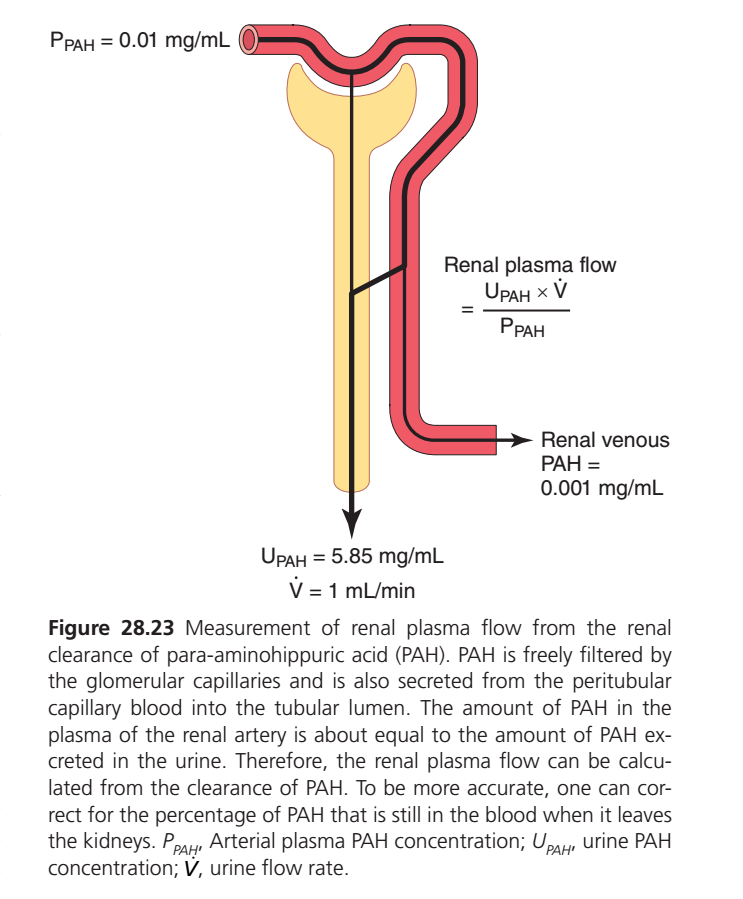
Measurement of Renal Plasma Flow (RPF) Using PAH — Simplified Concept
STEP 1: What is PAH?
PAH (Para-Aminohippuric Acid) is a special substance because:
✅ Freely filtered by the glomerulus
✅ Secreted by renal tubules
✅ Almost all PAH entering the kidney is removed in one pass
So very little PAH remains in renal venous blood.
BIG IDEA
Think of PAH as a colored dye entering the kidney.
Before Kidney
Blood enters kidney carrying PAH.
Arterial PAH concentrationPPAH=0.01 mg/mL
Inside Kidney
Kidney removes PAH by:
- Filtration
- Tubular secretion
Therefore almost all PAH is transferred into urine.
After Kidney
Very little PAH remains in blood.
Renal venous PAH0.001 mg/mL
Only a tiny amount escapes removal.
WHY PAH IS USED?
Because the kidney removes almost all PAH from plasma.
Therefore:
Amount of PAH entering kidney
≈
Amount of PAH appearing in urine
This allows us to calculate how much plasma flowed through the kidneys.
THE FORMULA
Guyton gives:RPF=PPAHUPAH×V
Where:
UPAH
PAH concentration in urine=5.85mg/mL
V
Urine flow rate=1mL/min
PPAH
PAH concentration in arterial plasma=0.01mg/mL
EASY CALCULATION
Step 1
Write formulaRPF=PPAHUPAH×V
Step 2
Insert valuesRPF=0.015.85×1
Step 3
Multiply numeratorRPF=0.015.85
Step 4
DivideRPF=585
ANSWER
RPF=585mL/min
WHAT DOES 585 mL/min MEAN?
It means:
Every minute
About585mL
of plasma passes through both kidneys.
VISUAL STORY
🩸 Blood enters kidney
⬇
PAH concentration = 0.01 mg/mL
⬇
Kidney filters + secretes PAH
⬇
Almost all PAH moves into urine
⬇
Urine PAH becomes very high
(5.85 mg/mL)
⬇
Very little PAH remains in venous blood
(0.001 mg/mL)
⬇
From this removal of PAH
⬇
Calculate Renal Plasma Flow585mL/min
WHY IS RENAL VENOUS PAH SHOWN?
The figure shows:0.001mg/mL
remaining in renal venous blood.
This tells us:
❌ PAH removal is not exactly 100%
✅ About 90% is removed
So for a more accurate calculation, Guyton sometimes applies a correction called the PAH extraction ratio.
KEY CONCEPT
- PAH is filtered and secreted by the kidney.
- Almost all PAH entering the kidney appears in urine.
- Therefore PAH clearance approximates Renal Plasma Flow (RPF).
- Formula:
RPF=PPAHUPAH×V
- Using the figure values:
RPF=585mL/min
- Meaning: about 585 mL of plasma flows through the kidneys each minute. 🚑🩸🩺
FILTRATION FRACTION IS CALCULATED FROM GFR DIVIDED BY RPF
- Filtration fraction (FF) is the fraction of plasma that is filtered through the glomerular membrane.
- To calculate filtration fraction, both GFR and RPF must be known.
- GFR can be measured using inulin clearance.
- RPF can be estimated using PAH clearance.
- If RPF is 650 mL/min and GFR is 125 mL/min, filtration fraction can be calculated.
EASY EQUATION
FF=RPFGFR
GIVEN VALUES
- GFR = 125 mL/min
- RPF = 650 mL/min
STEP 1
FF=650125
STEP 2
Divide numerator and denominator by 25:FF=265
STEP 3
FF=0.192
STEP 4
Rounded value:FF≈0.19
STEP 5 (Convert to Percentage)
FF=0.19×100 FF=19%
FINAL ANSWER
FF=0.19
orFF=19%
KEY CONCEPT
- Filtration Fraction (FF) = GFR ÷ RPF.
- FF represents the percentage of plasma filtered by the glomeruli.
- Normal GFR ≈ 125 mL/min.
- Normal RPF ≈ 650 mL/min.
- FF = 125 ÷ 650 = 0.19.
- FF ≈ 19%.
- This means about 19% of the plasma entering the kidneys is filtered into Bowman’s capsule, while about 81% continues into the peritubular capillaries.
CALCULATION OF TUBULAR REABSORPTION OR SECRETION
- If the glomerular filtration rate and urinary excretion rate of a substance are known, tubular reabsorption or secretion can be calculated.
- If urinary excretion is less than the filtered load, the substance has been reabsorbed by the renal tubules.
- If urinary excretion is greater than the filtered load, the substance has been secreted by the renal tubules.
- The amount appearing in the urine may represent filtration alone or filtration plus secretion.
EASY RULE
- Filtered Load > Excretion Rate = Net Reabsorption
- Filtered Load < Excretion Rate = Net Secretion
GIVEN VALUES
- Urine Flow Rate (V) = 1 mL/min
- Urine Sodium Concentration (UNa) = 70 μEq/mL
- Plasma Sodium Concentration (PNa) = 140 μEq/mL
- GFR = 100 mL/min
STEP 1: CALCULATE FILTERED LOAD
Formula
Filtered Load=GFR×PNa
Substitute Values
Filtered Load=100×140 Filtered Load=14,000 μEq/min
Answer
Filtered Load=14,000 μEq/min
STEP 2: CALCULATE URINARY EXCRETION RATE
Formula
Excretion Rate=UNa×V
Substitute Values
Excretion Rate=70×1 Excretion Rate=70 μEq/min
Answer
Excretion Rate=70 μEq/min
STEP 3: CALCULATE TUBULAR REABSORPTION
Formula
Tubular Reabsorption=Filtered Load−Excretion Rate
Substitute Values
Tubular Reabsorption=14,000−70 Tubular Reabsorption=13,930 μEq/min
FINAL ANSWER
Tubular Reabsorption=13,930 μEq/min
- Therefore, most of the filtered sodium was reabsorbed.
- Only a small amount of sodium was excreted in the urine.
- Comparison of a substance’s clearance with inulin clearance helps determine how the kidney handles that substance.
- If the clearance of a substance equals inulin clearance, the substance is filtered but neither reabsorbed nor secreted.
- If the clearance of a substance is less than inulin clearance, the substance is reabsorbed.
- If the clearance of a substance is greater than inulin clearance, the substance is secreted.
EASY COMPARISON WITH INULIN
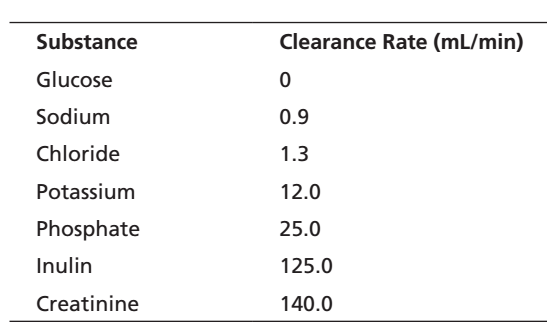
| Clearance Compared with Inulin | Interpretation |
|---|---|
| Equal to Inulin | Filtered Only |
| Less than Inulin | Reabsorbed |
| Greater than Inulin | Secreted |
KEY CONCEPT
- Filtered Load = GFR × Plasma Concentration
- Excretion Rate = Urine Concentration × Urine Flow Rate
- Tubular Reabsorption = Filtered Load − Excretion Rate
- Tubular Secretion = Excretion Rate − Filtered Load
- Filtered Sodium Load = 14,000 μEq/min
- Sodium Excretion Rate = 70 μEq/min
- Sodium Reabsorption = 13,930 μEq/min
- Clearance = Inulin → Filtered Only.
- Clearance < Inulin → Reabsorbed.
- Clearance > Inulin → Secreted.
Made by easiest self learning CEO and founder Dr sheen
