


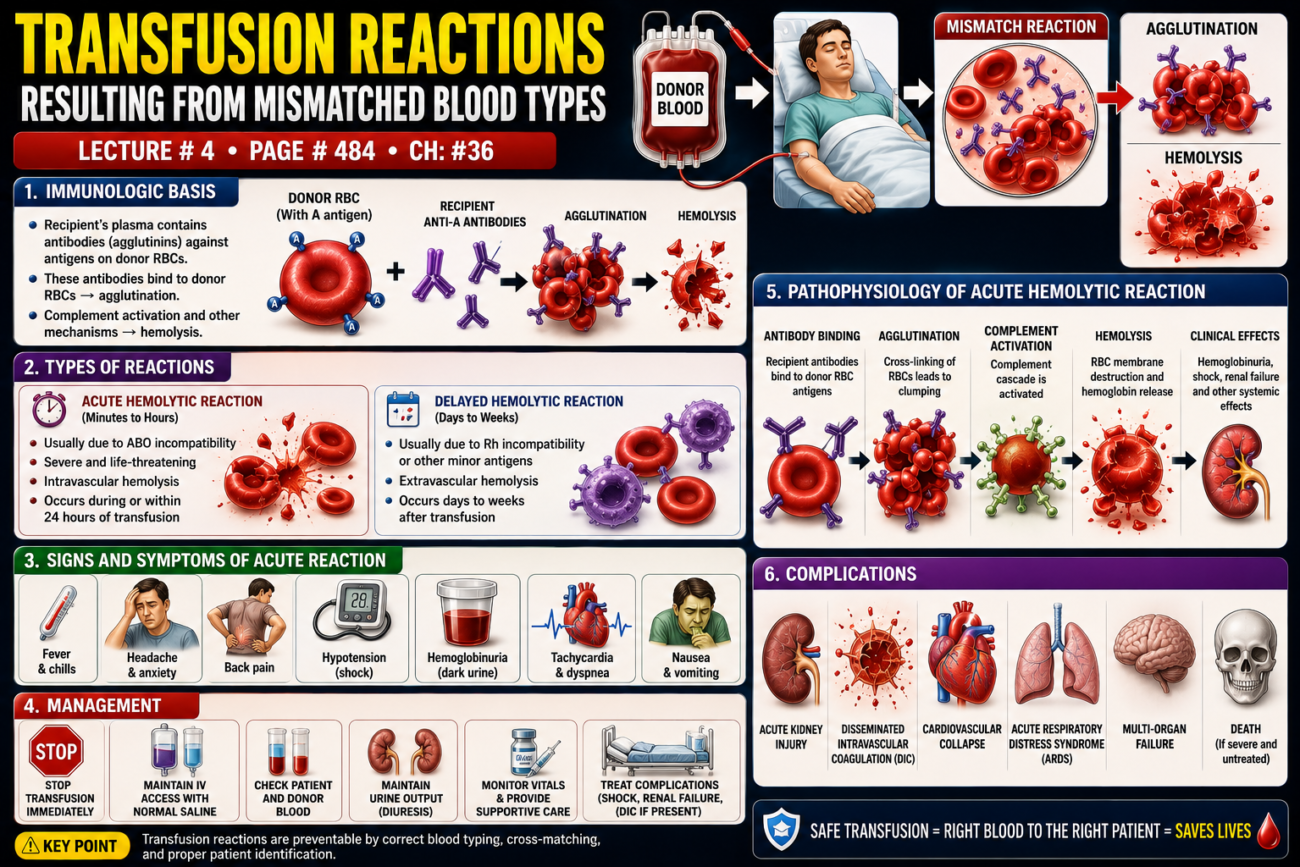
- If donor blood of one blood type is transfused into a recipient with a different blood type, a transfusion reaction is likely to occur.
- In this reaction, the donor RBCs are agglutinated.
- It is rare for the transfused blood to cause agglutination of the recipient’s RBCs.
- This is because the donor plasma is rapidly diluted by the large amount of the recipient’s plasma.
- Dilution lowers the titer of the donor agglutinins to a level that is usually too low to cause agglutination.
- The small amount of transfused blood does not significantly dilute the recipient’s plasma agglutinins.
- Therefore, the recipient’s agglutinins can still agglutinate the mismatched donor RBCs.
- As explained earlier, all transfusion reactions eventually cause:
- Immediate hemolysis due to hemolysins, or
- Delayed hemolysis due to phagocytosis of agglutinated RBCs.
- Hemoglobin released from destroyed RBCs is converted into bilirubin by phagocytes.
- The bilirubin is later excreted in the bile by the liver.
- The bilirubin level in body fluids may rise enough to cause jaundice.
- In jaundice, the internal tissues and skin become yellow because of bile pigment.
- If liver function is normal, the bilirubin is excreted into the intestines through bile.
- Therefore, jaundice usually does not develop in adults unless more than 400 mL of blood is hemolyzed within less than one day.
Key Concept
- Mismatched blood transfusion mainly causes agglutination of donor RBCs by the recipient’s agglutinins.
- Donor agglutinins are greatly diluted in the recipient’s plasma and usually do not agglutinate the recipient’s RBCs.
- Transfusion reactions cause immediate or delayed hemolysis.
- Released hemoglobin is converted into bilirubin, which may cause jaundice.
- In adults with a normal liver, jaundice usually appears only when more than 400 mL of blood is hemolyzed in less than one day.
Acute Kidney Failure After Transfusion Reactions
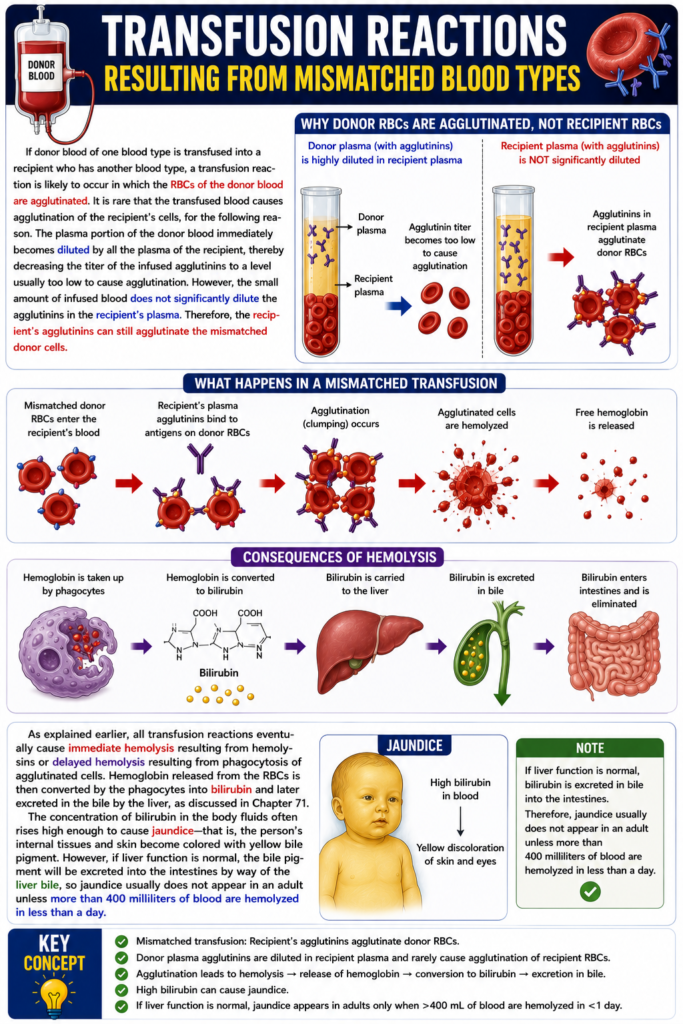
- One of the most serious complications of a transfusion reaction is acute kidney injury.
- It can begin within a few minutes to a few hours after the transfusion.
- It may continue until the person dies from acute renal failure.
- There are three main causes of kidney shutdown:
- 1. Renal vasoconstriction
- The antigen–antibody reaction releases toxic substances from the hemolyzed blood.
- These toxic substances cause powerful constriction of the renal blood vessels (renal vasoconstriction).
- 2. Decreased arterial pressure
- Loss of circulating RBCs and the production of toxic substances from hemolyzed cells, along with the immune reaction, can cause circulatory shock.
- Arterial blood pressure falls.
- Renal blood flow decreases.
- Urine output decreases.
- 3. Blockage of renal tubules by precipitated hemoglobin
- Large amounts of free hemoglobin are released into the blood after hemolysis.
- If the amount of free hemoglobin is greater than the binding capacity of haptoglobin, excess hemoglobin remains free.
- Haptoglobin is a plasma protein that binds small amounts of hemoglobin.
- Excess free hemoglobin passes through the glomerular membrane into the kidney tubules.
- If only a small amount enters the tubules, it is reabsorbed into the blood through the tubular epithelium.
- If a large amount enters the tubules, only a small portion is reabsorbed.
- Water continues to be reabsorbed.
- This increases the hemoglobin concentration inside the tubules.
- The hemoglobin precipitates.
- The precipitated hemoglobin blocks many kidney tubules.
- Together, renal vasoconstriction, circulatory shock, and renal tubular blockage cause acute renal shutdown.
- If the kidney shutdown is complete and does not recover, the patient usually dies within 7 to 12 days unless treated with an artificial kidney.
Key Concept
- Acute kidney injury is one of the most dangerous complications of a transfusion reaction.
- Three main causes:
- Renal vasoconstriction
- Decreased arterial pressure (circulatory shock)
- Blockage of renal tubules by precipitated hemoglobin
- These three mechanisms lead to acute renal shutdown.
- Without recovery or treatment with an artificial kidney, death may occur within 7–12 days.
MADE BY SELF LEARNING CEO AND FOUNDER DR SHEEN
