


After studying this topic, students will be able to:
- Describe the basic design of the nervous system.
- Explain the roles of sensory receptors, effectors, and synapses.
- Explain how the nervous system processes information and produces responses.
- Describe how information is stored as memory.
- Introduction
The nervous system is a highly organized system that receives sensory information, processes it, produces appropriate responses, and stores information for future use.
Sensory receptors collect information from the body and surroundings. This information enters the central nervous system, where important signals are selected and processed. The nervous system then controls muscles and glands to produce suitable ( PROPER OR APPROPRIATE) motor responses.
Synapses help control which nerve signals pass, which are blocked, and which are strengthened. ( signals are made stronger so they can pass more easily.) Some information is also stored through synaptic changes and becomes memory, which helps the brain compare new experiences with past experiences and guide future thinking and responses.
Simple overall flow:
Sensory information → Processing and integration → Motor response → Storage as memory
- The central nervous system (CNS) contains about 80–100 billion neurons.
- Fig. 46.1 shows a typical neuron found in the motor cortex of the brain.
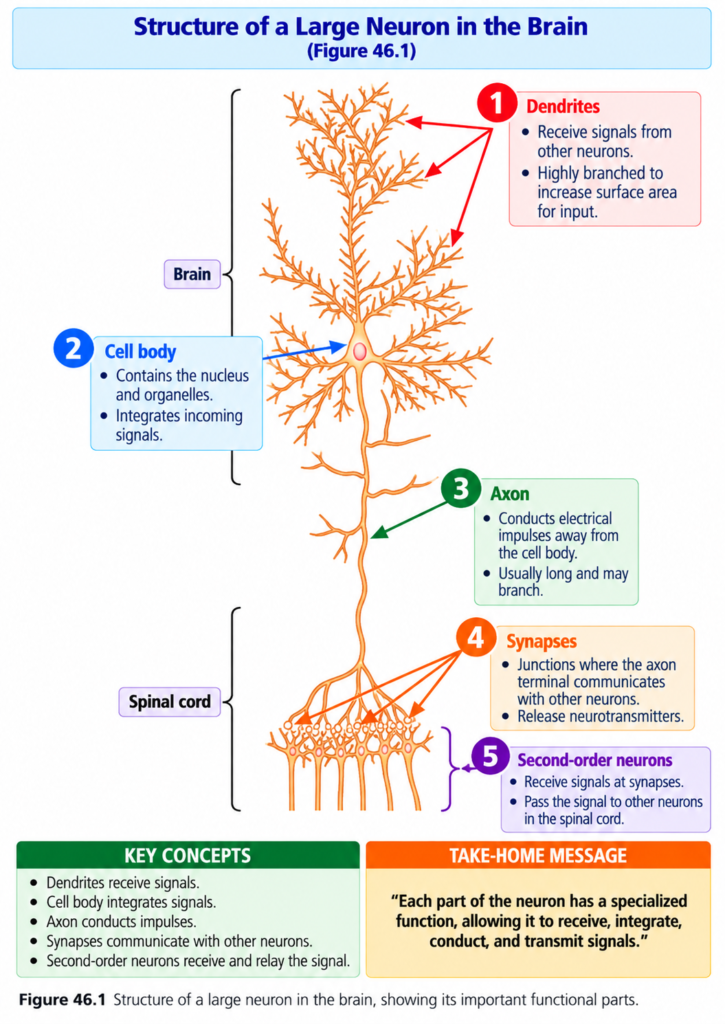
- Incoming signals enter the neuron mainly through:
- Dendrites
- Cell body
- Different neurons may receive from:
- A few hundred synaptic connections
- Up to 200,000 synaptic connections
- The output signal leaves the neuron through a single axon.
- This axon may divide into many branches that carry signals to:
- Other parts of the nervous system
- Peripheral parts of the body
- In most synapses, signals normally move in one forward direction:
- Axon of the preceding neuron → dendrites or cell membrane of the next neuron
- This one-way transmission helps nervous signals travel in the required direction to perform specific nervous functions.
SENSORY PART OF THE NERVOUS SYSTEM—SENSORY RECEPTORS
- Most activities of the nervous system begin with sensory experiences that stimulate sensory receptors.
- These receptors include:
- Visual receptors in the eyes
- Auditory receptors in the ears
- Tactile receptors on the body surface
- Other types of sensory receptors
- Sensory experiences may:
- Cause an immediate reaction from the brain.
- Be stored as memories for minutes, weeks, or years.
- Influence body reactions at a later time.
- Fig. 46.2 shows the somatic part of the sensory system.
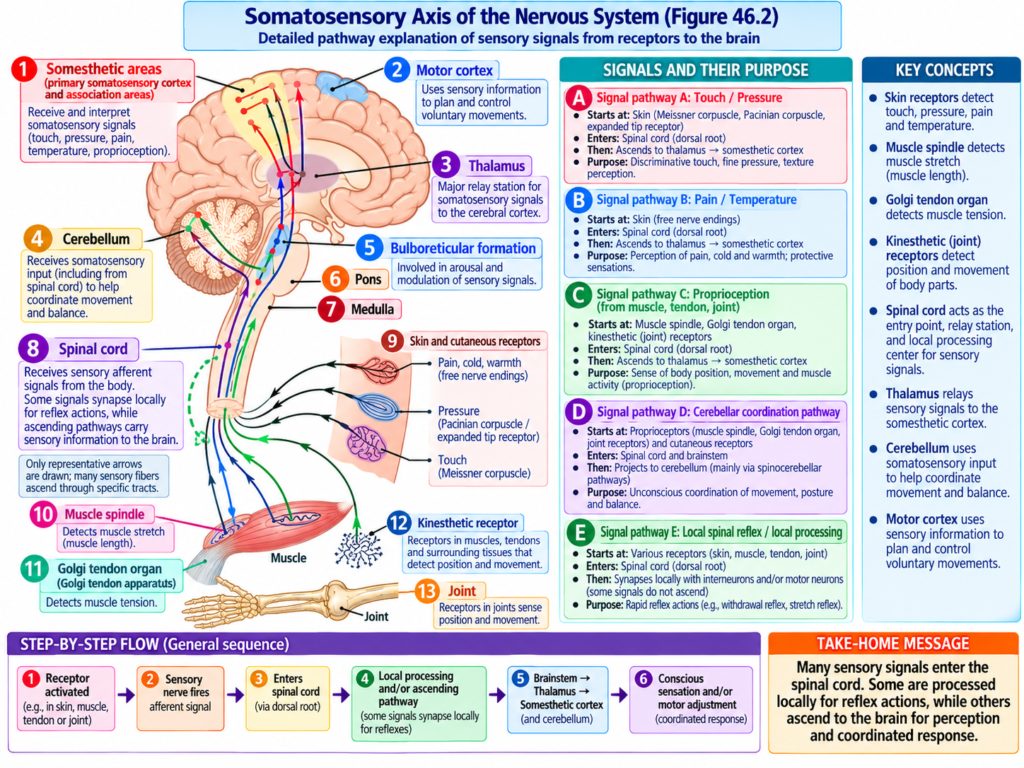
- This system carries sensory information from:
- Receptors over the entire body surface
- Some deep structures
- Sensory information enters the central nervous system through peripheral nerves.
- It is then carried to several sensory areas:
- Spinal cord at all levels
- Reticular substance of the medulla, pons, and mesencephalon
- Cerebellum
- Thalamus
- Cerebral cortex
MOTOR PART OF THE NERVOUS SYSTEM—EFFECTORS
- The nervous system controls body activities by controlling:
- Skeletal muscle contraction throughout the body
- Smooth muscle contraction in internal organs
- Secretion of active chemical substances from exocrine and endocrine glands
- These activities are called motor functions of the nervous system.
- The muscles and glands are called effectors because they perform the functions directed ( controlled, guided, or instructed.) by nerve signals.
- Fig. 46.3 shows the skeletal motor nerve axis, which controls skeletal muscle contraction.
- Running parallel to this system is the autonomic nervous system.
- The autonomic nervous system controls:
- Heart
- Smooth muscles
- Glands
- Other internal body systems
- This system is discussed in Chapter 61.
- Fig. 46.2 and Fig. 46.3 show that skeletal muscles can be controlled from several levels of the central nervous system:
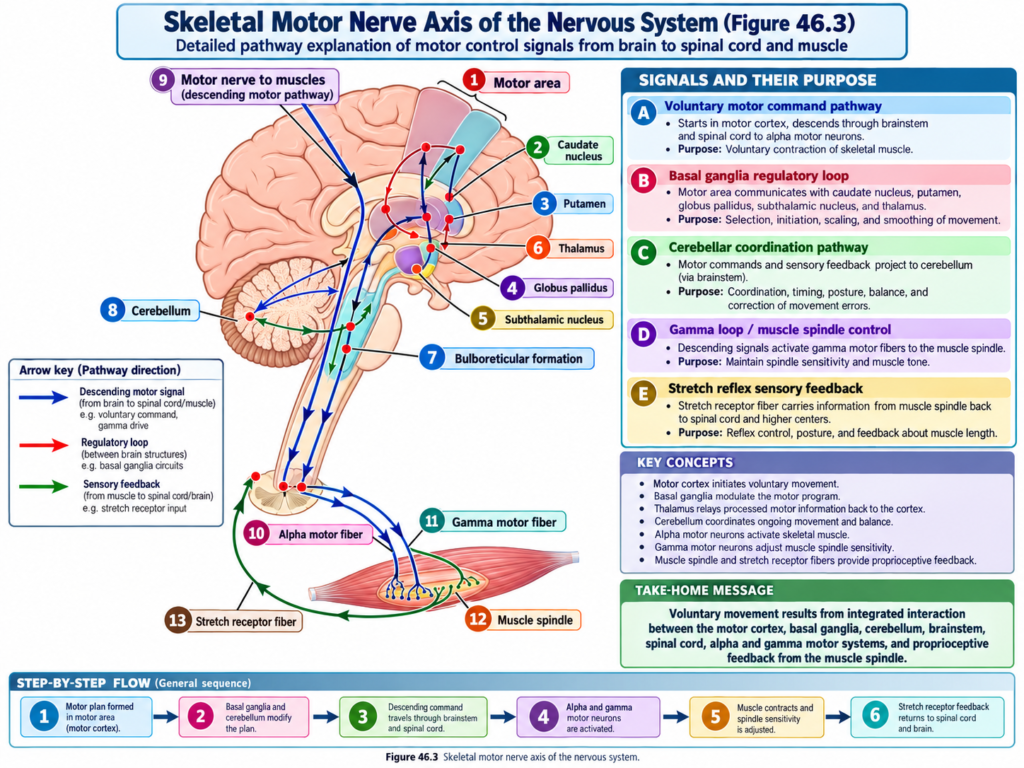
- Spinal cord
- Reticular substance of the medulla, pons, and mesencephalon
- Basal ganglia
- Cerebellum
- Motor cortex
- Each area has its own specific role.
- Lower regions mainly control automatic and immediate muscle responses to sensory stimuli.
- Higher regions control deliberate ( a movement you choose to make.)
and complex muscle movements through thought processes of the brain.
PROCESSING OF INFORMATION—INTEGRATIVE FUNCTION OF THE NERVOUS SYSTEM
- One important function of the nervous system is to process incoming information.
- This processing helps produce the correct:
- Mental response
- Motor response
- More than 99% of sensory information is ignored by the brain because it is not important.
- For example, a person is usually not aware of:
- Clothing touching the body
- Pressure of the seat while sitting
- Most objects in the field of vision
- Continuous background noise
- Important sensory information is sent to the proper integrative and motor areas of the brain.
- This causes the required response.
- This processing and directing of information is called the integrative function of the nervous system.
- Integrative function of the nervous system = the brain receives information, understands it, and decides the correct response.
· Easiest flow:
- Sensory information comes in → Brain processes it → Brain decides what to do → Correct response happens
- Example: 1
Touch a hot stove → Brain recognizes danger → Brain tells the muscles to move → Hand pulls away. - Example:2
- Hand touches a hot stove
- The hand is quickly lifted
- The body may move away
- The person may shout because of pain
ROLE OF SYNAPSES IN PROCESSING INFORMATION
- A synapse is the junction between one neuron and the next neuron.
- Synapses determine the direction in which nerve signals travel through the nervous system.
- Some synapses allow signals to pass easily.
- Other synapses allow signals to pass with difficulty.
- Signals from other parts of the nervous system can control synaptic transmission:
- Facilitatory signals can make transmission easier.
- Inhibitory signals can reduce or stop transmission.
- Therefore, synapses may be:
- Opened for signal transmission
- Closed for signal transmission
- Some postsynaptic neurons produce many output impulses.
- Other postsynaptic neurons produce only a few output impulses.
- Synapses therefore act as selectors of nerve signals:
- Weak signals may be blocked.
- Strong signals may be allowed to pass.
- Sometimes certain weak signals may be selected and made stronger.
- Signals may also be sent in many different directions.
Easiest concept:
Synapse receives a signal → selects or controls it → allows, blocks, or strengthens it → sends it onward.
( Sometimes, synapses select and strengthen weak signals and then send these signals in many different directions instead of only one direction. )
STORAGE OF INFORMATION—MEMORY
- Only a small part of important sensory information causes an immediate motor response.
- Much of the information is stored for:
- Future control of motor activities
- Thinking processes
- Most information storage occurs in the cerebral cortex.
- Small amounts can also be stored in:
- Basal regions of the brain
- Spinal cord
- Storage of information is called memory.
- Memory is also a function of the synapses.
- When the same type of sensory signal passes repeatedly through a sequence of synapses:
- The synapses become better able to transmit that signal again.
- This process is called facilitation.
- After repeated stimulation, the synapses can become so facilitated that signals produced inside the brain can activate the same synaptic pathway even without new sensory input.
- This can make a person feel as if the original sensation is happening again, but it is actually a memory of that sensation.
- The exact mechanism of long-term synaptic facilitation in memory is still uncertain.
- More details about sensory memory are discussed in Chapter 58.
- Once memories are stored, they become part of the brain’s future thinking process.
- The brain compares new sensory experiences with stored memories.
- Stored memories then help the brain:
- Select important new sensory information
- Send it to memory storage areas for future use
- Or send it to motor areas to produce an immediate body response
Easiest concept:
New information comes in → important information is stored → synapses become better at carrying the same signal → stored memories help future thinking and responses.
KEY CONCEPT
The nervous system works in a simple sequence:
Receive → Process → Decide → Respond → Remember
- Sensory receptors receive information from the body and surroundings.
- This information enters the central nervous system through sensory pathways.
- The brain and spinal cord process and select important signals.
- Synapses control where signals go and whether they are passed, blocked, or strengthened.
- The nervous system then sends commands to effectors:
- Muscles
- Glands
- These effectors produce the required motor response.
- Some important information is stored as memory.
- Stored memory helps the brain understand and respond better to future information.
One-Line Memory Concept
The nervous system receives information, processes it, produces the correct response, and stores useful information for future use.
CLINICAL IMPORTANCE
- Sensory receptors are important because they detect information from the body and surroundings and send it to the CNS.
- The central nervous system processes this sensory information and decides the correct mental or motor response.
- The nervous system ignores most unimportant sensory information, allowing attention to focus on important signals.
- Proper integration of sensory information is necessary for a quick and appropriate response.
- Example:
Touching a hot stove → sensory information reaches the CNS → the hand is quickly withdrawn → the body may also move away. - Motor pathways are important because they control:
- Skeletal muscles
- Smooth muscles
- Glands
- Effectors are important because muscles and glands actually perform the response ordered by nerve signals.
- Lower levels of the CNS mainly produce automatic and immediate responses, while higher levels control deliberate and complex movements.
- Synapses are important because they control:
- Which nerve signals pass
- Which signals are blocked
- Which signals are strengthened
- The direction in which signals travel
- Facilitatory signals make synaptic transmission easier, while inhibitory signals reduce or stop transmission.
- Repeated passage of signals through synapses can make those synapses better able to transmit the same signals again. This is called facilitation.
- Synaptic facilitation is important in the formation of memory.
- Stored memories help the brain:
- Compare new experiences with previous experiences
- Select important new information
- Guide future thinking
- Produce appropriate body responses
Easiest Clinical Concept
Sensation detected → CNS processes it → synapses control the signal → muscles or glands respond → important information may be stored as memory.
High-Yield Exam Concept
- Sensory receptors receive information from the body and surroundings.
- The CNS processes and selects important information.
- Synapses control signal flow by allowing, blocking, or strengthening signals.
- The nervous system sends commands to muscles and glands (effectors) to produce a response.
- Important information may be stored as memory and used later in thinking and future responses.
Ultra-short recall:
Input → Processing → Synapse control → Output → Memory
Reference:
. Guyton and Hall Textbook of Medical Physiology. 15th edition.
