

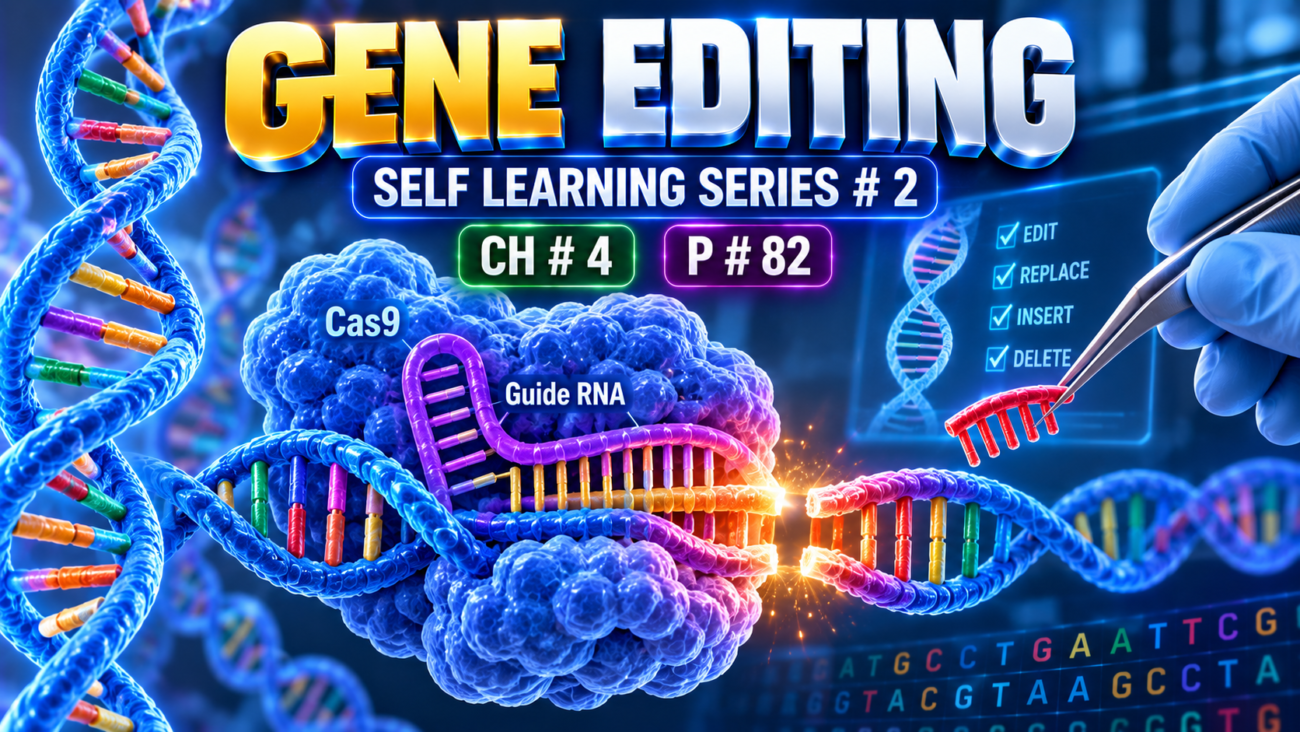
- Gene editing allows highly specific changes to the genome.
- A major advance came from the CRISPR-Cas system, especially CRISPR-Cas9.
- In bacteria, CRISPR-Cas acts as a form of acquired immunity against:
- phages
- plasmids
- Bacteria capture pieces of invading DNA and incorporate them into their own genome as CRISPR sequences.
- These CRISPR sequences are then:
- transcribed into RNA
- processed into guide-like RNA
- used to direct Cas9 nuclease to matching foreign DNA
- Cas9 then cuts the matching DNA → destroys the invading phage DNA.
- Gene editing uses the same principle with an artificial guide RNA (gRNA).
- The gRNA is designed to be complementary to a chosen DNA sequence.
- It binds Cas9 and guides it to the target DNA.
- At the target:
gRNA + Cas9 → precise recognition → double-stranded DNA break (Fig. 4.4). - The broken DNA can then be repaired in two important ways:
- Nonhomologous end joining (NHEJ):
- repairs the break directly
- may introduce somewhat random disruptive mutations
- therefore can disrupt the targeted gene
- Homologous recombination:
- allows precise introduction of a desired new DNA sequence
- Nonhomologous end joining (NHEJ):
- Both the gRNA and Cas9 can be delivered into cells using a single plasmid.
- CRISPR-Cas9 is especially useful because of its:
- high specificity
- flexibility
- relative ease of use
- Important applications include:
- introducing specific mutations into cells to model cancer and other diseases
- rapidly producing transgenic animals
- potentially correcting mutations responsible for heritable diseases
- The same technology could also be used to alter less desirable traits, which has created major ethical debate about its use.
KEY CONCEPT
- CRISPR = targeting system
- gRNA = finds the matching DNA
- Cas9 = cuts the DNA
- After cutting:
- NHEJ → disruptive mutation
- Homologous recombination → precise DNA correction/insertion
CONCEPTUAL EXAMPLES
- Disease-causing DNA sequence identified → matching gRNA designed → Cas9 cuts it → targeted gene editing.
- Cas9 cut repaired by NHEJ → gene becomes disrupted → gene knockout-like effect.
- Cas9 cut repaired using a desired DNA template → specific sequence inserted or corrected → precise gene correction.
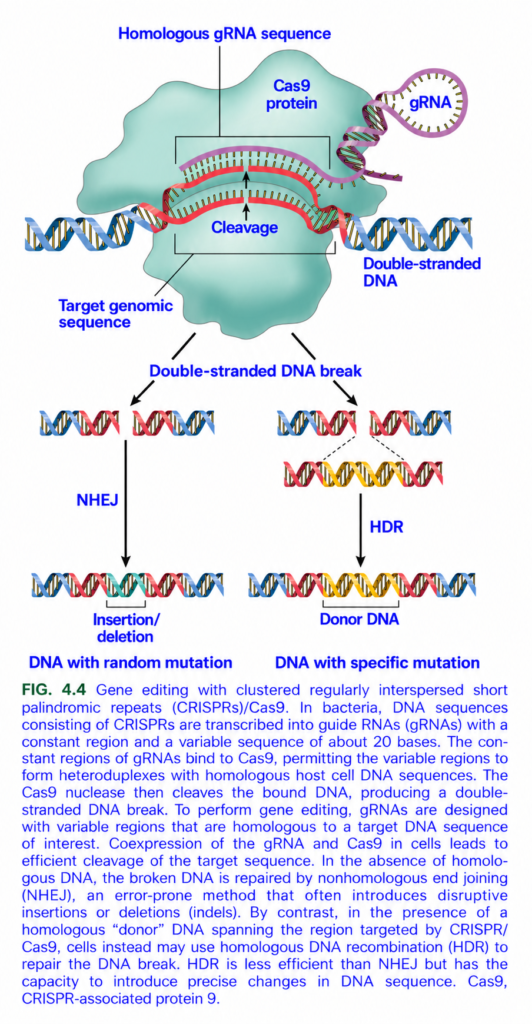
FIG. 4.4 — CRISPR/Cas9 Gene Editing
🧠 Simplest idea
gRNA finds the exact DNA target → Cas9 cuts both DNA strands → cell repairs the break → repair can create either a random mutation or a precise mutation.
Whole figure in one line
gRNA + Cas9 → target DNA recognition → double-stranded DNA break → NHEJ = random indel OR HDR + donor DNA = specific edit
1️⃣ TOP — gRNA guides Cas9
🟣 Purple strand = gRNA (guide RNA)
🟢 Large green structure = Cas9 protein
🔵 Double helix = normal double-stranded DNA
The gRNA contains a sequence homologous/complementary to the target DNA.
Arrow concept:
gRNA sequence matches target DNA
→ guides Cas9 to the correct genomic location.
🧠 Think:
gRNA = GPS
Cas9 = molecular scissors
2️⃣ Target genomic sequence
🔴 Red DNA region = the specific DNA sequence being targeted.
The complementary part of gRNA pairs with this target.
So:
Correct match → Cas9 positioned at the target
3️⃣ Cleavage
Black arrows labeled cleavage show Cas9 cutting:
- one DNA strand
- the opposite DNA strand
⬇️
Double-stranded DNA break
Meaning: both strands of DNA are cut.
After the break, TWO repair pathways are possible
4️⃣ LEFT — NHEJ
NHEJ = Non-Homologous End Joining
The broken DNA ends are simply joined back together.
But this repair is error-prone.
⬇️ Black arrow
Small DNA bases may be:
- inserted
- deleted
= Insertion / deletion (indel)
🟢/teal changed segment = random altered DNA.
Result:
DNA with random mutation
🧠 Easy idea:
NHEJ = quick repair, but messy
Often useful for knocking out/disrupting a gene.
5️⃣ RIGHT — HDR
HDR = Homology-Directed Repair
Here the cell is given:
🟡 Donor DNA
This donor DNA contains the desired new sequence.
The cell uses it as a template.
⬇️
Broken DNA + donor DNA template
→ accurate repair
→ desired sequence copied into chromosome.
Result:
DNA with specific mutation
🧠 Easy idea:
HDR = repair using a blueprint
🎨 COLOR / STRUCTURE GUIDE
- 🟢 Large green shape = Cas9 protein
- 🟣 Purple loop/strand = gRNA
- 🔵 DNA = surrounding genomic DNA
- 🔴 DNA segment = targeted/cut region
- 🟡 DNA segment = donor DNA carrying desired change
- 🟢/teal small altered region after NHEJ = random insertion/deletion
- ⚫ Black arrows = repair pathway direction
- 🟨 Yellow arrows = Cas9/gRNA action and targeting
⭐ MAIN DIFFERENCE
NHEJ
No donor template
→ inaccurate repair
→ insertion/deletion
→ random mutation
HDR
Donor DNA provided
→ template-guided repair
→ specific mutation
🧠 Fastest exam recall
gRNA finds → Cas9 cuts → cell repairs.
NHEJ = random indels
HDR = precise edit using donor DNA
⭐ One-line memory
CRISPR = GPS (gRNA) + scissors (Cas9) + repair (NHEJ or HDR).
GENETIC DISEASES
- Three commonly used terms should be distinguished:
- Hereditary
- Familial
- Congenital
- Hereditary disorders:
- are transmitted through the parents’ gametes
- therefore, they are familial
- Congenital simply means present at birth.
- A congenital disease does not have to be genetic.
- Example: congenital syphilis.
- Likewise, a genetic disease does not have to be congenital.
- Example: Huntington disease is genetic, but symptoms usually begin in the third or fourth decade of life.
KEY CONCEPT
- Hereditary → transmitted through parental gametes → familial.
- Congenital → present at birth, but may or may not be genetic.
- Genetic disease → may appear at birth or much later in life.
CONCEPTUAL EXAMPLES
- Congenital syphilis → present at birth but not genetic.
- Huntington disease → genetic but usually not apparent at birth.
NATURE OF GENETIC ABNORMALITIES CONTRIBUTING TO HUMAN DISEASE
- Genetic abnormalities can alter the structure or function of proteins → disturb cellular homeostasis → cause disease.
Mutations in Protein-Coding Genes
- Mutation = permanent change in DNA.
- Germ-cell mutations → can be transmitted to offspring → may cause inherited disease.
- Somatic-cell mutations → are not inherited, but are important in cancers and some congenital disorders.
- Important mutation types include:
- Point mutation = substitution of one nucleotide base by another.
- It may replace one amino acid with another → missense mutation.
- Example: mutation in the β-globin gene → hemoglobin S instead of hemoglobin A → sickle cell disease.
- If the mutation creates a premature stop codon → shortened protein or failure of protein production → nonsense mutation.
- Frameshift mutation:
- insertion or deletion of 1 or 2 base pairs
- shifts the DNA reading frame → abnormal downstream protein sequence.
- Trinucleotide repeat mutation:
- abnormal expansion of a 3-nucleotide sequence.
- Example: fragile X syndrome → expansion of CGG repeats in the FMR1 gene.
- Normal individuals average about 29 repeats.
- Affected individuals may have about 200–4000 repeats.
- Expansion can suppress normal FMR1 expression → intellectual disability.
- These mutations are dynamic → repeat number may increase during gametogenesis.
- Point mutation = substitution of one nucleotide base by another.
Alterations in Protein-Coding Genes Other Than Mutations
- Protein-coding genes can also be altered structurally without simple sequence mutations.
- Important changes include:
- amplifications
- deletions
- translocations
- These changes can produce abnormal gain or loss of protein function.
- They may occur:
- in the germline
- or be acquired in somatic cells.
- Some inherited abnormalities involve a whole chromosomal region rather than one gene.
- Example: 22q microdeletion syndrome.
- Copy number variations have been linked with increased risk of disorders such as autism.
- Cancers commonly acquire:
- amplifications
- deletions
- translocations
- Classic example:
t(9;22) BCR-ABL translocation → Philadelphia chromosome → chronic myeloid leukemia. - Genetic disorders can be divided into four major categories:
- Mendelian disorders
- mutation in a single gene
- usually high penetrance
- inherited and familial
- include enzyme defects and other inborn errors of metabolism
- Complex or multifactorial disorders
- caused by multiple genes + environmental influences
- examples: hypertension, diabetes, allergic diseases, autoimmune diseases
- Chromosomal disorders
- caused by abnormal chromosome number or structure
- example: Down syndrome
- Single-gene disorders with nonclassic inheritance
- include:
- triplet-repeat disorders
- mitochondrial DNA mutations
- disorders influenced by genomic imprinting
- include:
- Mendelian disorders
MENDELIAN DISORDERS: DISEASES CAUSED BY MUTATIONS IN SINGLE GENES
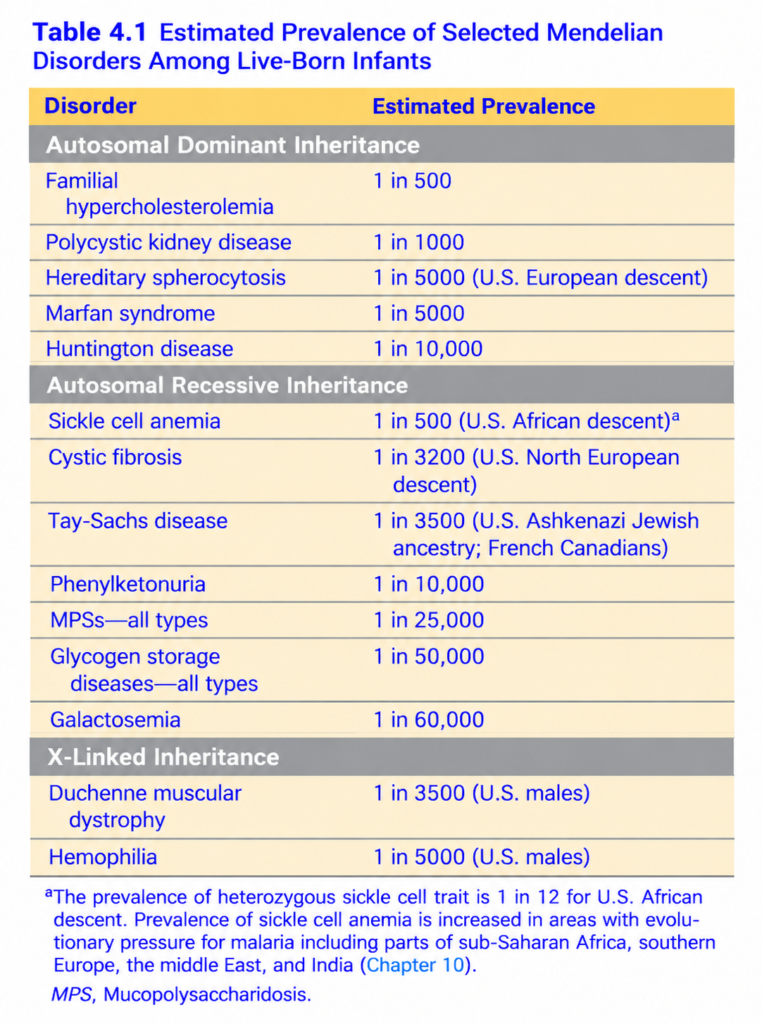
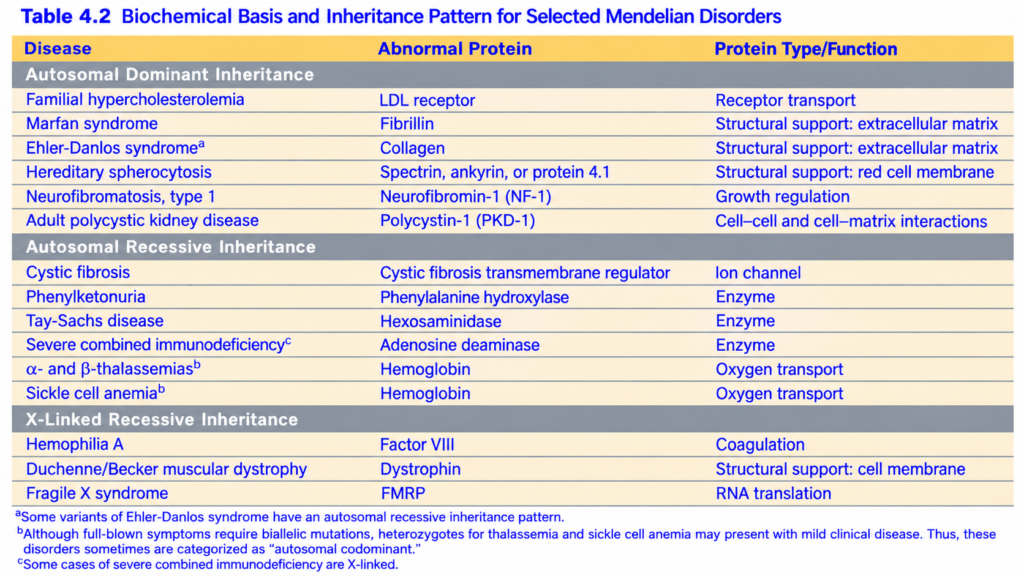
- Single-gene mutations usually follow classic Mendelian inheritance patterns (Tables 4.1 and 4.2).
- Main inheritance patterns:
- autosomal dominant
- autosomal recessive
- X-linked
- Although individual Mendelian disorders are rare, together they cause an important disease burden.
- A single mutation can produce many different effects → pleiotropy.
- Example: Marfan syndrome
- Mutation in fibrillin → abnormalities in:
- skeleton
- eyes
- cardiovascular system
- Different mutations in different genes can produce the same phenotype → genetic heterogeneity.
- Example: different mutations can cause retinitis pigmentosa.
- Genetic heterogeneity is important for:
- genetic counseling
- molecular diagnosis
- The severity of a single-gene disorder may also be changed by other genes called modifier genes.
- Prenatal genetic screening in high-risk populations has reduced the incidence of some inherited diseases, such as Tay-Sachs disease (Table 4.1).
KEY CONCEPT
- Mutation = permanent DNA change.
- Germline mutation → inherited; somatic mutation → not inherited.
- Missense = wrong amino acid.
- Nonsense = premature stop.
- Frameshift = reading frame shifted.
- Trinucleotide repeat = repeated 3-base sequence expands.
- Major genetic disease groups = Mendelian + multifactorial + chromosomal + nonclassic single-gene disorders.
- Pleiotropy = one gene → many effects.
- Genetic heterogeneity = different genes → similar disease.
- Modifier genes = alter severity of disease.
CONCEPTUAL EXAMPLES
- β-globin point mutation → HbS → sickle cell disease.
- FMR1 CGG repeat expansion → gene silencing → fragile X syndrome.
- Fibrillin mutation → eye + skeletal + cardiovascular abnormalities → pleiotropy.
- Different gene mutations → same retinal disease → genetic heterogeneity.
- BCR-ABL translocation → Philadelphia chromosome → chronic myeloid leukemia.
NATURE OF GENETIC ABNORMALITIES CONTRIBUTING TO HUMAN DISEASE
- Genetic abnormalities can alter the structure or function of proteins → disturb cellular homeostasis → cause disease.
Mutations in Protein-Coding Genes
- Mutation = permanent change in DNA.
- Germ-cell mutations → can be transmitted to offspring → may cause inherited disease.
- Somatic-cell mutations → are not inherited, but are important in cancers and some congenital disorders.
- Important mutation types include:
- Point mutation = substitution of one nucleotide base by another.
- It may replace one amino acid with another → missense mutation.
- Example: mutation in the β-globin gene → hemoglobin S instead of hemoglobin A → sickle cell disease.
- If the mutation creates a premature stop codon → shortened protein or failure of protein production → nonsense mutation.
- Frameshift mutation:
- insertion or deletion of 1 or 2 base pairs
- shifts the DNA reading frame → abnormal downstream protein sequence.
- Trinucleotide repeat mutation:
- abnormal expansion of a 3-nucleotide sequence.
- Example: fragile X syndrome → expansion of CGG repeats in the FMR1 gene.
- Normal individuals average about 29 repeats.
- Affected individuals may have about 200–4000 repeats.
- Expansion can suppress normal FMR1 expression → intellectual disability.
- These mutations are dynamic → repeat number may increase during gametogenesis.
- Point mutation = substitution of one nucleotide base by another.
Alterations in Protein-Coding Genes Other Than Mutations
- Protein-coding genes can also be altered structurally without simple sequence mutations.
- Important changes include:
- amplifications
- deletions
- translocations
- These changes can produce abnormal gain or loss of protein function.
- They may occur:
- in the germline
- or be acquired in somatic cells.
- Some inherited abnormalities involve a whole chromosomal region rather than one gene.
- Example: 22q microdeletion syndrome.
- Copy number variations have been linked with increased risk of disorders such as autism.
- Cancers commonly acquire:
- amplifications
- deletions
- translocations
- Classic example:
t(9;22) BCR-ABL translocation → Philadelphia chromosome → chronic myeloid leukemia. - Genetic disorders can be divided into four major categories:
- Mendelian disorders
- mutation in a single gene
- usually high penetrance
- inherited and familial
- include enzyme defects and other inborn errors of metabolism
- Complex or multifactorial disorders
- caused by multiple genes + environmental influences
- examples: hypertension, diabetes, allergic diseases, autoimmune diseases
- Chromosomal disorders
- caused by abnormal chromosome number or structure
- example: Down syndrome
- Single-gene disorders with nonclassic inheritance
- include:
- triplet-repeat disorders
- mitochondrial DNA mutations
- disorders influenced by genomic imprinting
- include:
- Mendelian disorders
MENDELIAN DISORDERS: DISEASES CAUSED BY MUTATIONS IN SINGLE GENES
- Single-gene mutations usually follow classic Mendelian inheritance patterns (Tables 4.1 and 4.2).
- Main inheritance patterns:
- autosomal dominant
- autosomal recessive
- X-linked
- Although individual Mendelian disorders are rare, together they cause an important disease burden.
- A single mutation can produce many different effects → pleiotropy.
- Example: Marfan syndrome
- Mutation in fibrillin → abnormalities in:
- skeleton
- eyes
- cardiovascular system
- Different mutations in different genes can produce the same phenotype → genetic heterogeneity.
- Example: different mutations can cause retinitis pigmentosa.
- Genetic heterogeneity is important for:
- genetic counseling
- molecular diagnosis
- The severity of a single-gene disorder may also be changed by other genes called modifier genes.
- Prenatal genetic screening in high-risk populations has reduced the incidence of some inherited diseases, such as Tay-Sachs disease (Table 4.1).
KEY CONCEPT
- Mutation = permanent DNA change.
- Germline mutation → inherited; somatic mutation → not inherited.
- Missense = wrong amino acid.
- Nonsense = premature stop.
- Frameshift = reading frame shifted.
- Trinucleotide repeat = repeated 3-base sequence expands.
- Major genetic disease groups = Mendelian + multifactorial + chromosomal + nonclassic single-gene disorders.
- Pleiotropy = one gene → many effects.
- Genetic heterogeneity = different genes → similar disease.
- Modifier genes = alter severity of disease.
CONCEPTUAL EXAMPLES
- β-globin point mutation → HbS → sickle cell disease.
- FMR1 CGG repeat expansion → gene silencing → fragile X syndrome.
- Fibrillin mutation → eye + skeletal + cardiovascular abnormalities → pleiotropy.
- Different gene mutations → same retinal disease → genetic heterogeneity.
- BCR-ABL translocation → Philadelphia chromosome → chronic myeloid leukemia.
Transmission Patterns of Single-Gene Disorders
Disorders of Autosomal Dominant Inheritance
- Autosomal dominant disorders appear in the heterozygous state → only one mutant allele is enough to cause disease.
- Usually, at least one parent is affected.
- Males and females are affected equally, and both can transmit the disorder.
- If an affected person has children with an unaffected person:
- each child has a 50% chance of inheriting the disease.
- Some affected patients have unaffected parents because the disorder results from a new mutation in the egg or sperm.
- Their siblings are usually unaffected.
- Clinical expression can vary because of:
- Reduced penetrance
- person inherits the mutant gene but shows no clinical features.
- Variable expressivity
- everyone with the mutant gene shows the trait, but severity differs.
- Example: neurofibromatosis type 1 may range from skin spots to multiple tumors and skeletal deformities.
- Reduced penetrance
- Some autosomal dominant diseases have delayed onset.
- Examples:
- Huntington disease
- inherited mutations that increase risk of adult cancers
- Examples:
- In many autosomal dominant disorders, about 50% reduction of normal gene product is enough to cause disease.
- Because half the normal amount of many enzymes is usually sufficient, autosomal dominant disorders often involve proteins other than enzymes, especially:
- Regulatory proteins
- receptors or transport proteins
- Example: LDL receptor mutation → familial hypercholesterolemia
- Structural proteins
- Example: collagen
- Example: spectrin → hereditary spherocytosis
- Regulatory proteins
- Sometimes the mutant protein interferes with the normal protein → dominant-negative effect.
- Example:
- Collagen normally consists of three chains forming a trimer.
- A mutant collagen chain interferes with assembly of normal chains → marked reduction in functional collagen.
- This occurs in some forms of osteogenesis imperfecta.
Disorders of Autosomal Recessive Inheritance
- Autosomal recessive disorders appear in the homozygous state → both alleles must be mutated.
- Typical pattern:
- parents are usually unaffected carriers
- several siblings may be affected
- each child has a 25% chance of being affected
- If the mutant gene is rare, affected patients are more likely to have consanguineous parents.
- Autosomal recessive disorders form the largest group of Mendelian disorders.
- Compared with autosomal dominant disorders:
- clinical expression is usually more uniform
- complete penetrance is common
- onset is often early in life
- New recessive mutations may occur, but they are often not noticed immediately because:
- a heterozygous carrier is usually asymptomatic
- the mutation may pass through several generations before two carriers have an affected child
- In many autosomal recessive disorders, the affected gene encodes an enzyme.
- Heterozygous carriers produce about:
- 50% normal enzyme
- 50% abnormal enzyme
- Usually, 50% normal enzyme activity is enough for normal cell function.
- Therefore, carriers usually remain clinically normal.
KEY CONCEPT
- Autosomal dominant = one mutant allele is enough → 50% risk to each child.
- Autosomal recessive = two mutant alleles required → 25% risk when both parents are carriers.
- Reduced penetrance = gene present, disease not expressed.
- Variable expressivity = same gene, different severity.
- Dominant-negative mutation = mutant protein interferes with normal protein.
- Autosomal recessive disorders commonly involve enzymes.
CONCEPTUAL EXAMPLES
- Affected parent + unaffected parent → each child has 1 in 2 chance → autosomal dominant.
- Two carrier parents → each child has 1 in 4 chance of disease → autosomal recessive.
- NF1 mutation → mild skin spots in one patient but tumors and skeletal changes in another → variable expressivity.
- Mutant collagen chain damages the function of normal collagen chains → dominant-negative effect.
X-Linked Disorders
- Most sex-linked disorders are X-linked.
- The Y chromosome contains:
- SRY gene → determines testes formation and male sexual differentiation.
- other genes in the male-specific Y region (MSY) → important for spermatogenesis.
- Mutations affecting the Y chromosome usually cause male infertility.
- Therefore, classic Y-linked Mendelian disorders are not generally transmitted.
- Most X-linked disorders are X-linked recessive.
- Heterozygous female carriers:
- usually have one normal X and one mutant X.
- each son has a 50% chance of receiving the mutant X and becoming affected.
- Female carriers usually do not show the full disease phenotype because they still have a normal allele.
- One X chromosome is randomly inactivated in each female cell, but enough cells usually retain an active normal X to prevent full disease expression.
- Affected male:
- cannot transmit the disorder to his sons, because sons receive his Y chromosome.
- transmits his affected X chromosome to all daughters → all daughters become carriers if the mother contributes a normal X.
KEY CONCEPT
- X-linked recessive → mainly affects males.
- Carrier mother → 50% of sons may be affected.
- Affected father → no affected sons through him.
- Affected father → all daughters receive his mutant X and become carriers.
- Female carriers are usually less affected because they also possess a normal X allele.
CONCEPTUAL EXAMPLES
- Carrier mother → one son receives mutant X → affected male.
- Carrier mother → another son receives normal X → unaffected male.
- Affected father + unaffected mother → sons receive father’s Y → sons unaffected through the father.
- The same affected father → every daughter receives his mutant X → all daughters are carriers.
