

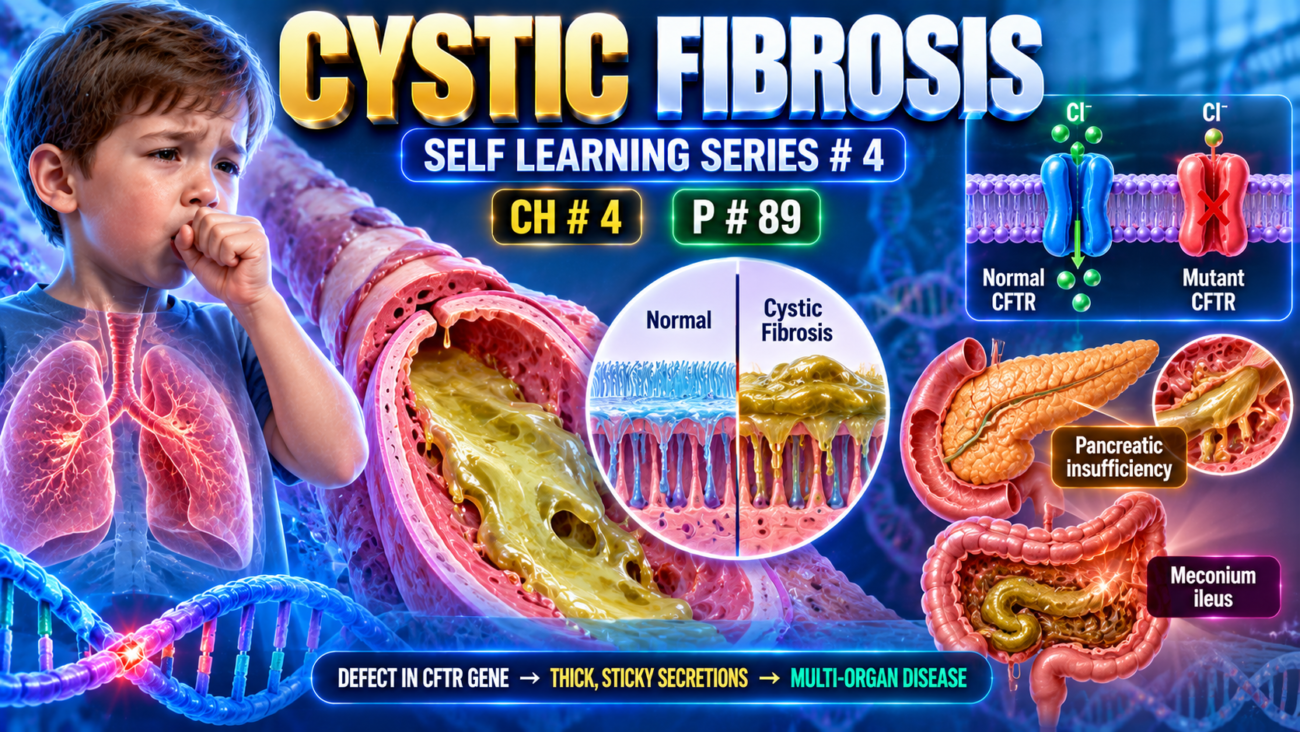
- Cystic fibrosis (CF) is an inherited disorder of epithelial ion transport affecting:
- exocrine glands
- respiratory tract
- gastrointestinal tract
- reproductive tract
- Defective ion transport produces thick, viscid secretions.
- These secretions block:
- airways → recurrent/chronic pulmonary infections
- pancreatic ducts → pancreatic insufficiency
- A characteristic biochemical finding is high sodium chloride in sweat, even though sweat glands remain structurally normal.
- Clinical features vary widely because of:
- different CFTR mutations
- effects of modifier genes
- CF is transmitted as an autosomal recessive disorder.
- In the United States:
- incidence is about 1 in 2500 live births
- carrier frequency among individuals of European descent is about 1 in 20
- Even heterozygous carriers may have increased susceptibility to pulmonary and pancreatic disease compared with the general population.
Pathogenesis
- The basic defect is reduced production or abnormal function of CFTR.
- CFTR is an epithelial chloride and bicarbonate channel.
- CFTR mutations make epithelial membranes relatively impermeable to chloride ions (Fig. 4.7).
- The effect differs by tissue.
- In sweat ducts:
- normal CFTR → reabsorbs chloride and supports sodium reabsorption through ENaC
- defective CFTR → ↓ NaCl reabsorption
- result → salty, hypertonic sweat
- In respiratory and intestinal epithelium:
- normal CFTR → secretes chloride into the lumen
- defective CFTR → ↓ chloride secretion
- loss of CFTR inhibition on ENaC → ↑ sodium absorption
- water follows sodium back into cells
- result → dehydrated surface fluid
- In the lungs:
- dehydrated surface fluid → impaired mucociliary clearance
- mucus becomes thick and concentrated
- → airway obstruction + recurrent pulmonary infections
- Thick secretions can also obstruct:
- pancreatic ducts → pancreatic insufficiency
- vas deferens → male infertility
- In the exocrine pancreas, CFTR also regulates bicarbonate secretion.
- Defective CFTR → ↓ bicarbonate → more acidic pancreatic secretions.
- Acidic secretions cause:
- mucin precipitation
- ↓ activity of digestive enzymes such as trypsin
- Both worsen pancreatic insufficiency.
- More than 2000 disease-causing CFTR mutations have been identified.
- Mutations may:
- reduce delivery of CFTR to the cell surface
- impair CFTR function
- Severe mutations → little or no CFTR function.
- Mild mutations → some residual CFTR function.
- The most common mutation is ΔF508:
- deletion of 3 nucleotides
- loss of phenylalanine at position 508
- CFTR misfolds → degraded inside the cell
- small amount reaching the surface is also dysfunctional
- found in about 70% of patients worldwide
- Disease severity is also influenced by modifier genes, including:
- MBL2
- TGF-β1
- These may modify how well the lungs tolerate severe infections.
KEY CONCEPT
- CF = autosomal recessive CFTR defect → abnormal chloride/bicarbonate transport.
- Sweat gland → ↓ NaCl reabsorption → salty sweat.
- Lung/intestine → ↑ Na⁺ and water absorption + ↓ Cl⁻ secretion → dehydrated mucus → thick secretions.
- Main consequences:
recurrent lung infections + pancreatic insufficiency + male infertility. - ΔF508 = most common CFTR mutation.
CONCEPTUAL EXAMPLES
- Sweat duct cannot reabsorb salt properly → salty sweat.
- Airway surface loses water → mucus becomes thick → poor mucociliary clearance + infection.
- Pancreatic duct becomes blocked by thick secretion → pancreatic insufficiency.
- Vas deferens obstruction → male infertility.
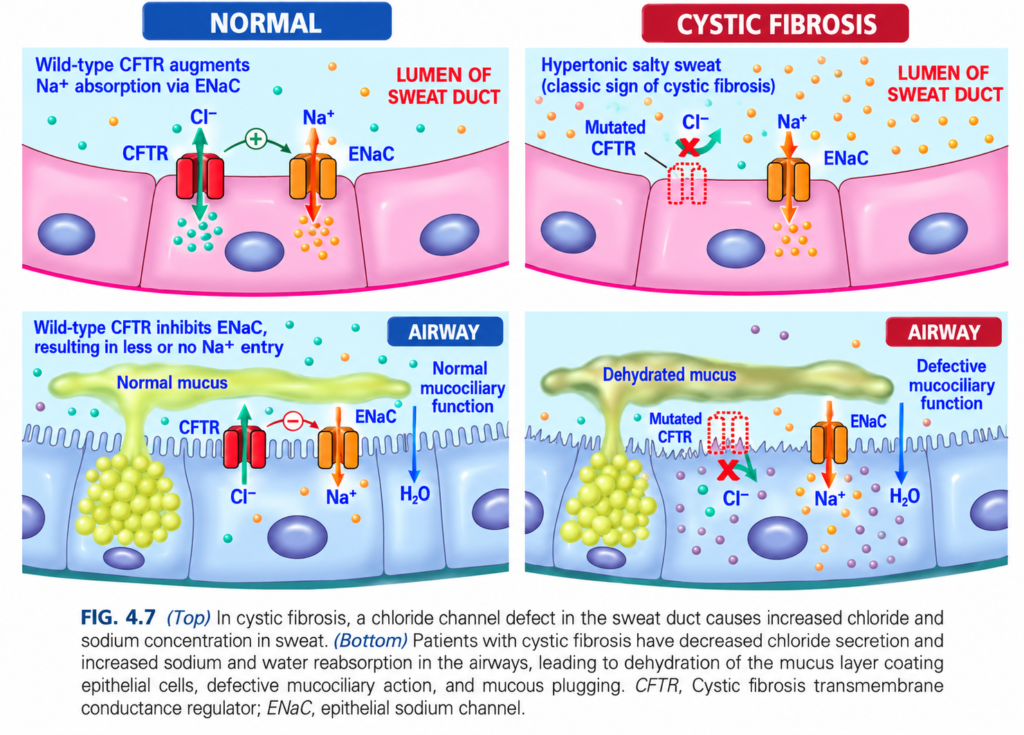
FIG. 4.7 — CYSTIC FIBROSIS: SWEAT DUCT vs AIRWAY
🧠 Simplest idea
The same CFTR defect gives 2 different effects:
Sweat duct → salt cannot be reabsorbed → SALTY SWEAT
Airway → salt + water are pulled into cells → mucus loses water → THICK, DEHYDRATED MUCUS
🔵 LEFT = NORMAL
1️⃣ TOP LEFT — Normal SWEAT DUCT
🎨 Color key
- 🟢 Green dots = Cl⁻ (chloride)
- 🟠 Orange dots = Na⁺ (sodium)
- 🔴 Red channel = CFTR
- 🟧 Orange channel = ENaC
- 🩷 Cells = sweat duct epithelial cells
Arrow-by-arrow
🔴 CFTR takes Cl⁻ from sweat lumen → into cell
Green downward arrow:
Cl⁻ in sweat
⬇️ through CFTR
Cl⁻ reabsorbed
CFTR also helps ENaC absorb Na⁺
Green + sign means:
Normal CFTR → promotes Na⁺ absorption through ENaC
🟠 Na⁺:
Sweat lumen → ENaC → cell
Result
NaCl is removed from sweat
➡️ Final sweat contains less salt.
🧠 Memory
Normal sweat duct = REABSORB SALT
🔴 TOP RIGHT — CYSTIC FIBROSIS in SWEAT DUCT
Dotted red CFTR + ❌ = mutated/nonfunctional CFTR
What happens?
↓ Cl⁻ reabsorption
+
↓ Na⁺ reabsorption
So Na⁺ and Cl⁻ remain in the sweat lumen.
⬆️
Hypertonic / very salty sweat
⭐ This is the classic basis of the sweat chloride test.
Fast memory
CF sweat = cannot TAKE salt back → salt stays in sweat
🔵 BOTTOM LEFT — Normal AIRWAY
Here CFTR behaves differently.
🔴 CFTR secretes Cl⁻ toward airway lumen
Green upward arrow:
Cl⁻ → out into airway surface fluid
This helps keep water at the airway surface.
CFTR also inhibits ENaC
🔴 minus sign between CFTR and ENaC:
CFTR ┤ ENaC
So less Na⁺ is absorbed into airway cells.
Therefore:
Less Na⁺ taken in
+
Cl⁻ secreted out
+
H₂O stays in airway lumen
⬇️
🟢 Normal mucus
= thin and hydrated
⬇️
Normal mucociliary function
Cilia can easily move mucus and trapped microbes out.
🧠 Memory
Normal airway CFTR keeps WATER with mucus.
🔴 BOTTOM RIGHT — CYSTIC FIBROSIS in AIRWAY
Mutated CFTR ❌ causes two major problems.
1️⃣ ↓ Cl⁻ secretion
CFTR cannot properly move chloride into airway lumen.
So:
↓ Cl⁻ in lumen
2️⃣ ENaC loses CFTR inhibition
Normally CFTR restrains ENaC.
But in CF:
CFTR defective → ENaC activity ↑
🟠 Na⁺ moves:
Airway lumen → epithelial cell
Water follows sodium:
Na⁺ inward → H₂O inward
⬇️
Airway surface loses water🟢 Thick yellow-green layer = DEHYDRATED MUCUS
Because water has been removed:
Mucus becomes thick + sticky
⬇️
Defective mucociliary clearance
Cilia cannot move the thick mucus properly.
⬇️
Mucus plugging + trapped bacteria → recurrent lung infections
⭐ MOST IMPORTANT CONTRAST
| Sweat duct | Airway |
|---|---|
| CFTR normally reabsorbs Cl⁻ | CFTR normally secretes Cl⁻ |
| Helps Na⁺ reabsorption | Inhibits ENaC |
| CF → NaCl stays in sweat | CF → Na⁺ + water absorbed into cells |
| Salty sweat | Dry, thick mucus |
🧠 Fastest exam recall
SWEAT
Broken CFTR → ↓ Cl⁻ & Na⁺ reabsorption → ↑ sweat chloride → SALTY SWEAT
AIRWAY
Broken CFTR → ↓ Cl⁻ secretion + ↑ ENaC Na⁺ absorption → water follows Na⁺ → DEHYDRATED THICK MUCUS
🔥 One-line memory
CF = “Salt stays OUT in sweat, but water leaves mucus in airway.
MORPHOLOGY
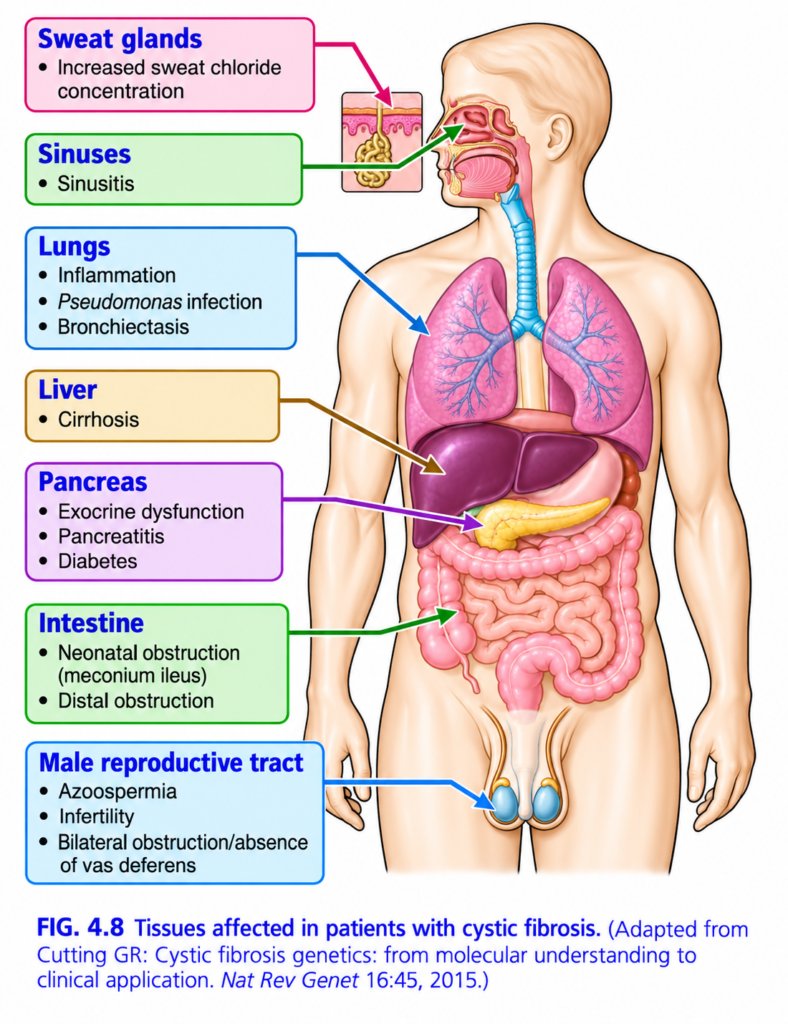
- Patients with cystic fibrosis (CF) can show many different manifestations (Fig. 4.8).
- Pancreatic abnormalities occur in about 85%–90% of patients.
- In mild disease:
- thick mucus accumulates in small pancreatic ducts
- exocrine glands may become mildly dilated
- In more advanced disease:
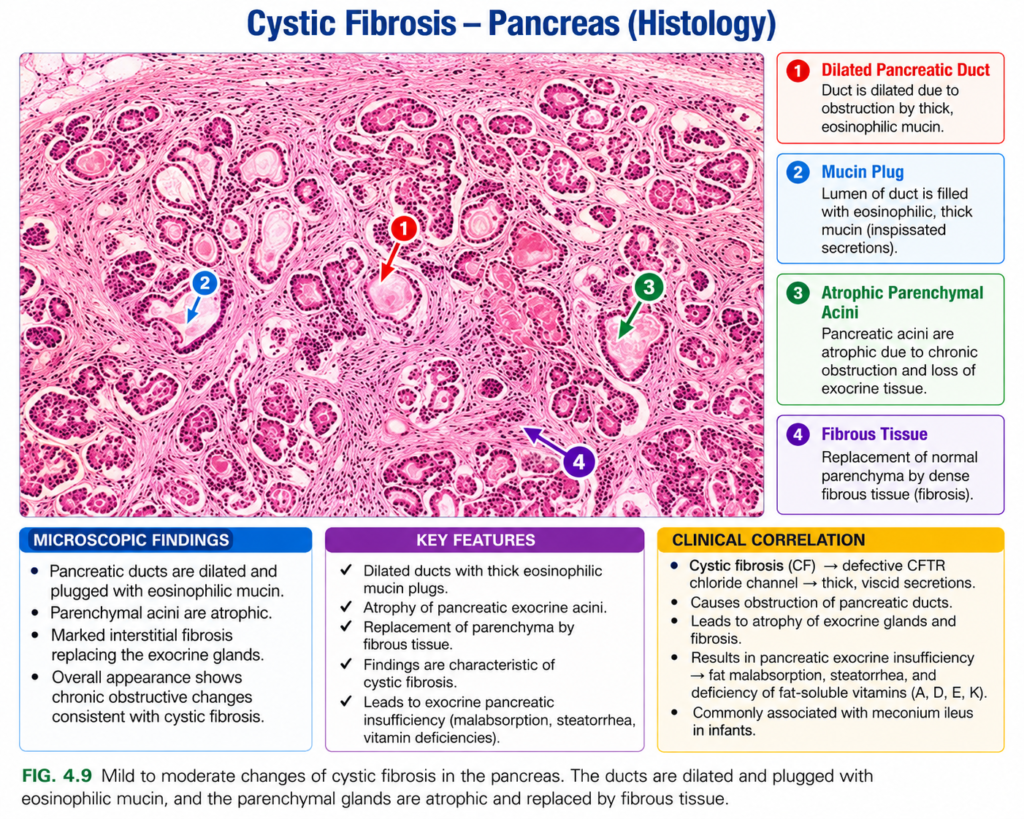
- pancreatic ducts become completely plugged
- → exocrine gland atrophy
- → progressive fibrosis (Fig. 4.9)
- Loss of pancreatic exocrine secretion → poor fat absorption → may cause vitamin A deficiency.
- Vitamin A deficiency may promote squamous metaplasia of pancreatic duct epithelium → may worsen injury from thick mucus.
- In infants, thick mucus may plug the small intestine → small-bowel obstruction called meconium ileus.
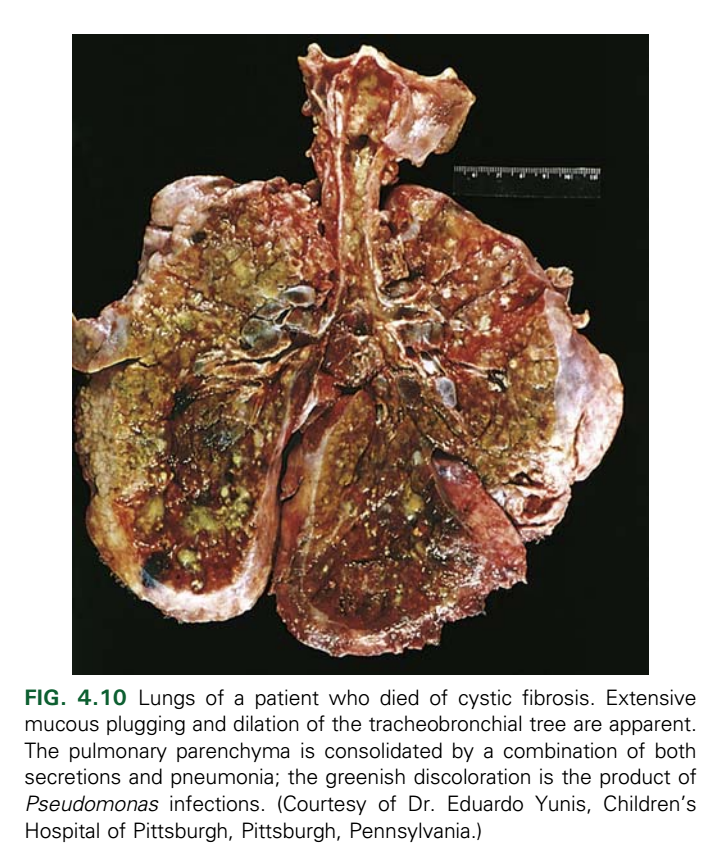
- Pulmonary disease is the most serious complication of CF (Fig. 4.10).
- Lung changes result from:
- airway obstruction by thick mucus from submucosal glands
- superimposed infections
- Bronchioles become distended with thick mucus, with:
- hyperplasia
- hypertrophy
of mucus-secreting cells.
- Recurrent infections → severe chronic bronchitis + bronchiectasis.
- Lung abscesses are also common.
- Common pulmonary pathogens include:
- Staphylococcus aureus
- Pseudomonas aeruginosa
- nontuberculous mycobacteria
- Burkholderia cepacia complex is particularly serious and may cause rapidly severe “cepacia syndrome.”
- In the liver:
- bile canaliculi become plugged with mucin
- ductular proliferation and portal inflammation occur
- hepatic steatosis (fatty liver) is common
- With time → cirrhosis → diffuse hepatic nodularity.
- Severe liver disease occurs in less than 10% of patients.
- In males:
- about 95% of those surviving to adulthood have azoospermia and infertility
- CF may cause atrophy of the vas deferens during development
- → bilateral absence of the vas deferens
- In some males, absent vas deferens may be the only clue to a CFTR mutation.
KEY CONCEPT
- Pancreas → mucus plugging → atrophy + fibrosis → exocrine insufficiency.
- Intestine → thick mucus → meconium ileus.
- Lungs → thick mucus + recurrent infection → bronchiectasis, bronchitis, abscesses.
- Liver → mucin plugging → fatty liver → possible cirrhosis.
- Male reproductive tract → absent vas deferens → azoospermia and infertility.
CONCEPTUAL EXAMPLES
- Pancreatic duct plugged by mucus → enzymes cannot reach intestine → fat malabsorption.
- Infant small bowel blocked by thick mucus → meconium ileus.
- Bronchioles blocked by mucus + bacteria → repeated infection → bronchiectasis.
- Vas deferens absent → sperm cannot enter semen → male infertility.
Clinical Features
- Cystic fibrosis (CF) has highly variable clinical manifestations (Fig. 4.8).
- About 5%–10% of patients present at birth or soon after with meconium ileus.
- Exocrine pancreatic insufficiency occurs in about 85%–90% of patients and is usually associated with two severe CFTR mutations, such as ΔF508/ΔF508.
- About 10%–15% have enough pancreatic function to avoid enzyme replacement:
- one severe + one mild mutation, or
- two mild mutations
- → pancreas-sufficient phenotype.
- Pancreatic insufficiency → poor digestion and absorption of fat and protein → increased loss in stool.
- Malabsorption usually appears during the first year of life:
- large, foul-smelling stools
- abdominal distention
- poor weight gain
- Poor fat absorption → deficiency of fat-soluble vitamins:
- vitamin A
- vitamin D
- vitamin K
- Severe protein malnutrition → hypoproteinemia → generalized edema.
- Persistent diarrhea may cause rectal prolapse in up to 10% of children.
- Patients with the pancreas-sufficient phenotype usually have fewer gastrointestinal problems and show good growth and development.
- Endocrine pancreatic failure (diabetes) is much less common and usually appears late in the disease.
- The major cause of death is cardiorespiratory disease, accounting for about 80% of deaths.
- Important pulmonary complications include:
- chronic cough
- persistent lung infections
- obstructive pulmonary disease
- cor pulmonale
- By age 18 years, about 80% of patients with severe CF harbor Pseudomonas aeruginosa.
- Some also harbor Burkholderia cepacia.
- Excessive antibiotic prophylaxis has contributed to the emergence of antibiotic-resistant Pseudomonas strains.
- Significant liver disease usually develops later, after pulmonary and pancreatic disease.
- With longer survival, liver disease has become the third most common cause of death, after cardiopulmonary and transplant-related complications.
- CF can also present in less typical forms.
- Some patients with recurrent childhood pancreatitis previously labeled idiopathic are now known to have biallelic CFTR variants different from classic CF mutations.
- CF carriers were once considered completely asymptomatic, but they may have an increased lifetime risk of:
- chronic lung disease, especially bronchiectasis
- recurrent sinonasal polyps
- Diagnosis is usually supported by:
- persistently elevated sweat electrolytes
- characteristic sinopulmonary and gastrointestinal findings
- family history
- A classic clue is that the infant’s skin “tastes salty.”
- CFTR gene sequencing is the gold standard for diagnosis.
- Management has improved through:
- stronger antimicrobial therapy
- pancreatic enzyme replacement
- bilateral lung transplantation
- These advances have increased median life expectancy to about 40 years, changing CF from mainly a fatal childhood disease into a chronic adult disease.
- New drugs can improve:
- CFTR folding
- CFTR movement to the cell membrane
- CFTR function
- The long-term effect of these newer molecular treatments on survival was still uncertain in the source text.
KEY CONCEPT
- Severe CFTR mutations → pancreatic insufficiency + severe multisystem disease.
- Milder mutations → pancreas may remain functional.
- Major clinical problems:
malabsorption + recurrent pulmonary infection + progressive cardiorespiratory disease. - Most deaths are due to cardiopulmonary complications.
- Diagnosis → high sweat electrolytes + clinical features + CFTR sequencing.
CONCEPTUAL EXAMPLES
- Pancreatic ducts blocked → digestive enzymes do not reach intestine → fat/protein malabsorption → foul stools + poor growth.
- Poor fat absorption → A, D, K vitamin deficiency.
- Thick airway mucus → repeated infection → chronic lung disease → cor pulmonale.
- Severe CFTR mutation on both alleles → pancreatic insufficiency more likely; milder mutations → pancreas-sufficient phenotype.
Diseases Caused by Mutations in Genes Encoding Enzymes
Phenylketonuria (PKU)
- Phenylketonuria (PKU) is caused by mutations producing severe deficiency of phenylalanine hydroxylase (PAH).
- PAH deficiency → ↑ phenylalanine in blood = hyperphenylalaninemia.
- PKU is an autosomal recessive disorder.
- Classic PKU affects about 1 in 10,000 live-born infants of European descent.
- Infants are usually normal at birth.
- Within weeks:
↑ plasma phenylalanine → impaired brain development. - By about 6 months, severe intellectual disability may become evident if untreated.
- Untreated children may also develop:
- seizures
- other neurologic abnormalities
- light skin and hair
- eczema
- Early restriction of dietary phenylalanine can prevent hyperphenylalaninemia and severe neurologic damage.
- Therefore, newborns are routinely screened for PKU soon after birth.
- Dietary treatment is recommended for life.
- Maternal PKU:
- A woman with PKU may appear healthy after stopping treatment but still have very high phenylalanine levels.
- Phenylalanine or its metabolites cross the placenta → damage the developing fetus.
- Children may develop:
- severe intellectual disability
- microcephaly
- congenital heart disease
- This occurs even though the infants themselves may only be heterozygous carriers.
Pathogenesis
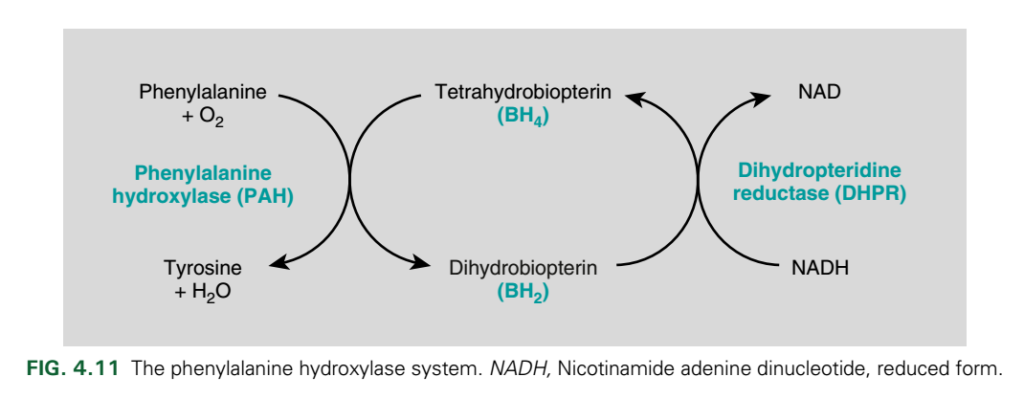
- The basic biochemical defect is inability to convert:
Phenylalanine → Tyrosine
- Normally, PAH converts excess dietary phenylalanine into tyrosine (Fig. 4.11).
- In PKU:
↓ PAH → phenylalanine cannot be converted efficiently → ↑ phenylalanine. - Excess phenylalanine is diverted into alternative shunt pathways.
- These produce abnormal metabolites that are excreted in:
- urine
- sweat
- These metabolites produce the characteristic musty or mousy odor.
- Excess phenylalanine or its metabolites contribute to brain injury.
- Tyrosine is also reduced.
- Because tyrosine is a precursor of melanin:
↓ tyrosine → ↓ melanin → lighter skin and hair. - About 1000 different PAH mutant alleles have been identified.
- Severe PAH deficiency → classic PKU.
- Partial PAH activity → milder disease or benign hyperphenylalaninemia.
- Serum phenylalanine measurement is used to distinguish these conditions.
- In classic PKU, phenylalanine is typically about 5 times normal.
- After biochemical diagnosis, the specific mutation can be identified → allows carrier testing in family members.
- Phenylalanine ammonia lyase (PAL) therapy has been studied to reduce phenylalanine by converting it into ammonia and other metabolites.
KEY CONCEPT
- PKU = autosomal recessive PAH deficiency → phenylalanine cannot become tyrosine → hyperphenylalaninemia.
- Main consequences:
brain injury + musty odor + reduced pigmentation. - Early dietary phenylalanine restriction prevents severe neurologic damage.
- Maternal PKU → high maternal phenylalanine damages the fetus.
CONCEPTUAL EXAMPLES
- PAH absent → phenylalanine builds up → brain development is impaired.
- Phenylalanine enters shunt pathways → abnormal metabolites → musty odor.
- ↓ Tyrosine → ↓ melanin → light skin and hair.
- Early newborn diagnosis + low-phenylalanine diet → major complications can be prevented.