


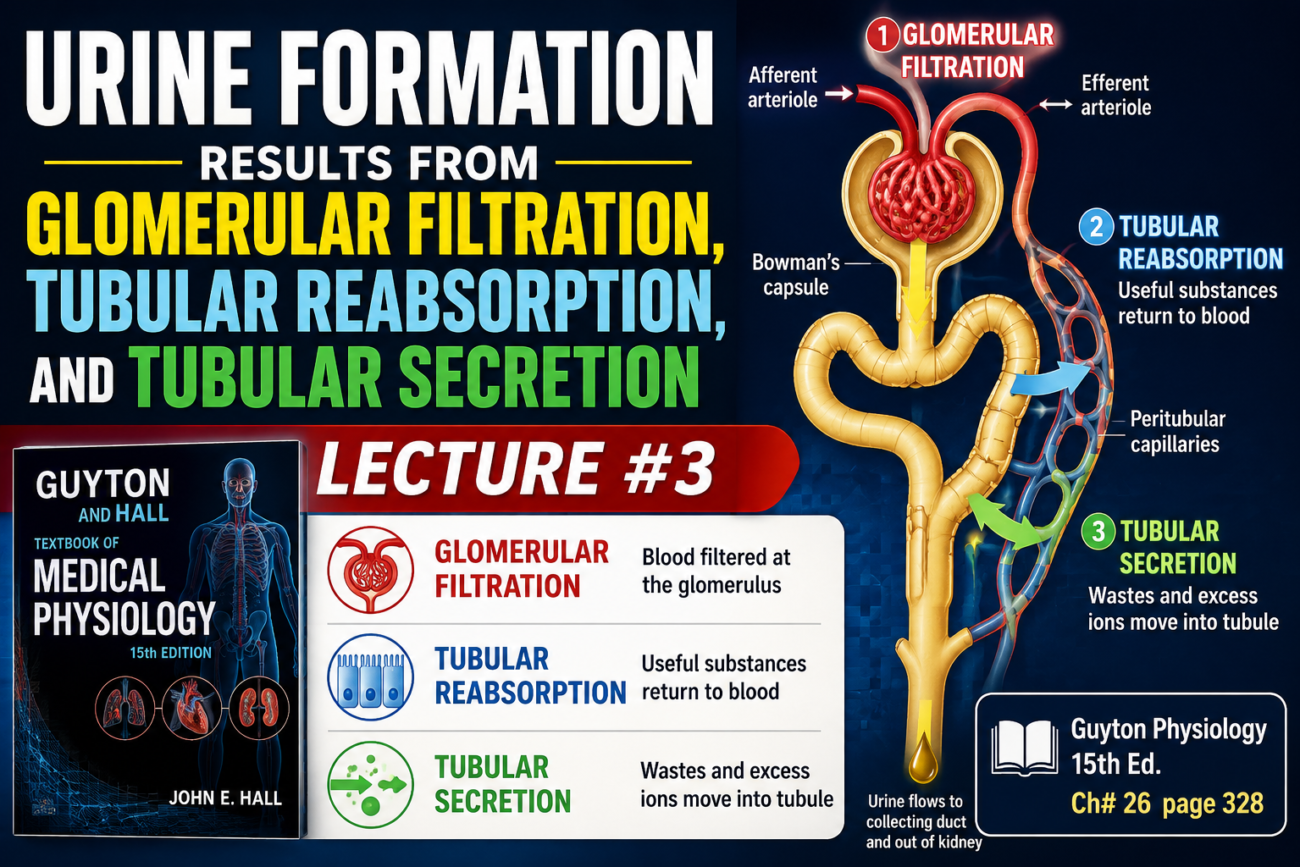
BASIC RENAL PROCESSES: FILTRATION, REABSORPTION, SECRETION, AND EXCRETION
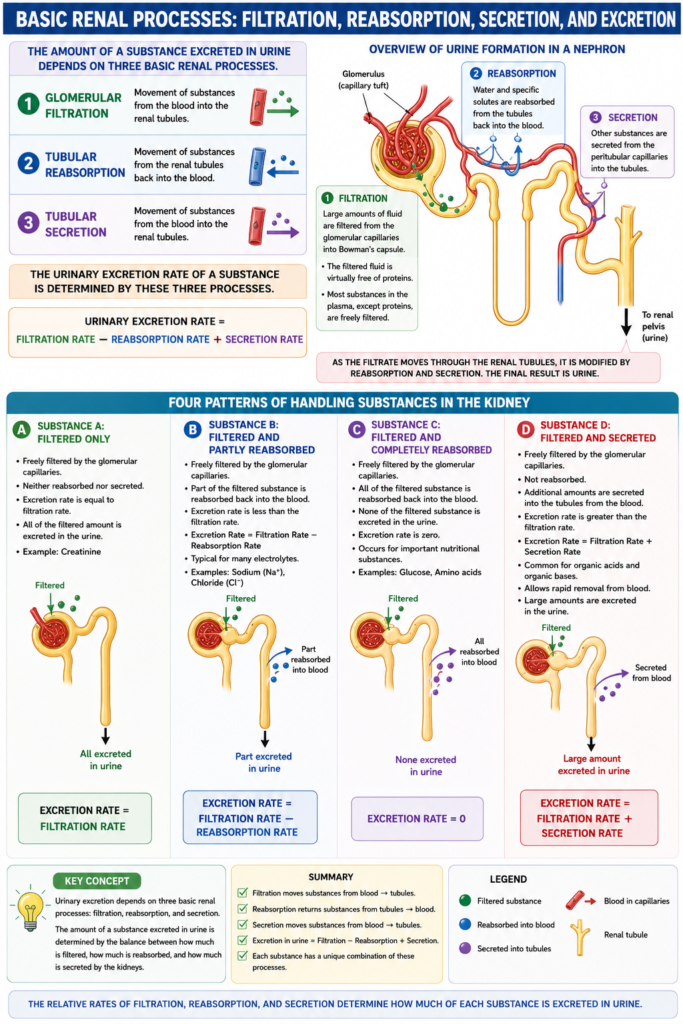
- The amount of a substance excreted in urine depends on three basic renal processes.
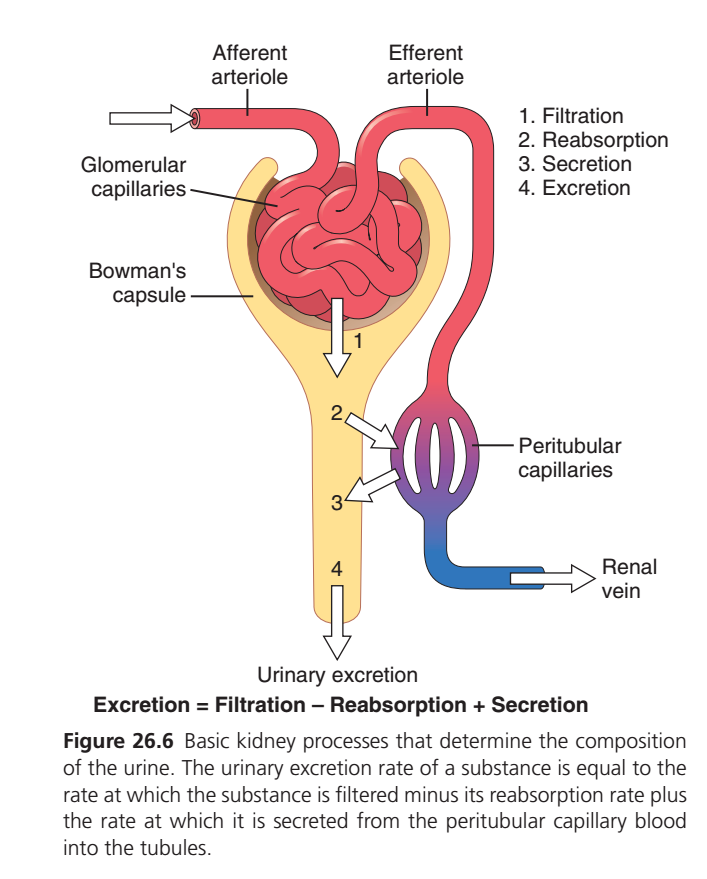
- These processes are glomerular filtration, tubular reabsorption, and tubular secretion.
- Glomerular filtration is the movement of substances from the blood into the renal tubules.
- Tubular reabsorption is the movement of substances from the renal tubules back into the blood.
- Tubular secretion is the movement of substances from the blood into the renal tubules.
- The urinary excretion rate of a substance is determined by these three processes.
- Urinary Excretion Rate = Filtration Rate − Reabsorption Rate + Secretion Rate.
- Urine formation begins when a large amount of fluid is filtered from the glomerular capillaries into Bowman’s capsule.
- The filtered fluid is virtually free of proteins.
- Most substances in the plasma, except proteins, are freely filtered.
- Therefore, the concentration of these substances in the glomerular filtrate is almost the same as in the plasma.
- As the filtrate moves through the renal tubules, it is modified.
- Water and specific solutes may be reabsorbed back into the blood.
- Other substances may be secreted from the peritubular capillaries into the tubules.
SUBSTANCE A: FILTERED ONLY
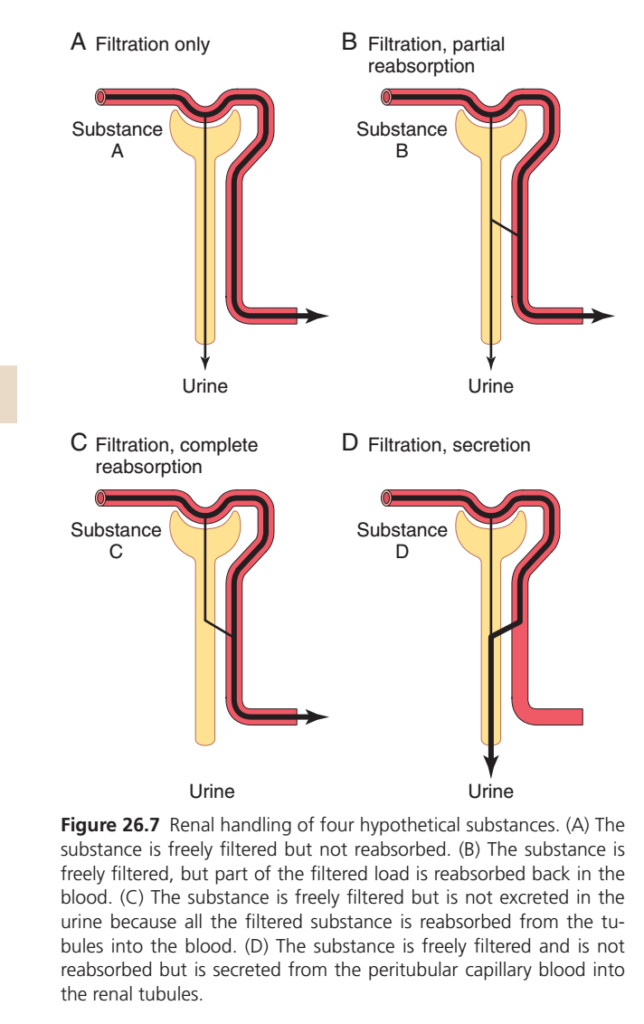
- The substance is freely filtered by the glomerular capillaries.
- It is neither reabsorbed nor secreted.
- Its excretion rate is equal to its filtration rate.
- All of the filtered amount is excreted in the urine.
- Creatinine is handled approximately in this manner.
SUBSTANCE B: FILTERED AND PARTLY REABSORBED
- The substance is freely filtered by the glomerular capillaries.
- Part of the filtered substance is reabsorbed back into the blood.
- The excretion rate is less than the filtration rate.
- Excretion Rate = Filtration Rate − Reabsorption Rate.
- This pattern is typical for many electrolytes.
- Examples include sodium and chloride ions.
SUBSTANCE C: FILTERED AND COMPLETELY REABSORBED
- The substance is freely filtered by the glomerular capillaries.
- All of the filtered substance is reabsorbed back into the blood.
- None of the filtered substance is excreted in the urine.
- The excretion rate is zero.
- This pattern occurs for important nutritional substances.
- Examples include glucose and amino acids.
SUBSTANCE D: FILTERED AND SECRETED
- The substance is freely filtered by the glomerular capillaries.
- It is not reabsorbed.
- Additional amounts of the substance are secreted into the tubules from the blood.
- The excretion rate is greater than the filtration rate.
- Excretion Rate = Filtration Rate + Secretion Rate.
- This pattern commonly occurs for organic acids and organic bases.
- This allows these substances to be rapidly removed from the blood.
- Large amounts are excreted in the urine.
- Each substance in the plasma undergoes a specific combination of filtration, reabsorption, and secretion.
- The urinary excretion rate of each substance depends on the relative rates of these three renal processes.
KEY CONCEPT
Urinary excretion depends on three basic renal processes: filtration, reabsorption, and secretion. The amount of a substance excreted in urine is determined by the balance between how much is filtered, how much is reabsorbed, and how much is secreted by the kidneys.
FILTRATION, REABSORPTION, AND SECRETION OF DIFFERENT SUBSTANCES
- In urine formation, tubular reabsorption is generally more important than tubular secretion.
- Tubular secretion is still important for controlling the excretion of potassium ions, hydrogen ions, and some other substances.
- Most metabolic waste products must be removed from the blood.
- These waste products include urea, creatinine, uric acid, and urates.
- These substances are poorly reabsorbed by the renal tubules.
- Because they are poorly reabsorbed, they are excreted in large amounts in the urine.
- Many foreign substances and drugs are also poorly reabsorbed.
- In addition, these substances are often secreted from the blood into the tubules.
- Therefore, their excretion rates are high.
- Some electrolytes are highly reabsorbed by the renal tubules.
- These electrolytes include sodium ions, chloride ions, and bicarbonate ions.
- Because they are highly reabsorbed, only small amounts appear in the urine.
- Certain nutritional substances are completely reabsorbed.
- Examples include glucose and amino acids.
- Although large amounts of glucose and amino acids are filtered, they normally do not appear in the urine.
- Glomerular filtration, tubular reabsorption, and tubular secretion are regulated according to the body’s needs.
- When there is excess sodium in the body, the filtration of sodium usually increases slightly.
- At the same time, a smaller fraction of filtered sodium is reabsorbed.
- This increases sodium excretion in the urine.
- When there is excess potassium in the body, urinary potassium excretion increases.
- This occurs mainly by increasing tubular secretion of potassium.
- Different substances are regulated by different combinations of filtration, reabsorption, and secretion.
- For most substances, filtration and reabsorption rates are much greater than excretion rates.
- Therefore, small changes in filtration or reabsorption can cause large changes in urinary excretion.
- For example, if the glomerular filtration rate increases by only 10%, urine volume can increase greatly if reabsorption remains unchanged.
- An increase in GFR from 180 L/day to 198 L/day could increase urine volume from 1.5 L/day to 19.5 L/day if tubular reabsorption stays constant.
- In normal conditions, glomerular filtration, tubular reabsorption, and tubular secretion work together in a coordinated manner.
- This coordination produces the required changes in renal excretion.
KEY CONCEPT
Renal excretion depends on the balance between filtration, reabsorption, and secretion. Waste products are usually poorly reabsorbed and are excreted, electrolytes are highly reabsorbed, and nutrients such as glucose and amino acids are completely reabsorbed. Even small changes in filtration or reabsorption can produce large changes in urinary excretion.
WHY ARE LARGE AMOUNTS OF SOLUTES FILTERED AND THEN REABSORBED BY THE KIDNEYS?
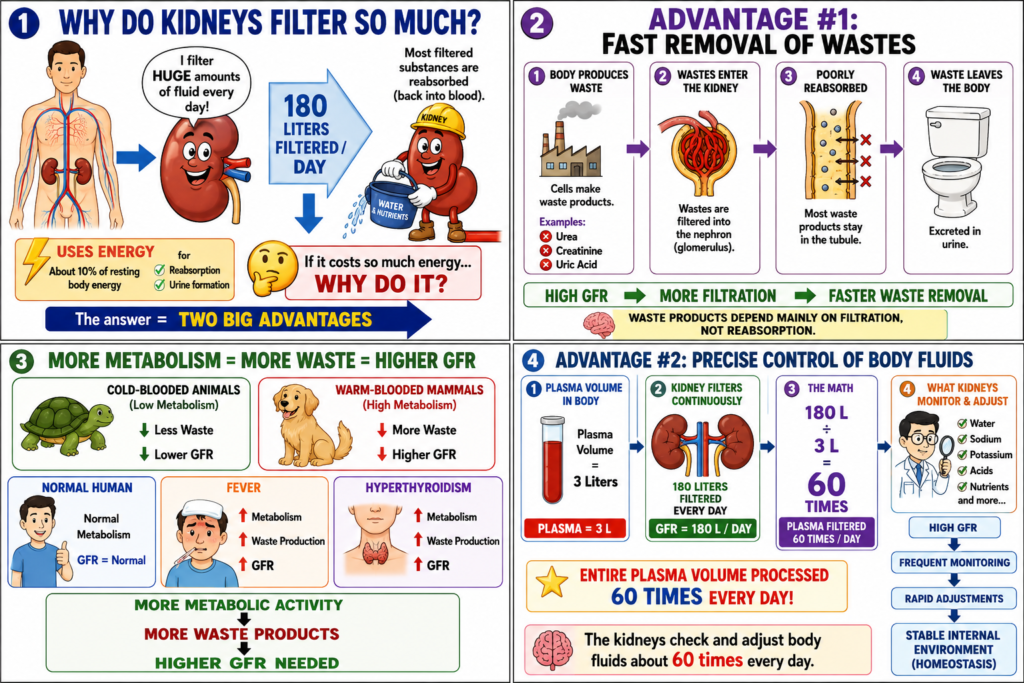
- The kidneys filter very large amounts of water and solutes every day.
- Most of these filtered substances are then reabsorbed back into the blood.
- Reabsorbing filtered substances requires a large amount of energy.
- About 10% of the body’s total resting energy expenditure is used for reabsorption and urine formation.
- Despite this energy cost, filtering large amounts of fluid provides important advantages.
- One major advantage is the rapid removal of waste products from the body.
- Most metabolic waste products are poorly reabsorbed by the renal tubules.
- Therefore, their excretion depends mainly on glomerular filtration.
- A high glomerular filtration rate (GFR) allows these waste products to be removed quickly.
- GFR is generally proportional to body size and metabolic rate.
- Warm-blooded mammals usually have a higher GFR than cold-blooded animals.
- Animals with higher metabolic rates produce more waste products.
- Therefore, they require a higher GFR for efficient waste removal.
- In humans, larger body size is associated with a higher GFR.
- Conditions that increase metabolic rate, such as fever and hyperthyroidism, are also associated with an increased GFR.
- An increased GFR helps remove the extra metabolic waste products produced under these conditions.
- A second important advantage of a high GFR is precise regulation of body fluids.
- The kidneys continuously filter and process body fluids.
- The total plasma volume in the body is about 3 liters.
- The normal GFR is about 180 liters per day.
- Therefore, the entire plasma volume can be filtered and processed about 60 times each day.
- This repeated filtration allows the kidneys to monitor body fluids continuously.
- It also allows the kidneys to regulate the volume and composition of body fluids rapidly and accurately.
KEY CONCEPT
Although filtering and reabsorbing large amounts of fluid requires significant energy, a high GFR provides two major advantages: rapid removal of waste products and precise control of body fluid volume and composition. The kidneys can filter the entire plasma volume about 60 times each day, allowing efficient homeostatic regulation.
SUMMARY
Urine formation is the process by which the kidneys remove waste products, regulate body fluids, and maintain the balance of electrolytes in the body. This process depends on three important mechanisms: glomerular filtration, tubular reabsorption, and tubular secretion. The amount of any substance excreted in the urine is determined by the balance between these three processes.
The first step is glomerular filtration, in which water and small dissolved substances are filtered from the blood into Bowman’s capsule. Most substances such as glucose, amino acids, electrolytes, and urea are freely filtered, while blood cells and most proteins remain in the bloodstream. The filtered fluid then enters the renal tubules for further processing.
The second step is tubular reabsorption, where useful substances are transported from the tubules back into the blood. The kidneys reabsorb most of the filtered water, electrolytes, glucose, and amino acids so that these essential substances are not lost in the urine. In fact, reabsorption is quantitatively the most important process in urine formation.
The third step is tubular secretion, in which certain substances are actively moved from the blood into the renal tubules. This process helps remove excess potassium, hydrogen ions, drugs, and other unwanted substances from the body. Tubular secretion is especially important for maintaining electrolyte and acid-base balance.
Different substances are handled differently by the kidneys. Some substances, such as creatinine, are filtered and excreted with little or no reabsorption. Electrolytes like sodium and chloride are filtered and partially reabsorbed. Nutrients such as glucose and amino acids are normally completely reabsorbed and therefore do not appear in urine. Other substances, including many drugs and organic acids, are filtered and secreted, allowing their rapid elimination from the body.
Although the kidneys filter about 180 liters of fluid each day, only about 1.5 liters of urine are produced because most of the filtered fluid is reabsorbed. This high filtration rate allows waste products to be removed rapidly and enables the kidneys to continuously monitor and regulate the body’s fluid composition. The entire plasma volume is filtered many times each day, allowing precise control of water balance, electrolyte concentration, and overall homeostasis.
In summary, urine formation results from the coordinated actions of glomerular filtration, tubular reabsorption, and tubular secretion. Together, these processes remove metabolic wastes, conserve essential nutrients, regulate body fluid balance, and maintain a stable internal environment necessary for normal body function.
