


Body Fluid Compartments Overview
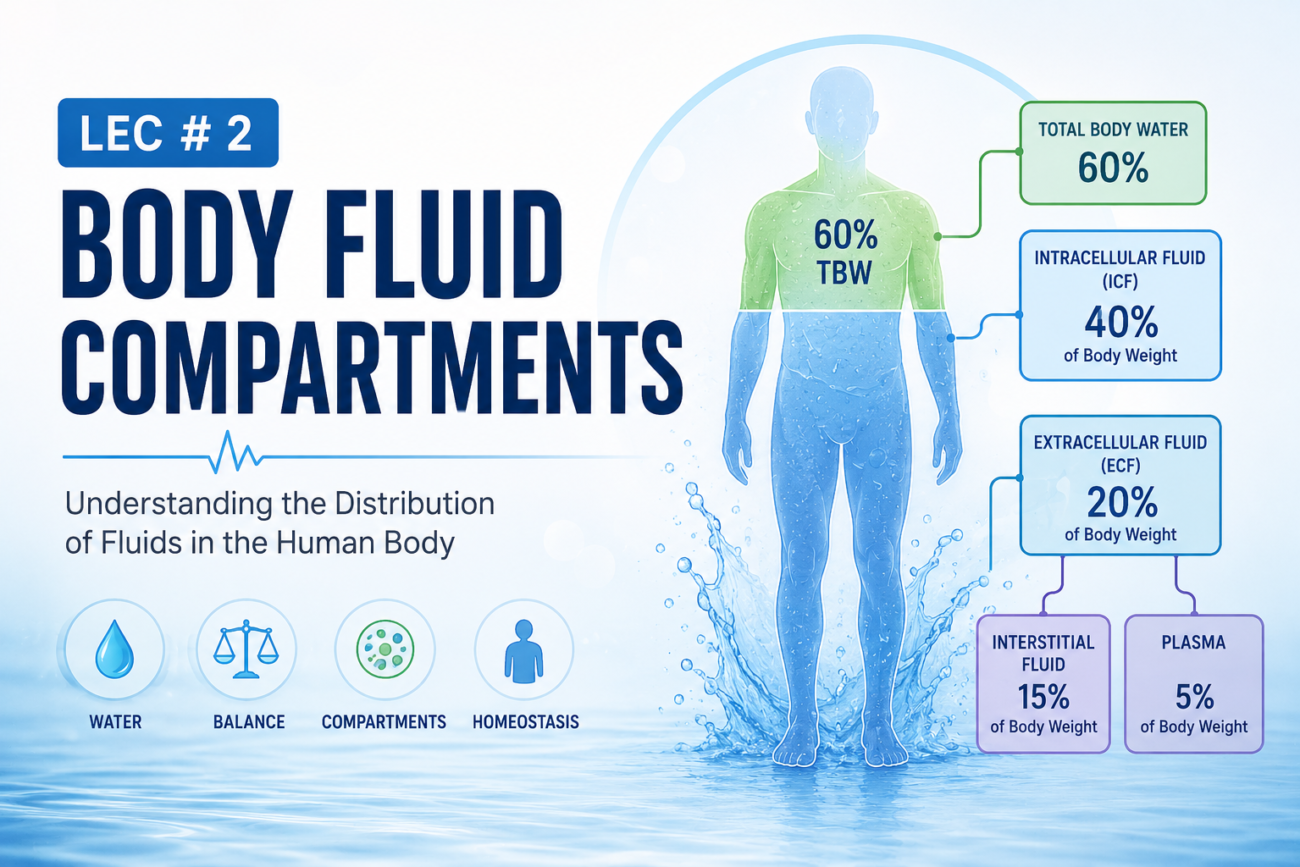
- Water in the body is called total body fluid.
- It is mainly divided into two major compartments:
- Intracellular Fluid (ICF)
- Extracellular Fluid (ECF)
Key Concept:
👉 Body fluid is mainly divided into inside-cell fluid (ICF) and outside-cell fluid (ECF).
👉 ECF consists of interstitial fluid and blood plasma.
Transcellular Fluid (Special Body Fluid)
- A small fluid compartment in the body is called transcellular fluid.
- It is a specialized part of extracellular fluid (ECF).
Examples of Transcellular Fluid
- Synovial fluid → around joints
- Peritoneal fluid → in the abdominal cavity
- Pericardial fluid → around the heart
- Intraocular fluid → inside the eye
- Cerebrospinal fluid (CSF) → around the brain and spinal cord
Important Point
- It is usually considered part of the extracellular fluid.
- Its composition may sometimes be different from plasma and interstitial fluid.
Volume
- Total transcellular fluid in the body = about 1–2 liters
Key Concept
Transcellular Fluid = Specialized extracellular fluid found in specific body spaces (joints, eye, heart, abdomen, brain, and spinal cord).
Total Body Water in an Adult Male
- In a 70-kg adult man, total body water is about 60% of body weight.
- This equals approximately 42 liters of water.
Factors Affecting Total Body Water
- Age
- Muscle mass
- Amount of body fat
Total Body Water in Women and Babies
Women
- Women usually have more body fat than men.
- Therefore, their total body water is about 50% of body weight.
- This percentage can vary depending on:
- Age
- Muscle mass
- Body fat percentage
Premature and Newborn Babies
- Total body water is 70–75% of body weight.
- Babies have a much higher water content than adults.
Important Concept
The amount of body water is not the same for everyone.
Factors That Affect Total Body Water
- Age
- Sex (male or female)
- Muscle mass
- Body fat percentage
Quick Comparison
| Group | Total Body Water |
|---|---|
| Adult Male | ~60% of body weight |
| Adult Female | ~50% of body weight |
| Premature/Newborn Baby | 70–75% of body weight |
Key Point
- More muscle = More water
- More fat = Less water
- Babies have the highest percentage of body water.
Body Weight and Body Fluid Compartments
Increase in Average Body Weight
- In many countries, average body weight and body fat have increased over the last 30 years.
Average Adult Body Weight (United States)
- Adult men (>20 years): approximately 90 kg (198 lb)
- Adult women (>20 years): approximately 77.5 kg (171 lb)
Why Is This Important?
- Many physiology examples use a 70-kg man as the standard model.
- However, many people weigh more than 70 kg.
- Therefore, body fluid compartment volumes must be adjusted according to actual body weight.
Key Concept
- Body fluid volumes are related to body size and composition.
- Higher body weight → Different total body fluid amounts
- Calculations based on a 70-kg man may not accurately represent everyone.
Take-Home Message
When studying body fluid compartments, remember that real-life values vary with body weight, body fat, age, and sex, so standard 70-kg calculations often need adjustment.
Intracellular Fluid (ICF) Compartment
What is Intracellular Fluid?
- Intracellular fluid (ICF) is the fluid inside the body’s cells.
- It is found within the trillions of cells that make up the body.
Amount of Intracellular Fluid
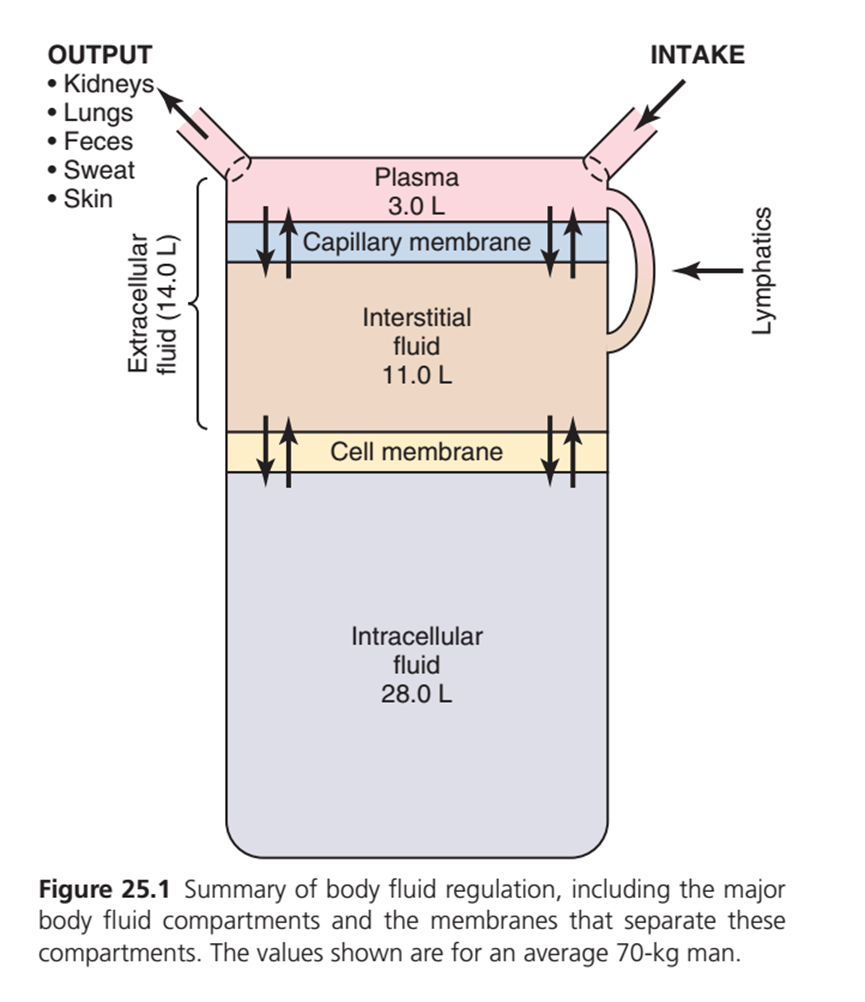
- Total body water in an average 70-kg person = 42 liters
- About two-thirds of this water is inside cells.
- Therefore, intracellular fluid = 28 liters
Percentage of Body Weight
- Intracellular fluid makes up about 40% of total body weight.
Easy Formula
Total Body Water (42 L) × 2/3 = Intracellular Fluid (28 L)
Key Concept
- Intracellular Fluid (ICF) = Fluid inside cells
- Volume = 28 L
- About 2/3 of total body water
- About 40% of body weight in an average person.
ICF Composition Concept
- Inside Each Cell: Each cell has its own mixture of substances (fluid).
- The exact composition can vary slightly from cell to cell.
- General similarity exists across all cells and species.
Important Idea
- The cell fluid composition is highly conserved in nature.
Why It Matters
- Because all cells have similar internal fluid composition:
- The intracellular fluid (ICF) of all cells can be treated as one large compartment.
Key Concept
All cell fluids together = One large intracellular fluid compartment
Even though cells are individual units, their internal fluid is functionally similar. So, in physiology, we consider ICF as a single unified body fluid space.
Extracellular Fluid (ECF) Compartment
What is Extracellular Fluid?
- All body fluid outside the cells is called extracellular fluid (ECF).
Total Amount
- ECF = about 20% of body weight
- In a 70-kg man = about 14 liters
Main Parts of ECF
1. Interstitial Fluid
- Makes up more than 3/4 of ECF
- About 11 liters
- Fluid present between the cells
