


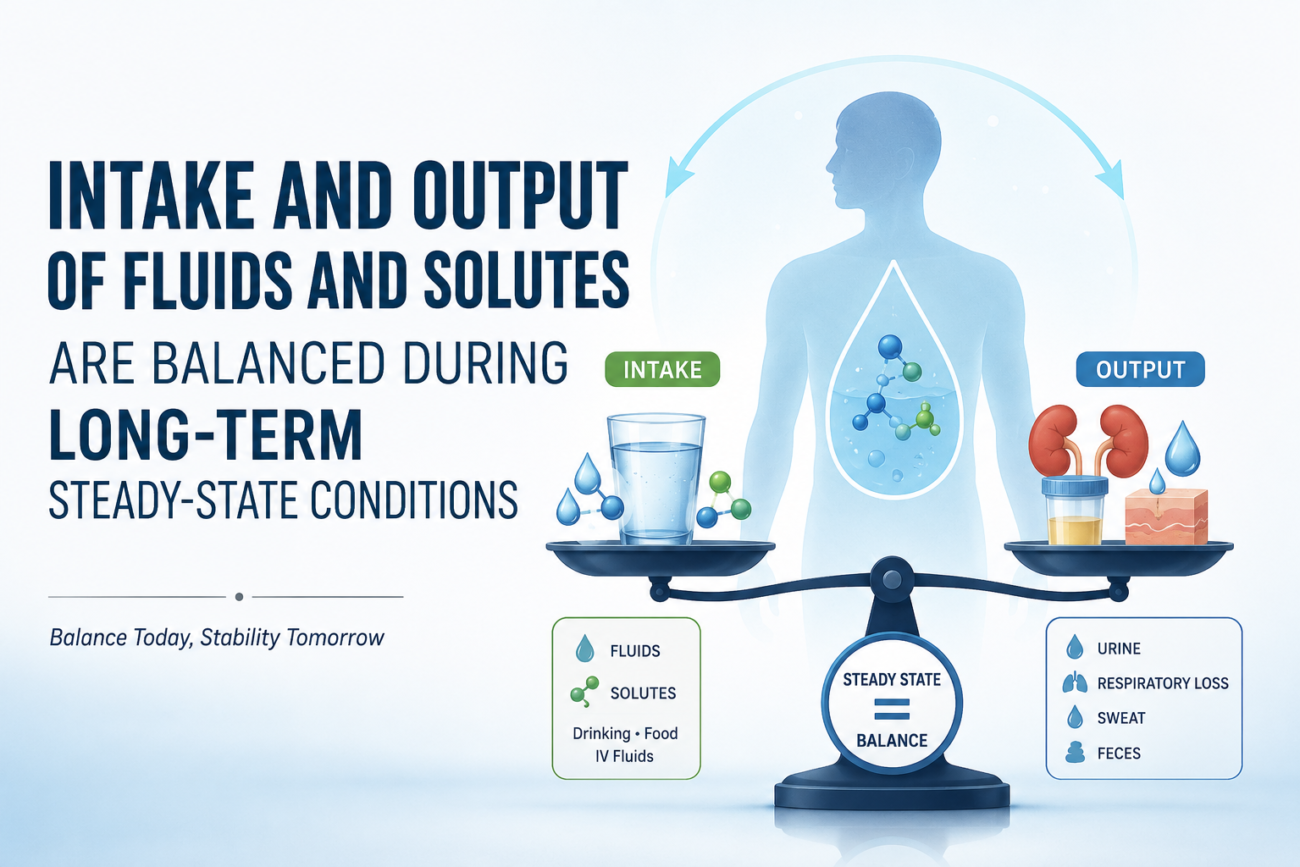
INTAKE AND OUTPUT OF FLUIDS AND SOLUTES ARE BALANCED DURING LONG-TERM STEADY-STATE CONDITIONS
- Body fluids stay almost constant in the body.
- This is surprising because fluid and solutes are always moving in and out.
- They also shift between different body compartments.
- Fluid and electrolytes entering the body are not fixed; they change a lot.
- The body must remove the same amount that it takes in.
- This balance keeps fluid volume and electrolytes normal.
DAILY INTAKE OF WATER
- · Water enters the body from two main sources.
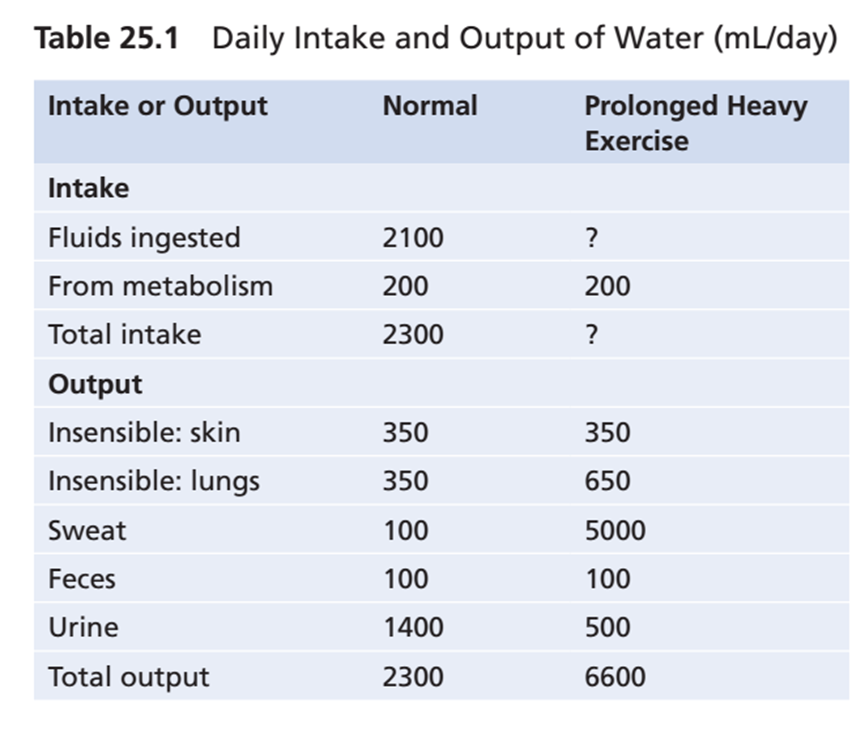
- · First, we drink water and get water from food (~2100 mL/day).
- · Second, the body makes a small amount of water by metabolism (~200 mL/day).
- · Total daily water intake is about 2300 mL/day.
- · Water intake can change a lot in different people and situations.
- · It depends on climate, habits, and physical activity.
Daily Loss of Body Water
- The body loses water continuously in ways we cannot control.
- Water is lost through breathing (respiratory tract).
- Water is also lost through the skin by evaporation.
- Together, this is about 700 mL/day under normal conditions.
- This is called insensible water loss.
- It is called “insensible” because we do not feel or notice it, even though it happens all the time.
- The skin loses water continuously by diffusion (~300–400 mL/day).
- This happens even without sweating.
- It also occurs in people without sweat glands.
- The cornified layer of skin reduces this water loss.
- This layer contains cholesterol and acts as a barrier.
- If this layer is destroyed (e.g., severe burns), water loss increases greatly.
- In burns, loss may rise 10 times (about 3–5 L/day).
- Therefore, burn patients need large amounts of IV fluids to replace this loss.
- Water is continuously lost from the lungs during breathing.
- This loss is about 300–400 mL/day and is called insensible water loss.
- Inspired air becomes fully humidified inside the respiratory tract.
- It reaches a vapor pressure of about 47 mm Hg before being exhaled.
- Incoming air usually has lower water vapor pressure than this.
- So, water moves from the body into the air and is lost.
- In cold weather, air is very dry (low vapor pressure).
- This increases water loss from the lungs.
- That is why the throat and airways feel dry in cold weather.
Fluid Loss in Sweat.
- Water loss through sweating varies greatly with activity and temperature.
- Normally, sweat loss is about 100 mL/day.
- In hot weather or heavy exercise, it can rise to 1–2 L/hour.
- This can quickly dehydrate the body if not replaced.
- Therefore, the body increases thirst to stimulate water intake and maintain balance.
Water Loss by the Kidneys
- Most body water is lost through urine, which is controlled by the kidneys.
- The kidneys adjust urine output through multiple regulatory mechanisms.
- This control is essential to maintain a stable volume and composition of body fluids (homeostasis).
- Many clinical problems occur when these control systems fail.
- In long-term balance (steady state), intake and output of water and solutes remain equal.
- This keeps body fluids stable despite continuous exchange with the environment and between body compartments.
Daily Water Intake
The average daily water intake is approximately 2300 mL/day:
- ~2100 mL from drinks and food
- ~200 mL produced through metabolism
Water intake varies according to climate, personal habits, and activity level.
Daily Water Loss
Daily water loss occurs through:
- Insensible loss (skin and lungs)
- Feces
- Urine (major route)
Insensible water loss is continuous and cannot be easily regulated by the body.
Role of the Kidneys in Water Balance
- The kidneys are the primary regulators of water balance.
- Urine output can vary significantly depending on hydration status:
Dehydration: Approximately 0.5 L/day
High Water Intake: Up to 20 L/day
Electrolyte Balance
- Electrolyte intake varies greatly, similar to water intake.
- Important electrolytes include:
- Sodium (Na+)
- Chloride (Cl–)
- Potassium (K+)
- Sodium intake may range from 20 mEq/day to 300–500 mEq/day among different individuals.
Homeostatic Regulation by the Kidneys
- The kidneys regulate body fluid and electrolyte balance by adjusting excretion.
- Excretion is matched closely to intake to maintain internal stability.
- The kidneys also compensate for abnormal fluid and electrolyte losses during disease conditions.
- These regulatory mechanisms are discussed in greater detail in kidney physiology.
Key Point: The kidneys are the body’s main regulators of water and electrolyte balance. By adjusting urine volume and composition, they maintain homeostasis despite large variations in daily intake and losses.
Summary
The human body keeps its water and electrolytes in balance every day. Even though fluids and salts are always moving in and out, the total amount stays almost the same. This balance is very important for good health.
Water enters the body in two ways. We get most of it from drinks and food. A small amount is also made inside the body during metabolism. On average, a person takes in about 2300 milliliters of water daily. The amount can change depending on the weather, activity, and habits.
Water leaves the body through several routes. Some loss is invisible, called insensible loss. This happens through the skin and lungs and totals about 700 milliliters per day. We lose more water when we sweat, especially in hot weather or during exercise. A small amount goes out in feces. The largest amount of water leaves through urine. The kidneys control urine output very carefully. They can make less urine when the body needs to save water and more when there is extra.
The kidneys are the main organs that maintain balance. They adjust the amount of water and salts removed so that intake equals output. This keeps body fluids stable.
Examples:
In hot weather, a person working outside sweats a lot and feels thirsty. Drinking more water helps restore balance. In cases of severe diarrhea, a person can lose several liters quickly and needs fast treatment to avoid dehydration. Burn patients lose extra water through damaged skin and need more fluids through drips.
In this way, the body works hard to stay balanced for healthy living.
By: Dr Sheen CEO
