


LEARNING OBJECTIVES
By the end of this topic, students should be able to:
- Explain the basic functions of synapses in the central nervous system.
- Differentiate between chemical and electrical synapses.
- Describe the role of neurotransmitters and gap junctions in synaptic transmission.
- Explain one-way conduction in chemical synapses.
INTRODUCTION
Synapses are the sites where nerve signals pass from one neuron to another in the central nervous system. During synaptic transmission, a nerve impulse may be blocked, repeated, or combined with other impulses. Synapses are mainly of two types: chemical and electrical. Chemical synapses use neurotransmitters and transmit signals in one direction, whereas electrical synapses allow direct movement of ions between connected cells and can transmit signals in both directions.
- Information in the central nervous system (CNS) is mainly transmitted as nerve action potentials, also called nerve impulses.
- These nerve impulses pass through a series of neurons, from one neuron to the next.
- When an impulse reaches the next neuron, it may:
- Be blocked → the impulse does not pass to the next neuron.
- Change from one impulse into repeated impulses → one impulse produces several impulses.
- Combine with impulses from other neurons → several impulses are integrated together.
- This combination can produce complex patterns of nerve impulses in the next neurons.
- All these functions are called synaptic functions of neurons.
Easiest Example: Several impulses are integrated together = many nerve signals coming from different neurons are combined together in one neuron to produce a final response.
Signal from neuron A + signal from neuron B + signal from neuron C → all combine in the next neuron → the next neuron decides what signal to send forward.
TYPES OF SYNAPSES—CHEMICAL AND ELECTRICAL
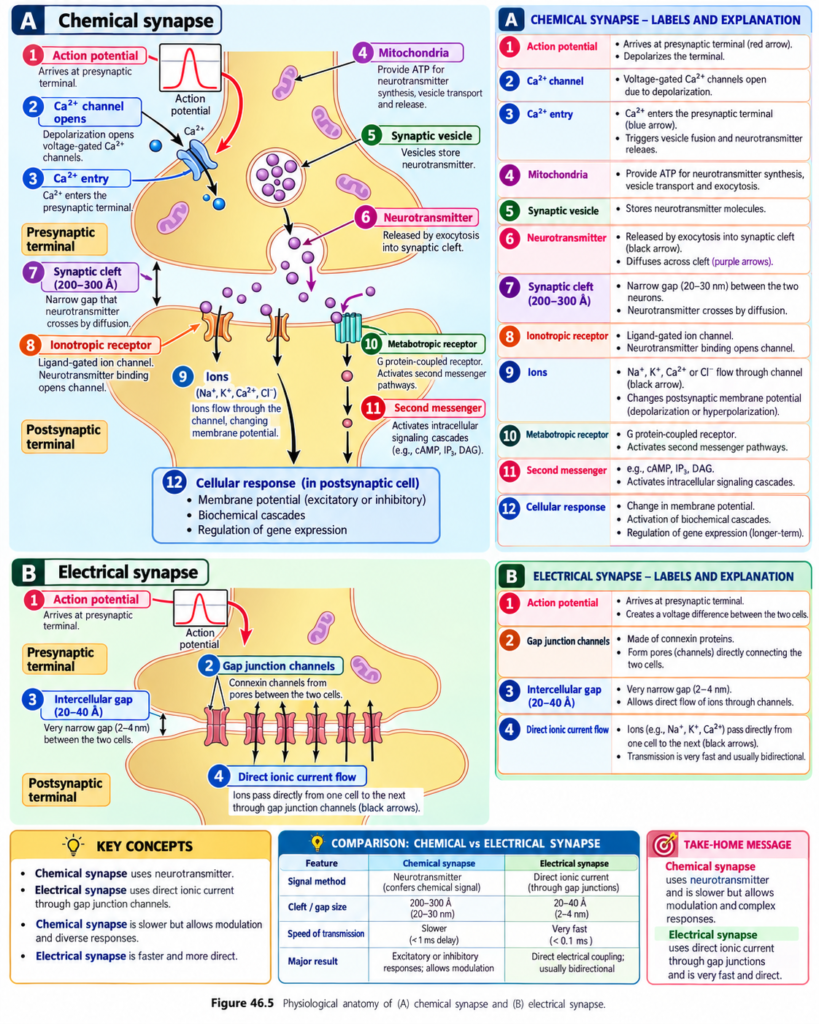
- There are two major types of synapses (Fig. 46.5):
- Chemical synapses
- Electrical synapses
- Most synapses that transmit signals in the human central nervous system are chemical synapses.
- In a chemical synapse:
- The first neuron releases a chemical substance from its nerve ending.
- This chemical is called a neurotransmitter or transmitter substance.
- The neurotransmitter then acts on receptor proteins in the membrane of the next neuron.
- It may:
- Excite the next neuron
- Inhibit the next neuron
- Change its sensitivity in another way (Video 46.1)
- More than 50 important neurotransmitters have been discovered.
- Some well-known neurotransmitters are:
- Acetylcholine
- Norepinephrine
- Epinephrine
- Histamine
- Gamma-aminobutyric acid (GABA)
- Glycine
- Serotonin
- Dopamine
- Glutamate
- In an electrical synapse:
- The cytoplasm of one cell is directly connected with the cytoplasm of the next cell.
- These connections are made by groups of ion channels called gap junctions.
- Gap junctions allow ions to move freely from one cell into the next cell.
- These junctions were discussed in Chapter 4.
- Through gap junctions and similar junctions, action potentials pass:
- From one smooth muscle fiber to the next in visceral smooth muscle (Chapter 8)
- From one cardiac muscle cell to the next in cardiac muscle (Chapter 9)
- Although most brain synapses are chemical, chemical and electrical synapses can exist together and interact in the central nervous system.
- Electrical synapses can transmit signals in both directions.
- This bidirectional transmission helps coordinate the activity of large groups of connected neurons.
- Electrical synapses can help detect when several connected neurons develop subthreshold depolarizations at the same time.
- This can:
- Increase neuronal sensitivity
- Help a group of connected neurons fire together at the same time
- Some hormone-secreting neurons in the hypothalamus are also connected by electrical synapses.
- These electrical connections allow the neurons to:
- Fire action potentials at about the same time
- Produce a burst of hormone secretion into the circulation
Easiest Example:
Chemical synapse: First neuron releases a neurotransmitter → neurotransmitter acts on the next neuron.
Electrical synapse: Ions move directly from one connected cell to the next through gap junctions → connected neurons can fire together.
CONCEPTUAL STORY
Think of two neurons trying to communicate.
In a chemical synapse, the first neuron releases a neurotransmitter. This chemical reaches receptors on the next neuron and may excite it, inhibit it, or change its sensitivity.
In an electrical synapse, the two cells are directly connected by gap junctions. Ions pass directly from one cell to the next, so signals can travel very quickly and even in both directions.
Because of this direct connection, groups of neurons can become active together at the same time. In the hypothalamus, this can help connected neurons fire together and produce a burst of hormone secretion.
“ONE-WAY” CONDUCTION AT CHEMICAL SYNAPSES
- Chemical synapses always transmit signals in only one direction.
- The signal passes:
- From the presynaptic neuron → the neuron that releases the neurotransmitter
- To the postsynaptic neuron → the neuron on which the neurotransmitter acts
- So, in a chemical synapse:
Presynaptic neuron → neurotransmitter released → postsynaptic neuron
- This is different from electrical synapses, which can often transmit signals in either direction.
- One-way conduction allows nerve signals to be sent toward specific goals.
- This directed transmission sends signals to specific and highly focused areas:
- Within the nervous system
- At the endings of peripheral nerves
- Because signals are directed to specific places, the nervous system can perform many functions, including:
- Sensation
- Motor control
- Memory
- Many other functions
Easiest Example:
Presynaptic neuron releases neurotransmitter → neurotransmitter acts on postsynaptic neuron → signal moves forward only, toward the required target.
CLINICAL IMPARTANCE
- Abnormal synaptic transmission can disturb how nerve impulses are blocked, repeated, or combined, which may affect normal nervous system function.
- Chemical synapses are especially important because most synapses in the human central nervous system use neurotransmitters to transmit signals.
- Changes in neurotransmitter action can alter whether the next neuron is excited, inhibited, or has its sensitivity modified.
- Electrical synapses are important for coordinating groups of interconnected neurons so that they can become active at nearly the same time.
- Disturbance of this electrical coordination may affect the synchronous firing of connected neurons.
- Electrical synapses between some hypothalamic hormone-secreting neurons help them fire together and produce a burst of hormone secretion into the circulation.
- One-way conduction in chemical synapses is important because it directs nerve signals toward specific targets.
- Proper direction of synaptic signals is essential for normal sensation, motor control, memory, and other nervous system functions.
HIGH-YIELD POINTS
- CNS information is mainly transmitted as nerve action potentials (nerve impulses) from one neuron to another.
- At a synapse, an impulse may be blocked, repeated, or integrated with impulses from other neurons.
- The two major types of synapses are:
- Chemical synapses
- Electrical synapses
- Most synapses in the human CNS are chemical synapses.
- In a chemical synapse, the presynaptic neuron releases a neurotransmitter.
- The neurotransmitter acts on receptors of the postsynaptic neuron and may:
- Excite
- Inhibit
- Modify its sensitivity
- More than 50 important neurotransmitters have been discovered.
- Important neurotransmitters include:
- Acetylcholine
- Norepinephrine
- Epinephrine
- Histamine
- GABA
- Glycine
- Serotonin
- Dopamine
- Glutamate
- In electrical synapses, adjacent cells are directly connected by gap junctions.
- Gap junctions allow free movement of ions from one cell to the next.
- Electrical synapses can transmit signals in both directions.
- Bidirectional transmission helps coordinate large groups of interconnected neurons.
- Electrical synapses can promote increased neuronal sensitivity and synchronous firing.
- Some hypothalamic hormone-secreting neurons are connected by electrical synapses, helping them fire at about the same time and produce a burst of hormone secretion.
- Chemical synapses transmit signals in one direction only:
- Presynaptic neuron → postsynaptic neuron
- One-way conduction directs signals toward specific targets.
- This specific transmission helps the nervous system perform:
- Sensation
- Motor control
- Memory
- Other nervous system functions
REFERENCE SOURCE
Guyton and Hall Textbook of Medical Physiology, 15th Edition
Chapter 46 – General Design of the Nervous System, Sensory Receptors, and Neural Circuits
Topic: Central Nervous System Synapses
Section includes Types of Synapses—Chemical and Electrical and “One-Way” Conduction at Chemical Synapses.
.
