


Learning Objectives
By the end of this topic, students should be able to:
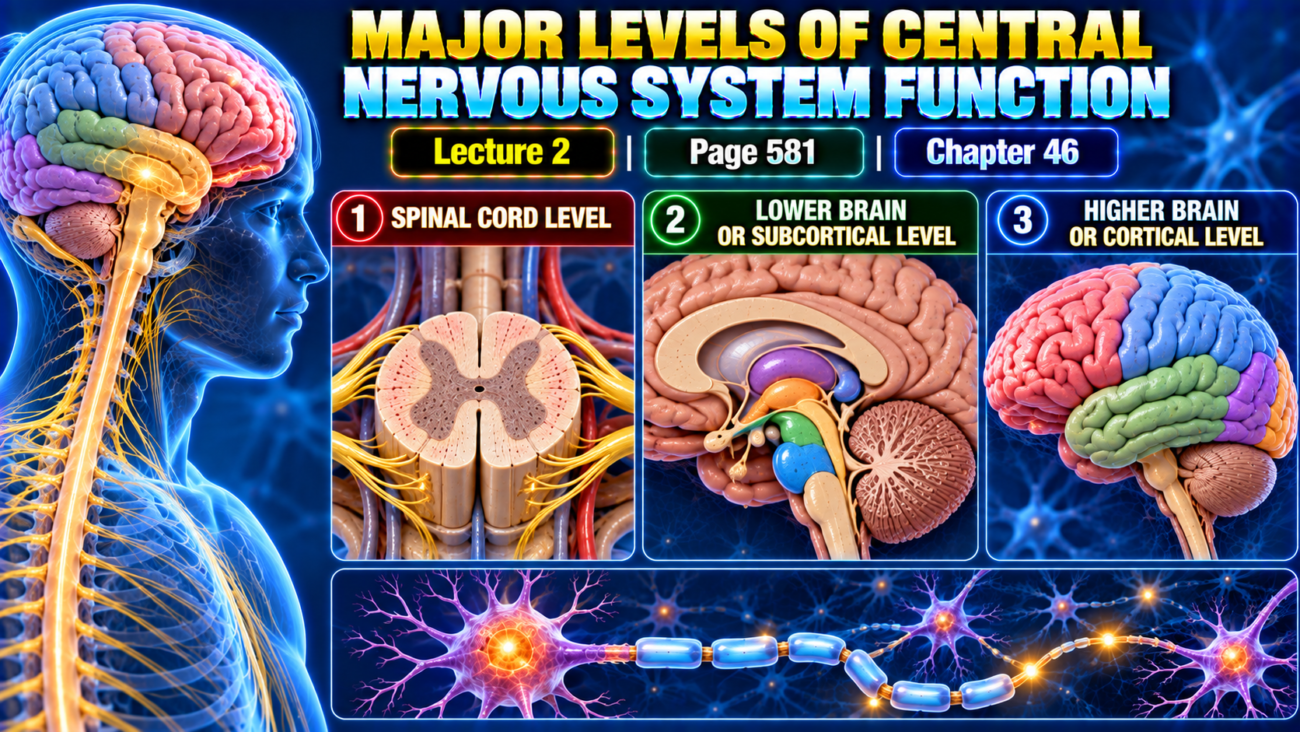
- Identify the three major functional levels of the CNS.
- Describe the main functions of the spinal cord, lower brain, and cerebral cortex.
- Explain the basic similarities between the nervous system and a computer.
Introduction
- The central nervous system (CNS) works at different functional levels.
- Its three major levels are:
- Spinal cord level
- Lower brain or subcortical level
- Higher brain or cortical level
- Each level performs specific functions, but they also work together.
- The nervous system receives sensory information, uses stored information, and produces appropriate responses and actions.
- The human nervous system has developed special functional abilities during different stages of human evolution.
- Because of this development, the central nervous system (CNS) has three major functional levels:
- Spinal cord level
- Lower brain or subcortical level
- Higher brain or cortical level
Easiest Example:
Think of the CNS as working at three levels: spinal cord → lower brain → higher brain.
SPINAL CORD LEVEL
- The spinal cord is not only a pathway carrying signals:
- From the body to the brain
- From the brain back to the body
- The spinal cord can also perform many organized functions by itself.
- Even if the spinal cord is cut in the high neck region, several spinal cord functions can still occur.
- Neuronal circuits in the spinal cord can produce:
- Walking movements
- Withdrawal reflexes that move body parts away from painful objects
- Reflexes that stiffen the legs to support the body against gravity
- Reflexes that control:
- Local blood vessels
- Gastrointestinal movements
- Urinary excretion
- Higher levels of the nervous system often do not control the body directly.
- Instead, they send signals to control centers in the spinal cord.
- These signals command the spinal cord centers to perform their functions.
Easiest Example:
The brain can give a command to the spinal cord, and the spinal cord carries out the required reflex or movement.
SPINAL CORD LEVEL – CONCEPTUAL SUMMARY
Imagine the spinal cord as a smart control center, not just a pathway carrying messages between the body and brain.
Even if the spinal cord is separated from the brain at a high level, its own neuronal circuits can still produce walking movements, pull the body away from pain, stiffen the legs to support the body against gravity, and control blood vessels, intestinal movements, and urination.
This means the brain often does not control every action directly. Instead, it sends a command to the spinal cord, and the spinal cord performs the required function through its own control centers.
Concept:
Brain gives the order → Spinal cord carries out the action.
LOWER BRAIN OR SUBCORTICAL LEVEL
- Many subconscious activities of the body are controlled by the lower parts of the brain.
- These lower brain areas include:
- Medulla
- Pons
- Mesencephalon
- Hypothalamus
- Thalamus
- Cerebellum
- Basal ganglia
- Arterial blood pressure and breathing are controlled mainly by the:
- Medulla
- Pons
- Balance and equilibrium are controlled by:
- Parts of the cerebellum
- Reticular substance of the medulla, pons, and mesencephalon
- Feeding reflexes, such as:
- Salivation
- Licking the lips after tasting food
are controlled by areas in the:
- Medulla
- Pons
- Mesencephalon
- Amygdala
- Hypothalamus
- Many emotional responses can still occur even after much of the cerebral cortex is destroyed.
- These include:
- Anger
- Excitement
- Sexual response
- Reaction to pain
- Reaction to pleasure
Easiest Example:
When tasty food enters the mouth, you may start salivating automatically without thinking about it. This is an example of a subconscious function controlled by lower brain centers.
HIGHER BRAIN OR CORTICAL LEVEL
- The cerebral cortex performs important functions beyond those of the spinal cord and lower brain.
- It acts as a very large storehouse of memory and information.
- The cerebral cortex does not work alone.
- It always works together with the lower centers of the nervous system.
- Without the cerebral cortex, functions of the lower brain centers may become less precise.
- Stored information in the cortex helps make these functions:
- More definite
- More accurate
- More precise
- The cerebral cortex is essential for most thought processes.
- However, the cortex cannot function by itself.
- Lower brain centers initiate wakefulness in the cerebral cortex.
- This wakefulness opens the cortex’s stored memories for use in thinking.
- Therefore, each part of the nervous system has its own specific function.
- The cerebral cortex provides the mind with access to a large amount of stored information.
Easiest Example:
The lower brain wakes the cortex, and the cortex uses stored memories and information to help us think and act more precisely.
COMPARISON OF THE NERVOUS SYSTEM TO A COMPUTER
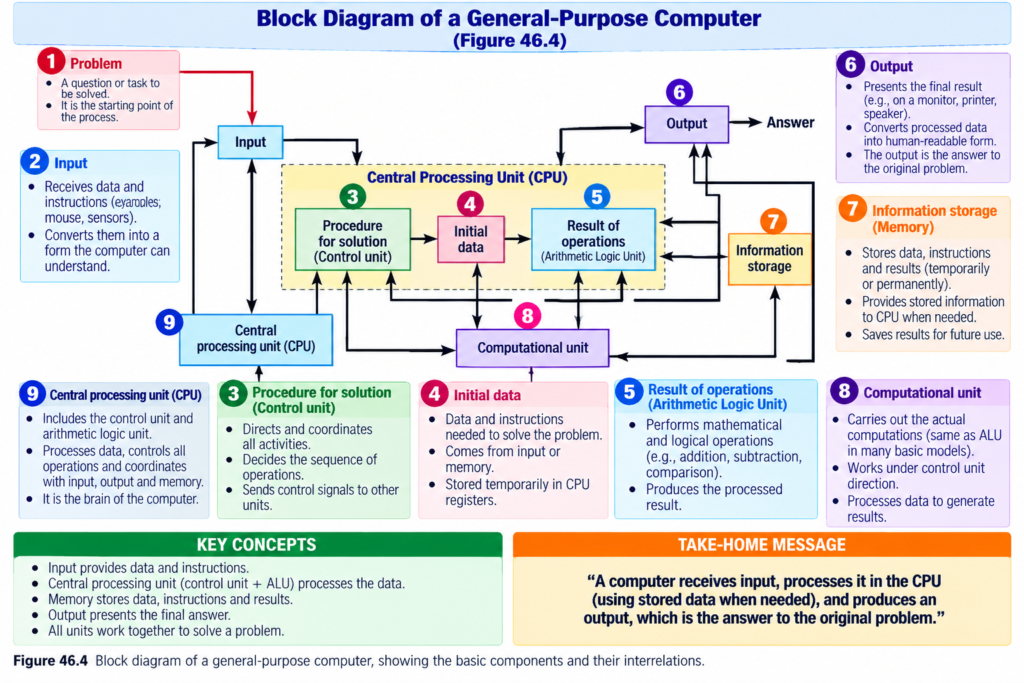
- A computer and the nervous system have many similar features.
- A computer has input circuits, which are similar to the sensory part of the nervous system.
- It also has output circuits, which are similar to the motor part of the nervous system.
- In a simple computer, the output depends directly on the input.
- This is similar to a simple spinal cord reflex.
- In a more complex computer, the output depends on:
- New input signals
- Information already stored in memory
- This is similar to the more complex processing of the higher nervous system.
- More complex computers also have a central processing unit (CPU).
- The CPU controls the sequence of operations.
- This is similar to brain control mechanisms that shift attention from:
- One thought to another
- One sensation to another
- One motor activity to another
- In this way, complex sequences of thought or action can occur.
- Fig. 46.4 shows a simple block diagram of a computer and its similarity to the nervous system.
- The brain continuously:
- Collects sensory information
- Combines it with stored information
- Uses it to control the daily activities of the body
Easiest Example:
A computer takes input → uses stored memory → processes the information → gives output.
In a similar way, the nervous system receives sensory input → uses stored information → processes it → produces a body response.
Clinical IMPORTANCE
- Spinal cord neuronal circuits can still produce organized functions even after the spinal cord is cut at a high neck level.
- These spinal cord functions include:
- Walking movements
- Withdrawal reflexes from painful objects
- Reflex stiffening of the legs to support the body against gravity
- Control of local blood vessels
- Control of gastrointestinal movements
- Control of urinary excretion
- Medulla and pons mainly control:
- Arterial pressure
- Respiration
- Equilibrium depends on:
- Parts of the cerebellum
- Reticular substance of the medulla, pons, and mesencephalon
- Feeding reflexes, such as:
- Salivation
- Licking the lips after tasting food
are controlled by the medulla, pons, mesencephalon, amygdala, and hypothalamus.
- Emotional responses such as anger, excitement, sexual response, reaction to pain, and reaction to pleasure can still occur even after destruction of much of the cerebral cortex.
- Without the cerebral cortex, functions of lower brain centers become less precise.
- The cerebral cortex is essential for most thought processes.
- Lower brain centers initiate wakefulness in the cerebral cortex.
QUICK REVISION
- CNS has 3 major functional levels:
- Spinal cord level
- Lower brain/subcortical level
- Higher brain/cortical level
- Spinal cord:
- Carries signals between body and brain.
- Can also perform organized functions through its own neuronal circuits.
- Controls walking movements, withdrawal reflexes, leg stiffening, local blood vessels, gastrointestinal movements, and urinary excretion.
- Higher centers can command spinal cord control centers to perform functions.
- Lower brain/subcortical level:
- Controls many subconscious activities.
- Includes medulla, pons, mesencephalon, hypothalamus, thalamus, cerebellum, and basal ganglia.
- Medulla + pons → arterial pressure and respiration.
- Cerebellum + reticular substance → equilibrium.
- Lower brain areas control feeding reflexes.
- Many emotional responses can still occur even after much of the cerebral cortex is destroyed.
- Higher brain/cortical level:
- Cerebral cortex is a large memory storehouse.
- Works together with lower nervous system centers.
- Makes lower brain functions more precise.
- Essential for most thought processes.
- Lower brain centers initiate wakefulness in the cortex.
- Cortex opens stored information for use by the mind.
- Nervous system and computer:
- Sensory portion = input
- Motor portion = output
- Simple computer output resembles simple spinal reflexes.
- Complex processing uses input + stored memory.
- CPU is similar to brain control mechanisms.
- Fig. 46.4 shows this similarity.
- Brain continuously collects sensory information and combines it with stored information to control bodily activity.
Reference: Guyton and Hall Textbook of Medical Physiology, 15th Edition, Chapter 46 — Organization of the Nervous System:
