


Learning Objectives
After studying this topic, students will be able to:
- Describe the transmission of smell signals from the olfactory receptors to the olfactory bulb and higher centers of the brain.
- Differentiate the primitive, less old, and newer olfactory pathways and explain their main functions.
- Explain the role of centrifugal inhibitory control in improving odor discrimination.
Introduction
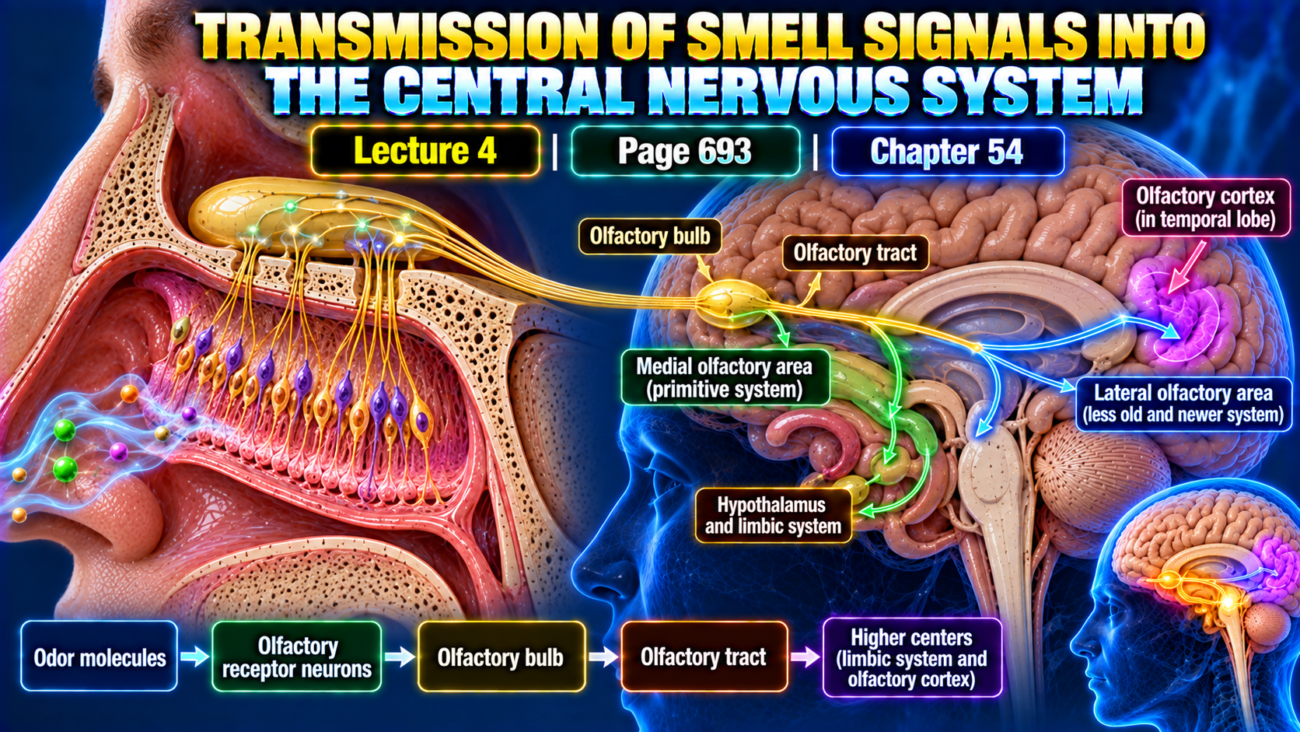
Smell signals travel from the olfactory receptors in the nasal cavity to the olfactory bulb and then to different areas of the brain. These pathways are closely connected with the limbic system, which explains the strong relationship of smell with emotions, behavior, food preference, and learned aversion. The olfactory system includes primitive pathways for basic reflex responses, less old pathways for learned responses, and a newer pathway for conscious perception and analysis of odors.
- The olfactory parts of the brain were among the earliest brain structures to develop in primitive animals.
- Much of the rest of the brain appears to have developed around these early olfactory areas.
- Some brain areas that originally served smell later became part of the basal brain structures involved in:
- Emotions
- Other aspects of human behavior
- These structures are called the limbic system, as discussed in Chapter 59.
Transmission of Olfactory Signals Into the Olfactory Bulb
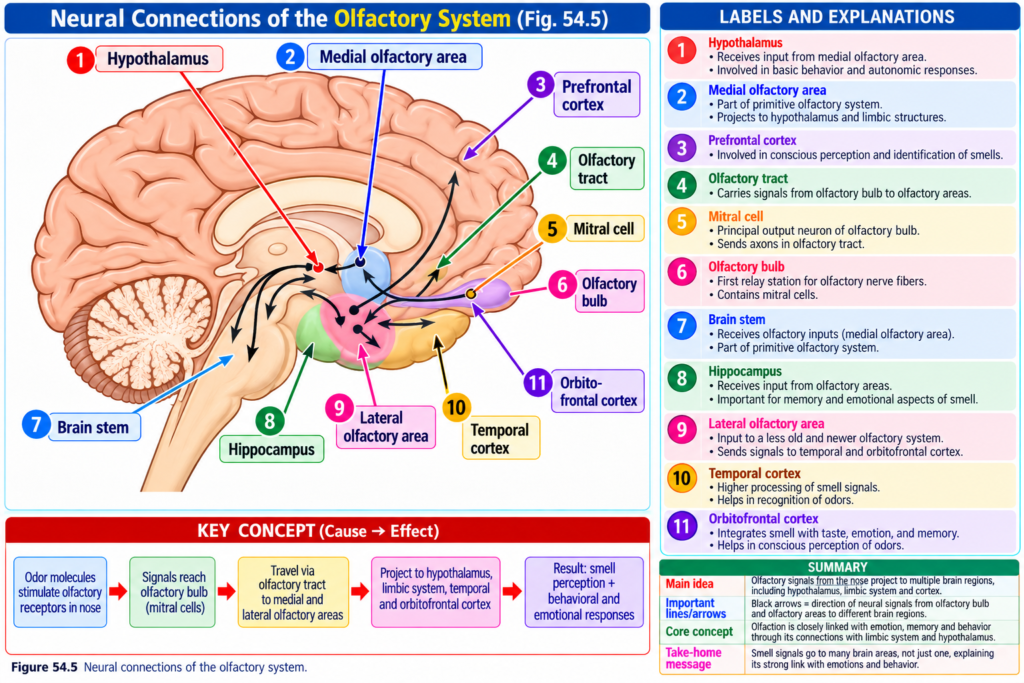
- The olfactory bulb is shown in Fig. 54.5.
- Olfactory nerve fibers passing backward from the bulb form cranial nerve I, also called the olfactory tract.
- The olfactory tract and olfactory bulb are anterior outgrowths of brain tissue from the base of the brain.
- The enlarged end forms the olfactory bulb.
- The olfactory bulb lies over the cribriform plate.
- The cribriform plate separates:
- The brain cavity
- From the upper part of the nasal cavity
- The cribriform plate contains many small openings.
- Small nerves pass upward through these openings:
- From the olfactory membrane in the nasal cavity
- → Into the olfactory bulb in the cranial cavity
- Fig. 54.3 shows the close relationship between the olfactory cells and the olfactory bulb.
- Short axons from olfactory cells end in small rounded structures called glomeruli.
- Each olfactory bulb contains several thousand glomeruli.
- Each glomerulus receives about:
- 25,000 axons from olfactory cells
- Dendrites from about 25 large mitral cells
- Dendrites from about 60 smaller tufted cells
- The cell bodies of the mitral and tufted cells lie in the olfactory bulb above the glomeruli.
- Their dendrites receive synaptic signals from the olfactory cell neurons.
- The mitral and tufted cells then send their axons through the olfactory tract.
- These axons carry olfactory signals to higher levels of the central nervous system.
- Some research suggests that different glomeruli respond to different odors.
- Specific glomeruli may therefore help analyze different odor signals entering the central nervous system.
Primitive and Newer Olfactory Pathways Into the Central Nervous System
- The olfactory tract enters the brain at the anterior junction between the mesencephalon and cerebrum.
- There, it divides into two pathways, as shown in Fig. 54.5:
- Medial pathway → goes to the medial olfactory area
- Lateral pathway → goes to the lateral olfactory area
- The medial olfactory area represents the primitive olfactory system.
- The lateral olfactory area provides input to:
- A less old olfactory system
- A newer olfactory system
The Primitive Olfactory System—The Medial Olfactory Area
- The medial olfactory area contains a group of nuclei in the midbasal part of the brain, just anterior to the hypothalamus.
- The most prominent are the septal nuclei.
- These midline nuclei send signals to:
- The hypothalamus
- Other primitive parts of the limbic system
- This area is mainly concerned with basic behavior.
- Its importance can be understood from animal studies.
- When the lateral olfactory areas on both sides are removed and only the medial system remains:
- Basic responses to smell are still present.
- These include:
- Licking the lips
- Salivation
- Other feeding responses caused by the smell of food
- Basic emotional responses associated with smell
- Removal of the lateral areas abolishes the more complicated olfactory conditioned reflexes.
The Less Old Olfactory System—The Lateral Olfactory Area
- The lateral olfactory area is mainly formed by:
- Prepyriform cortex
- Pyriform cortex
- Cortical part of the amygdaloid nuclei
- From these areas, signals pass to almost all parts of the limbic system.
- They especially pass to less primitive areas such as the hippocampus.
- These areas are important for learning to:
- Like certain foods
- Dislike certain foods
- Based on previous experience
- For example, these pathways may cause a person to develop a strong aversion to foods that previously caused:
- Nausea
- Vomiting
- Many pathways from the lateral olfactory area also pass directly to an older part of the cerebral cortex called the paleocortex.
- The paleocortex is located in the anteromedial part of the temporal lobe.
- This is the only area of the cerebral cortex where sensory signals reach the cortex directly without first passing through the thalamus.
The Newer Pathway
- A newer olfactory pathway passes through the thalamus.
- The pathway is:
- Olfactory pathway
- → Dorsomedial thalamic nucleus
- → Lateroposterior quadrant of the orbitofrontal cortex
- Studies in monkeys suggest that this newer system helps in the conscious analysis of odor.
Summary
- The primitive olfactory system controls basic olfactory reflexes.
- The less old olfactory system provides automatic but partly learned control of:
- Food intake
- Aversion to toxic or unhealthy foods
- The newer olfactory system is similar to other cortical sensory systems.
- It is used for:
- Conscious perception of smell
- Analysis of smell
Centrifugal Control of Activity in the Olfactory Bulb By the Central Nervous System
- Many nerve fibers arise from the olfactory parts of the brain.
- They pass outward through the olfactory tract to the olfactory bulb.
- This direction is called centrifugal, meaning from the brain toward the periphery.
- These fibers end on many small granule cells located among the:
- Mitral cells
- Tufted cells
- The granule cells send inhibitory signals to the mitral and tufted cells.
- This inhibitory feedback may help sharpen the ability to distinguish one odor from another.
Key Concept
- Smell signals begin in the olfactory receptors and pass to the olfactory bulb.
- In the olfactory bulb, signals are processed through glomeruli, mitral cells, and tufted cells.
- These signals then travel through the olfactory tract to different brain pathways.
- The olfactory tract divides mainly into:
- Medial olfactory pathway → primitive olfactory system
- Lateral olfactory pathway → less old and newer olfactory systems
- The primitive olfactory system mainly controls basic smell-related reflexes and emotional responses.
- The less old olfactory system helps produce learned likes and dislikes related to food and previous experiences.
- The newer olfactory system passes through the thalamus to the orbitofrontal cortex and is involved in conscious perception and analysis of smell.
- The brain can also send signals back to the olfactory bulb. These centrifugal signals activate granule cells, which inhibit mitral and tufted cells and may help improve discrimination between different odors.
Cause → Effect Flow
Odor stimulates olfactory receptors
→ olfactory bulb processes the signal
→ olfactory tract carries the signal
→ primitive / less old / newer pathways are activated
→ basic reflexes, learned responses, and conscious smell perception occur.
Examples for Understanding
Example 1 — Smell of Food
Smell of food
→ primitive olfactory pathway becomes active
→ salivation, lip licking, and feeding responses may occur.
Example 2 — Food Aversion
A food previously caused nausea or vomiting
→ the less old olfactory system remembers the experience
→ the person may later develop a strong dislike or aversion to that food.
Example 3 — Conscious Smell Recognition
An odor signal passes through the dorsomedial thalamic nucleus to the orbitofrontal cortex
→ the smell is consciously perceived and analyzed.
Example 4 — Distinguishing Odors
Centrifugal signals activate granule cells in the olfactory bulb
→ granule cells inhibit mitral and tufted cells
→ this may sharpen the ability to distinguish one odor from another.
Clinical Importance
- Some brain areas that originally served smell later became part of the basal brain structures involved in:
- Emotions
- Other aspects of human behavior
- These structures are called the limbic system.
- The primitive olfactory system controls basic olfactory reflexes.
- Basic responses to smell are still present:
- Licking the lips
- Salivation
- Other feeding responses caused by the smell of food
- Basic emotional responses associated with smell
- These areas are important for learning to:
- Like certain foods
- Dislike certain foods
- Based on previous experience
- These pathways may cause a person to develop a strong aversion to foods that previously caused:
- Nausea
- Vomiting
- The less old olfactory system provides automatic but partly learned control of:
- Food intake
- Aversion to toxic or unhealthy foods
- The newer olfactory system is used for:
- Conscious perception of smell
- Analysis of smell
- This inhibitory feedback may help sharpen the ability to distinguish one odor from another.
High-Yield Points
- The olfactory parts of the brain were among the earliest brain structures to develop in primitive animals.
- Some brain areas that originally served smell later became part of the limbic system, which is involved in:
- Emotions
- Other aspects of human behavior
- The olfactory bulb lies over the cribriform plate.
- Small olfactory nerves pass:
- From the olfactory membrane in the nasal cavity
- → Through openings in the cribriform plate
- → Into the olfactory bulb
- Short axons from olfactory cells end in glomeruli.
- Each glomerulus receives:
- About 25,000 axons from olfactory cells
- Dendrites from about 25 large mitral cells
- Dendrites from about 60 smaller tufted cells
- Mitral and tufted cells send their axons through the olfactory tract to higher levels of the central nervous system.
- Different glomeruli may respond to different odors.
- The olfactory tract divides into:
- Medial pathway → medial olfactory area
- Lateral pathway → lateral olfactory area
- The medial olfactory area represents the primitive olfactory system.
- The primitive olfactory system is mainly concerned with:
- Basic responses to smell
- Licking the lips
- Salivation
- Feeding responses
- Basic emotional responses
- The lateral olfactory area is mainly formed by:
- Prepyriform cortex
- Pyriform cortex
- Cortical part of the amygdaloid nuclei
- The less old olfactory system is important for learning to:
- Like certain foods
- Dislike certain foods
- Develop food aversion after previous nausea or vomiting
- The paleocortex is the only area of the cerebral cortex where sensory signals reach the cortex directly without first passing through the thalamus.
- The newer olfactory pathway passes:
- → Dorsomedial thalamic nucleus
- → Lateroposterior quadrant of the orbitofrontal cortex
- The newer olfactory system helps in:
- Conscious perception of smell
- Analysis of smell
- The primitive olfactory system controls basic olfactory reflexes.
- The less old olfactory system provides automatic but partly learned control of:
- Food intake
- Aversion to toxic or unhealthy foods
- Centrifugal fibers pass from the olfactory parts of the brain back to the olfactory bulb.
- These fibers act through granule cells.
- Granule cells send inhibitory signals to:
- Mitral cells
- Tufted cells
- This inhibitory feedback may help sharpen the ability to distinguish one odor from another.
EASY SUMMARY
Imagine that a smell enters the nose. The smell first stimulates the olfactory cells in the olfactory membrane. Their small nerve fibers pass upward through tiny openings in the cribriform plate and enter the olfactory bulb.
Inside the olfactory bulb, the olfactory nerve endings reach small rounded structures called glomeruli. Each glomerulus receives many olfactory axons and connects with the dendrites of mitral cells and tufted cells. These cells receive the smell signal and send it forward through the olfactory tract toward higher parts of the brain. Different glomeruli may respond to different odors, helping the brain analyze different smells.
When the olfactory tract reaches the brain, it divides into two main pathways: a medial pathway and a lateral pathway.
The medial pathway goes to the medial olfactory area. This is the primitive olfactory system. It is mainly related to basic smell responses and behavior. Because it connects with the hypothalamus and limbic system, the smell of food can produce simple responses such as salivation, licking the lips, feeding responses, and basic emotional reactions.
The lateral pathway goes to the lateral olfactory area. This area forms the basis of the less old olfactory system and also gives input to the newer olfactory system.
The less old olfactory system is linked with the limbic system and hippocampus. It helps a person learn from previous experience. Because of this system, a person may learn to like or dislike certain foods. If a food previously caused nausea or vomiting, its smell may later produce a strong aversion.
Some signals from the lateral olfactory area also pass directly to the paleocortex. This is special because olfactory sensory signals can reach this cortex without first passing through the thalamus.
The newer olfactory pathway does pass through the thalamus. It goes through the dorsomedial thalamic nucleus and then to the orbitofrontal cortex. This pathway is important for the conscious perception and analysis of smell.
So, in a simple way:
Primitive system
→ basic smell reflexes and emotional responses
Less old system
→ learned food preference, dislike, and food aversion
Newer system
→ conscious perception and analysis of odor
The brain also sends signals back toward the olfactory bulb. These are called centrifugal signals. They act on granule cells, which inhibit mitral and tufted cells. This inhibitory control may help make odor discrimination sharper, so the brain can better distinguish one smell from another.
One-Line Memory Flow
Smell → Olfactory cells → Cribriform plate → Olfactory bulb → Glomeruli → Mitral & tufted cells → Olfactory tract → Primitive / Less old / Newer pathways → Reflexes, learned responses, and conscious smell perception.
Reference: This content is based on Guyton and Hall Textbook of Medical Physiology, 15th Edition, Chapter 54 — The Chemical Senses: Taste and Smell.
