


Learning Objectives
After studying this topic, students will be able to:
- Explain how a taste stimulus produces a receptor potential in a taste cell.
- Describe how different taste receptors produce salty, sour, sweet, bitter, and umami sensations.
- Explain how stimulation of taste buds produces nerve impulses and taste adaptation.
- Mechanism of Stimulation of Taste Buds
Introduction
- Taste begins when a taste substance stimulates the taste receptor cells.
- This stimulation changes the electrical potential of the taste cell and produces a receptor potential.
- Different taste substances act through specific ion channels or G-protein-coupled receptors.
- These changes activate the taste receptor cells and generate nerve signals.
- At first, the taste nerve sends a strong immediate signal.
- With continued stimulation, the taste bud partially adapts and sends a weaker continuous signal.
TASTE BUDS AND THEIR FUNCTION
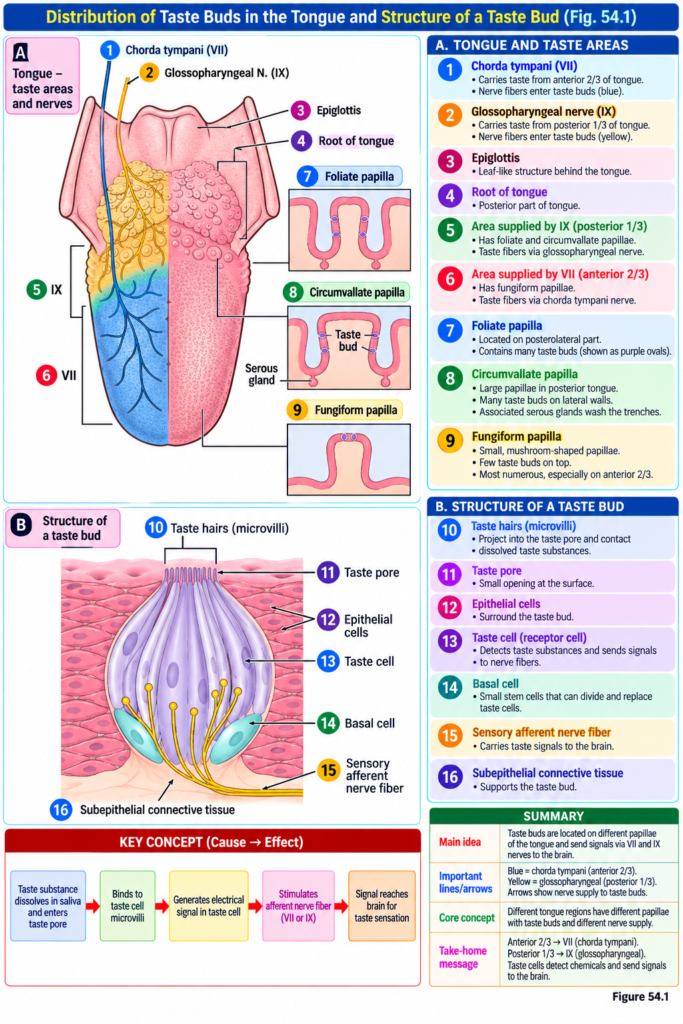
- Fig. 54.1B shows a taste bud.
- A taste bud is about 1/30 mm in diameter and 1/16 mm in length.
- It is made of epithelial cells.
- Some epithelial cells are supporting cells, called sustentacular cells.
- Other epithelial cells are taste cells.
- Each taste bud contains about 100 taste cells.
- Taste cells are continuously replaced by mitotic division of the surrounding epithelial cells.
- Therefore, some taste cells are young cells.
- Other taste cells become mature and move toward the center of the taste bud.
- These mature cells eventually break up and dissolve.
- The average life span of a taste cell is about 10 days.
- However, the life span varies considerably:
- Some taste cells are removed in only 2 days.
- Others may survive for more than 3 weeks.
- The outer tips of the taste cells are arranged around a small taste pore.
- From the tip of each taste cell, several microvilli, also called taste hairs, project into the taste pore.
- These microvilli extend toward the cavity of the mouth.
- The microvilli provide the receptor surface for taste.
- A branching network of taste nerve fibers is present around the bodies of the taste cells.
- These nerve fibers are stimulated by the taste receptor cells.
- Some nerve fibers enter folds in the membranes of the taste cells.
- In some taste cells, many vesicles are present beneath the cell membrane near the nerve fibers.
- These vesicles contain neurotransmitter substances.
- During taste stimulation, neurotransmitters are released through the cell membrane.
- These neurotransmitters excite the endings of the taste nerve fibers.
- Sour taste cells have typical synapses.
- They release serotonin (5-hydroxytryptamine; 5-HT) as a neurotransmitter.
- Sweet, salty, umami, and bitter taste cells do not appear to have typical synaptic vesicles.
- When stimulated, these cells produce and release ATP.
- ATP acts as a neurotransmitter in this situation.
- This neurotransmitter function is different from the normal role of ATP in supplying energy for metabolic processes.
- Other neurotransmitters, including acetylcholine, may also participate in transmission of nerve signals from taste cells.
Location of the Taste Buds
- Taste buds are present on three types of papillae of the tongue (Fig. 54.1A).
- Circumvallate papillae
- A large number of taste buds are present on the walls of the troughs surrounding these papillae.
- Circumvallate papillae form a V-shaped line on the posterior surface of the tongue.
- Foliate papillae
- A moderate number of taste buds are present on these papillae.
- They are located in folds along the lateral surfaces of the tongue.
- Fungiform papillae
- A moderate number of taste buds are present on these papillae.
- They are found over the flat anterior surface of the tongue.
- Additional taste buds are also present on the palate.
- A few taste buds are found on the:
- Tonsillar pillars
- Epiglottis
- Proximal esophagus
- Adults have about 3,000–10,000 taste buds.
- Children have slightly more taste buds than adults.
- After about 45 years of age, many taste buds begin to degenerate.
- Therefore, taste sensitivity decreases in older people.
Specificity of Taste Buds for a Primary Taste Stimulus
- Microelectrode studies show that a single taste bud usually responds mainly to one of the five primary taste stimuli when the taste substance is present in a low concentration.
- At a high concentration, most taste buds can be stimulated by two or more primary taste stimuli.
- At high concentrations, taste buds may also respond to some other taste stimuli that do not fit into the primary taste categories.
MECHANISM OF STIMULATION OF TASTE BUDS
Definition: Mechanism of stimulation of taste buds means the process by which a taste substance stimulates taste receptor cells, produces an electrical change, and finally generates nerve signals.
Receptor Potential
Definition: Receptor potential for taste is the change in electrical potential of a taste cell when a taste substance stimulates it.
- The inside of the taste cell membrane is normally negatively charged compared with the outside.
- This is similar to most other sensory receptor cells.
- When a taste substance is applied to the taste hairs, part of this negative charge is lost.
- Therefore, the taste cell becomes depolarized.
- Within a wide range, the decrease in electrical potential is approximately proportional to the logarithm of the concentration of the stimulating substance. ( As the concentration of the taste substance increases, the taste cell becomes more depolarized, but the change increases gradually rather than in direct proportion. )
- This electrical change is called the receptor potential for taste.
- Most taste substances produce the receptor potential by binding to a protein receptor molecule.
- This receptor is present on the outer surface of the taste receptor cell, near or within the taste villus membrane.
- Binding of the taste chemical opens ion channels.
- Positively charged sodium ions (Na⁺) or hydrogen ions (H⁺) enter the taste cell.
- Their entry reduces the normal negative charge of the cell.
- Therefore, the taste cell becomes depolarized.
- The taste chemical is then gradually washed away from the taste villus by saliva.
- Removal of the taste chemical removes the stimulus.
- The type of receptor protein in each taste villus determines the type of taste that is perceived.
- Salty taste
- Sodium ions produce the salty taste sensation.
- Receptor proteins open specific ion channels in the apical membrane of the taste cells.
- These channels are likely the epithelial sodium channels (ENaC).
- Opening of these channels activates the receptors.
- Sour taste
- Hydrogen ions produce the sour taste sensation.
- They activate specific ion channels in the taste cells.
- Sweet and bitter tastes
- These tastes use G-protein-coupled receptors in the apical membrane.
- Activation of these receptors produces second-messenger substances inside the taste cells.
- These second messengers produce intracellular chemical changes.
- These changes generate the taste signals.
- Sweet taste
- Sweet compounds are detected by two closely related G-protein-coupled receptors:
- T1R2
- T1R3
- Sweet compounds are detected by two closely related G-protein-coupled receptors:
- Umami taste
- The receptor for umami taste is believed to be a combination of:
- T1R1
- T1R3
- Therefore, T1R3 acts as a co-receptor for both sweet and umami tastes.
- The receptor for umami taste is believed to be a combination of:
- Bitter taste
- Bitter taste is detected by another family of G-protein-coupled receptors called T2R receptors.
- This family contains about 30 different receptors.
- Individual bitter-sensitive taste receptor cells contain several T2R receptors.
- Each T2R recognizes a particular group of bitter compounds.
- This arrangement allows one type of bitter-sensitive taste receptor cell to detect many different bitter compounds.
- Sour taste
- Sour taste is associated with acidic food or drink.
- It is believed to be detected by ion channels opened by hydrogen ions.
- The exact mechanism is not completely understood.
- Current evidence suggests that acid responses may involve:
- Acid-sensitive potassium channel (KIR2.1)
- Hydrogen ion–selective ion channel (otopetrin 1)
Generation of Nerve Impulses By the Taste Bud
Definition: Generation of nerve impulses by the taste bud means the production of nerve signals after the taste receptor cells are stimulated.
- When a taste stimulus is first applied, the discharge rate of the taste nerve fibers rapidly rises to a peak within a small fraction of a second.
- During the next few seconds, the taste bud begins to adapt.
- The discharge rate then falls to a lower steady level while the taste stimulus is still present.
- Therefore, the taste nerve first sends a strong immediate signal.
- It then sends a weaker continuous signal as the taste bud partially adapts to the stimulus.
KEY CONCEPT
- Taste substance → receptor activation → ion movement or second-messenger activation → depolarization → receptor potential → nerve signal.
- The type of receptor determines which taste is perceived.
- Salty and sour tastes mainly involve specific ion channels.
- Sweet, bitter, and umami tastes involve G-protein-coupled receptors.
- Taste nerve activity is strongest at the beginning and then decreases because of partial adaptation.
Conceptual Examples
- Salty: Sodium ions → specific ion channels such as ENaC open → taste receptor is activated.
- Sour: Hydrogen ions → acid-sensitive ion channels open → sour taste signal is produced.
- Sweet: Sweet compound → T1R2 + T1R3 receptors → second-messenger changes → sweet taste signal.
- Umami: Umami substance → T1R1 + T1R3 receptor complex → umami taste signal.
- Bitter: Bitter compound → T2R receptors → intracellular changes → bitter taste signal.
- Continued taste stimulus: Strong initial nerve discharge → partial adaptation → weaker continuous nerve signal.
CLINICAL IMPORTANCE
- Taste depends on the ability of taste receptor cells to depolarize after stimulation.
- Different tastes use different receptor mechanisms:
- Salty taste: mainly related to sodium entry through specific ion channels such as ENaC.
- Sour taste: related to hydrogen ions acting through acid-sensitive ion channels.
- Sweet taste: detected mainly by T1R2 + T1R3 receptors.
- Umami taste: detected mainly by T1R1 + T1R3 receptors.
- Bitter taste: detected by the T2R receptor family.
- T1R3 is important because it acts as a co-receptor for both sweet and umami tastes.
- Bitter-sensitive cells contain several T2R receptors, allowing detection of many different bitter compounds.
- Sour taste mechanisms are not completely understood, but KIR2.1 and otopetrin 1 may participate in detecting acids.
- Taste buds show partial adaptation during continuous stimulation.
- Therefore, a taste stimulus produces a strong initial nerve signal, followed by a weaker continuous signal.
HIGH-YIELD POINTS
- Taste stimulation causes depolarization of the taste receptor cell.
- The electrical change produced in a taste cell is called the receptor potential for taste.
- Greater concentration of a stimulating substance generally produces a greater change in receptor potential.
- Taste chemicals act by binding to receptor proteins or by affecting specific ion channels.
- Na⁺ → salty taste.
- H⁺ → sour taste.
- Salty and sour tastes → mainly ion-channel mechanisms.
- Sweet, bitter, and umami tastes → G-protein-coupled receptor mechanisms.
- Sweet receptor = T1R2 + T1R3.
- Umami receptor = T1R1 + T1R3.
- T1R3 = common co-receptor for sweet and umami.
- Bitter receptors = T2R family.
- There are about 30 different T2R receptors.
- A bitter-sensitive taste receptor cell can express multiple T2Rs.
- Sour taste may involve:
- KIR2.1
- Otopetrin 1
- Saliva gradually removes the taste chemical from the taste villus and therefore removes the stimulus.
- Taste nerve discharge reaches a rapid initial peak.
- It then falls to a lower steady level because of partial adaptation.
QUICK REVISION
Taste substance
→ stimulates taste receptor
→ ion channel or G-protein-coupled receptor activation
→ electrical change in taste cell
→ depolarization
→ receptor potential
→ nerve signal
Salty
→ Na⁺
→ specific ion channels, likely ENaC
Sour
→ H⁺
→ acid-sensitive ion channels
→ possible involvement of KIR2.1 + otopetrin 1
Sweet
→ T1R2 + T1R3
Umami
→ T1R1 + T1R3
Bitter
→ T2R receptor family
Continuous taste stimulation
→ strong immediate nerve discharge
→ partial adaptation
→ weaker continuous discharge
REFERENCE SOURCE
- Guyton and Hall Textbook of Medical Physiology
- 15th Edition
- Chapter 54 — The Chemical Senses: Taste and Smell
- Mechanism of Stimulation of Taste Buds
