

- Some single-gene disorders do not follow classic Mendelian inheritance.
- Three important groups:
- triplet repeat mutations
- mitochondrial gene mutations
- abnormalities involving genomic imprinting
Triplet Repeat Mutations
- These disorders result from abnormal expansion of a 3-nucleotide sequence within a gene.
- Increasing repeats → gene dysfunction.
- Examples include:
- Fragile X syndrome
- Huntington disease
- myotonic dystrophy
- spinocerebellar ataxias
- About 50 diseases are known to result from these mutations, and those identified so far are associated with neurodegenerative abnormalities.
Fragile X Syndrome (FXS)
- Fragile X syndrome is the prototype triplet-repeat disorder.
- It results from expansion of CGG repeats in the FMR1 gene.
- FXS is:
- the most common genetic cause of intellectual disability in males
- overall second only to Down syndrome
- Frequency:
- males → about 1 in 1550
- females → about 1 in 8000
- FMR1 repeat expansions are also associated with:
- fragile X–associated tremor/ataxia syndrome
- fragile X–associated primary ovarian insufficiency
- The name “fragile X” came from the old cytogenetic appearance:
- cells grown in folate-deficient medium showed a constriction/discontinuity in the long arm of X
- this method has largely been replaced by DNA analysis of repeat number
- Typical affected males may show:
- severe intellectual disability
- long face
- large mandible
- large, everted ears
- macroorchidism
- Other possible features:
- hyperextensible joints
- high-arched palate
- mitral valve prolapse
- These physical findings may be subtle or absent.
- The most consistent distinctive physical finding after puberty is macroorchidism, present in at least 90% of affected males.
- Neurologic and behavioral manifestations include:
- epilepsy → about 30%
- aggressive behavior → about 90%
- autism spectrum disorder
- anxiety/hyperactivity disorders
- FXS mainly affects males, but its inheritance differs from typical X-linked recessive disorders (Fig. 4.21).
- Carrier males:
- about 20%–50% of males carrying an FMR1 expansion may lack typical neurologic disease
- they transmit the altered gene to all daughters
- affected descendants may appear in later generations
- these men are called normal transmitting males
- Affected females:
- about 20% of carrier females may show intellectual disability and other manifestations
- this is more frequent than in typical X-linked recessive diseases
- Anticipation:
- disease becomes more severe in successive generations
- caused by progressive expansion of the triplet repeat
- The unusual inheritance is explained by the dynamic nature of CGG repeat expansion.
- Repeat numbers:
- normal → average around 29 CGG repeats
- premutation → 52–200 repeats
- full mutation → 200–4000 repeats
- Carrier males and females generally carry a premutation.
- During oogenesis, a premutation may expand further: premutation → more CGG repeats → full mutation
- This expansion does not usually occur during spermatogenesis.
- A carrier female can therefore transmit a full mutation to either:
- sons
- daughters
- This explains:
- why some carrier males remain unaffected → premutation
- why some carrier females can have affected children → premutation expands during oogenesis
KEY CONCEPT
- Fragile X = FMR1 CGG triplet-repeat expansion.
- Normal ≈ 29 repeats → premutation 52–200 → full mutation 200–4000.
- Expansion mainly occurs during oogenesis.
- More repeats across generations → anticipation → more severe disease.
- Major clues:
intellectual disability + long face + large ears + macroorchidism.
CONCEPTUAL EXAMPLES
- Male carries a premutation → may appear normal → passes it to all daughters → normal transmitting male.
- Daughter inherits premutation → during her oogenesis repeats expand → child receives full mutation → Fragile X syndrome.
- Repeat size increases from one generation to the next → disease becomes more severe → anticipation.
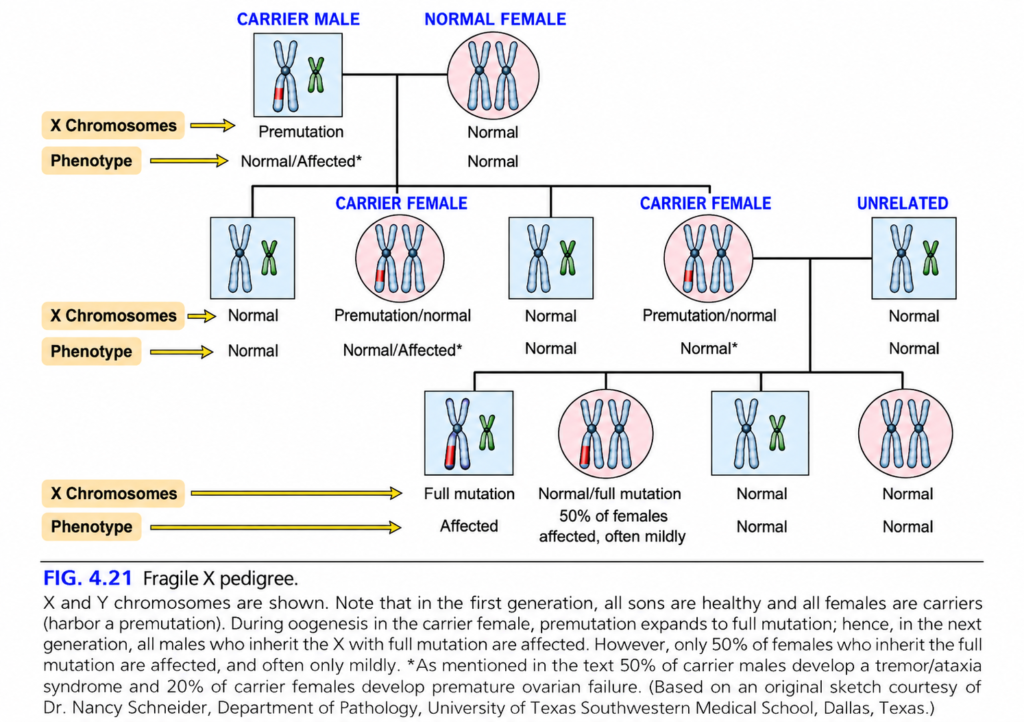
FIG. 4.21 — FRAGILE X PEDIGREE
🧠 Simplest idea
Fragile X shows anticipation: a small FMR1 CGG-repeat expansion (premutation) can become a full mutation when transmitted through a carrier mother → the next generation may develop Fragile X syndrome.
Whole figure in one flow
Carrier male (premutation)
→ gives his abnormal X to ALL daughters
→ daughters become carrier females
→ during formation of their eggs, the repeat may expand
→ full mutation
→ affected sons and variably affected daughters.
🎨 COLOR / SYMBOL GUIDE
- 🔵 Square = male
- 🩷 Circle = female
- 🔵 Long chromosome = X chromosome
- 🟢 Small chromosome = Y chromosome
- 🔴 Segment on X = FMR1 repeat expansion
- ⚫ Family lines = inheritance pathway
1️⃣ TOP — CARRIER MALE + NORMAL FEMALE
👨 Carrier male
He has:
X with premutation + normal Y
The 🔴 marked area on his X represents the expanded FMR1 CGG repeat.
A premutation usually means approximately:
55–200 CGG repeats
It is not yet the classic full Fragile X mutation.
Why can a premutation male look normal?
Because FMR1 is generally still expressed.
So he usually does not have classic Fragile X syndrome.
However, some older male premutation carriers can develop:
FXTAS
= Fragile X–associated tremor/ataxia syndrome.
2️⃣ Why are his SONS normal?
A father gives:
Y chromosome → sons
He does not give his X chromosome to sons.
Therefore:
Carrier father → son gets Y → no paternal FMR1 premutation
✅ Sons shown here are normal.
3️⃣ Why are ALL his DAUGHTERS carriers?
A father gives:
his only X chromosome → every daughter
Since his X carries the premutation:
Carrier father
→ premutation X
→ all daughters receive it
Their mother supplies a normal X.
So daughters become:
Premutation X / normal X
= carrier females
🧠 Key rule:
Father gives X to ALL daughters, Y to ALL sons.
4️⃣ MIDDLE — CARRIER FEMALE
A carrier female has:
one normal X + one premutation X
She may appear normal.
But some premutation females can develop:
Fragile X–associated primary ovarian insufficiency
→ reduced ovarian function / premature ovarian failure.
5️⃣ ⭐ MOST IMPORTANT ARROW — Premutation → Full mutation
During:
OOGENESIS
= formation of eggs in the carrier female
the CGG repeats may become longer.
So:
Premutation
⬇️ repeat expansion
FULL MUTATION
A full mutation generally means:
>200 CGG repeats
This is the key reason disease becomes more severe in later generations.
🧠 This is called:
ANTICIPATION
More repeats in later generation → greater likelihood/severity of disease.6️⃣ BOTTOM LEFT — MALE WITH FULL MUTATION
A son receives:
- Y from father
- abnormal X from carrier mother
If that maternal X has expanded to a full mutation:
Xfull mutation + Y
⬇️
Affected male
Why severe?
A male has only one X chromosome.
There is no second normal FMR1 copy to compensate.
7️⃣ What happens molecularly?
Full mutation:
>200 CGG repeats
→ methylation of the FMR1 promoter
→ FMR1 gene silenced
→ ↓ FMRP
→ abnormal synaptic development/function
→ Fragile X phenotype.
Simple:
Too many CGGs → gene switched OFF → FMRP ↓ → neurologic problems BOTTOM MIDDLE — Female with full mutation
A daughter may receive:
one normal X + one full-mutation X
But females have two X chromosomes.
Because of random:
X-inactivation
some cells use the normal X and some use the abnormal X.
Therefore females are:
variably affected
The figure emphasizes that only about 50% may show clinical manifestations, often milder than affected males.
9️⃣ Why are some children completely normal?
A carrier mother does not pass the abnormal X to every child.
Each child has a chance of receiving:
- normal maternal X
or - abnormal maternal X.
Thus some sons and daughters remain normal.
⭐ MOST IMPORTANT INHERITANCE CONCEPT
👨 Carrier father
Premutation X
→ ALL daughters = premutation carriers
→ NO sons inherit his abnormal X
👩 Carrier mother
Premutation may expand during oogenesis
→ full mutation can appear in children
→ males with full mutation = affected
→ females with full mutation = variably affected
🧠 Why does Fragile X show “anticipation”?
Because:
CGG repeats expand between generations
especially during maternal transmission.
So:
Premutation
→ larger repeat
→ full mutation
→ disease appears/becomes more severe.
🔥 Fastest exam recall
FMR1 gene → X chromosome
Premutation = ~55–200 CGG repeats
Full mutation = >200 repeats
Full mutation → hypermethylation → FMR1 OFF → ↓FMRP
Inheritance:
Carrier father → all daughters carriers, no affected sons from him
Carrier mother → repeat can expand → affected sons + variably affected daughters
⭐ One-line memory
Fragile X = maternal CGG-repeat expansion → FMR1 silencing → anticipation; males are usually more severely affected.
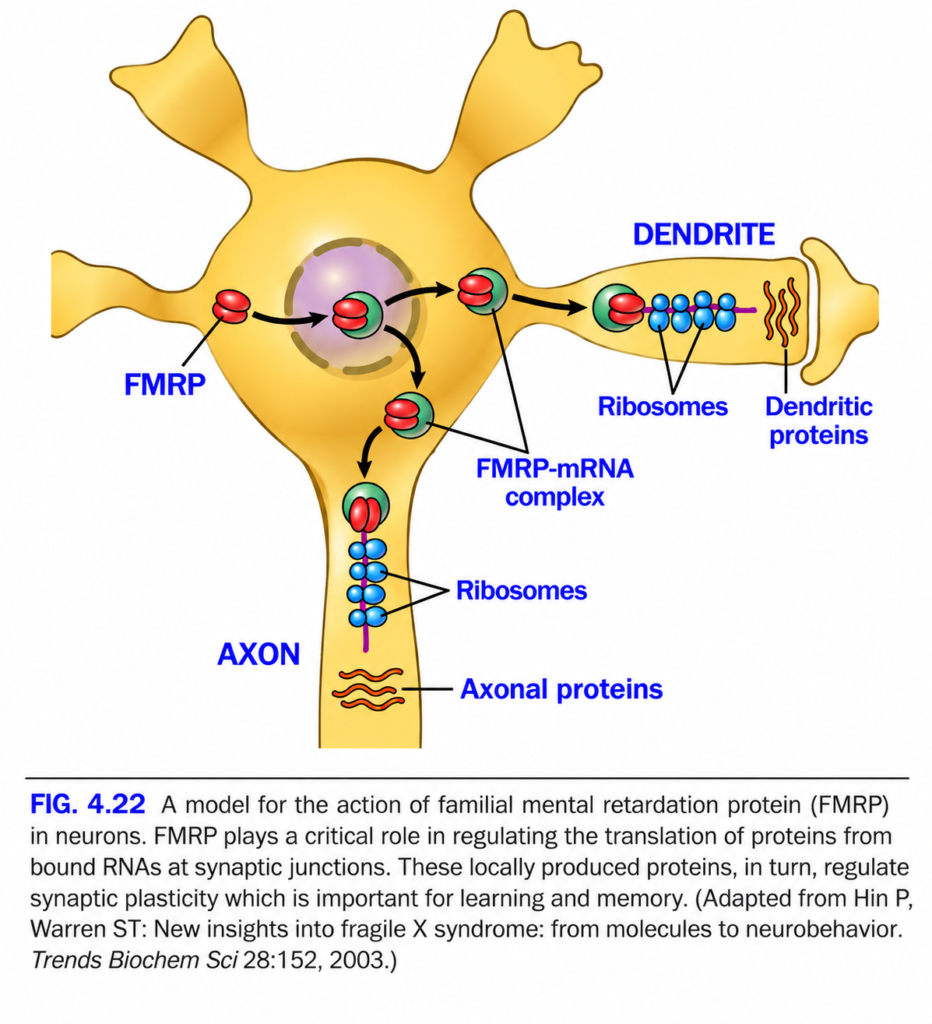
FIG. 4.22 — FMRP FUNCTION IN NEURONS
🧠 Simplest idea
FMRP binds selected mRNAs, carries them to dendrites/axons, and controls when ribosomes translate them into proteins. These local proteins are important for synaptic plasticity, learning, and memory.
Whole figure in one flow
FMRP + mRNA → transport through neuron → reaches dendrite/axon → ribosome → controlled local protein synthesis → normal synaptic function
1️⃣ Yellow cell = Neuron
The large yellow structure is the nerve cell.
- Upper branches = dendrites
- Long lower process = axon
- Purple central area = nucleus
2️⃣ 🔴 FMRP
The red structure = FMRP
FMRP = Fragile X messenger ribonucleoprotein
It is an RNA-binding protein.
Main job:
FMRP binds particular mRNAs and regulates their translation.
🧠 Think:
FMRP = mRNA transporter + translation controller
3️⃣ 🟢🔴 FMRP–mRNA complex
Green + red structure = FMRP bound to mRNA.
Black arrows show:
FMRP binds mRNA
→ forms FMRP–mRNA complex
→ complex moves away from the cell body.
4️⃣ Black arrows = Transport
The complex travels toward:
➡️ Dendrites
and
⬇️ Axon
This allows the neuron to carry the instructions for making proteins close to where those proteins are actually needed.
Easy concept:
Instead of making every protein in the cell body:
Neuron sends mRNA to the destination → makes protein locally.
5️⃣ 🔵 Ribosomes
Blue circles = ribosomes.
When the FMRP–mRNA complex reaches the correct location:
Ribosome reads mRNA
→ translation
→ new protein produced.
6️⃣ RIGHT — Dendritic proteins
At the dendrite:
FMRP-controlled mRNA
→ ribosome
→ 🟠 wavy dendritic proteins
These proteins help modify the synapse.
⬇️
Synaptic plasticity
= ability of synapses to become stronger or weaker with activity.
This is essential for:
Learning + memory
7️⃣ BOTTOM — Axonal proteins
The same idea occurs in the axon:
mRNA transported into axon
→ local ribosomes translate it
→ axonal proteins
These proteins help maintain and modify axonal function.
⭐ Why is FMRP important in Fragile X syndrome?
Normally:
FMRP → keeps local mRNA translation under proper control
In Fragile X syndrome:
FMR1 gene silenced
→ ↓ FMRP
→ excessive/uncontrolled translation of certain synaptic mRNAs
→ abnormal synaptic proteins
→ impaired synaptic plasticity
→ problems with learning and cognition.
🎨 COLOR / ARROW GUIDE
- 🟡 Yellow = neuron
- 🟣 Purple center = nucleus
- 🔴 Red = FMRP
- 🟢 structure around FMRP = bound mRNA complex
- 🔵 Blue circles = ribosomes
- 🟠 Wavy lines = newly made proteins
- ⚫ Black arrows = movement of FMRP–mRNA complexes
🧠 Fastest exam recall
FMRP binds mRNA → transports it to dendrites/axons → controls local translation → normal synaptic plasticity.
🔥 Fragile X:
↓ FMRP → ↑ inappropriate synaptic protein translation → abnormal synaptic function → impaired learning/memory.
Fragile X–Associated Tremor/Ataxia Syndrome and Fragile X–Associated Primary Ovarian Failure
- FMR1 CGG premutations can cause disorders different from classic fragile X syndrome.
- These disorders result from a toxic gain of function, rather than loss of FMRP.
- Two important disorders are:
- Fragile X–associated primary ovarian failure
- Fragile X–associated tremor/ataxia syndrome
- Fragile X–associated primary ovarian failure:
- occurs in about 20% of females carrying an FMR1 premutation
- ovarian failure develops before age 40
- causes:
- menstrual irregularities
- decreased fertility
- Fragile X–associated tremor/ataxia syndrome:
- occurs in about 50% of premutation-carrying males
- usually begins in the sixth decade of life
- is a progressive neurodegenerative disorder
- major manifestations:
- intention tremor
- cerebellar ataxia
- may later progress to parkinsonism
KEY CONCEPT
- FMR1 full mutation → fragile X syndrome → loss of FMRP function.
- FMR1 premutation → toxic gain of function → ovarian failure in females or tremor/ataxia syndrome in older males.
- Female premutation carrier → premature ovarian failure + reduced fertility.
- Male premutation carrier → late-onset tremor + ataxia ± parkinsonism.
CONCEPTUAL EXAMPLES
- Woman carrying an FMR1 premutation develops irregular periods before age 40 → fragile X–associated primary ovarian failure.
- Older man carrying an FMR1 premutation develops intention tremor followed by gait incoordination → fragile X–associated tremor/ataxia syndrome.
Pathogenesis
- In some FMR1 premutation carriers, the gene is not methylated or silenced.
- Instead: FMR1 remains active → excess CGG-containing FMR1 mRNA is produced
- This abnormal mRNA becomes toxic.
- Toxic FMR1 mRNA:
- binds RNA-binding proteins
- traps/sequesters them
- prevents them from performing their normal functions
- In affected males: expanded FMR1 mRNA + trapped RNA-binding proteins → nuclear aggregates → intranuclear inclusions
- These inclusions occur in both:
- central nervous system
- peripheral nervous system
- This toxic RNA mechanism contributes to fragile X–associated tremor/ataxia syndrome.
- The mechanism of fragile X–associated primary ovarian insufficiency is less clear.
- FMR1 mRNA aggregates have been found in:
- granulosa cells
- ovarian stromal cells
- These aggregates may cause: ovarian follicle injury/death → premature ovarian failure
- General principles of trinucleotide repeat diseases:
- Repeat expansion alters gene function.
- The number of repeats needed to change a premutation → full mutation differs between diseases.
- Site of repeat expansion also differs:
- Fragile X syndrome → expansion mainly during oogenesis
- Huntington disease → expansion may occur during spermatogenesis
- Repeat expansions may occur in:
- untranslated/noncoding regions
- coding regions (Fig. 4.23)
- Expansion in a noncoding region usually causes: gene silencing → ↓ protein production → loss of function Example: Fragile X → ↓ FMRP
- Expansion in a coding region usually produces: abnormal protein → misfolding → toxic gain of function Example: Huntington disease
- Many toxic coding-region mutations involve CAG repeats.
- CAG codes for glutamine → expanded CAG repeats produce long polyglutamine tracts.
- These disorders are therefore called polyglutamine diseases.
- Misfolded proteins commonly accumulate as cytoplasmic aggregates, especially in nervous tissue.
KEY CONCEPT
- FMR1 premutation → gene remains active → toxic CGG-containing mRNA → traps RNA-binding proteins → cell dysfunction.
- Fragile X full mutation → methylation + gene silencing → loss of FMRP.
- Noncoding repeat expansion → usually loss of function.
- Coding CAG expansion → polyglutamine misfolded protein → toxic gain of function.
CONCEPTUAL EXAMPLES
- Premutation FMR1 mRNA traps important proteins in neurons → nuclear inclusions → tremor/ataxia.
- FMR1 RNA aggregates in ovarian cells → possible follicle loss → premature ovarian insufficiency.
- CAG expansion in a coding region → long polyglutamine protein → misfolding + toxic protein aggregates.
