


- Glycogen storage diseases are inherited disorders caused by deficiency of enzymes involved in glycogen synthesis or breakdown.
- Enzyme deficiency → excessive accumulation of normal or abnormal glycogen in tissues.
- The type, location, and tissue distribution of stored glycogen depend on the specific enzyme defect.
- Glycogen usually accumulates in the cytoplasm.
- Pompe disease is also a lysosomal storage disease because its deficient enzyme is located in lysosomes.
- Most glycogen storage diseases are autosomal recessive.
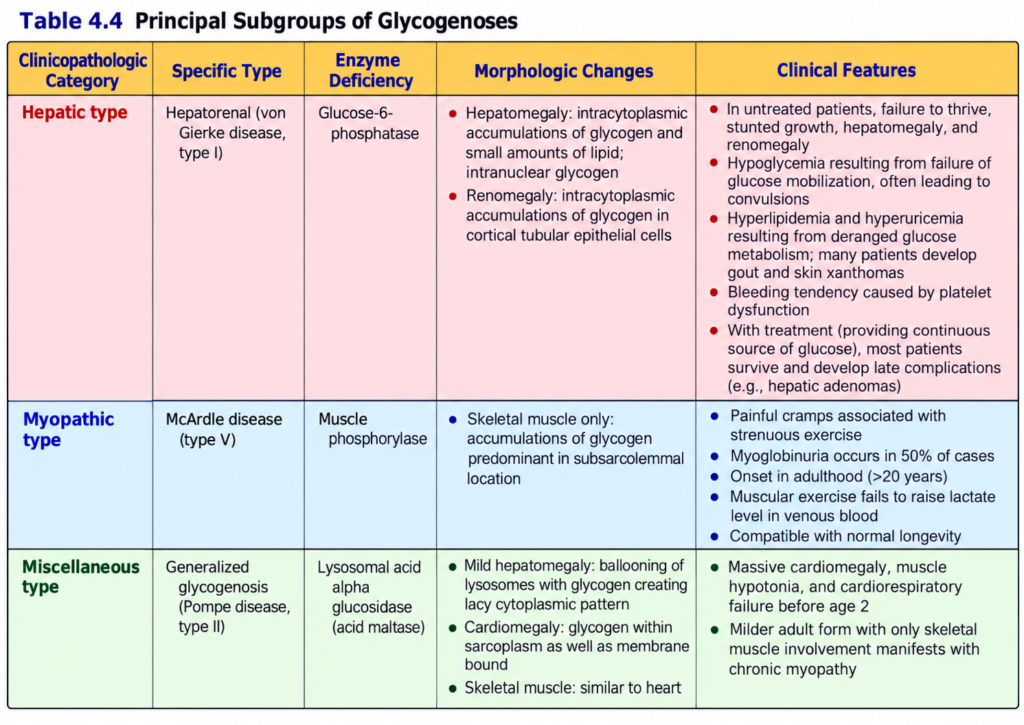
- About a dozen forms are known and can be grouped into three major categories (Table 4.4).
Hepatic type
- The liver normally:
- stores glucose as glycogen
- breaks glycogen down to release free glucose
- Deficiency of hepatic glycogen-metabolizing enzymes causes two major effects:
- glycogen accumulation → hepatomegaly
- inability to produce enough glucose → hypoglycemia (Fig. 4.16)
- Von Gierke disease (type I) is the major hepatic form.
- It results from deficiency of glucose-6-phosphatase.
Myopathic type
- Skeletal muscle uses glycogen as an important energy source.
- Defects in enzymes involved in glycolysis → glycogen accumulates in muscle + energy production falls.
- Major manifestations:
- muscle weakness
- exercise-induced muscle cramps
- myoglobinuria
- exercise fails to increase blood lactate normally because glycolysis is blocked
- Important examples:
- McArdle disease (type V) → deficiency of muscle phosphorylase
- Type VII glycogenosis → deficiency of muscle phosphofructokinase
Type II Glycogenosis (Pompe Disease)
- Pompe disease is caused by deficiency of acid α-glucosidase (lysosomal acid maltase).
- Glycogen accumulates in almost every organ.
- The most prominent finding is cardiomegaly (eFig. 4.1).
- Severe disease → cardiorespiratory failure.
- Many affected patients die within the first 2 years.
- Glucosidase replacement therapy can:
- improve cardiac muscle damage
- modestly prolong survival
KEY CONCEPT
- Hepatic glycogenosis → liver enlargement + hypoglycemia.
- Myopathic glycogenosis → muscle glycogen accumulation + exercise intolerance.
- Pompe disease → lysosomal enzyme deficiency + widespread glycogen storage + cardiomegaly.
- Von Gierke = glucose-6-phosphatase deficiency.
- McArdle = muscle phosphorylase deficiency.
CONCEPTUAL EXAMPLES
- Liver cannot release glucose from stored glycogen → glycogen builds up + blood glucose falls.
- Muscle cannot use glycogen properly during exercise → cramps + weakness + myoglobinuria.
- Lysosomal acid maltase is absent → glycogen accumulates in cardiac muscle → cardiomegaly and cardiorespiratory failure.
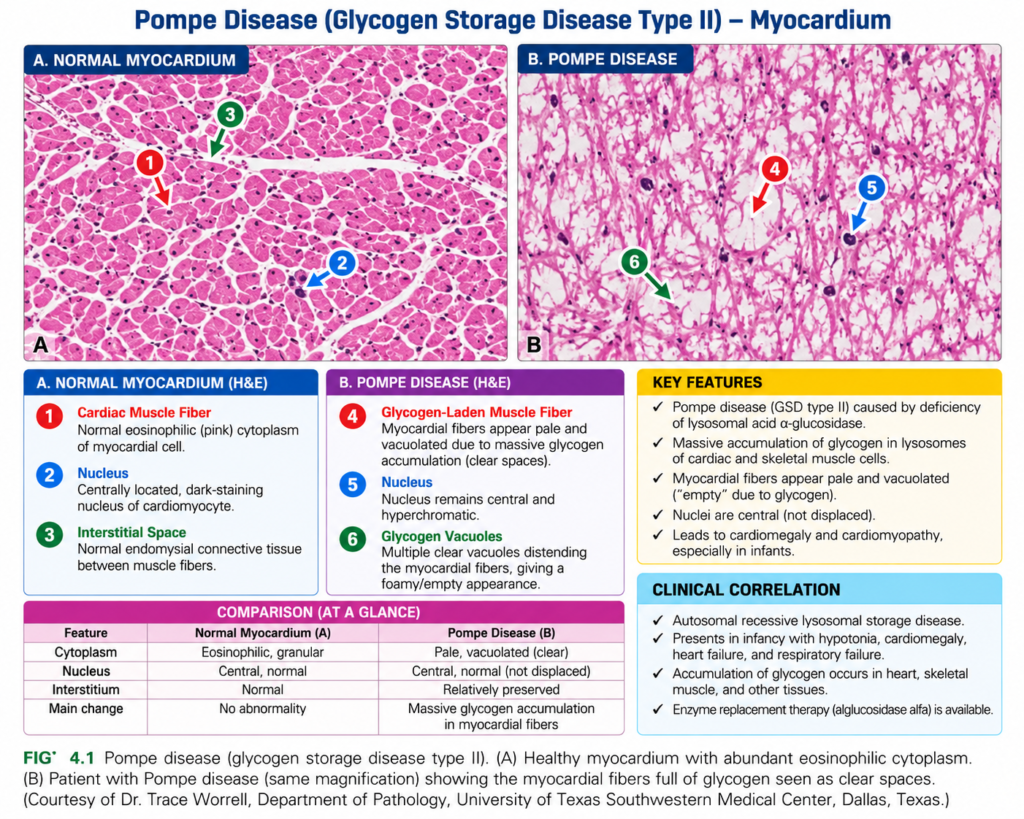
FIG. 4.16 — GLYCOGEN STORAGE DISEASES
🧠 Simplest idea
Glycogen = stored glucose.
If an enzyme needed to break glycogen or use glucose is missing, glycogen accumulates and the organ cannot do its normal job.
Whole figure in one line
Liver defect → cannot maintain blood glucose → hypoglycemia
Muscle defect → cannot make enough ATP during exercise → muscle weakness/low energy
🟦 LEFT SIDE — NORMAL
1️⃣ Normal liver
🟢 Hexagons = glycogen
🔵 Small shapes = glucose
The liver can move both ways:
Glucose → glycogen
→ stores glucose after meals.
Glycogen → glucose
→ releases glucose during fasting.
Glucose-6-phosphatase
This liver enzyme allows glucose-6-phosphate to become free glucose.
⬇️ Yellow arrow
Liver glucose → blood glucose → other tissues
🧠 Main liver job:
Keep blood glucose normal.
2️⃣ Normal skeletal muscle
Blood glucose enters muscle.
Muscle can:
Store it
Glucose → glycogen
or
Use it
Glycogen → glucose intermediates → glycolysis → ATPMuscle phosphorylase
Helps break:
Glycogen → usable glucose phosphate
Phosphofructokinase
Important enzyme in:
Glycolysis → ATP
⬇️
⚡ ATP = ENERGY for muscle contraction
🟥 RIGHT SIDE — GLYCOGEN STORAGE DISEASES
3️⃣ TOP RIGHT — HEPATIC TYPE
The figure shows:
❌ Glucose-6-phosphatase deficiency
The liver may have glycogen, but it cannot efficiently make free glucose for the blood.
So:
Glycogen stored
→ glucose cannot be properly released
→ glycogen accumulates in liver
→ blood glucose falls
⬇️
LOW BLOOD GLUCOSE / HYPOGLYCEMIA
Easy concept:
The liver has glucose stored, but cannot export it properly.
⭐ Classic example: Von Gierke disease (GSD I)
4️⃣ BOTTOM RIGHT — MYOPATHIC TYPE
Here the problem is mainly inside skeletal muscle.
Two examples are shown.
A. ❌ Muscle phosphorylase deficiency
Glycogen cannot be broken down properly.
Muscle glycogen
❌ → usable glucose intermediates
So:
- glycogen accumulates
- less substrate enters glycolysis
- ↓ ATP
- exercise intolerance / muscle fatigue
⭐ Classic example: McArdle disease (GSD V)
B. ❌ Phosphofructokinase deficiency
Glycolysis itself is blocked.
Glucose
→ glycolysis ❌
→ less ATP
⬇️
LOW ENERGY OUTPUT
⭐ Classic example: Tarui disease (GSD VII)
🎨 ARROW / COLOR GUIDE
- 🟢 Green hexagons = glycogen
- 🔵 Blue shapes = glucose
- 🟨 Yellow arrows = direction of glucose/glycogen metabolism
- 🔴 Muscle = skeletal muscle
- 🟣 Liver = liver
- ❌ Enzyme deficiency = metabolic pathway blocked
⭐ MOST IMPORTANT DIFFERENCE
| Hepatic GSD | Myopathic GSD |
|---|---|
| Liver mainly affected | Muscle mainly affected |
| Cannot maintain blood glucose | Cannot make enough ATP |
| Hypoglycemia | Exercise intolerance / weakness |
| Glycogen accumulates in liver | Glycogen accumulates in muscle |
🧠 Fastest exam recall
LIVER
Glycogen → glucose → blood
If blocked:
➡️ Hypoglycemia
MUSCLE
Glycogen → glycolysis → ATP
If blocked:
➡️ Low energy / exercise intolerance
⭐ One-line memory
Liver glycogen is for BLOOD GLUCOSE; muscle glycogen is for MUSCLE ENERGY.
