
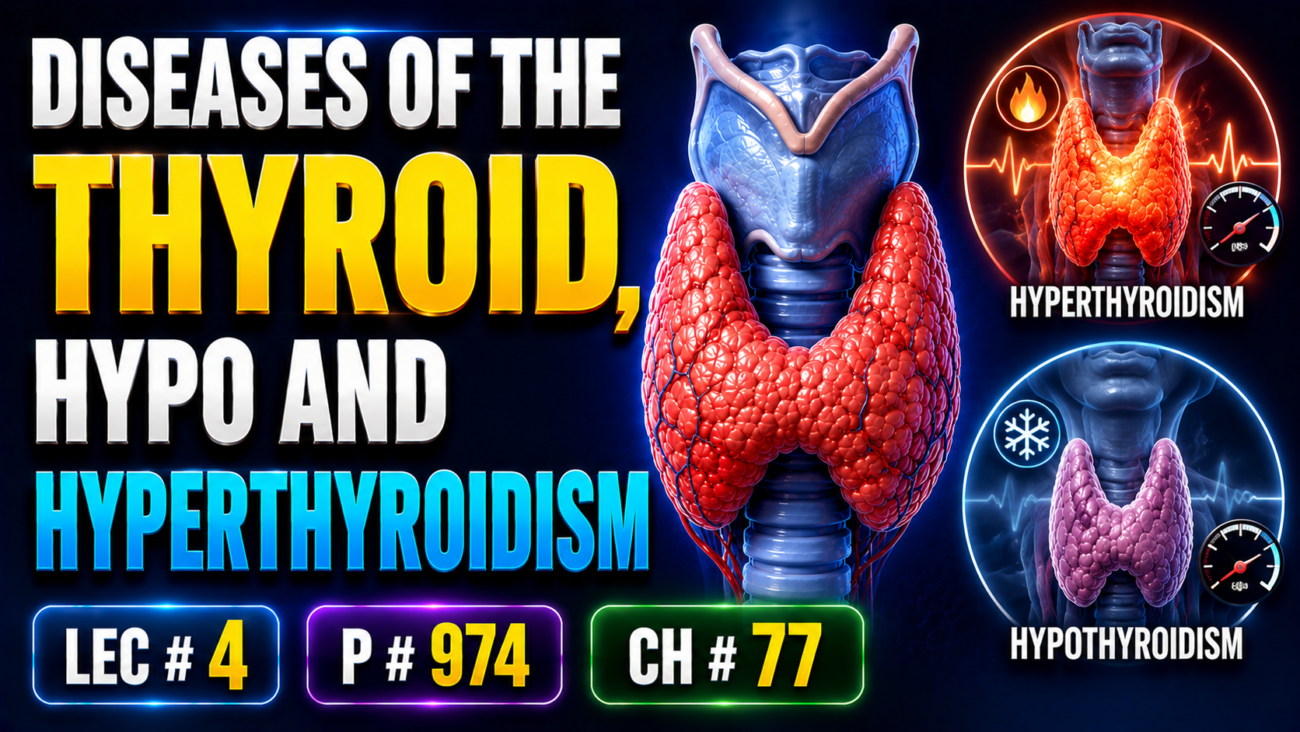
- Hyperthyroidism means excessive thyroid hormone activity.
- Most effects are explained by the increased actions of thyroid hormones on body tissues.
- In many patients, the thyroid becomes 2–3 times larger than normal.
- The thyroid follicles show marked cell growth and folding, greatly increasing the number of thyroid cells.
- Each thyroid cell also increases its secretion several times.
- Some hyperplastic glands can secrete thyroid hormone at 5–15 times the normal rate.
- Graves disease is the most common form of hyperthyroidism.
- It is an autoimmune disease in which thyroid-stimulating immunoglobulins (TSIs) form against the thyroid TSH receptor.
- TSIs bind to the same receptors as TSH and continuously activate the cAMP system.
- This causes continuous thyroid stimulation and excessive thyroid hormone production.
- TSI stimulation lasts up to 12 hours, whereas TSH stimulation lasts a little over 1 hour.
- Increased thyroid hormone then suppresses pituitary TSH secretion.
- Therefore, TSH is usually very low or almost zero in Graves disease.
- The antibodies are thought to result from autoimmunity against thyroid tissue, possibly after thyroid cell antigens are released.
- Thyroid adenoma is another cause of hyperthyroidism.
- It is a localized thyroid tumor that produces large amounts of thyroid hormone.
- Unlike Graves disease, it is usually not associated with autoimmune disease.
- Excess hormone from the adenoma suppresses pituitary TSH secretion.
- Low TSH almost completely suppresses hormone secretion by the remaining normal thyroid tissue.
KEY CONCEPT
- Hyperthyroidism → excessive thyroid hormone production/action.
- Graves disease: TSI → TSH receptor → cAMP continuously activated → ↑ T₃/T₄ → ↓ TSH.
- Thyroid adenoma: tumor → ↑ T₃/T₄ → ↓ TSH → normal thyroid tissue suppressed.
- Graves: usually diffuse thyroid enlargement.
- Adenoma: localized hormone-secreting tumor.
CONCEPTUAL EXAMPLES
- Graves disease: TSI acts like persistent TSH → thyroid remains continuously stimulated.
- High T₃/T₄ in Graves: negative feedback → TSH ≈ zero.
- Adenoma: tumor produces T₃/T₄ independently → TSH falls → rest of thyroid becomes inactive.
Symptoms of Hyperthyroidism
- Hyperthyroidism commonly causes:
- High excitability
- Heat intolerance
- Increased sweating
- Weight loss, sometimes severe
- Diarrhea
- Muscle weakness
- Nervousness or psychic disorders
- Extreme fatigue with inability to sleep
- Hand tremor
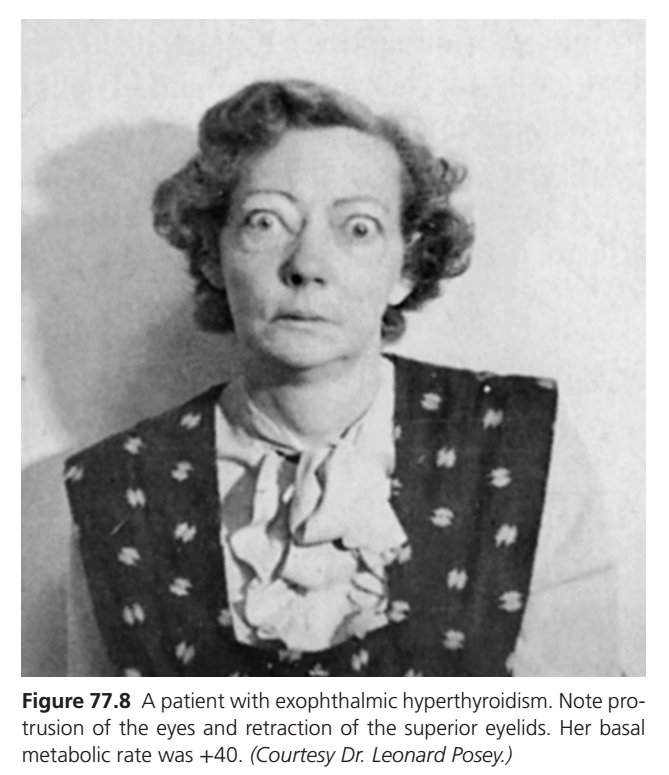
- Exophthalmos means protrusion of the eyeballs and is common in hyperthyroidism (Fig. 77.8).
- Severe exophthalmos occurs in about one-third of patients.
- Severe protrusion can stretch the optic nerve and damage vision.
- More commonly, incomplete eyelid closure causes the eyes to become dry, irritated, infected, and sometimes ulcerated.
- The protrusion results from swelling of tissues behind the eyes and changes in the extraocular muscles.
- Immunoglobulins reacting with eye muscles are often present, especially when TSI levels are high.
- Therefore, exophthalmos is likely related to an autoimmune process and usually improves when hyperthyroidism is treated.
- The most accurate usual diagnostic test is measurement of free thyroxine (and sometimes T₃) in plasma.
- Basal metabolic rate is usually increased by about 30–60% in severe hyperthyroidism.
- TSH is usually almost absent because high circulating T₄ and T₃ strongly suppress pituitary TSH secretion.
- TSI is usually high in thyrotoxicosis but low in thyroid adenoma.
- A direct treatment is surgical removal of most of the thyroid gland.
- Before surgery, propylthiouracil is usually given for several weeks until the basal metabolic rate becomes normal.
- Then high concentrations of iodides are given for 1–2 weeks to reduce thyroid size and blood supply before surgery.
- These preparations greatly reduce operative mortality.
- Radioactive iodine can also treat a hyperplastic, toxic thyroid gland.
- About 80–90% of injected iodide is taken up by the hyperplastic thyroid within 1 day.
- If the iodide is radioactive, it destroys many thyroid secretory cells.
- Usually about 5 millicuries is given, followed by reassessment after several weeks.
- Additional doses may be given until normal thyroid function is reached.
KEY CONCEPT
Hyperthyroidism → ↑ metabolism + ↑ excitability + heat intolerance + sweating + weight loss + diarrhea + weakness + tremor.
Diagnosis:
Free T₄/T₃ ↑ + TSH ↓; TSI ↑ in Graves/thyrotoxicosis but low in thyroid adenoma.
Treatment:
PTU → high-dose iodide → surgery, or radioactive iodine.
CONCEPTUAL EXAMPLES
- High T₃/T₄ → TSH almost zero → confirms strong negative feedback.
- TSI high → Graves-type thyrotoxicosis.
- TSI low → thyroid adenoma more likely.
- Exophthalmos + hyperthyroidism → autoimmune thyroid process likely.
- Radioactive iodine uptake by toxic thyroid → destroys secretory cells.
Hypothyroidism
- Hypothyroidism generally produces effects opposite to hyperthyroidism.
- It is often caused by autoimmunity against the thyroid gland (Hashimoto disease).
- In Hashimoto disease, autoimmunity destroys the thyroid instead of stimulating it.
- Autoimmune thyroiditis causes inflammation → progressive deterioration → fibrosis → decreased or absent thyroid hormone secretion.
- Goiter means a greatly enlarged thyroid gland.
- Endemic colloid goiter occurs when the diet lacks enough iodine.
- About 50 mg of iodine/year is needed to make adequate thyroid hormones.
- Iodine deficiency → T₄/T₃ ↓ → less negative feedback → TSH ↑.
- High TSH continuously stimulates thyroid cells → large amounts of thyroglobulin colloid accumulate → thyroid enlarges.
- Because iodine is lacking, T₄/T₃ still cannot be adequately formed.
- The follicles may enlarge so much that the thyroid becomes 10–20 times normal size.
- Idiopathic nontoxic colloid goiter can occur even without iodine deficiency.
- The thyroid may produce normal or, more commonly, reduced amounts of thyroid hormone.
- Mild thyroiditis may cause slight hypothyroidism → TSH ↑ → growth of remaining thyroid tissue.
- This may produce a nodular thyroid, with some areas growing while others are damaged.
- Some colloid goiters result from abnormalities in thyroid hormone formation:
- ↓ iodide trapping → inadequate iodide enters thyroid cells.
- ↓ peroxidase activity → iodide is not properly oxidized.
- ↓ coupling of iodinated tyrosines → T₄/T₃ cannot form.
- ↓ deiodinase activity → iodine cannot be efficiently recycled.
- Some foods contain goitrogenic substances with antithyroid activity, especially certain varieties of turnips and cabbages.
- These substances can reduce thyroid hormone formation → TSH ↑ → thyroid enlargement.
- The physiological effects of hypothyroidism are generally:
- Fatigue and extreme sleepiness, sometimes sleeping 12–14 hours/day
- Muscular sluggishness
- Slow heart rate
- ↓ cardiac output
- ↓ blood volume
- Sometimes ↑ body weight
- Constipation
- Mental sluggishness
- Reduced hair growth and scaly skin
- Husky, frog-like voice
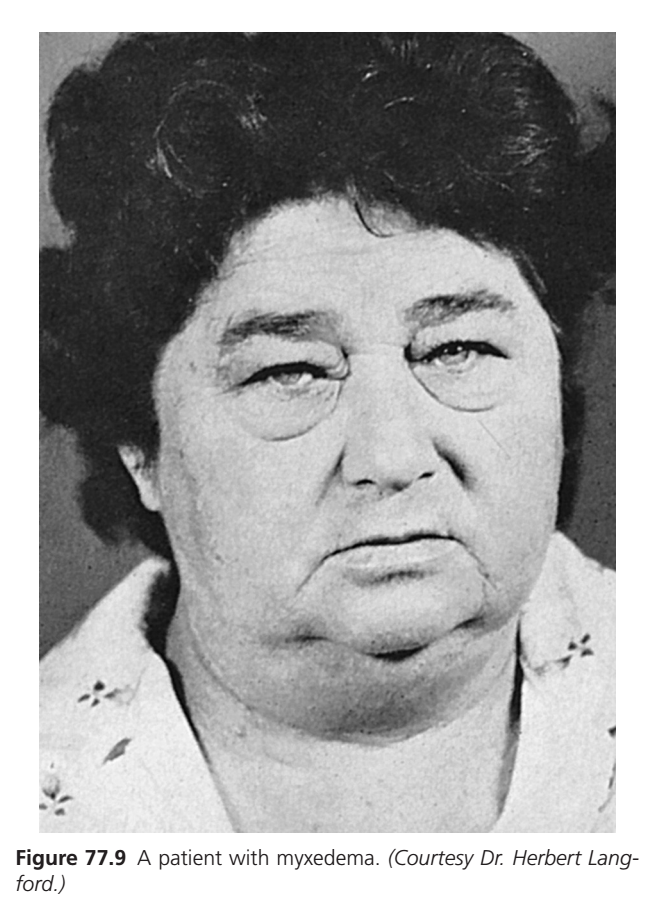
- Severe cases → myxedema
- Myxedema occurs with almost total loss of thyroid hormone function (Fig. 77.9).
- Excess hyaluronic acid and chondroitin sulfate bound to protein accumulate in tissue spaces.
- This increases interstitial fluid, but the fluid becomes gel-like and mainly immobile.
- Therefore, the edema is nonpitting.
- Lack of thyroid hormone increases blood cholesterol because of altered fat metabolism and reduced liver cholesterol excretion into bile.
- Increased cholesterol can promote atherosclerosis.
- This can contribute to peripheral vascular disease, deafness, and coronary artery disease.
- In hypothyroidism, free T₄ is low.
- In myxedema, the basal metabolic rate falls about 30–50%.
- After a test dose of TRH, TSH usually increases greatly.
- This response is reduced in the rare cases where the pituitary responds poorly to TRH.
- Thyroxine treatment can maintain a steady thyroid hormone effect because its action lasts more than 1 month (Fig. 77.4).
- Therefore, daily oral thyroxine can maintain thyroid hormone activity at a steady level.
- Proper treatment can restore hypothyroid patients to near-normal function.
- Severe hypothyroidism during fetal life, infancy, or childhood causes failure of body growth and intellectual disability.
- Causes include congenital absence of the thyroid, genetic defects in thyroid hormone production, or iodine deficiency.
- A newborn without a thyroid may initially appear normal because some thyroid hormone was supplied by the mother before birth.
- After a few weeks, movements become sluggish and physical and mental growth become severely impaired.
- Early treatment with adequate iodine or thyroxine can restore normal physical growth.
- If treatment is delayed for more than a few weeks, mental development may remain permanently impaired because thyroid hormone is needed for neuronal growth, branching, and myelination.
- Skeletal growth is affected more than soft-tissue growth, producing an obese, stocky, short appearance.
- The tongue may become disproportionately large and can interfere with swallowing and breathing.
KEY CONCEPT
Hypothyroidism → T₃/T₄ ↓ → metabolism ↓ + TSH usually ↑ → thyroid enlargement may occur.
Iodine deficiency → T₃/T₄ ↓ → TSH ↑ → goiter.
Severe thyroid hormone deficiency → myxedema in adults; impaired growth and brain development in children.
CONCEPTUAL EXAMPLES
- Iodine ↓ → T₃/T₄ ↓ → TSH ↑ → thyroid grows → goiter.
- Hashimoto disease → thyroid destruction → T₃/T₄ ↓ → hypothyroidism.
- Hypothyroidism → metabolism ↓ → fatigue + cold/slow body functions + weight gain tendency.
- Severe deficiency → hyaluronic acid/chondroitin sulfate ↑ → gel-like tissue fluid → nonpitting myxedema.
- Childhood hypothyroidism untreated early → impaired brain development + poor growth.