


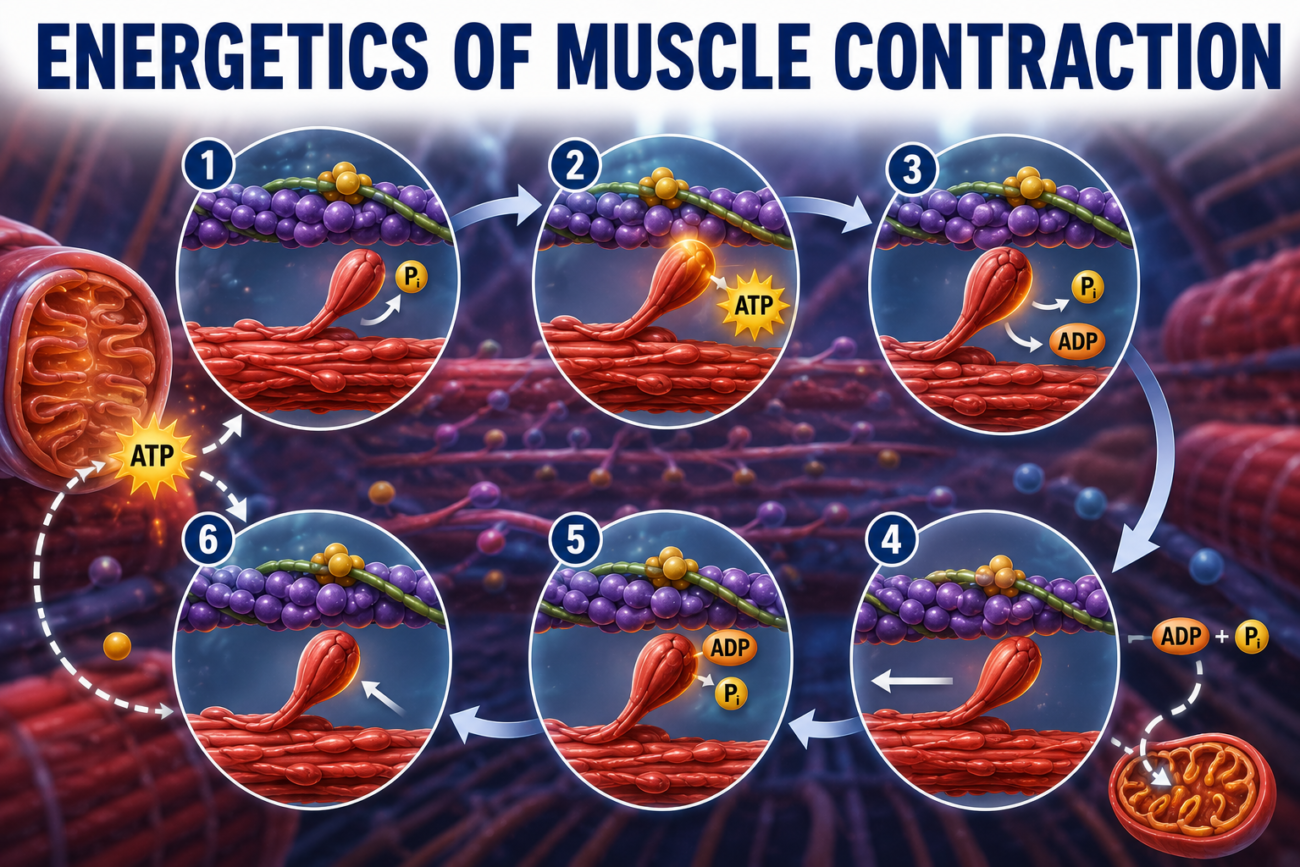
Work Output During Muscle Contraction
- When a muscle contracts against a load, it performs work.
- Work means that energy is transferred from the muscle to an external object.
- This transferred energy is used to:
- Lift an object to a greater height, or
- Overcome resistance and produce movement.
Formula for Work
W=L×D
Where:
- W = Work output
- L = Load (the force or weight being lifted)
- D = Distance (how far the load moves)
Understanding the Formula
- If the load (L) increases, the work done increases, provided the distance remains the same.
- If the distance (D) increases, the work done also increases, provided the load remains the same.
- If either the load or the distance is zero, no work is done.
Examples
Example 1
- Load = 10 kg
- Distance = 2 m
W=10×2=20
- The muscle performs 20 units of work.
Example 2
- Load = 20 kg
- Distance = 2 m
W=20×2=40
- Since the load doubled, the work also doubled.
Example 3
- Load = 10 kg
- Distance = 4 m
W=10×4=40
- Since the distance doubled, the work also doubled.
Source of Energy
- The energy needed to perform work comes from chemical reactions inside the muscle cells.
- During muscle contraction, ATP is broken down, releasing the energy required for:
- Cross-bridge cycling
- Muscle shortening
- Moving the external load
Easy Conceptual Story
Imagine you are lifting a school bag.
- If you lift a light bag a short distance, you do less work.
- If you lift a heavier bag, you do more work.
- If you lift the same bag to a higher shelf, you also do more work.
So:
- Heavier load = More work
- Greater distance = More work
- No movement = No work, even if your muscles are producing force.
KEY CONCEPT
- A muscle performs work when it contracts against a load.
- Work means transferring energy from the muscle to move an external object or overcome resistance.
- Work is calculated by the equation: W=L×DW = L \times DW=L×D.
- W = Work output, L = Load, D = Distance moved.
- Increasing either the load or the distance increases the work done.
- The energy required for work comes from ATP breakdown during muscle contraction.
Three Sources of Energy for Muscle Contraction
- Muscle contraction requires a continuous supply of energy (ATP).
- Most ATP is used for the walk-along (cross-bridge) mechanism, where myosin pulls the actin filament.
- Small amounts of ATP are also required for:
- Pumping Ca²⁺ from the sarcoplasm back into the sarcoplasmic reticulum after contraction.
- Pumping Na⁺ and K⁺ across the muscle cell membrane to maintain the ionic balance needed for action potentials.
ATP Supply Is Very Limited
- The ATP concentration inside a muscle fiber is about 4 mmol/L (4 mM).
- This stored ATP can support maximum muscle contraction for only about 1–2 seconds.
- During contraction:
- ATP is broken down into ADP and phosphate (Pi).
- The released energy powers muscle contraction.
- Therefore, ATP must be regenerated continuously.
- ADP is rapidly rephosphorylated to ATP within a fraction of a second, allowing contraction to continue.
- There are three sources of energy that regenerate ATP.
1. Phosphocreatine (Creatine Phosphate) — The Immediate Energy Source
- The first and fastest source of energy is phosphocreatine (PCr).
- Phosphocreatine contains a high-energy phosphate bond, similar to ATP.
- In fact, its high-energy phosphate bond contains slightly more free energy than an ATP phosphate bond.
- Therefore, phosphocreatine is broken down immediately when ATP levels fall.
- The released phosphate combines with ADP to rapidly regenerate ATP.
Limitation of Phosphocreatine
- The amount of phosphocreatine stored in muscle is also limited.
- It is about five times greater than the ATP store.
- Together, the stored ATP and phosphocreatine provide enough energy for only about 5–8 seconds of maximum muscle contraction.
2. Glycolysis — The Short-Term Energy Source
- The second source of energy is glycolysis.
- Glycolysis is the breakdown of glycogen stored in muscle cells.
- Glycogen is rapidly converted into:
- Pyruvic acid
- Lactic acid
- This process releases energy.
- The released energy is used to:
- Convert ADP back into ATP.
- Rebuild phosphocreatine stores.
Importance of Glycolysis
First Advantage
- Glycolysis can occur even without oxygen (anaerobic metabolism).
- Therefore, muscles can continue contracting:
- When oxygen delivery is inadequate.
- For many seconds and sometimes for more than one minute.
Second Advantage
- ATP is produced about 2.5 times faster by glycolysis than by oxidative metabolism.
- Therefore, glycolysis provides rapid energy during intense exercise.
Limitation of Glycolysis
- During glycolysis, large amounts of metabolic end products (especially lactic acid) accumulate inside the muscle.
- These products reduce the efficiency of glycolysis.
- Therefore, glycolysis cannot maintain maximum muscle contraction for much longer than about one minute.
3. Oxidative Metabolism — The Long-Term Energy Source
- The third and final source of energy is oxidative metabolism.
- In oxidative metabolism:
- Oxygen combines with the end products of glycolysis and other food molecules.
- This reaction produces large amounts of ATP.
- More than 95% of the energy used during prolonged muscle activity comes from oxidative metabolism.
Food Sources Used
Oxidative metabolism uses:
- Carbohydrates
- Fats
- Proteins
During Long-Duration Exercise
- During very prolonged maximal exercise lasting many hours, most of the energy comes from fats.
- During exercise lasting 2–4 hours, up to one-half of the energy may come from stored carbohydrates (glycogen).
Easy Conceptual Story
Imagine your muscle is like a car with three fuel tanks.
Fuel Tank 1 – ATP + Phosphocreatine 🚀
- This is the emergency turbo fuel.
- It provides instant energy.
- It lasts only 5–8 seconds.
Fuel Tank 2 – Glycolysis ⚡
- When the first tank empties, the muscle breaks down stored glycogen.
- This supplies energy quickly, even without oxygen.
- However, lactic acid builds up, so this fuel lasts only about one minute.
Fuel Tank 3 – Oxidative Metabolism 🌬️
- This is the main fuel tank.
- It uses oxygen together with carbohydrates, fats, and proteins.
- It produces large amounts of ATP.
- It supports long-term muscle activity for hours.
KEY CONCEPT
- Most ATP is used for the actin–myosin cross-bridge (walk-along) mechanism, while smaller amounts are used for Ca²⁺ pumping and Na⁺/K⁺ pumping.
- Stored ATP lasts only about 1–2 seconds during maximal contraction.
- Phosphocreatine is the first and fastest source of ATP regeneration, providing energy for about 5–8 seconds.
- Glycolysis breaks down muscle glycogen to regenerate ATP without oxygen and supports intense contraction for up to about one minute.
- Oxidative metabolism uses oxygen with carbohydrates, fats, and proteins to produce ATP and supplies more than 95% of the energy for prolonged muscle contraction.
- During very long-duration exercise, fats become the major energy source, whereas stored carbohydrates contribute significantly during the first 2–4 hours.
DR SHEEN SELF LEARNING SERIES
Three Sources of Energy for Muscle Contraction – The Muscle’s Three Fuel Tanks
Imagine your muscle is a powerful sports car. To keep moving, the engine needs a continuous supply of fuel (ATP). Without ATP, the muscle cannot contract even for a second.
Most ATP is used by the actin–myosin cross-bridges (walk-along mechanism) that pull the muscle fibers and produce movement. A small amount of ATP is also needed to pump calcium (Ca²⁺) back into the sarcoplasmic reticulum after contraction and to maintain the sodium (Na⁺) and potassium (K⁺) balance required for the next nerve impulse.
The problem is that muscles store only a tiny amount of ATP. This stored ATP can power maximum muscle contraction for only about 1–2 seconds. Therefore, the muscle must continuously make new ATP. It does this using three energy systems, just like a car has three different fuel tanks.
Fuel Tank 1 – Phosphocreatine (PCr): The Emergency Booster 🚀
When the muscle suddenly starts working, it immediately uses phosphocreatine (PCr).
Think of phosphocreatine as the emergency power bank for your muscle. As soon as ATP begins to decrease, phosphocreatine donates its high-energy phosphate to ADP, quickly producing new ATP.
This system works within seconds and supplies energy almost instantly. However, the phosphocreatine store is also limited. Together, stored ATP and phosphocreatine keep the muscle working at maximum power for only about 5–8 seconds.
Example: Sprinting at the start of a race or lifting a very heavy weight.
Fuel Tank 2 – Glycolysis: The Quick Backup Battery ⚡
Once phosphocreatine is exhausted, the muscle switches to its second fuel tank—glycolysis.
Here, the muscle breaks down its stored glycogen into pyruvate and lactic acid, releasing energy to make more ATP.
The best feature of glycolysis is that it does not require oxygen. This allows muscles to continue working during intense exercise even when oxygen cannot reach them fast enough.
However, as glycolysis continues, lactic acid accumulates, making the muscles tired and reducing energy production. Therefore, this system can support maximum effort for only about one minute.
Example: A 400-meter sprint or climbing several flights of stairs rapidly.
Fuel Tank 3 – Oxidative Metabolism: The Main Fuel Tank 🌬️
For activities lasting many minutes or even hours, the muscle uses its largest and most efficient fuel tank—oxidative metabolism.
This system uses oxygen together with carbohydrates, fats, and proteins to produce a large amount of ATP.
Although it works more slowly than glycolysis, it produces far more ATP and provides more than 95% of the energy needed during prolonged muscle activity.
During very long exercise, fats become the main fuel, while during the first 2–4 hours, stored glycogen still contributes a large portion of the energy.
Example: Long-distance running, cycling, swimming, or walking for hours.
The Complete Story
Think of your muscle as a car with three fuel tanks.
- Tank 1 (ATP + Phosphocreatine) gives an instant burst of energy but empties within 5–8 seconds.
- Tank 2 (Glycolysis) provides fast backup energy without oxygen, but lactic acid builds up, so it lasts only about one minute.
- Tank 3 (Oxidative Metabolism) is the main fuel supply, using oxygen with carbohydrates, fats, and proteins to keep the muscle working for hours.
The muscle automatically changes from one fuel tank to the next depending on how long and how hard you exercise, ensuring a continuous supply of ATP so contraction never stops.KEY CONCEPT
- ATP is the direct energy source for muscle contraction.
- Most ATP powers the actin–myosin cross-bridge (walk-along mechanism), while smaller amounts pump Ca²⁺ and Na⁺/K⁺.
- Stored ATP lasts only 1–2 seconds.
- Phosphocreatine is the fastest emergency ATP source, lasting 5–8 seconds.
- Glycolysis provides rapid ATP without oxygen, but lactic acid limits it to about one minute.
- Oxidative metabolism uses oxygen, carbohydrates, fats, and proteins to produce large amounts of ATP and provides more than 95% of the energy for prolonged muscle activity.
- During very long exercise, fats become the major fuel, while glycogen contributes significantly during the first 2–4 hours.
Efficiency of Muscle Contraction
- Muscle efficiency means how much of the energy supplied to the muscle is converted into useful work instead of being lost as heat.
- Like an engine or motor, a muscle is not 100% efficient.
- During muscle contraction, only a small part of the energy becomes useful work, while most of the energy is released as heat.
What Is Muscle Efficiency?
- Efficiency is calculated as the percentage of energy input that is converted into useful work.
- Energy Input = Chemical energy stored in nutrients (food).
- Useful Output = Mechanical work performed by the muscle.
- Remaining Energy = Heat.
Maximum Efficiency
- Even under optimal conditions, muscle efficiency is less than 25%.
- This means:
- Less than 25% of the energy becomes useful work.
- More than 75% of the energy is lost as heat.
Why Is Muscle Efficiency So Low?
First Energy Loss
- During the conversion of food energy into ATP, about 50% of the original energy is lost as heat.
- Therefore, only about half of the food energy is stored in ATP.
Second Energy Loss
- Even after ATP is formed, only about 40–45% of the energy stored in ATP can be converted into mechanical work.
- The remaining ATP energy is also released as heat.
- Therefore, energy is lost twice:
- During ATP formation.
- During ATP utilization by the muscle.
Effect of Contraction Speed on Efficiency
Very Slow Contraction
- If the muscle contracts very slowly or develops tension without moving:
- The muscle still produces maintenance heat.
- However, little or no external work is performed.
- Therefore, efficiency decreases greatly.
- In some situations, the efficiency may become almost zero.
Very Fast Contraction
- If the muscle contracts too rapidly:
- Much of the energy is used to overcome viscous friction inside the muscle.
- Less energy is available for useful work.
- Therefore, efficiency also decreases.
Moderate Contraction Speed
- The highest muscle efficiency occurs when the muscle contracts at a moderate speed.
- Maximum efficiency is achieved when the contraction velocity is about 30% of the muscle’s maximum contraction velocity.
Easy Conceptual Story
Imagine a car engine.
- If the engine runs too slowly, it burns fuel but the car hardly moves.
- If the engine runs at extremely high speed, much of the fuel is wasted because of friction and heat.
- The best fuel efficiency occurs at a moderate speed, where the car travels the greatest distance with the least fuel.
Your muscles work in exactly the same way.
- Too slow → Heat is produced but very little work.
- Too fast → More energy is lost overcoming internal friction.
- Moderate speed → Maximum efficiency and maximum useful work.
KEY CONCEPT
- Muscle efficiency is the percentage of chemical energy converted into useful mechanical work.
- Even under optimal conditions, muscle efficiency is less than 25%; most of the energy is released as heat.
- About 50% of food energy is lost during ATP formation.
- Only about 40–45% of the energy stored in ATP is converted into mechanical work; the rest is released as heat.
- Very slow contractions produce maintenance heat with little work, reducing efficiency.
- Very rapid contractions waste energy overcoming internal viscous friction, also reducing efficiency.
- Maximum efficiency occurs when the muscle contracts at about 30% of its maximum contraction velocity.
PREPARE AND MADE SELF LEARNING BY DR SHEEN
