


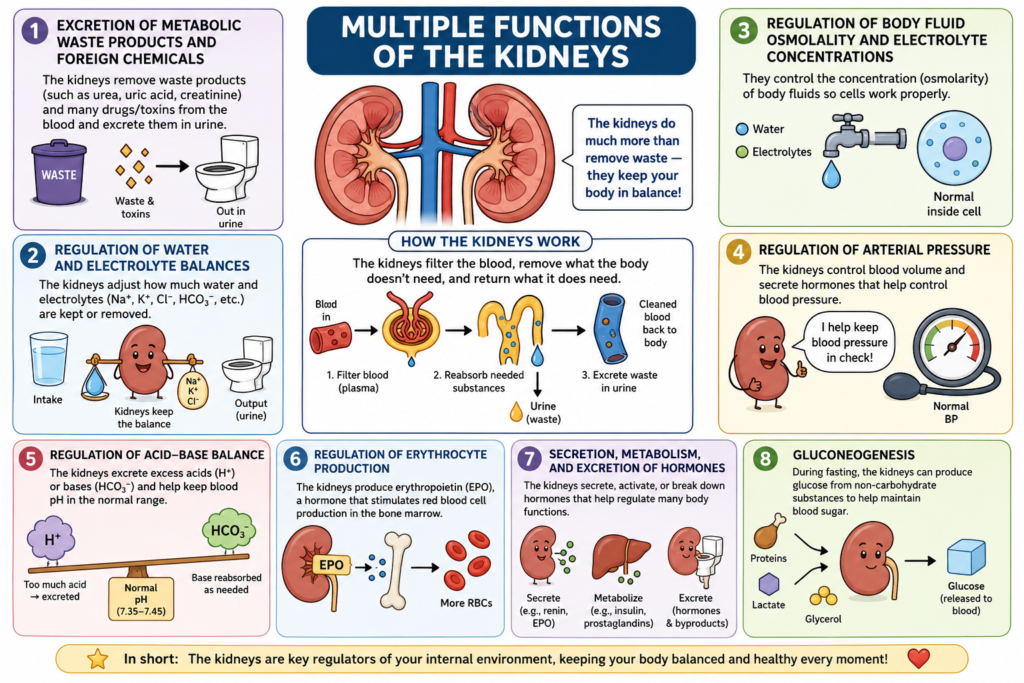
MULTIPLE FUNCTIONS OF THE KIDNEYS
- Most people know that one important function of the kidneys is to remove waste materials that enter the body or are produced during metabolism.
- Another very important function of the kidneys is to control the volume and electrolyte composition of body fluids.
- The balance between intake and output of water and almost all electrolytes is mainly maintained by the kidneys.
- Intake comes from food, drinks, or metabolic production.
- Output occurs through excretion or metabolic consumption.
- This regulatory function helps maintain a stable internal environment for normal cell activities.
- The kidneys perform many important functions by filtering the plasma.
- They remove substances from the filtrate at different rates according to the body’s needs.
- The kidneys eliminate unwanted substances by excreting them in the urine.
- They return needed substances from the filtrate back to the blood.
IMPORTANT HOMEOSTATIC FUNCTIONS OF THE KIDNEYS
- Excretion of metabolic waste products and foreign chemicals.
- Regulation of water and electrolyte balance.
- Regulation of body fluid osmolality and electrolyte concentrations.
- Regulation of arterial blood pressure.
- Regulation of acid–base balance.
- Regulation of erythrocyte (red blood cell) production.
- Secretion, metabolism, and excretion of hormones.
- Gluconeogenesis (formation of glucose).
KEY CONCEPT
The kidneys maintain body homeostasis by filtering blood, removing wastes, balancing water and electrolytes, regulating blood pressure and acid–base balance, supporting red blood cell production, handling hormones, and producing glucose when needed.
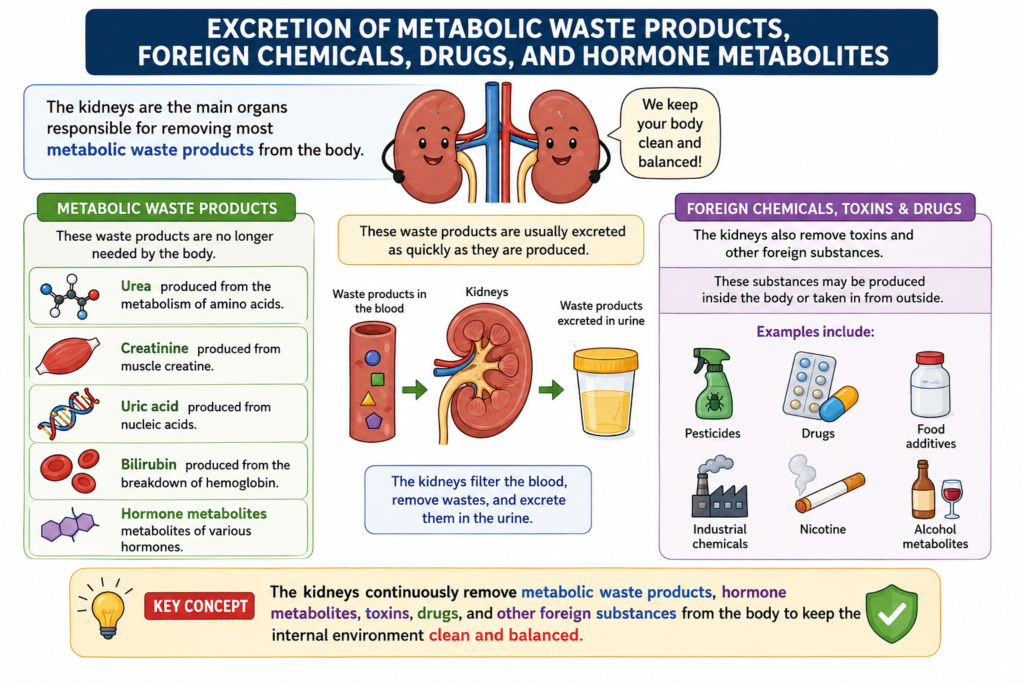
EXCRETION OF METABOLIC WASTE PRODUCTS, FOREIGN CHEMICALS, DRUGS, AND HORMONE METABOLITES
- The kidneys are the main organs responsible for removing most metabolic waste products from the body.
- These waste products are no longer needed by the body.
- Urea is produced from the metabolism of amino acids.
- Creatinine is produced from muscle creatine.
- Uric acid is produced from nucleic acids.
- Bilirubin is produced from the breakdown of hemoglobin.
- The kidneys also remove metabolites of various hormones.
- These waste products are usually excreted as quickly as they are produced.
- The kidneys also remove toxins and other foreign substances.
- These substances may be produced inside the body or taken in from outside.
- Examples include pesticides, drugs, and food additives.
KEY CONCEPT
The kidneys continuously remove metabolic waste products, hormone metabolites, toxins, drugs, and other foreign substances from the body to keep the internal environment clean and balanced.
REGULATION OF WATER AND ELECTROLYTE BALANCES
- To maintain homeostasis, the excretion of water and electrolytes must equal their intake over the long term.
- If intake is greater than excretion, the amount of that substance in the body increases.
- If intake is less than excretion, the amount of that substance in the body decreases.
- Temporary imbalances of water and electrolytes can occur in normal and disease conditions.
- Life depends on restoring water and electrolyte balance.
- Water and electrolyte intake is mainly controlled by eating and drinking habits.
- The kidneys adjust their excretion rates to match the intake of different substances.
- When sodium intake suddenly increases from 30 mEq/day to 300 mEq/day, the kidneys respond by increasing sodium excretion.
- Within 2–3 days, sodium excretion rises to about 300 mEq/day.
- This restores the balance between sodium intake and sodium output.
- During the 2–3 days of adaptation, a small amount of sodium accumulates in the body.
- This sodium accumulation slightly increases extracellular fluid volume.
- The increase in fluid volume triggers hormonal and other compensatory responses.
- These responses signal the kidneys to increase sodium excretion.
- The kidneys have a remarkable ability to adjust sodium excretion according to sodium intake.
- Sodium intake can increase to about 1500 mEq/day with only small changes in extracellular fluid volume or plasma sodium concentration.
- Sodium intake can also decrease to about 10 mEq/day with only small changes in body fluid balance.
- The same principle applies to water and most other electrolytes.
- These electrolytes include chloride, potassium, calcium, hydrogen, magnesium, and phosphate ions.
- The kidneys use specialized mechanisms to maintain this balance and preserve homeostasis.
KEY CONCEPT
The kidneys maintain homeostasis by continuously adjusting the excretion of water and electrolytes to match their intake, keeping body fluid volume and electrolyte concentrations nearly constant despite large changes in consumption.
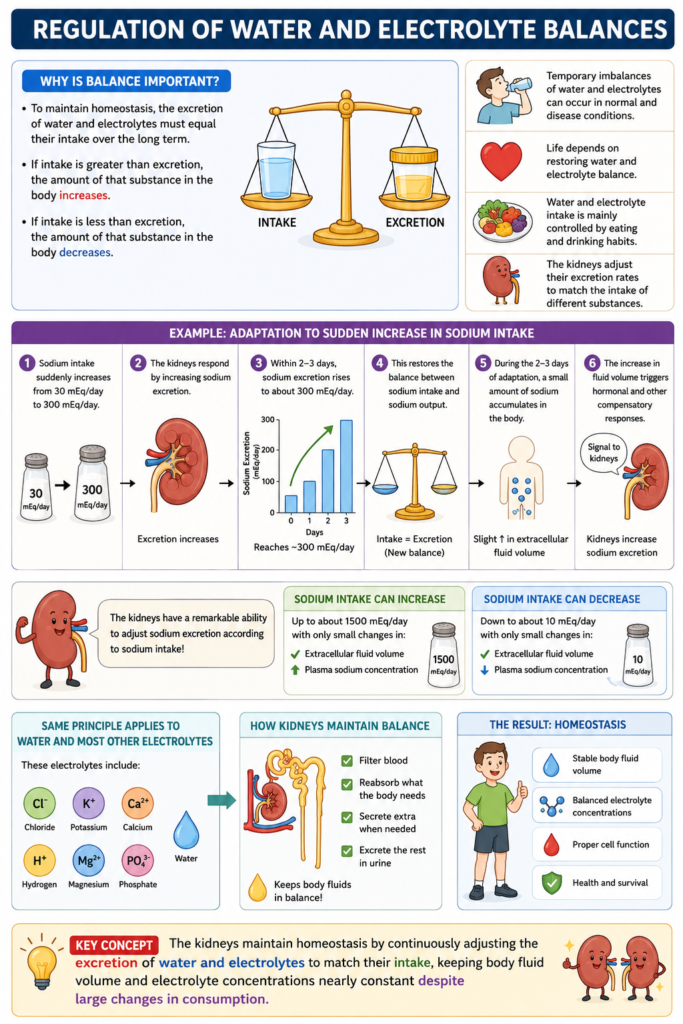
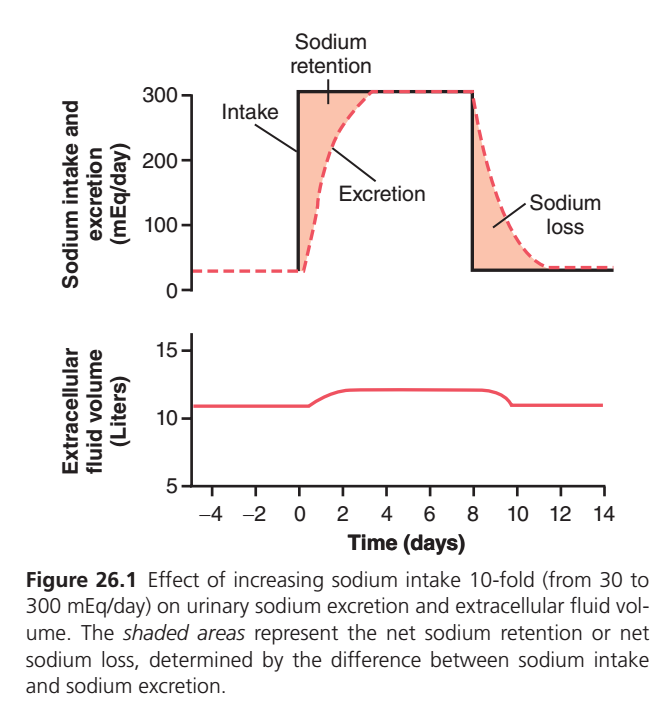
FIGURE 26.1: EFFECT OF A 10-FOLD INCREASE IN SODIUM INTAKE
WHAT THE GRAPH IS SHOWING
This graph explains how the kidneys adjust sodium excretion when sodium intake suddenly increases and then decreases.
The graph has two parts:
- Upper graph → Sodium intake and sodium excretion
- Lower graph → Extracellular fluid (ECF) volume
UPPER GRAPH
Y-Axis
Sodium intake and excretion (mEq/day)
- Higher value = more sodium entering or leaving the body.
- Lower value = less sodium entering or leaving the body.
X-Axis
Time (days)
Shows what happens over several days.
BLACK SOLID LINE = SODIUM INTAKE
This line represents how much sodium a person eats.
Before Day 0
- Sodium intake = 30 mEq/day
- This is a low sodium intake.
At Day 0
The black line suddenly jumps upward.
- Sodium intake increases from 30 → 300 mEq/day
- This is a 10-fold increase.
Day 0 to Day 8
- Sodium intake remains at 300 mEq/day
- The person continues eating a high-sodium diet.
Around Day 8
The black line suddenly drops.
- Sodium intake falls back to 30 mEq/day
After Day 8
- Sodium intake stays low.
RED DASHED LINE = SODIUM EXCRETION
This line shows how much sodium the kidneys remove in urine.
Before Day 0
- Excretion = about 30 mEq/day
- Intake = Excretion
Meaning
The body is in sodium balance.
No sodium is being stored or lost.
At Day 0
Sodium intake suddenly rises to 300 mEq/day.
But the kidneys cannot respond instantly.
So:
- Intake = 300 mEq/day
- Excretion = still about 30 mEq/day
Meaning
Much more sodium is entering than leaving.
Day 0 to Day 3
The red dashed line gradually rises.
This means:
- Kidneys are increasing sodium excretion.
- Hormonal mechanisms are adjusting.
Excretion rises from:
- 30 mEq/day
- → 100
- → 200
- → 300 mEq/day
Around Day 3
The red dashed line reaches the black line.
Now:
- Intake = 300 mEq/day
- Excretion = 300 mEq/day
Meaning
A new sodium balance has been established.
Day 3 to Day 8
Both lines overlap.
- Intake = Excretion
Again, sodium balance exists.
After Day 8
Sodium intake suddenly falls back to 30 mEq/day.
However, kidneys are still excreting sodium rapidly.
So initially:
- Intake = 30 mEq/day
- Excretion = about 300 mEq/day
Meaning
More sodium is leaving than entering.
Day 8 to Day 12
The kidneys gradually reduce sodium excretion.
The red dashed line slowly falls until it reaches:
- 30 mEq/day
After Day 12
- Intake = Excretion = 30 mEq/day
Balance is restored again.
SHADED AREA 1 = SODIUM RETENTION
(Left shaded region after Day 0)
What does it represent?
The difference between:
Sodium intake − Sodium excretion
During this period:
- Intake is greater than excretion.
Example:
- Intake = 300
- Excretion = 100
Difference = +200 mEq
This extra sodium remains in the body.
Meaning
The body is storing sodium.
This is called:
Sodium Retention
WHY DOES SODIUM RETENTION OCCUR?
Because the kidneys need time to adjust.
They cannot instantly excrete the extra sodium.
Therefore sodium temporarily accumulates.
RESULT OF SODIUM RETENTION
Extra sodium pulls water with it.
Therefore:
- More water stays in the body.
- Extracellular fluid volume increases.
SHADED AREA 2 = SODIUM LOSS
(Right shaded region after Day 8)
What does it represent?
The difference between:
Sodium excretion − Sodium intake
During this period:
- Excretion is greater than intake.
Example:
- Excretion = 200
- Intake = 30
Difference = 170 mEq
This sodium is removed from body stores.
Meaning
The body is losing sodium.
This is called:
Sodium Loss
WHY DOES SODIUM LOSS OCCUR?
Because kidneys are still excreting sodium at a high rate even after intake falls.
The kidneys again need time to readjust.
LOWER GRAPH
RED SOLID LINE = EXTRACELLULAR FLUID (ECF) VOLUME
This graph shows the amount of fluid outside the body’s cells.
Examples:
- Plasma
- Interstitial fluid
Before Day 0
ECF volume is about:
11 Liters
Normal steady state.
Day 0 to Day 3
Sodium retention occurs.
Since sodium attracts water:
- Water is retained.
- ECF volume increases.
The curve rises from:
11 L → about 12 L
Day 3 to Day 8
Sodium balance is restored.
ECF volume remains slightly elevated.
The curve stays flat.
Day 8 to Day 10
Sodium loss occurs.
Water follows sodium out of the body.
ECF volume decreases.
The curve falls.
After Day 10
ECF volume returns to approximately:
11 Liters
Normal level again.
SIMPLE STORY OF THE WHOLE GRAPH
Step 1
Person suddenly eats a lot of sodium.
↓
Step 2
Kidneys are slow to adjust.
↓
Step 3
More sodium enters than leaves.
↓
Step 4
Sodium retention occurs (first shaded area).
↓
Step 5
Water is retained with sodium.
↓
Step 6
Extracellular fluid volume increases.
↓
Step 7
Kidneys adapt and excrete more sodium.
↓
Step 8
Balance is restored.
↓
Step 9
Sodium intake suddenly decreases.
↓
Step 10
Kidneys continue excreting sodium for a short time.
↓
Step 11
Sodium loss occurs (second shaded area).
↓
Step 12
Water leaves with sodium.
↓
Step 13
Extracellular fluid volume returns to normal.
KEY CONCEPT
The shaded areas represent temporary sodium gain or sodium loss because kidney excretion does not change instantly. The kidneys gradually adjust sodium excretion to match sodium intake, and any temporary sodium retention or loss causes corresponding changes in extracellular fluid volume.
REGULATION OF ARTERIAL PRESSURE
- The kidneys play a major role in the long-term regulation of arterial blood pressure.
- They regulate arterial pressure by excreting different amounts of sodium and water.
- When the kidneys excrete more sodium and water, the amount of fluid in the body decreases.
- When the kidneys excrete less sodium and water, the amount of fluid in the body increases.
- By adjusting sodium and water excretion, the kidneys help control arterial pressure over long periods.
- The kidneys also help regulate arterial pressure in the short term.
- They do this by secreting hormones and vasoactive factors.
- One important substance secreted by the kidneys is renin.
- Renin leads to the formation of vasoactive products.
- One important vasoactive product is angiotensin II.
- These substances help regulate arterial pressure.
KEY CONCEPT
The kidneys regulate arterial pressure in two ways: long-term control by adjusting sodium and water excretion, and short-term control by releasing substances such as renin that lead to the formation of angiotensin II and other vasoactive factors.
REGULATION OF ACID–BASE BALANCE
- The kidneys help regulate the acid–base balance of the body.
- They work together with the lungs and body fluid buffers to maintain normal acid–base balance.
- The kidneys regulate acid–base balance by excreting acids from the body.
- They also regulate the body’s buffer stores.
- Body fluid buffers help resist changes in pH.
- The kidneys are the only organs that can eliminate certain types of acids from the body.
- These acids include sulfuric acid and phosphoric acid.
- Sulfuric acid and phosphoric acid are produced during the metabolism of proteins.
- The kidneys remove these acids to help maintain normal body fluid pH.
KEY CONCEPT
The kidneys maintain acid–base balance by excreting acids and regulating body fluid buffers. They are the only organs that can eliminate certain metabolic acids, such as sulfuric acid and phosphoric acid, produced during protein metabolism.
REGULATION OF ERYTHROCYTE PRODUCTION
- The kidneys secrete a hormone called erythropoietin.
- Erythropoietin stimulates the production of red blood cells.
- Red blood cells are produced by hematopoietic stem cells in the bone marrow.
- One important stimulus for erythropoietin secretion is hypoxia.
- Hypoxia means a low level of oxygen in the body’s tissues.
- When oxygen levels decrease, the kidneys increase erythropoietin secretion.
- Increased erythropoietin stimulates the bone marrow to produce more red blood cells.
- The kidneys normally produce almost all of the erythropoietin found in the circulation.
- In severe kidney disease, erythropoietin production decreases.
- People whose kidneys have been removed and are receiving hemodialysis also produce much less erythropoietin.
- Reduced erythropoietin production leads to decreased red blood cell formation.
- As a result, severe anemia can develop.
KEY CONCEPT
The kidneys regulate red blood cell production by secreting erythropoietin. Low oxygen levels stimulate erythropoietin release, which increases red blood cell formation in the bone marrow. Severe kidney disease can cause anemia because of decreased erythropoietin production.
REGULATION OF 1,25-DIHYDROXYVITAMIN D₃ PRODUCTION
- The kidneys produce 1,25-dihydroxyvitamin D₃ (calcitriol).
- Calcitriol is the active form of vitamin D.
- The kidneys form calcitriol by adding a hydroxyl group at the “number 1” position of vitamin D.
- This process is called hydroxylation.
- Calcitriol is essential for normal calcium deposition in bones.
- Calcitriol is also essential for calcium reabsorption by the gastrointestinal tract.
- The gastrointestinal tract absorbs calcium more effectively in the presence of calcitriol.
- Calcitriol plays an important role in regulating calcium levels in the body.
- Calcitriol also plays an important role in regulating phosphate levels.
KEY CONCEPT
The kidneys produce calcitriol (1,25-dihydroxyvitamin D₃), the active form of vitamin D. Calcitriol is essential for calcium absorption from the gastrointestinal tract, normal calcium deposition in bones, and the regulation of calcium and phosphate balance.
GLUCOSE SYNTHESIS (GLUCONEOGENESIS)
- The kidneys can synthesize glucose from amino acids and other precursors.
- This process occurs during prolonged fasting.
- The formation of glucose from non-carbohydrate substances is called gluconeogenesis.
- During prolonged fasting, the kidneys add glucose to the blood.
- The kidneys’ ability to produce glucose during fasting is comparable to that of the liver.
EFFECTS OF KIDNEY FAILURE
- In chronic kidney disease or acute kidney failure, the normal homeostatic functions of the kidneys are disrupted.
- Severe abnormalities in body fluid volume and composition can develop rapidly.
- In complete kidney failure, potassium accumulates in the body.
- Acids also accumulate in the body.
- Excess fluid accumulates in the body.
- Other waste substances also build up.
- The accumulation of these substances can become life-threatening.
- Without treatment, complete kidney failure can cause death within a few days.
- Clinical interventions such as hemodialysis are required in complete kidney failure.
- Hemodialysis helps remove accumulated substances from the body.
- Hemodialysis partially restores body fluid and electrolyte balance.
KEY CONCEPT
The kidneys can produce glucose during prolonged fasting through gluconeogenesis, with a capacity similar to the liver. When kidney function fails, waste products, potassium, acids, and fluid accumulate rapidly, making treatments such as hemodialysis essential for survival.
SUMMARY, Functions of the Kidneys
The kidneys are very important organs that help maintain the body’s internal environment. Most people know that the kidneys remove waste products from the body, but they perform many other essential functions that are necessary for life.
One of the main functions of the kidneys is the excretion of metabolic waste products and foreign substances. During normal metabolism, the body produces waste materials such as urea, creatinine, uric acid, bilirubin, and hormone metabolites. These substances are no longer needed and can be harmful if they accumulate in the body. The kidneys remove these wastes through urine. They also eliminate toxins, drugs, pesticides, and food additives that enter the body.
Another important function is the regulation of water and electrolyte balance. The kidneys continuously adjust the amount of water and electrolytes excreted in urine so that intake matches output. If a person drinks more water or consumes more salt, the kidneys increase their excretion. If intake decreases, the kidneys conserve these substances. This process helps maintain normal body fluid volume and electrolyte concentrations.
The kidneys also play a major role in the regulation of arterial blood pressure. They control blood pressure by regulating the amount of sodium and water in the body. By increasing or decreasing the excretion of these substances, the kidneys can influence blood volume and blood pressure. They also produce renin, which leads to the formation of angiotensin II, an important substance involved in blood pressure regulation.
Another vital function is the regulation of acid–base balance. The kidneys work together with the lungs and body buffers to maintain a normal pH in body fluids. They remove excess acids from the body and help regulate buffer stores. The kidneys are especially important because they are the only organs capable of eliminating certain acids, such as sulfuric acid and phosphoric acid, which are produced during protein metabolism.
The kidneys are also responsible for the regulation of erythrocyte (red blood cell) production. They produce a hormone called erythropoietin, which stimulates the bone marrow to produce red blood cells. When oxygen levels in the body decrease, the kidneys release more erythropoietin. In severe kidney disease, erythropoietin production falls, which can lead to anemia.
Another important function of the kidneys is the production of 1,25-dihydroxyvitamin D₃ (calcitriol), the active form of vitamin D. Calcitriol is necessary for the absorption of calcium from the gastrointestinal tract and for normal calcium deposition in bones. It also helps regulate calcium and phosphate balance in the body.
During prolonged fasting, the kidneys can perform gluconeogenesis, which is the synthesis of glucose from amino acids and other substances. This allows the kidneys to add glucose to the bloodstream and help maintain blood glucose levels. During long periods of fasting, the kidneys can produce amounts of glucose comparable to those produced by the liver.
When kidney function is severely impaired, these important homeostatic functions are disrupted. Waste products, acids, potassium, and excess fluid accumulate in the body. Without treatment, complete kidney failure can become life-threatening within a few days. In such situations, treatments such as hemodialysis are required to remove waste products and help restore fluid and electrolyte balance.
Key Concept
The kidneys are essential for maintaining homeostasis. They remove wastes, regulate water and electrolytes, control blood pressure and acid–base balance, stimulate red blood cell production, activate vitamin D, produce glucose during fasting, and help keep the body’s internal environment stable.
