


Learning Objectives
After studying this topic, students will be able to:
- Describe the pathway of taste signals from the tongue to the cerebral cortex.
- Explain the role of the brain stem in taste reflexes and salivary secretion.
- Understand rapid adaptation of taste.
- Explain how body needs and previous experience influence taste preference.
Introduction
Taste is more than simply detecting different foods. Taste signals from the tongue and pharyngeal region travel through specific cranial nerves to the brain stem, thalamus, and cerebral cortex.
Within the brain stem, taste signals also help control salivary secretion during eating and digestion. Taste sensations can adapt rapidly during continuous stimulation, and taste preferences can change according to the body’s need for specific substances.
Previous pleasant or unpleasant experiences with food can also influence future food choices, showing that the central nervous system plays an important role in taste preference and taste aversion.
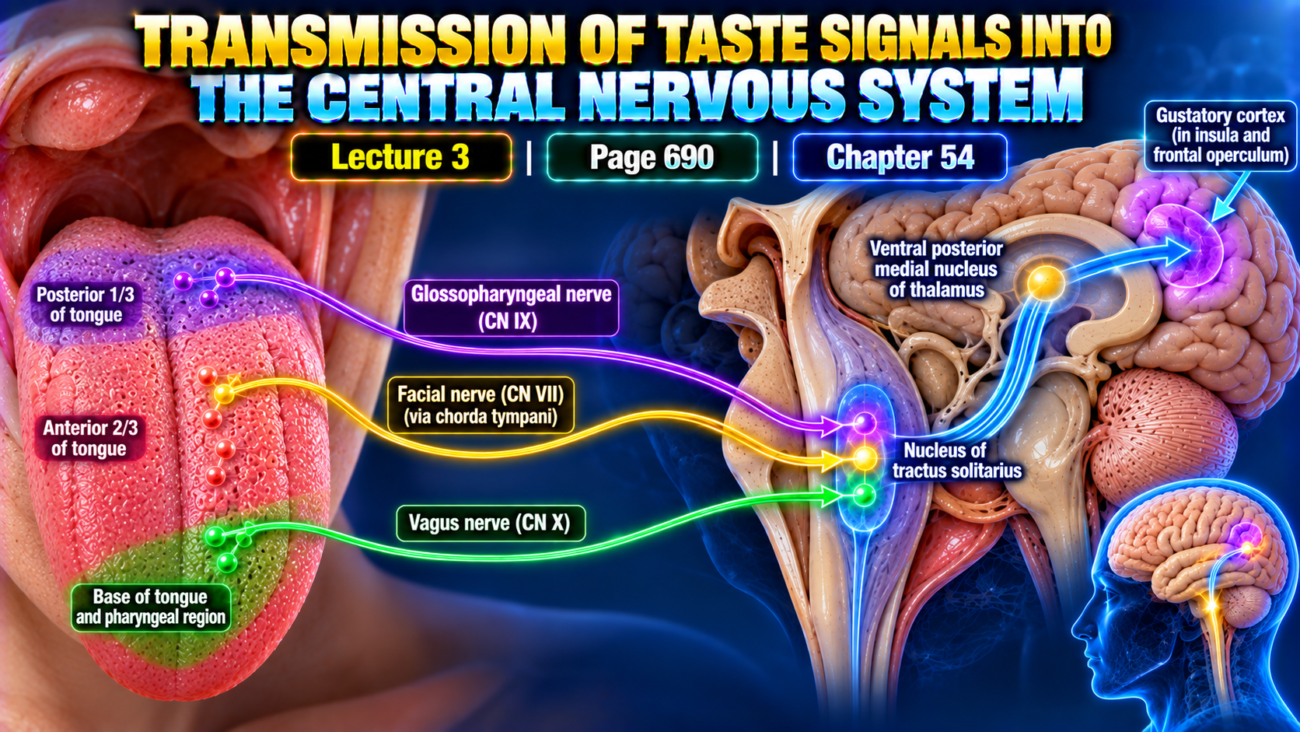
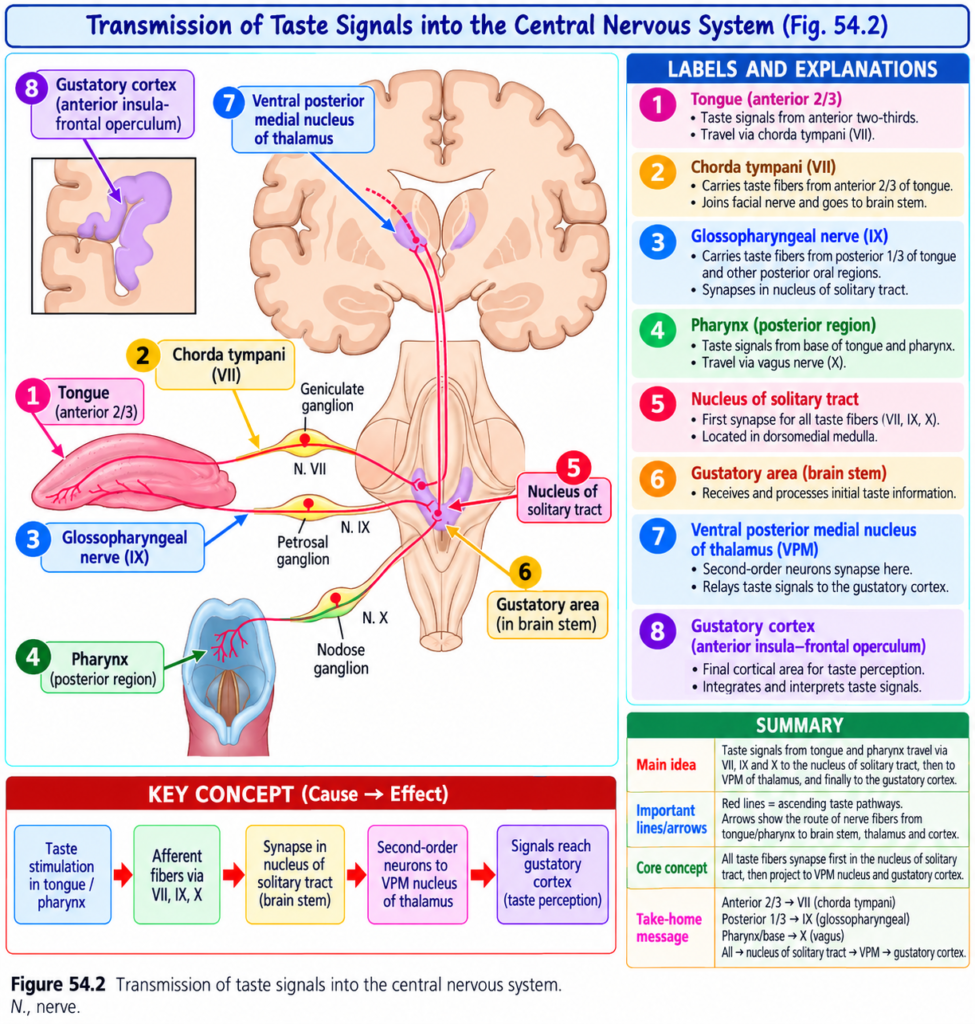
- Figs. 54.1 and 54.2 show the pathways that carry taste signals from the tongue and pharyngeal region to the central nervous system.
- Taste signals from the anterior two-thirds of the tongue travel through:
- Lingual nerve
- → Chorda tympani
- → Facial nerve
- → Tractus solitarius in the brain stem
- Taste signals from the circumvallate papillae at the back of the tongue and other posterior regions of the mouth and throat travel through:
- Glossopharyngeal nerve
- → Tractus solitarius
- These signals enter at a slightly more posterior level.
- A few taste signals from the base of the tongue and other parts of the pharyngeal region travel through:
- Vagus nerve
- → Tractus solitarius
- All taste fibers then synapse in the nuclei of the tractus solitarius in the posterior brain stem.
- From these nuclei, second-order neurons travel to a small area of the ventral posterior medial nucleus of the thalamus.
- This thalamic area lies slightly medial to the thalamic endings of the facial region of the dorsal column–medial lemniscal system.
- From the thalamus, third-order neurons travel to:
- The lower tip of the postcentral gyrus in the parietal cerebral cortex
- The area that curves deep into the sylvian fissure
- The adjacent opercular insular area
- This cortical area lies slightly lateral, ventral, and rostral to the area that receives tactile signals from the tongue in cerebral somatic area I.
- Therefore, the taste pathways closely parallel the somatosensory pathways from the tongue.
Taste Pathway – A Tiny Journey
Imagine a taste signal starting its journey from the tongue.
From the anterior two-thirds, it rides through the lingual nerve → chorda tympani → facial nerve and reaches the tractus solitarius.
From the back of the tongue, another taste signal takes the glossopharyngeal nerve, while a few signals from the base of the tongue and pharynx travel through the vagus nerve.
All three routes meet at one station: the nucleus of the tractus solitarius in the brain stem.
From there, the signal climbs to the VPM nucleus of the thalamus and finally reaches the postcentral gyrus and opercular-insular area of the cerebral cortex.
Easy journey:
Tongue → Cranial nerves → Tractus solitarius → VPM thalamus → Cerebral cortex → Taste perception
Taste Reflexes Are Integrated in the Brain Stem
- From the tractus solitarius, many taste signals travel within the brain stem.
- These signals pass directly to the superior and inferior salivatory nuclei.
- These nuclei then send signals to the:
- Submandibular glands
- Sublingual glands
- Parotid glands
- These signals help control saliva secretion during the ingestion and digestion of food.
Taste Reflexes Are Integrated in the Brain Stem
- From the tractus solitarius, many taste signals travel within the brain stem.
- These signals pass directly to the superior and inferior salivatory nuclei.
- These nuclei then send signals to the:
- Submandibular glands
- Sublingual glands
- Parotid glands
- These signals help control saliva secretion during the ingestion and digestion of food.
Rapid Adaptation of Taste
- Taste sensations adapt rapidly during continuous stimulation.
- This adaptation may become almost complete within about 1 minute.
- Studies of taste nerve fibers show that adaptation at the taste buds causes only about half of this rapid adaptation.
- Therefore, the remaining strong adaptation most likely occurs in the central nervous system.
- The exact mechanism of this central adaptation is not known.
- This is different from many other sensory systems, where adaptation occurs mainly at the receptors.
TASTE PREFERENCE AND CONTROL OF THE DIET
- Taste preference means choosing certain foods over others.
- This preference helps control what an animal eats.
- Taste preferences can change according to the body’s need for specific substances.
- Experiments show this clearly:
- Salt-depleted animals after adrenalectomy prefer water containing a high concentration of sodium chloride instead of pure water.
- They may take enough sodium chloride to meet the body’s needs and prevent death from salt depletion.
- Animals given excessive insulin develop low blood sugar and automatically choose the sweetest food available.
- Calcium-depleted, parathyroidectomized animals prefer water containing a high concentration of calcium chloride.
- Similar examples occur in everyday life:
- Salt licks in desert areas attract animals from long distances.
- Humans usually reject foods that produce an unpleasant sensation, which may protect them from undesirable substances.
- Taste preference most likely depends mainly on a mechanism in the central nervous system, rather than directly on the taste receptors.
- However, taste receptors may become more sensitive to a nutrient that the body needs.
- Previous experience with pleasant or unpleasant tastes also strongly affects taste preference.
- For example, if a person becomes sick soon after eating a particular food, the person may develop a negative preference or taste aversion to that food.
- The same type of taste aversion can also occur in animals.
Taste Preference – A Tiny Story
Imagine the brain as a smart food selector.
When the body lacks salt, it pushes the animal toward salty water.
When blood glucose falls after excess insulin, it drives the animal toward the sweetest food.
When the body lacks calcium, it favors calcium-rich water.
So, taste preference changes according to the body’s needs.
But the brain also remembers experience. If a food once makes someone sick, the brain may label it as “avoid”, producing taste aversion.
Easy concept:
Body need + past experience → CNS control → food preference
KEY CONCEPT
- Taste pathway:
Tongue/pharynx → Cranial nerves → Tractus solitarius → VPM thalamus → Cerebral cortex - Taste reflex:
Tractus solitarius → Salivatory nuclei → Salivary glands → Saliva secretion during eating and digestion - Taste adaptation:
Continuous taste stimulation → rapid adaptation → about half occurs at taste buds → remaining strong adaptation occurs mainly in the central nervous system. - Taste preference:
Body need + previous experience → CNS control → food choice
Conceptual Examples
- Salt depletion → preference for sodium chloride
- Low blood glucose after excess insulin → preference for sweet food
- Calcium depletion → preference for calcium chloride
- Food followed by sickness → taste aversion to that food
CLINICAL IMPORTANCE
- Taste signals help control salivary secretion during the ingestion and digestion of food through the superior and inferior salivatory nuclei.
- Taste adapts rapidly during continuous stimulation, with much of the final adaptation occurring in the central nervous system.
- Taste preference helps match food intake with the body’s needs:
- Salt depletion → preference for sodium chloride
- Low blood glucose after excess insulin → preference for sweet food
- Calcium depletion → preference for calcium chloride
- An unpleasant taste sensation may help a person reject undesirable substances.
- If a person becomes sick after eating a particular food, the person may later develop taste aversion to that food.
HIGH-YIELD POINTS
- Anterior two-thirds of tongue:
Lingual nerve → Chorda tympani → Facial nerve → Tractus solitarius - Posterior tongue/circumvallate papillae:
Glossopharyngeal nerve → Tractus solitarius - Base of tongue and pharyngeal region:
Vagus nerve → Tractus solitarius - All taste fibers synapse in the nuclei of the tractus solitarius.
- Second-order neurons:
Tractus solitarius → VPM nucleus of thalamus - Third-order neurons:
Thalamus → Postcentral gyrus + Opercular insular area - Taste reflexes activate the superior and inferior salivatory nuclei, helping control secretion from the submandibular, sublingual, and parotid glands.
- Taste sensation may adapt almost completely within about 1 minute of continuous stimulation.
- Adaptation of taste buds accounts for only about half of rapid taste adaptation; the remaining strong adaptation occurs mainly in the central nervous system.
- Taste preference changes according to body needs and is influenced by previous pleasant or unpleasant experiences.
- Salt depletion → sodium chloride preference
- Low blood glucose after excess insulin → sweet food preference
- Calcium depletion → calcium chloride preference
- Illness after eating a particular food may produce taste aversion.
QUICK REVISION
Taste pathway:
Tongue/pharynx → Cranial nerves → Tractus solitarius → VPM thalamus → Cerebral cortex
Taste reflex:
Tractus solitarius → Salivatory nuclei → Salivary glands → Saliva secretion
Taste adaptation:
Continuous stimulation → Rapid adaptation → Taste buds + CNS
Taste preference:
Body need + previous experience → CNS control → Food choice
Most Critical Takeaway
Tractus solitarius is the main brain-stem receiving point for taste signals, while the CNS plays a major role in taste adaptation, taste preference, and taste aversion.
REFERENCE SOURCE
Guyton and Hall Textbook of Medical Physiology, 15th Edition — Chapter 54: The Chemical Senses: Taste and Smell.
