


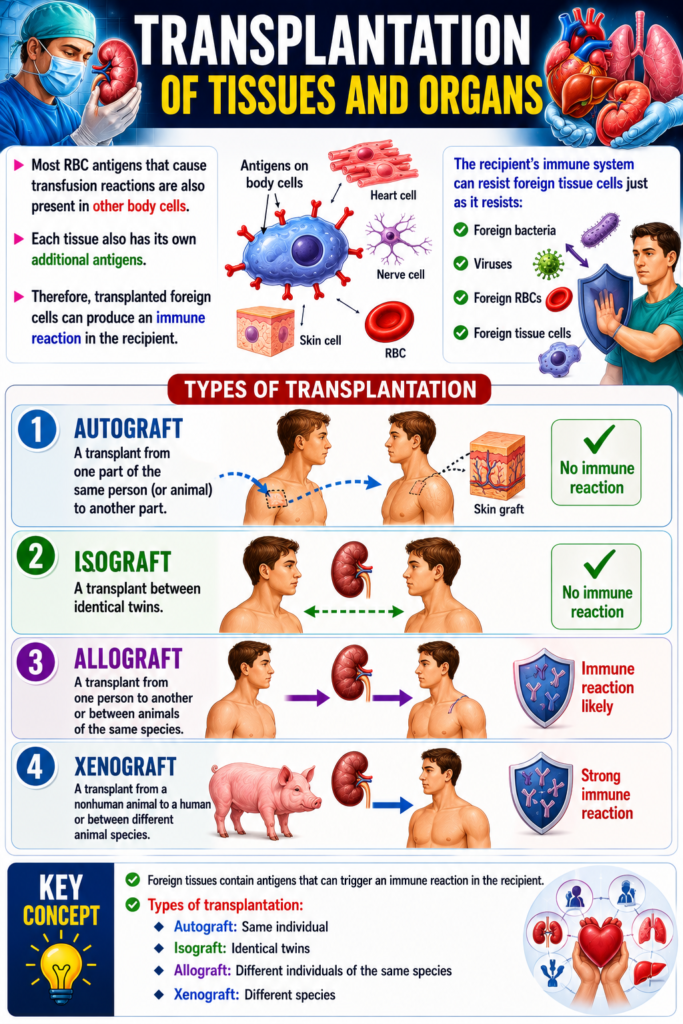
- Most RBC antigens that cause transfusion reactions are also present in other body cells.
- Each tissue also has its own additional antigens.
- Therefore, transplanted foreign cells can produce an immune reaction in the recipient.
- The recipient’s immune system can resist foreign tissue cells just as it resists:
- Foreign bacteria
- Viruses
- Foreign RBCs
- A transplant from one part of the same person (or animal) to another part is called an autograft.
- A transplant between identical twins is called an isograft.
- A transplant from one person to another or between animals of the same species is called an allograft.
- A transplant from a nonhuman animal to a human or between different animal species is called a xenograft.
Key Concept
- Foreign tissues contain antigens that can trigger an immune reaction in the recipient.
- Types of transplantation:
- Autograft: Same individual
- Isograft: Identical twins
- Allograft: Different individuals of the same species
- Xenograft: Different species
Transplantation of Cellular Tissues
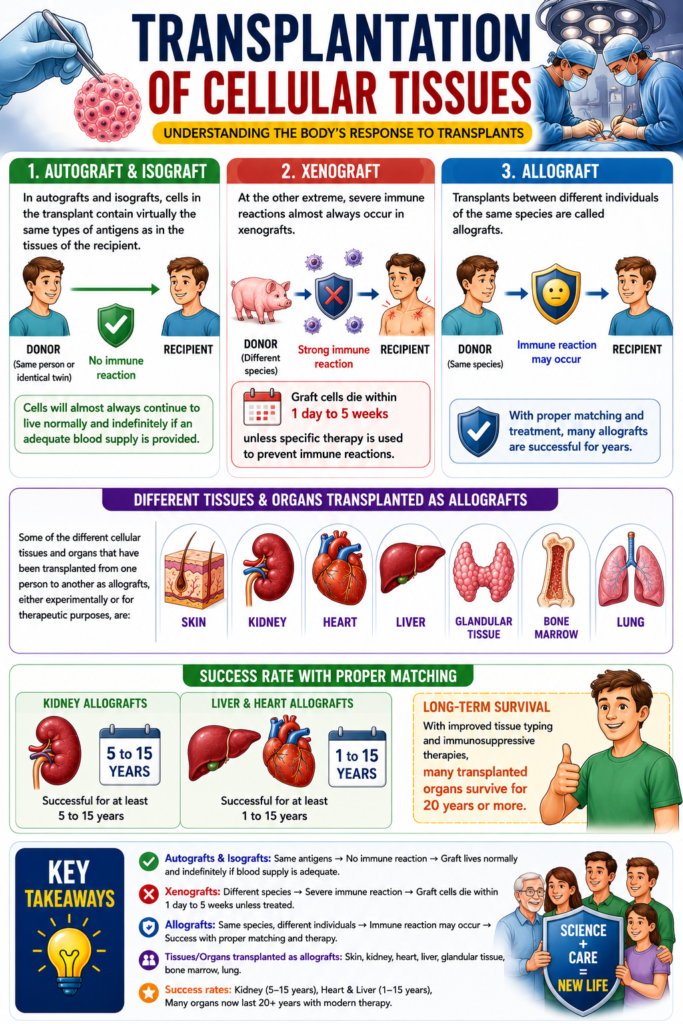
- In autografts and isografts, the transplanted cells have almost the same antigens as the recipient’s tissues.
- Therefore, these transplanted cells usually survive normally and indefinitely if they receive an adequate blood supply.
- In xenografts, severe immune reactions almost always occur.
- These immune reactions cause the death of graft cells.
- The graft cells usually die within 1 day to 5 weeks after transplantation unless specific therapy is used to prevent the immune reaction.
- Different tissues and organs have been transplanted as allografts for experimental or therapeutic purposes.
- These include:
- Skin
- Kidney
- Heart
- Liver
- Glandular tissue
- Bone marrow
- Lung
- With proper tissue matching, many kidney allografts have remained successful for 5 to 15 years.
- Liver and heart allografts have remained successful for 1 to 15 years.
- With improved tissue typing and immunosuppressive therapy, many transplanted organs survive for 20 years or more.
Key Concept
- Autografts and isografts usually survive because their antigens are almost identical to the recipient’s tissues.
- Xenografts usually undergo severe immune rejection within 1 day to 5 weeks unless treated.
- Successful allografts depend on proper tissue matching and immunosuppressive therapy.
- Modern transplanted organs can survive for 20 years or more.
ATTEMPTS TO OVERCOME IMMUNE REACTIONS IN TRANSPLANTED TISSUE
- Because transplantation of certain tissues and organs is very important, many attempts have been made to prevent antigen–antibody reactions.
- Some of these methods have shown clinical or experimental success.
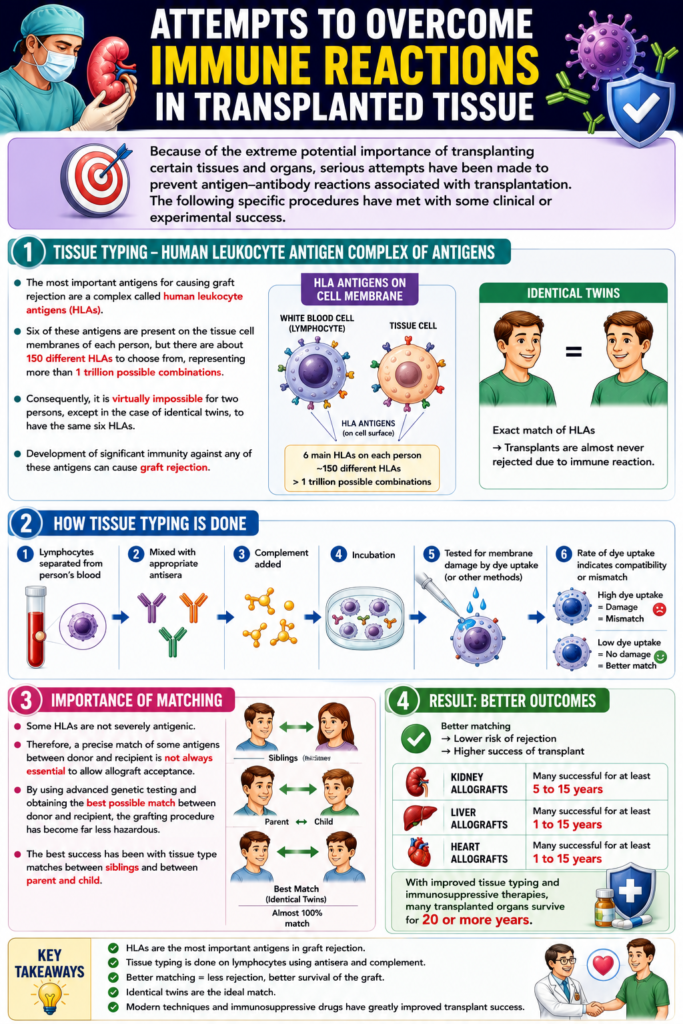
- The most important antigens responsible for graft rejection are called human leukocyte antigens (HLAs).
- Each person has six HLA antigens on the tissue cell membranes.
- There are about 150 different HLAs.
- These produce more than 1 trillion possible HLA combinations.
- Therefore, it is almost impossible for two people, except identical twins, to have the same six HLAs.
- Development of immunity against any of these HLAs can cause graft rejection.
- HLAs are present on white blood cells as well as tissue cells.
- Therefore, tissue typing is performed using lymphocytes separated from the person’s blood.
- The lymphocytes are mixed with appropriate antisera and complement.
- After incubation, the cells are tested for membrane damage.
- Membrane damage is usually detected by measuring the uptake of a special dye through the lymphocyte membrane.
- Some HLAs are not highly antigenic.
- Therefore, an exact match of all HLAs between the donor and recipient is not always necessary for successful allograft acceptance.
- More advanced genetic testing helps achieve the best possible donor–recipient match.
- This has made grafting procedures less hazardous.
- The best transplant success occurs between siblings.
- Good success is also achieved between parent and child.
- Identical twins have an exact HLA match.
- Therefore, transplants between identical twins are almost never rejected because of an immune reaction.
Key Concept
- Human leukocyte antigens (HLAs) are the main antigens responsible for graft rejection.
- Each person has six HLAs, selected from about 150 different HLAs, creating more than 1 trillion possible combinations.
- Tissue typing is performed using lymphocytes.
- Genetic matching between donor and recipient reduces the risk of graft rejection.
- Identical twins have an exact HLA match, so their transplants are rarely rejected.
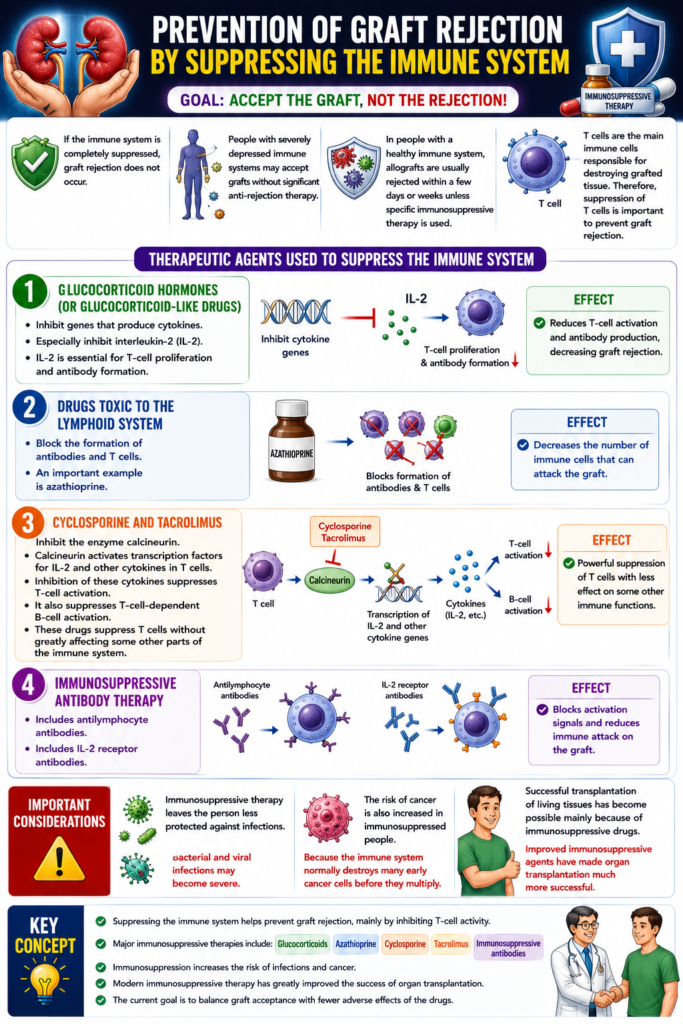
Prevention of Graft Rejection By Suppressing the Immune System
- If the immune system is completely suppressed, graft rejection does not occur.
- People with severely depressed immune systems may accept grafts without significant anti-rejection therapy.
- In people with a healthy immune system, allografts are usually rejected within a few days or weeks unless specific immunosuppressive therapy is used.
- T cells are the main immune cells responsible for destroying grafted tissue.
- Therefore, suppression of T cells is important to prevent graft rejection.
- Therapeutic agents used to suppress the immune system include:
- 1. Glucocorticoid hormones (or glucocorticoid-like drugs)
- Inhibit genes that produce cytokines.
- Especially inhibit interleukin-2 (IL-2).
- IL-2 is essential for T-cell proliferation and antibody formation.
- 2. Drugs toxic to the lymphoid system
- Block the formation of antibodies and T cells.
- An important example is azathioprine.
- 3. Cyclosporine and tacrolimus
- Inhibit the enzyme calcineurin.
- Calcineurin activates transcription factors for IL-2 and other cytokines in T cells.
- Inhibition of these cytokines suppresses T-cell activation.
- It also suppresses T-cell-dependent B-cell activation.
- These drugs suppress T cells without greatly affecting some other parts of the immune system.
- 4. Immunosuppressive antibody therapy
- Includes antilymphocyte antibodies.
- Includes IL-2 receptor antibodies.
- Immunosuppressive therapy leaves the person less protected against infections.
- Bacterial and viral infections may become severe.
- The risk of cancer is also increased in immunosuppressed people.
- This is because the immune system normally destroys many early cancer cells before they multiply.
- Successful transplantation of living tissues has become possible mainly because of immunosuppressive drugs.
- Improved immunosuppressive agents have made organ transplantation much more successful.
- The current goal of immunosuppressive therapy is to balance graft acceptance with fewer adverse effects of the drugs.
Key Concept
- Suppressing the immune system helps prevent graft rejection, mainly by inhibiting T-cell activity.
- Major immunosuppressive therapies include:
- Glucocorticoids
- Azathioprine
- Cyclosporine
- Tacrolimus
- Immunosuppressive antibodies
- Immunosuppression increases the risk of infections and cancer.
- Modern immunosuppressive therapy has greatly improved the success of organ transplantation.
MADE BY SELF LEARNING CEO AND FOUNDER DR SHEEN
