


- The determinant of GFR that changes the most is the glomerular hydrostatic pressure.
- Glomerular hydrostatic pressure is the determinant of GFR that is most subject to physiological control.
- Glomerular hydrostatic pressure is influenced by the sympathetic nervous system.
- Glomerular hydrostatic pressure is influenced by hormones.
- Glomerular hydrostatic pressure is influenced by autacoids.
- Autacoids are vasoactive substances.
- These substances are released in the kidneys.
- These substances act locally within the kidneys.
- Glomerular hydrostatic pressure is also influenced by other feedback controls.
- These feedback controls are intrinsic to the kidneys.
KEY CONCEPT
The most important and variable determinant of GFR is glomerular hydrostatic pressure, which is controlled by the sympathetic nervous system, hormones, autacoids, and intrinsic kidney feedback mechanisms.
STRONG SYMPATHETIC NERVOUS SYSTEM ACTIVATION DECREASES GFR
- Most kidney blood vessels are richly supplied by sympathetic nerve fibers.
- The afferent arterioles receive sympathetic nerve supply.
- The efferent arterioles also receive sympathetic nerve supply.
- Strong activation of the renal sympathetic nerves causes constriction of the renal arterioles.
- Constriction of the renal arterioles decreases renal blood flow.
- Constriction of the renal arterioles also decreases GFR.
- Moderate sympathetic stimulation has little effect on renal blood flow.
- Moderate sympathetic stimulation has little effect on GFR.
- Moderate decreases in pressure at the carotid sinus baroreceptors activate the sympathetic nervous system by reflex.
- Moderate decreases in pressure at the cardiopulmonary receptors also activate the sympathetic nervous system by reflex.
- This reflex sympathetic activation does not substantially change renal blood flow.
- This reflex sympathetic activation does not substantially change GFR.
- Even mild increases in renal sympathetic activity can stimulate renin release.
- Even mild increases in renal sympathetic activity can increase renal tubular reabsorption.
- Increased renal tubular reabsorption decreases sodium excretion.
- Increased renal tubular reabsorption decreases water excretion.
- The renal sympathetic nerves are especially important in reducing GFR during severe acute disturbances.
- These disturbances usually last from a few minutes to a few hours.
- Severe acute disturbances include the defense reaction.
- Severe acute disturbances include brain ischemia.
- Severe acute disturbances include severe hemorrhage.
- Severe acute disturbances include heavy exercise.
KEY CONCEPT
Strong sympathetic activation constricts renal arterioles, decreases renal blood flow, and decreases GFR. Mild to moderate sympathetic activation has little effect on renal blood flow and GFR but can increase renin release and tubular reabsorption, reducing sodium and water excretion.
HORMONAL AND AUTACOID CONTROL OF RENAL CIRCULATION
- Several hormones and autacoids can influence GFR.
- Several hormones and autacoids can influence renal blood flow.
- Norepinephrine can constrict the afferent and efferent arterioles.
- Epinephrine can constrict the afferent and efferent arterioles.
- Constriction of these arterioles decreases GFR.
- Constriction of these arterioles decreases renal blood flow.
- Norepinephrine is released during activity of the sympathetic nervous system.
- Epinephrine is released from the adrenal medulla.
- Blood levels of norepinephrine and epinephrine generally increase and decrease with sympathetic nervous system activity.
- Therefore, these hormones usually have little effect on renal hemodynamics under normal conditions.
- Norepinephrine and epinephrine become important during conditions associated with strong sympathetic activation.
- One example is severe hemorrhage.
- Endothelin is another powerful vasoconstrictor.
- Endothelin is a peptide.
- Endothelin is released by damaged vascular endothelial cells of the kidneys.
- Endothelin is also released by other tissues.
- The physiological role of endothelin is complex.
- Endothelin may help in hemostasis.
- Hemostasis helps minimize blood loss.
- When a blood vessel is damaged, the endothelium is also damaged.
- Damage to the endothelium causes the release of endothelin.
- Released endothelin causes powerful vasoconstriction.
- Plasma endothelin levels increase in many diseases associated with endothelial injury.
- These diseases include toxemia of pregnancy.
- These diseases include acute renal failure.
- These diseases include chronic uremia.
- Increased endothelin may contribute to renal vasoconstriction.
- Increased endothelin may contribute to decreased GFR in some of these pathological conditions.
KEY CONCEPT
Norepinephrine, epinephrine, and endothelin are vasoconstrictors that constrict renal blood vessels, reducing renal blood flow and GFR. Their effects become especially important during strong sympathetic activation or conditions associated with endothelial injury.
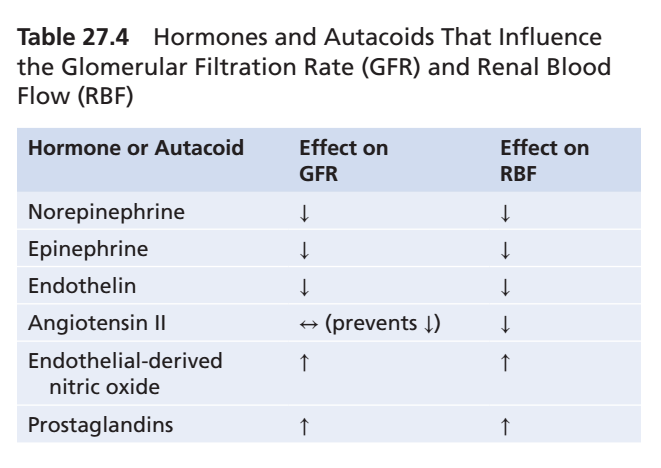
NOREPINEPHRINE, EPINEPHRINE, AND ENDOTHELIN CONSTRICT RENAL BLOOD VESSELS AND DECREASE GFR AND RENAL BLOOD FLOW
- Norepinephrine constricts the afferent arterioles.
- Norepinephrine constricts the efferent arterioles.
- Epinephrine constricts the afferent arterioles.
- Epinephrine constricts the efferent arterioles.
- Constriction of these arterioles decreases GFR.
- Constriction of these arterioles decreases renal blood flow.
- Epinephrine is released from the adrenal medulla.
- Blood levels of norepinephrine and epinephrine generally follow the activity of the sympathetic nervous system.
- Therefore, norepinephrine and epinephrine usually have little effect on renal hemodynamics.
- Their effects become important during strong sympathetic nervous system activation.
- One example of strong sympathetic activation is severe hemorrhage.
- Endothelin is another vasoconstrictor.
- Endothelin is a peptide.
- Endothelin is released by damaged vascular endothelial cells of the kidneys.
- Endothelin is also released by other tissues.
- The physiological role of endothelin is complex.
- Endothelin may contribute to hemostasis.
- Hemostasis helps minimize blood loss.
- When a blood vessel is severed, the endothelium is damaged.
- Damage to the endothelium causes the release of endothelin.
- Released endothelin causes powerful vasoconstriction.
- Plasma endothelin levels increase in many diseases associated with endothelial injury.
- These diseases include toxemia of pregnancy.
- These diseases include acute renal failure.
- These diseases include chronic uremia.
- Increased endothelin levels may contribute to renal vasoconstriction.
- Increased endothelin levels may contribute to decreased GFR in some pathological conditions.
KEY CONCEPT
Norepinephrine, epinephrine, and endothelin are vasoconstrictors that constrict afferent and efferent arterioles, reducing renal blood flow and GFR. Their effects are especially important during severe sympathetic activation or endothelial injury.
ANGIOTENSIN II PREFERENTIALLY CONSTRICTS EFFERENT ARTERIOLES IN MOST PHYSIOLOGICAL CONDITIONS AND REDUCES RENAL BLOOD FLOW WHILE ATTENUATING DECREASES IN GFR
- Angiotensin II is a powerful renal vasoconstrictor.
- Angiotensin II acts as a circulating hormone.
- Angiotensin II also acts as a locally produced autacoid or paracrine hormone.
- Angiotensin II is formed in the kidneys.
- Angiotensin II is also formed in the systemic circulation.
- Receptors for angiotensin II are present in almost all blood vessels of the kidneys.
- The preglomerular blood vessels are relatively protected from angiotensin II–mediated constriction.
- The afferent arterioles are especially protected from angiotensin II–mediated constriction.
- This protection occurs during physiological conditions associated with activation of the renin-angiotensin system.
- One example is a low-sodium diet.
- Another example is reduced renal perfusion pressure due to renal artery stenosis.
- This protection is due to the release of vasodilators.
- Nitric oxide is an important vasodilator.
- Prostaglandins are also important vasodilators.
- These vasodilators counteract the vasoconstrictor effects of angiotensin II in these blood vessels.
- The efferent arterioles are highly sensitive to angiotensin II.
- In most physiological conditions, angiotensin II preferentially constricts the efferent arterioles.
- Increased angiotensin II levels tend to increase glomerular hydrostatic pressure.
- Increased angiotensin II levels tend to decrease renal blood flow.
- Increased angiotensin II formation usually occurs when arterial pressure is decreased.
- Increased angiotensin II formation usually occurs during volume depletion.
- These conditions tend to decrease GFR.
- In these conditions, angiotensin II constricts the efferent arterioles.
- Efferent arteriolar constriction helps prevent a decrease in glomerular hydrostatic pressure.
- Efferent arteriolar constriction helps prevent a decrease in GFR.
- Constriction of the efferent arterioles reduces renal blood flow.
- Reduced renal blood flow decreases blood flow through the peritubular capillaries.
- Decreased peritubular capillary flow increases renal tubular reabsorption of sodium and water.
- Increased angiotensin II levels occur during a low-sodium diet.
- Increased angiotensin II levels also occur during volume depletion.
- Increased angiotensin II helps maintain GFR.
- Increased angiotensin II helps maintain normal excretion of metabolic waste products.
- Urea depends on glomerular filtration for excretion.
- Creatinine depends on glomerular filtration for excretion.
- Angiotensin II–induced constriction of efferent arterioles increases sodium reabsorption.
- Angiotensin II–induced constriction of efferent arterioles increases water reabsorption.
- Increased sodium and water reabsorption helps restore blood volume.
- Increased sodium and water reabsorption helps restore blood pressure.
KEY CONCEPT
Angiotensin II preferentially constricts the efferent arteriole, which decreases renal blood flow but helps maintain glomerular hydrostatic pressure and GFR during low blood pressure, low sodium intake, or volume depletion. It also increases sodium and water reabsorption to restore blood volume and blood pressure.
ENDOTHELIAL-DERIVED NITRIC OXIDE DECREASES RENAL VASCULAR RESISTANCE AND INCREASES GFR AND RENAL BLOOD FLOW
- Endothelial-derived nitric oxide is an autacoid.
- Nitric oxide decreases renal vascular resistance.
- Nitric oxide is released by the vascular endothelium throughout the body.
- A basal level of nitric oxide production is important for maintaining vasodilation of the kidneys.
- A basal level of nitric oxide production is important for maintaining normal excretion of sodium and water.
- Drugs that inhibit nitric oxide formation increase renal vascular resistance.
- Drugs that inhibit nitric oxide formation decrease GFR.
- Drugs that inhibit nitric oxide formation decrease urinary sodium excretion.
- These effects can eventually cause high blood pressure.
- In some patients with hypertension, damage to the vascular endothelium may impair nitric oxide production.
- In some patients with atherosclerosis, damage to the vascular endothelium may impair nitric oxide production.
- Impaired nitric oxide production may contribute to increased renal vasoconstriction.
- Impaired nitric oxide production may contribute to elevated blood pressure.
PROSTAGLANDINS AND BRADYKININ DECREASE RENAL VASCULAR RESISTANCE AND TEND TO INCREASE GFR AND RENAL BLOOD FLOW
- Prostaglandins (PGE₂ and PGI₂) cause vasodilation.
- Bradykinin causes vasodilation.
- Prostaglandins act as hormones and autacoids.
- Bradykinin acts as a hormone and autacoid.
- Prostaglandins increase renal blood flow.
- Prostaglandins increase GFR.
- Bradykinin increases renal blood flow.
- Bradykinin increases GFR.
- Under normal conditions, these vasodilators do not appear to be major regulators of renal blood flow.
- Under normal conditions, these vasodilators do not appear to be major regulators of GFR.
- These vasodilators may reduce the renal vasoconstrictor effects of the sympathetic nerves.
- These vasodilators may reduce the renal vasoconstrictor effects of angiotensin II.
- These effects are especially important in the afferent arterioles.
- By opposing constriction of the afferent arterioles, prostaglandins help prevent excessive decreases in GFR.
- By opposing constriction of the afferent arterioles, prostaglandins help prevent excessive decreases in renal blood flow.
- During stressful conditions, such as volume depletion, prostaglandins become more important.
- During stressful conditions, such as after surgery, prostaglandins become more important.
- Nonsteroidal anti-inflammatory drugs (NSAIDs) inhibit prostaglandin synthesis.
- Aspirin is an example of an NSAID.
- Under stressful conditions, NSAIDs may cause significant reductions in GFR.
KEY CONCEPT
Nitric oxide, prostaglandins, and bradykinin are renal vasodilators. They decrease renal vascular resistance and help increase or maintain renal blood flow and GFR. Prostaglandins are especially important during stress because they protect the afferent arterioles from excessive vasoconstriction.
Summarized Essay
The glomerular hydrostatic pressure is the most important determinant of the glomerular filtration rate (GFR) and is the factor most subject to physiological regulation. Changes in glomerular hydrostatic pressure can significantly alter GFR and are controlled by the sympathetic nervous system, hormones, locally acting substances called autacoids, and intrinsic kidney feedback mechanisms. These regulatory systems help maintain normal filtration and kidney function under a variety of physiological conditions.
One of the major regulators of kidney function is the sympathetic nervous system. The afferent and efferent arterioles receive abundant sympathetic nerve supply. During strong sympathetic activation, these arterioles constrict, reducing renal blood flow and decreasing GFR. Such responses occur during severe conditions such as hemorrhage, intense exercise, brain ischemia, or the defense reaction. In contrast, mild to moderate sympathetic stimulation usually causes little change in renal blood flow or GFR. However, even mild sympathetic activation can increase renin release and enhance sodium and water reabsorption, thereby reducing urinary excretion and helping conserve body fluids.
Several hormones also influence renal circulation. Norepinephrine and epinephrine are powerful vasoconstrictors that constrict both afferent and efferent arterioles, reducing renal blood flow and GFR. Under normal conditions, their effects are usually minimal because circulating levels are low. However, during severe sympathetic activation, such as severe blood loss, these hormones become important in reducing renal blood flow and conserving body fluids.
Another important vasoconstrictor is endothelin, a peptide released by damaged endothelial cells. Endothelin causes strong vasoconstriction and may contribute to reduced renal blood flow and decreased GFR in conditions associated with endothelial injury, such as toxemia of pregnancy, acute renal failure, and chronic uremia. Although endothelin may help reduce blood loss after vascular injury, excessive endothelin production can contribute to kidney dysfunction.
Angiotensin II plays a unique role in regulating kidney function. It is a potent vasoconstrictor that preferentially constricts the efferent arteriole while having relatively little effect on the afferent arteriole under most physiological conditions. This selective constriction helps maintain glomerular hydrostatic pressure and GFR when arterial pressure falls, blood volume decreases, or sodium intake is low. Although angiotensin II decreases renal blood flow, it prevents excessive reductions in GFR and allows continued filtration of waste products such as urea and creatinine. In addition, angiotensin II increases sodium and water reabsorption, helping restore blood volume and blood pressure during volume depletion.
Not all regulatory substances constrict renal blood vessels. Nitric oxide (NO) is a powerful vasodilator produced by vascular endothelial cells. A continuous basal release of nitric oxide is essential for maintaining low renal vascular resistance, adequate renal blood flow, and normal GFR. Inhibition of nitric oxide production causes vasoconstriction, decreases GFR, reduces sodium excretion, and may contribute to the development of hypertension. Endothelial damage in hypertension and atherosclerosis can impair nitric oxide production, further increasing vascular resistance.
Other important renal vasodilators include prostaglandins (PGE₂ and PGI₂) and bradykinin. These substances increase renal blood flow and tend to increase GFR. Under normal conditions, they are not major regulators of kidney function. However, during stressful situations such as volume depletion, surgery, or increased sympathetic activity, they become especially important because they oppose excessive vasoconstriction of the afferent arterioles. By protecting afferent arteriolar blood flow, prostaglandins help prevent large reductions in renal blood flow and GFR. This explains why drugs such as NSAIDs (e.g., aspirin), which inhibit prostaglandin synthesis, can sometimes reduce GFR significantly in susceptible patients.
In summary, regulation of GFR and renal blood flow depends largely on changes in glomerular hydrostatic pressure. Vasoconstrictors such as sympathetic stimulation, norepinephrine, epinephrine, endothelin, and angiotensin II generally reduce renal blood flow, whereas vasodilators such as nitric oxide, prostaglandins, and bradykinin help maintain or increase renal perfusion. Among these regulators, angiotensin II is particularly important because it preserves GFR during low blood pressure and volume depletion, while nitric oxide and prostaglandins protect the kidneys from excessive vasoconstriction. Together, these mechanisms ensure stable kidney function and maintenance of body fluid homeostasis
